Recent Confirmed OrdersLast 7 days
United States11.8 gGHK-Cu 100 mg · Semaglutide 50 mg · AOD-9604 10 mg · Ipamorelin 10 mg · CJC-1295 + Ipamorelin 10 mg · Bacteriostatic Water 10 ml
View all

Other research materials

KLOW (GHK-Cu + BPC-157 + TB-500 + KPV)

Unstandardized four-component GHK-Cu/BPC-157/TB-500-fragment/KPV research blend

Component-specific purity and net content required; no single blend purity applies · target, verify batch COACAS Confirm per batch COARUO
Research statusExploratory mixture with no direct peer-reviewed blend study
Supplied formFour-component mixture: metal-peptide complex plus three distinct peptides
Lead time14–21 days
KLOW (GHK-Cu + BPC-157 + TB-500 + KPV) — Lyophilized material; confirm released-lot appearance on the COA
KLOW (GHK-Cu + BPC-157 + TB-500 + KPV) — Lyophilized material; confirm released-lot appearance on the COA · Representative packaging image · verify the ordered lot
Representative packaging image · verify the ordered lot

Decision summary

Key benefits

  • Defensible research value is limited to mixture characterization, component-resolved assay development, compatibility and degradation studies, comparison with single-component controls, and hypothesis testing across distinct pathways
  • Tissue repair, anti-inflammatory, recovery, skin and hair benefits have not been demonstrated for KLOW.
Published research context is presented for literature orientation only. It is not a dosing, treatment or human-use instruction.
Qualification data

Specifications to confirm against the released lot

CAS
Confirm per batch COA
Formula
Not applicable — mixture or multi-component material
Molecular weight
Component-specific; no single molecular weight
Appearance
Lyophilized material; confirm released-lot appearance on the COA
Purity
Component-specific purity and net content required; no single blend purity applies · target, verify batch COA
Storage
Follow the released blend lot's COA and stability data. Define temperature, light, moisture, matrix, container, concentration, adsorption, oxidation, metal exchange, aggregation and freeze-thaw controls. A generic 28-day refrigerated solution claim is not a substitute for mixture-specific stability testing.
MOQ
On request
Lead time
14–21 days

Qualification matrix

Identity, purity and content are separate release questions.

Identity

Confirm the stated molecule and supplied form. Start with the matching batch COA; request sequence-level evidence only when the buyer's written procedure requires it and availability or a separate scope has been agreed.

Purity

Review RP-HPLC method conditions, wavelength, integration and related-peak handling. A percentage without the method is not enough.

Content

Net peptide content is not the same as gross lyophilized powder weight. Ask which assay supports the stated amount and whether water/counter-ion is addressed.

Stability

Define long-term storage and transit exposure separately. Cold-chain can be quoted when the buyer’s risk assessment requires it and adds cost.

Research context

What researchers study about KLOW (GHK-Cu + BPC-157 + TB-500 + KPV)

KLOW is a commercial name for a mixture of GHK-Cu, BPC-157, an acetylated thymosin-β4 fragment marketed as TB-500, and KPV. No standardized composition or peer-reviewed study of the four-component blend was identified. Individual-component findings cannot establish blend-level identity, compatibility, synergy, safety, pharmacokinetics or efficacy. The product should be treated as an exploratory research mixture, not a regenerative treatment.

  • Appropriate study purposes include component identity and ratio verification, copper/free-copper analysis, cross-component compatibility, oxidation and aggregation, solution stability, single-component versus mixture controls, and model-specific mechanistic experiments
  • No human tissue-repair, inflammation, recovery, skin, hair or gastrointestinal indication has been established for KLOW.

Mechanism context

The question the literature is testing

The components have distinct proposed biology, but even the molecular identities require precision: GHK-Cu is a metal-peptide complex; BPC-157 is a 15-residue peptide; marketed TB-500 is commonly an acetylated thymosin-β4 fragment rather than full-length thymosin β4; and KPV is a tripeptide derived from the alpha-MSH C-terminus. Pathway overlap does not prove additivity or synergy, and mixing may change copper coordination, oxidation, adsorption, aggregation or component availability.

Evidence map

Research routes and exposure context

Evidence tierAnalytical / laboratory context
Routes reported in sources
In vitro
Dose / exposure contextProtocol-specific; verify the cited primary source
Routes and exposure contexts summarize cited studies or approved finished-product labels. They are not instructions for administering this RUO material; no customer dose is provided.

Evidence boundaries

Compatibility, limitations and decision context

  • No safety study exists for the four-component mixture
  • FDA's compounding-risk materials identify important data gaps and characterization or immunogenicity concerns for BPC-157, injectable GHK-Cu and KPV
  • Very small or route-specific single-component reports cannot establish KLOW safety
  • WADA/USADA materials also create sport-specific compliance concerns for BPC-157 and thymosin-β4 derivatives
  • Not for human or veterinary administration.

Interactions reported in the literature

  • The mixture itself is an interaction experiment
  • Do not add GLOW components, LL-37, thymosin alpha-1, growth hormone, anticoagulants, immunosuppressants or other peptides based on vendor compatibility tables
  • Any co-exposure requires a justified design, single-component and vehicle controls, and component-resolved analysis.
Literature context is not a supplier release result or human-use instruction. Follow your institution's approved laboratory risk assessment.

Factory batch documentation

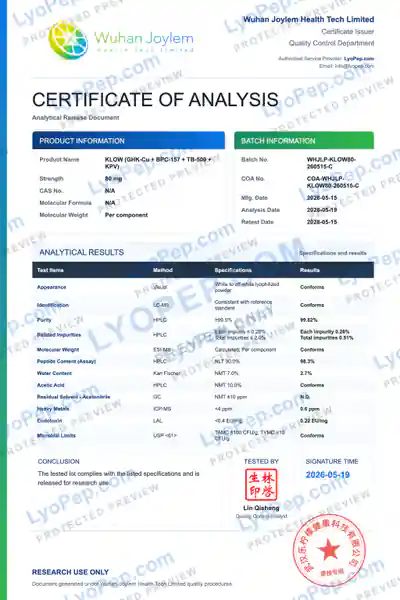
KLOW (GHK-Cu + BPC-157 + TB-500 + KPV) factory batch COAs

Representative records, refreshed periodically

Published COAs show representative factory batches and may not be the latest available. For a current quote or shipment, our sales team can confirm the applicable lot and provide its COA.

Independent testing, arranged on request

Third-party reports are not routinely published. If independent verification is required, we can agree the laboratory, method, acceptance criteria and remedy before testing. If the agreed specification is not met, an appropriate resolution—including a refund where applicable—can be discussed under the agreed terms. Unless otherwise agreed in writing, the buyer pays the cost of this optional testing.

Help reviewing your COA

Need help reading a factory COA or third-party report? Our sales team can clarify test items, specifications and how the results relate to the lot under discussion.

Ask for the current packet, not a generic certificate

  • Require identity and quantitative assay for all four components, measured mass and molar ratios with uncertainty, complete sequence/modification records, copper loading and free copper, orthogonal intact-mass confirmation, component-resolved related-substance methods, aggregates, water and residual solvents, and blend-specific stability
  • A single HPLC purity value, appearance, solution clarity or a generic third-party COA cannot release this mixture.
Released-batch COARP-HPLC result and method contextIdentity result appropriate to the moleculeWater / counter-ion context where relevantSDS and handling statementAdditional testing scoped on request

Available fills

Quote the fill and pack configuration you need

Reference SKUFillBase pack
KLOW-80MG80 mg10 vials

Handling

Storage in the lab and temperature during transit are different decisions

Follow the released blend lot's COA and stability data. Define temperature, light, moisture, matrix, container, concentration, adsorption, oxidation, metal exchange, aggregation and freeze-thaw controls. A generic 28-day refrigerated solution claim is not a substitute for mixture-specific stability testing.

State destination, season, acceptable transit exposure and whether your protocol requires insulated or cold-chain service. Additional temperature-control cost is quoted explicitly.

Buyer FAQ

Terms to settle before the purchase order

Can a buyer arrange third-party testing?+

Yes. Testing must be performed by a mutually accepted, established specialist laboratory. Fee allocation, specification, sampling, method and acceptance rule must be agreed before testing; if an agreed independent result shows nonconformance, the remedy follows the signed order terms. Unless otherwise agreed in writing, the buyer pays the cost of this optional testing.

Does HPLC purity prove peptide content?+

No. Chromatographic purity describes the relative peak profile under a stated method. Identity, water, counter-ion, residual solvents and assay/content may require separate methods.

Is cold-chain shipping always required?+

Not always. Heat can accelerate degradation, especially during summer and long transit. Cold-chain reduces exposure but raises cost. State the destination and stability risk so the right service can be quoted.

How are payment terms handled?+

Available methods and milestones depend on order value, destination and project type. The pro forma invoice should state currency, bank details, fees, payment milestones and the release condition.

Why must the testing laboratory understand peptide chemistry?+

Free-base and salt forms, hydrophilic and hydrophobic sequences, aggregation and adsorption can change sample preparation and method suitability. Use a laboratory experienced with the molecule class.

These are buyer-qualification references, not claims that this RUO material is regulated, certified or released under those frameworks. Applicability depends on the buyer's workflow and jurisdiction.

Selected sources

Literature behind the research context

  • No direct KLOW study was identified. Component context is provided by the listed PubMed-indexed BPC-157, thymosin-β4, KPV and GHK-Cu literature with explicit molecule, formulation and model limits. Regulatory and compliance context is controlled by FDA's current compounding-risk page, WADA's 2026 Prohibited List and USADA's BPC-157 guidance. Clinic and vendor GLOW/KLOW pages document marketing claims only.
  1. 01

    Multifunctionality and Possible Medical Application of the BPC 157 Peptide-Literature and Patent Review

    Pharmaceuticals (Basel) · 2025 · peer-reviewed literature and patent review

    Open source
  2. 02

    The Stable Gastric Pentadecapeptide BPC 157 Pleiotropic Beneficial Activity and Its Possible Relations with Neurotransmitter Activity

    Pharmaceuticals (Basel) · 2024 · peer-reviewed review article

    Open source
  3. 03

    Regeneration or Risk? A Narrative Review of BPC-157 for Musculoskeletal Healing

    Current Reviews in Musculoskeletal Medicine · 2025 · narrative/scoping review

    Open source
  4. 04

    Safety of Intravenous Infusion of BPC157 in Humans: A Pilot Study

    Alternative Therapies in Health and Medicine · 2025 · IRB-approved human pilot study

    Open source
  5. 05

    Thymosin β4: a multi-functional regenerative peptide. Basic properties and clinical applications

    Expert Opinion on Biological Therapy · 2012 · peer-reviewed review

    Open source
  6. 06

    Thymosin beta4 accelerates wound healing

    Journal of Investigative Dermatology · 1999 · peer-reviewed original research (animal model)

    Open source
  7. 07

    Thymosin Beta-4 and TB-500 in Tissue Healing, Regeneration, and Musculoskeletal Repair: A Scoping Review

    Applied Sciences (MDPI) · 2026 · scoping review (detail unverified)

    Open source
  8. 08

    alpha-MSH related peptides: a new class of anti-inflammatory and immunomodulating drugs

    Annals of the Rheumatic Diseases · 2007 · peer-reviewed review

    Open source

Product FAQ

Questions buyers ask about KLOW (GHK-Cu + BPC-157 + TB-500 + KPV)

What composition must be disclosed before ordering a KLOW blend?+

KLOW is a market-defined name, not a standardized scientific formulation. The quotation and specification should state the exact net amount and molar amount of GHK-Cu, BPC-157, Ac-LKKTETQ marketed as TB-500, and KPV; their terminal states, counterions and copper form; the target mass and molar ratios; and whether the material was co-lyophilized or blended after separate manufacture. “80 mg total” does not identify the component amounts or verify the formulation.

What should a batch-specific KLOW COA and supporting packet contain?+

Require independent identity and quantitative assay for all four components, component-resolved chromatography, intact mass or sequence-confirming data, measured mass and molar ratios with uncertainty, copper loading and free copper, related substances and degradants, aggregate assessment, water, counterions and residual solvents. Add microbiological or endotoxin controls only where required by the research protocol. Confirm the exact deliverables at quotation; do not assume a generic COA or one dominant mass-spectral signal qualifies the blend.

Why are single-component purity and stability claims insufficient for KLOW?+

A four-component mixture has no meaningful single molecular weight, CAS or aggregate HPLC purity value. Mixing can change copper coordination, oxidation, adsorption, aggregation and component recovery. Require blend-specific homogeneity, vial-uniformity and stability data that track every component and the ratio under intended shipping, temperature, light, container, diluent, concentration and freeze-thaw conditions. Individual-component studies do not establish blend compatibility, synergy, safety or efficacy.