Research statusPreclinical evidence; terminated Phase 1 program; RUO only
Supplied formDisulfide-cyclized CKGGRAKDC homing domain linked to a D-amino-acid D(KLAKLAK)2 pro-apoptotic domain
Lead time14–21 days
Representative packaging image · verify the ordered lot
Decision summary
Key benefits
Preclinical findings include reduced fat mass and changes in insulin-related measures in obese rodent and rhesus-monkey models
These results support research into adipose-vasculature targeting and prohibitin-associated biology, but they do not establish human efficacy, safety or a therapeutic benefit
No peer-reviewed human outcome data are available.
Published research context is presented for literature orientation only. It is not a dosing, treatment or human-use instruction.
Qualification data
Specifications to confirm against the released lot
CAS
859216-15-2
Formula
C111H206N36O28S2
Molecular weight
Approximately 2557.2 Da
Appearance
Lot-specific lyophilized solid; confirm colour and cake condition on the released-batch COA
Purity
≥ 99.0% · target, verify batch COA
Storage
Follow the released lot COA, SDS and formulation-specific stability statement. Temperature, light protection, shipping range and any post-reconstitution hold time depend on peptide form, counterion, excipients, concentration and container. Assign no universal refrigerated or frozen period without stability-indicating data for the supplied lot.
Identity, purity and content are separate release questions.
Identity
Confirm the stated molecule and supplied form. Start with the matching batch COA; request sequence-level evidence only when the buyer's written procedure requires it and availability or a separate scope has been agreed.
Purity
Review RP-HPLC method conditions, wavelength, integration and related-peak handling. A percentage without the method is not enough.
Content
Net peptide content is not the same as gross lyophilized powder weight. Ask which assay supports the stated amount and whether water/counter-ion is addressed.
Stability
Define long-term storage and transit exposure separately. Cold-chain can be quoted when the buyer’s risk assessment requires it and adds cost.
Research context
What researchers study about Adipotide (FTPP)
Adipotide (Prohibitin-TP01/TP01, also called FTPP or HKPao) is a chimeric, adipose-vasculature-targeted peptidomimetic developed at the University of Texas MD Anderson Cancer Center / UTHealth Houston (Kolonin, Pasqualini, and Arap laboratories), later licensed to Arrowhead Research (now Arrowhead Pharmaceuticals) for clinical development. Its CKGGRAKDC targeting domain recognizes the prohibitin/annexin A2 (ANXA2) receptor pair expressed on white adipose tissue vascular endothelial cells, and delivers a pro-apoptotic D-(KLAKLAK)2 payload that causes the supporting blood vessels to undergo apoptosis, in turn depriving adipocytes of blood supply and triggering their apoptosis. Rapid fat loss and improved insulin resistance were observed in obese animal models (mice and rhesus monkeys). Around 2011, MD Anderson initiated a human Phase 1 trial (NCT01262664) in patients with castration-resistant prostate cancer and obesity; the trial registry marks it as "Terminated," with the officially listed reason being "Terminated per PI's request" (Principal Investigator Dr. Amado Zurita; the trial ran from May 2012 to January 2019 and enrolled only 4 of a planned 39 patients). Numerous secondary sources (industry news, vendor blogs) attribute the termination to unacceptable human nephrotoxicity, but this specific mechanism does not appear in the primary registry text itself, and no formally published human safety paper exists — so this claim should be treated as a widely repeated but not primary-source-confirmed account. The compound is currently used only as a research reference material, is not an approved human drug, and has no FDA-approved indication.
Laboratory topics include adipose-vasculature homing, prohibitin-associated targeting, mitochondrial-membrane-disrupting D-peptides, obesity-model biology, metabolic biomarkers and renal safety signals
These are research areas, not approved indications or ranked treatment claims.
Mechanism context
The question the literature is testing
In the reported preclinical model, the cyclic CKGGRAKDC homing domain associated with markers on white-adipose-tissue vascular endothelium, and the linked amphipathic D(KLAKLAK)2 payload disrupted mitochondrial membranes after uptake, promoting endothelial apoptosis and secondary adipose-tissue involution. Receptor assignments and downstream effects are model-dependent; they do not prove selective targeting, efficacy or safety in humans. Proposed renal metabolism of the D-peptide domain is mechanistic context, not proof of the cause of human-trial termination.
Evidence map
Research routes and exposure context
Evidence tierMixed evidence contextResearch areaOther research materialsRoutes reported in sources
No administration route applies
Dose / exposure contextProtocol-specific; verify the cited primary source
Routes and exposure contexts summarize cited studies or approved finished-product labels. They are not instructions for administering this RUO material; no customer dose is provided.
Evidence boundaries
Compatibility, limitations and decision context
Not approved for human use and supplied only as an RUO reference material
Animal studies reported dose-related proximal-tubule changes and other renal findings that were largely reversible during recovery
NCT01262664 was terminated after 4 of 39 planned participants; the official reason is 'Terminated per PI's request,' and no peer-reviewed human safety results were published
Secondary claims that human nephrotoxicity caused termination remain unconfirmed
Interactions reported in the literature
No controlled product-specific interaction or compatibility study was located
This page does not recommend combinations with GLP-1/GIP agents, other peptides or nephrotoxic substances
Experimental compatibility and co-exposure questions require protocol-specific risk assessment and direct analytical or toxicological evidence.
Literature context is not a supplier release result or human-use instruction. Follow your institution's approved laboratory risk assessment.
Factory batch documentation
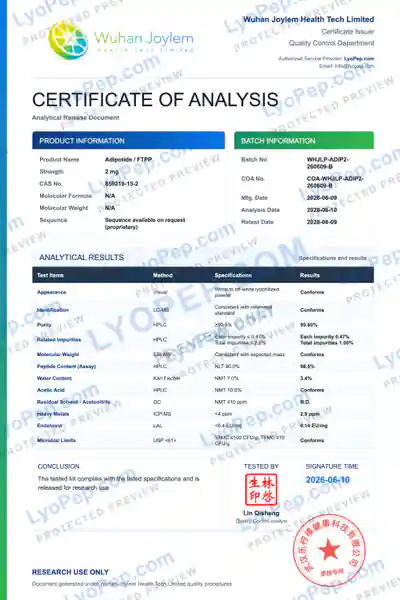
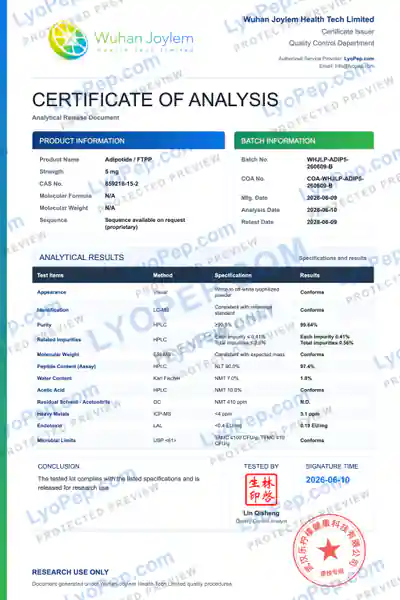
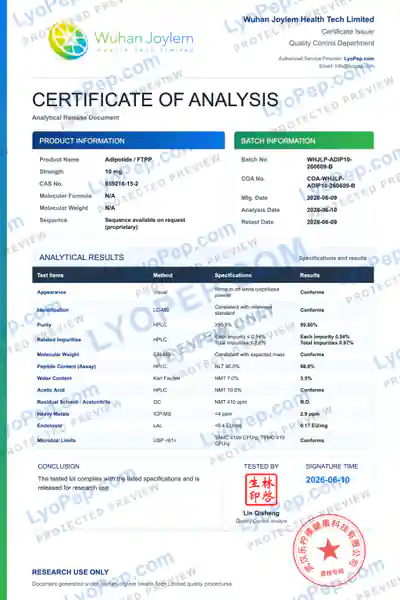
Adipotide (FTPP) factory batch COAs
Adipotide (FTPP)2 mg · WHJLP-ADIP2-260609-B
Adipotide (FTPP)5 mg · WHJLP-ADIP5-260609-B
Adipotide (FTPP)10 mg · WHJLP-ADIP10-260609-B
Representative records, refreshed periodically
Published COAs show representative factory batches and may not be the latest available. For a current quote or shipment, our sales team can confirm the applicable lot and provide its COA.
Independent testing, arranged on request
Third-party reports are not routinely published. If independent verification is required, we can agree the laboratory, method, acceptance criteria and remedy before testing. If the agreed specification is not met, an appropriate resolution—including a refund where applicable—can be discussed under the agreed terms. Unless otherwise agreed in writing, the buyer pays the cost of this optional testing.
Help reviewing your COA
Need help reading a factory COA or third-party report? Our sales team can clarify test items, specifications and how the results relate to the lot under discussion.
Ask for the current packet, not a generic certificate
Define the exact construct, termini, Cys1-Cys9 disulfide connectivity, D-residue positions, counterion and supplied form
Require traceable synthesis and lot records, theoretical and measured intact mass, peptide mapping or LC-MS/MS, a stability-indicating chromatographic purity and impurity profile, quantitative peptide content, water and counterion data, relevant residuals and lot-specific stability evidence
Mass alone cannot establish stereochemistry; appearance, dissolution or HPLC area percentage cannot establish identity, content, sterility or suitability for human use.
Released-batch COARP-HPLC result and method contextIdentity result appropriate to the moleculeWater / counter-ion context where relevantSDS and handling statementAdditional testing scoped on request
Available fills
Quote the fill and pack configuration you need
Reference SKUFillBase pack
FTPP-02MG2 mg10 vials
FTPP-05MG5 mg10 vials
FTPP-10MG10 mg10 vials
Handling
Storage in the lab and temperature during transit are different decisions
Follow the released lot COA, SDS and formulation-specific stability statement. Temperature, light protection, shipping range and any post-reconstitution hold time depend on peptide form, counterion, excipients, concentration and container. Assign no universal refrigerated or frozen period without stability-indicating data for the supplied lot.
State destination, season, acceptable transit exposure and whether your protocol requires insulated or cold-chain service. Additional temperature-control cost is quoted explicitly.
Buyer FAQ
Terms to settle before the purchase order
Can a buyer arrange third-party testing?+
Yes. Testing must be performed by a mutually accepted, established specialist laboratory. Fee allocation, specification, sampling, method and acceptance rule must be agreed before testing; if an agreed independent result shows nonconformance, the remedy follows the signed order terms. Unless otherwise agreed in writing, the buyer pays the cost of this optional testing.
Does HPLC purity prove peptide content?+
No. Chromatographic purity describes the relative peak profile under a stated method. Identity, water, counter-ion, residual solvents and assay/content may require separate methods.
Is cold-chain shipping always required?+
Not always. Heat can accelerate degradation, especially during summer and long transit. Cold-chain reduces exposure but raises cost. State the destination and stability risk so the right service can be quoted.
How are payment terms handled?+
Available methods and milestones depend on order value, destination and project type. The pro forma invoice should state currency, bank details, fees, payment milestones and the release condition.
Why must the testing laboratory understand peptide chemistry?+
Free-base and salt forms, hydrophilic and hydrophobic sequences, aggregation and adsorption can change sample preparation and method suitability. Use a laboratory experienced with the molecule class.
These are buyer-qualification references, not claims that this RUO material is regulated, certified or released under those frameworks. Applicability depends on the buyer's workflow and jurisdiction.
Selected sources
Literature behind the research context
(1) Kolonin MG et al., "Reversal of obesity by targeted ablation of adipose tissue," Nature Medicine (2004), DOI 10.1038/nm1048: foundational mouse study identifying the cyclic CKGGRAKDC white-adipose-vasculature homing motif and prohibitin association. (2) Barnhart KF et al., "A Peptidomimetic Targeting White Fat Causes Weight Loss and Improved Insulin Resistance in Obese Monkeys," Science Translational Medicine (2011), DOI 10.1126/scitranslmed.3002621, PMC3666164: non-human-primate efficacy and safety study reporting changes in body weight and metabolic measures together with dose-related proximal-tubule findings that were largely reversible during recovery. Its protocol-specific doses, routes and durations are historical animal-study details, not recommendations. (3) Staquicini FI et al., "Vascular ligand-receptor mapping by direct combinatorial selection in cancer patients," PNAS (2011), DOI 10.1073/pnas.1114503108: human-tissue vascular ligand-receptor mapping that included the prohibitin/annexin A2 system in normal white adipose tissue. (4) ClinicalTrials.gov NCT01262664: the Phase 1 study enrolled 4 participants against 39 planned and is listed as terminated with the official reason "Terminated per PI's request"; no peer-reviewed human results were located. (5) NIH PubChem CID 163360068 records molecular formula C₁₁₁H₂₀₆N₃₆O₂₈S₂ and molecular weight 2557.2 Da for the deposited structure. Identity of a supplied lot still requires batch-specific analytical confirmation.
01
Reversal of obesity by targeted ablation of adipose tissue
Nature Medicine · 2004 · peer-reviewed original research (foundational/landmark)
What is the design rationale for Adipotide's two-domain construct?+
The published construct joins the cyclic CKGGRAKDC vascular-homing domain to the pro-apoptotic D(KLAKLAK)2 domain through a GG linker. In the reported preclinical models, the homing domain was used to target markers associated with white-adipose-tissue vasculature, while the amphipathic D-peptide payload disrupted mitochondrial membranes after cellular uptake. This is model-level mechanistic evidence, not a demonstrated human therapeutic effect.
How should the identity of Adipotide be confirmed?+
Use an orthogonal analytical package. Intact mass and peptide mapping or LC-MS/MS can support sequence and disulfide-state assessment, but mass alone cannot distinguish D- from L-amino-acid configuration. D-residue assignments require traceable synthesis records and, where the specification demands it, a suitable stereochemical, chiral or enzyme-based method. Also verify termini, disulfide connectivity, peptide content and the lot impurity profile; no single test establishes the whole construct.
Related research materials
Compare adjacent molecules and documentation needs.