Recent Confirmed OrdersLast 7 days
Australia520 mgTirzepatide 40 mg · Semaglutide 2 mg · Dihexa 10 mg
View all

Other research materials

Lemon Bottle

Trade-name multi-ingredient material · authenticity, intended external-use versus injection identity and composition must be verified by lot

Component-wise specification; confirm on released-lot COA · target, verify batch COACAS 83-88-5RUO
Research statusNo qualifying clinical study identified; injectable marketing is unapproved and sampled product identity has been inconsistent
Supplied formMulti-ingredient aqueous formulation (non-peptide; no single molecular identity)
Lead timeConfirmed with quote
Lemon Bottle — Lot-specific aqueous material; colour or clarity cannot establish authenticity, composition, sterility or suitability
Lemon Bottle — Lot-specific aqueous material; colour or clarity cannot establish authenticity, composition, sterility or suitability · Representative packaging image · verify the ordered lot
Representative packaging image · verify the ordered lot

Decision summary

Key benefits

  • Defensible research value is limited to authenticity testing, supply-chain and label verification, multi-ingredient assay development, undeclared-substance screening, formulation characterization and comparison of regulatory evidence
  • No fat-loss, body-contouring, metabolic or skin-tightening benefit has been established for an independently qualified injectable formulation.
Published research context is presented for literature orientation only. It is not a dosing, treatment or human-use instruction.
Qualification data

Specifications to confirm against the released lot

CAS
83-88-5
Formula
Not applicable — mixture or multi-component material
Molecular weight
Component-specific; no single molecular weight
Appearance
Lot-specific aqueous material; colour or clarity cannot establish authenticity, composition, sterility or suitability
Purity
Component-wise specification; confirm on released-lot COA · target, verify batch COA
Storage
Follow only independently verified released-lot labelling and stability data for the authenticated product and intended research use. Distributor room-temperature or after-opening advice does not establish identity, microbiological quality or stability of another source. Quarantine temperature excursions and any lot lacking traceable storage conditions.
MOQ
On request
Lead time
Confirmed with quote

Qualification matrix

Identity, purity and content are separate release questions.

Identity

Confirm the stated molecule and supplied form. Start with the matching batch COA; request sequence-level evidence only when the buyer's written procedure requires it and availability or a separate scope has been agreed.

Purity

Review RP-HPLC method conditions, wavelength, integration and related-peak handling. A percentage without the method is not enough.

Content

Net peptide content is not the same as gross lyophilized powder weight. Ask which assay supports the stated amount and whether water/counter-ion is addressed.

Stability

Define long-term storage and transit exposure separately. Cold-chain can be quoted when the buyer’s risk assessment requires it and adds cost.

Research context

What researchers study about Lemon Bottle

Lemon Bottle is a trade name used for multi-ingredient aqueous products and is not a peptide or single defined substance. FDA warning letters dated March 3, 2025 identified LemonBottle Ampoule Solution sold with injectable fat-loss claims as an unapproved new drug. Swissmedic classified injection-labelled products as unauthorized medicines and reported major declaration mismatches among samples from different sources: one contained only caffeine and another contained none of the listed ingredients. The distributor later stated it could not verify those samples as original and that its original product is an external-use cosmetic, not intended for injection. Product name, packaging or a cosmetic registration therefore cannot establish authenticity, composition or injectable quality.

  • Appropriate laboratory contexts include authentication, quantitative composition, undeclared-ingredient screening, container and stability studies, particulate and microbiological method development, and comparison of label claims with regulator findings
  • No approved clinical indication exists.

Mechanism context

The question the literature is testing

No verified in-vivo mechanism exists for a standardized Lemon Bottle formulation because composition and authenticity are not reliably established and no qualifying clinical study of a fixed blend was identified. Mechanistic statements about riboflavin, lecithin or bromelain describe individual ingredients or marketing hypotheses and cannot prove fat-cell disruption by the traded product. It must not be equated with deoxycholic acid or Kybella, a different, specifically regulated finished drug.

Evidence map

Research routes and exposure context

Evidence tierApproved finished-product context
Routes reported in sources
Topical
Dose / exposure contextProtocol-specific; verify the cited primary source
Routes and exposure contexts summarize cited studies or approved finished-product labels. They are not instructions for administering this RUO material; no customer dose is provided.

Evidence boundaries

Compatibility, limitations and decision context

  • Not for human or veterinary administration
  • FDA warns that unapproved fat-dissolving injections have been associated with permanent scarring, serious infection, skin deformity, cysts and deep painful nodules, and its 2025 warning letters identified LemonBottle Ampoule Solution as an unapproved new drug
  • Swissmedic advises against use and reported falsified or mismatched sampled products
  • Unknown composition, injectable marketing and absent validated sterility or endotoxin controls create substantial and unresolved risk.

Interactions reported in the literature

  • No human combination, compatibility or injection-site guidance applies
  • Do not combine this material with deoxycholic acid, phosphatidylcholine, fillers, botulinum toxin or other body-contouring products
  • Laboratory mixture studies require authenticated components, single-component controls and component-resolved analytics.
Literature context is not a supplier release result or human-use instruction. Follow your institution's approved laboratory risk assessment.

Factory batch documentation

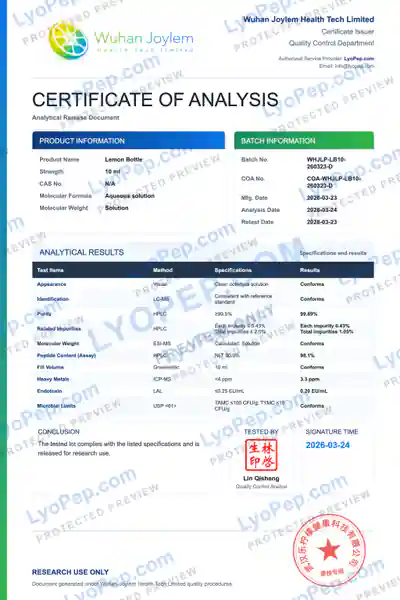
Lemon Bottle factory batch COAs

Representative records, refreshed periodically

Published COAs show representative factory batches and may not be the latest available. For a current quote or shipment, our sales team can confirm the applicable lot and provide its COA.

Independent testing, arranged on request

Third-party reports are not routinely published. If independent verification is required, we can agree the laboratory, method, acceptance criteria and remedy before testing. If the agreed specification is not met, an appropriate resolution—including a refund where applicable—can be discussed under the agreed terms. Unless otherwise agreed in writing, the buyer pays the cost of this optional testing.

Help reviewing your COA

Need help reading a factory COA or third-party report? Our sales team can clarify test items, specifications and how the results relate to the lot under discussion.

Ask for the current packet, not a generic certificate

  • Treat product identity as unverified until an authenticated supply chain and independent testing agree
  • Require manufacturer/distributor authorization, lot traceability, tamper evidence, full quantitative composition, orthogonal identity and assay for declared ingredients, broad undeclared-substance screening, pH, osmolality where relevant, particulates, container integrity and stability
  • If microbiological limits, endotoxin or sterility are required, each needs a validated method, acceptance limit and released-lot result
  • Cosmetic registration, clear appearance, a generic COA or ingredient list is insufficient.
Released-batch COARP-HPLC result and method contextIdentity result appropriate to the moleculeWater / counter-ion context where relevantSDS and handling statementAdditional testing scoped on request

Available fills

Quote the fill and pack configuration you need

Reference SKUFillBase pack
LB-10ML10 ml10 vials

Handling

Storage in the lab and temperature during transit are different decisions

Follow only independently verified released-lot labelling and stability data for the authenticated product and intended research use. Distributor room-temperature or after-opening advice does not establish identity, microbiological quality or stability of another source. Quarantine temperature excursions and any lot lacking traceable storage conditions.

State destination, season, acceptable transit exposure and whether your protocol requires insulated or cold-chain service. Additional temperature-control cost is quoted explicitly.

Buyer FAQ

Terms to settle before the purchase order

Can a buyer arrange third-party testing?+

Yes. Testing must be performed by a mutually accepted, established specialist laboratory. Fee allocation, specification, sampling, method and acceptance rule must be agreed before testing; if an agreed independent result shows nonconformance, the remedy follows the signed order terms. Unless otherwise agreed in writing, the buyer pays the cost of this optional testing.

Does HPLC purity prove peptide content?+

No. Chromatographic purity describes the relative peak profile under a stated method. Identity, water, counter-ion, residual solvents and assay/content may require separate methods.

Is cold-chain shipping always required?+

Not always. Heat can accelerate degradation, especially during summer and long transit. Cold-chain reduces exposure but raises cost. State the destination and stability risk so the right service can be quoted.

How are payment terms handled?+

Available methods and milestones depend on order value, destination and project type. The pro forma invoice should state currency, bank details, fees, payment milestones and the release condition.

Why must the testing laboratory understand peptide chemistry?+

Free-base and salt forms, hydrophilic and hydrophobic sequences, aggregation and adsorption can change sample preparation and method suitability. Use a laboratory experienced with the molecule class.

These are buyer-qualification references, not claims that this RUO material is regulated, certified or released under those frameworks. Applicability depends on the buyer's workflow and jurisdiction.

Selected sources

Literature behind the research context

  • Primary regulatory sources: FDA Amazon warning letter MARCS-CMS 695821 dated March 3, 2025, which identifies LemonBottle Ampoule Solution with injectable fat-loss claims as an unapproved new drug; FDA consumer guidance on harms from unapproved fat-dissolving injections; and Swissmedic’s March 26, 2024 warning plus June 25, 2024 addendum describing sample mismatches and the distributor’s external-use-only position. Marketing, sales-volume and clinic protocol claims were removed from the decision content.
  1. 01

    Dermal Necrosis and Chronic Abscess Formation Following Fat Dissolving Injections Administered by a Non-Medical Practitioner: A Case Report

    OSF Preprints (Center for Open Science) · 2026 · case report (preprint, not yet peer-reviewed)

    Open source
  2. 02

    Swissmedic issues warning about the illegal medicinal product "Lemon Bottle" lipolysis solution

    Swissmedic (Swiss national medicines regulatory authority) · 2024 · regulatory document / national medicines-agency public warning

    Open source
  3. 03

    Using Fat-Dissolving Injections That Are Not FDA Approved Can Be Harmful

    U.S. Food and Drug Administration (FDA) · 2024 · regulatory document / consumer safety communication

    Open source
  4. 04

    Fox Pharma LLC — Warning Letter 699225

    U.S. Food and Drug Administration (FDA), Office of Compliance · 2025 · regulatory document / FDA enforcement warning letter

    Open source
  5. 05

    Urgent regulation of fat injections, fillers and botox needed

    Chartered Trading Standards Institute (UK) · 2025 · industry/professional body statement

    Open source

Product FAQ

Questions buyers ask about Lemon Bottle

Is Lemon Bottle a peptide or a single defined chemical product?+

No. It is a trade name used for multi-ingredient aqueous products and has no single sequence, formula, molecular mass or CAS identity. Online use of “Lemon Bottle peptide” is chemically inaccurate. The named product, manufacturer, supply chain, intended external-use or injectable presentation, full quantitative composition and released-lot test results must be established separately.

What should a decision-ready batch package contain?+

Request manufacturer and authorized-distributor evidence, traceable lot and chain of custody, intended-use labelling, full quantitative composition, orthogonal identity and assay for every declared active, broad screening for undeclared substances, pH, osmolality where relevant, appearance and particulates, container integrity and lot-specific stability. Microbial limits, endotoxin and sterility are separate validated attributes; none can be inferred from a sealed ampoule, clear solution or cosmetic registration.