Recent Confirmed OrdersLast 7 days
Australia520 mgTirzepatide 40 mg · Semaglutide 2 mg · Dihexa 10 mg
View all

Other research materials

SNAP-8

Acetyl Octapeptide-3 reference material for cosmetic-formulation research

Confirm chromatographic purity and net peptide content separately on the batch COA · target, verify batch COACAS 868844-74-0RUO
Research statusTechnical Identity Established / Independent Efficacy Evidence Limited
Supplied formN-acetylated, C-terminally amidated octapeptide
Lead timeConfirmed with quote
SNAP-8 — Lyophilized material; confirm released-lot appearance on the COA
SNAP-8 — Lyophilized material; confirm released-lot appearance on the COA · Representative packaging image · verify the ordered lot
Representative packaging image · verify the ordered lot

Decision summary

Key benefits

  • The supported B2B value is as a defined cosmetic-formulation research active with a traceable sequence and manufacturer technical history
  • Wrinkle-depth percentages, rapid visible improvement, superiority to Argireline and muscle-relaxation claims are primarily manufacturer or indirect evidence
  • Multi-active microneedle studies can support formulation hypotheses but cannot establish the independent contribution of SNAP-8.
Published research context is presented for literature orientation only. It is not a dosing, treatment or human-use instruction.
Qualification data

Specifications to confirm against the released lot

CAS
868844-74-0
Formula
C41H70N16O16S
Molecular weight
1075.2 Da
Appearance
Lyophilized material; confirm released-lot appearance on the COA
Purity
Confirm chromatographic purity and net peptide content separately on the batch COA · target, verify batch COA
Storage
Follow the batch COA and stability data for the exact form. Cayman specifies -20°C and at least four years for its solid research reagent, while Lubrizol's aqueous trade solution has different excipients and specifications. Neither statement automatically applies to another supplier's lyophilized lot or a finished cosmetic. Protect methionine-containing material from unvalidated oxidation, heat, light and repeated freeze-thaw exposure.
MOQ
On request
Lead time
Confirmed with quote

Qualification matrix

Identity, purity and content are separate release questions.

Identity

Confirm the stated molecule and supplied form. Start with the matching batch COA; request sequence-level evidence only when the buyer's written procedure requires it and availability or a separate scope has been agreed.

Purity

Review RP-HPLC method conditions, wavelength, integration and related-peak handling. A percentage without the method is not enough.

Content

Net peptide content is not the same as gross lyophilized powder weight. Ask which assay supports the stated amount and whether water/counter-ion is addressed.

Stability

Define long-term storage and transit exposure separately. Cold-chain can be quoted when the buyer’s risk assessment requires it and adds cost.

Research context

What researchers study about SNAP-8

SNAP-8 is the trade name commonly associated with Acetyl Octapeptide-3, an acetylated, C-terminally amidated cosmetic-research peptide derived from the SNAP-25-mimetic design concept. Manufacturer materials position it for the appearance of expression lines, but direct independent human evidence for SNAP-8 alone is sparse. The available human patch studies used multi-active microneedle formulations, so their outcomes cannot be attributed to this peptide alone. Describing SNAP-8 as a topical botulinum-toxin substitute overstates both clinical evidence and demonstrated delivery to the neuromuscular target.

  • Appropriate uses include cosmetic formulation screening, peptide stability and delivery studies, SNARE-related in vitro assays, and analytical method development
  • Expression-line outcomes remain a cosmetic appearance hypothesis with limited independent single-ingredient evidence
  • Multi-active microneedle results and Argireline trials must not be presented as SNAP-8-alone efficacy.

Mechanism context

The question the literature is testing

SNAP-8 was designed from a SNAP-25 N-terminal motif and is proposed to interfere with SNARE-complex assembly in model systems. Evidence from longer SNAP-25 fragments and the related hexapeptide Argireline supports the design rationale, but it does not prove that topically formulated SNAP-8 reaches an intact human neuromuscular junction at an effective concentration. Skin penetration, stability, target engagement and clinical relevance depend on the finished formulation and remain important evidence gaps.

Evidence map

Research routes and exposure context

Evidence tierAnalytical / laboratory context
Routes reported in sources
Topical
Dose / exposure contextProtocol-specific; verify the cited primary source
Routes and exposure contexts summarize cited studies or approved finished-product labels. They are not instructions for administering this RUO material; no customer dose is provided.

Evidence boundaries

Compatibility, limitations and decision context

  • Raw SNAP-8 powder is not a finished cosmetic and is not for injection
  • The multi-ingredient patch studies reported local tolerability for their tested formulations, not universal safety of pure peptide
  • No adequate basis was found for blanket pregnancy or breastfeeding prohibitions, a claim of zero systemic absorption, or broad suitability for sensitive or periocular skin
  • Finished products require region-specific cosmetic safety assessment, microbiological control, stability, packaging compatibility, exposure evaluation and appropriate human compatibility testing.

Interactions reported in the literature

  • No validated clinical synergy or incompatibility matrix exists for Argireline, Leuphasyl, Matrixyl, hyaluronic acid, ascorbyl glucoside, GHK-Cu, niacinamide, retinoids or acids
  • Formulators should test pH, ionic strength, metal binding, methionine oxidation, proteolysis, adsorption, preservative compatibility and assay interference in the complete formula rather than relying on layering advice.
Literature context is not a supplier release result or human-use instruction. Follow your institution's approved laboratory risk assessment.

Factory batch documentation

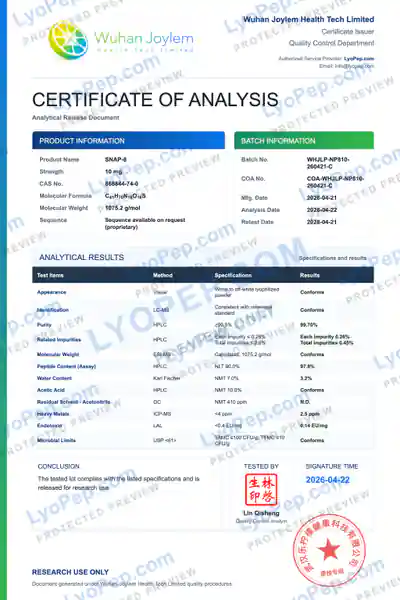
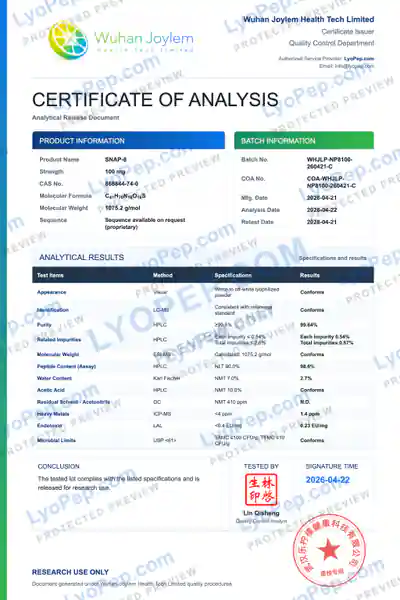
SNAP-8 factory batch COAs

Representative records, refreshed periodically

Published COAs show representative factory batches and may not be the latest available. For a current quote or shipment, our sales team can confirm the applicable lot and provide its COA.

Independent testing, arranged on request

Third-party reports are not routinely published. If independent verification is required, we can agree the laboratory, method, acceptance criteria and remedy before testing. If the agreed specification is not met, an appropriate resolution—including a refund where applicable—can be discussed under the agreed terms. Unless otherwise agreed in writing, the buyer pays the cost of this optional testing.

Help reviewing your COA

Need help reading a factory COA or third-party report? Our sales team can clarify test items, specifications and how the results relate to the lot under discussion.

Ask for the current packet, not a generic certificate

  • Require sequence and terminal-modification confirmation by high-resolution intact mass plus MS/MS or peptide mapping, chromatographic purity with impurity profile, quantitative peptide content, methionine-oxidation and deamidation controls, counterion, water, residual solvents and lot-specific stability
  • For cosmetic manufacture also require bioburden or microbial limits, preservative-system compatibility and formulation recovery
  • Appearance and a nominal HPLC area percentage alone are insufficient.
Released-batch COARP-HPLC result and method contextIdentity result appropriate to the moleculeWater / counter-ion context where relevantSDS and handling statementAdditional testing scoped on request

Available fills

Quote the fill and pack configuration you need

Reference SKUFillBase pack
SNAP8-010MG10 mg10 vials
SNAP8-100MG100 mg10 vials

Handling

Storage in the lab and temperature during transit are different decisions

Follow the batch COA and stability data for the exact form. Cayman specifies -20°C and at least four years for its solid research reagent, while Lubrizol's aqueous trade solution has different excipients and specifications. Neither statement automatically applies to another supplier's lyophilized lot or a finished cosmetic. Protect methionine-containing material from unvalidated oxidation, heat, light and repeated freeze-thaw exposure.

State destination, season, acceptable transit exposure and whether your protocol requires insulated or cold-chain service. Additional temperature-control cost is quoted explicitly.

Buyer FAQ

Terms to settle before the purchase order

Can a buyer arrange third-party testing?+

Yes. Testing must be performed by a mutually accepted, established specialist laboratory. Fee allocation, specification, sampling, method and acceptance rule must be agreed before testing; if an agreed independent result shows nonconformance, the remedy follows the signed order terms. Unless otherwise agreed in writing, the buyer pays the cost of this optional testing.

Does HPLC purity prove peptide content?+

No. Chromatographic purity describes the relative peak profile under a stated method. Identity, water, counter-ion, residual solvents and assay/content may require separate methods.

Is cold-chain shipping always required?+

Not always. Heat can accelerate degradation, especially during summer and long transit. Cold-chain reduces exposure but raises cost. State the destination and stability risk so the right service can be quoted.

How are payment terms handled?+

Available methods and milestones depend on order value, destination and project type. The pro forma invoice should state currency, bank details, fees, payment milestones and the release condition.

Why must the testing laboratory understand peptide chemistry?+

Free-base and salt forms, hydrophilic and hydrophobic sequences, aggregation and adsorption can change sample preparation and method suitability. Use a laboratory experienced with the molecule class.

These are buyer-qualification references, not claims that this RUO material is regulated, certified or released under those frameworks. Applicability depends on the buyer's workflow and jurisdiction.

Selected sources

Literature behind the research context

  • The 2024 Annals of Dermatology and earlier microneedle studies evaluated multi-active patches containing SNAP-8; they do not isolate its effect. The 2025 cosmeceutical review supplies current secondary context but repeats a disputed identity value. The 2004 SNAP-25-fragment paper and 2002 Argireline paper are mechanistic lineage, not SNAP-8 clinical trials. Lubrizol is the primary manufacturer source for trade-solution composition and claims; Cayman and NCATS support identity; the European Commission CosIng database is informative and does not itself authorize an ingredient or finished product.
  1. 01

    Clinical Safety and Efficacy Evaluation of a Dissolving Microneedle Patch Having Dual Anti-Wrinkle Effects With Safe and Long-Term Activities

    Annals of Dermatology · 2024 · peer-reviewed original research (randomized, placebo-controlled clinical study)

    Open source
  2. 02

    Efficacy of Bioactive Peptides Loaded on Hyaluronic Acid Microneedle Patches: A Monocentric Clinical Study

    Journal of Cosmetic Dermatology · 2020 · peer-reviewed original research (monocentric clinical study)

    Open source
  3. 03

    Peptides: Emerging Candidates for the Prevention and Treatment of Skin Senescence: A Review

    Biomolecules · 2025 · peer-reviewed narrative review

    Open source
  4. 04

    Small Peptides Patterned After the N-Terminus Domain of SNAP25 Inhibit SNARE Complex Assembly and Regulated Exocytosis

    Journal of Neurochemistry · 2004 · peer-reviewed original research

    Open source
  5. 05

    A Synthetic Hexapeptide (Argireline) With Antiwrinkle Activity

    International Journal of Cosmetic Science · 2002 · peer-reviewed original research (landmark/foundational paper)

    Open source
  6. 06

    SNAP-8 peptide solution C

    Lubrizol · 2026 · original manufacturer technical source

    Open source
  7. 07

    Acetyl Octapeptide-3

    Cayman Chemical · 2026 · research reagent technical specification

    Open source
  8. 08

    Acetyl Octapeptide-3

    NCATS Inxight Drugs · 2026 · U.S. government substance record

    Open source

Product FAQ

Questions buyers ask about SNAP-8

How is SNAP-8 distinguished from Acetyl Hexapeptide-8 (Argireline)?+

SNAP-8 is commonly associated with Acetyl Octapeptide-3, sequence Ac-Glu-Glu-Met-Gln-Arg-Arg-Ala-Asp-NH₂. Acetyl Hexapeptide-8/Argireline is a different six-residue peptide. Specify the complete sequence, N-terminal acetylation, C-terminal amidation, stereochemistry and methionine-oxidation limit; trade names, a CAS or an HPLC retention time alone do not establish that the correct peptide was supplied.

Does a manufacturer’s 3–10% use level mean 3–10% pure SNAP-8 peptide?+

No. The cited 3–10% recommendation applies to Lubrizol’s aqueous SNAP-8 trade solution, which contains water, Acetyl Octapeptide-3 and caprylyl glycol. A formulator must obtain the trade solution’s active assay and calculate the actual peptide concentration. Copying that percentage to pure lyophilized powder would create a major concentration error. Finished-formula pH, preservative compatibility, recovery, delivery and safety still require validation.

What evidence and batch data should a buyer require for SNAP-8?+

Independent human evidence for SNAP-8 alone is limited; multi-active microneedle studies and Argireline data cannot establish its individual effect or skin delivery. For the raw material, require high-resolution intact mass plus sequence-confirming identity, chromatographic purity with impurity assignment, quantitative peptide content, methionine oxidation and deamidation controls, counterion, water, residual solvents and lot-specific stability. A finished cosmetic also needs microbiological, preservative, packaging, exposure and compatibility assessment.