Recent Confirmed OrdersLast 7 days
Australia520 mgTirzepatide 40 mg · Semaglutide 2 mg · Dihexa 10 mg
View all

Other research materials

Vitamin B12

Form-specific cobalamin research material; exact identity confirmed at RFQ

≥ 99.0% · target, verify batch COACAS 68-19-9RUO
Research statusThe cobalamin family is extensively studied, and specific finished cyanocobalamin or hydroxocobalamin drug products have approved medical uses. This catalog material is bulk Research Use Only material; it is not an approved drug, dietary-supplement finished product or sterile dosage form. reference context · supplied material is RUO
Supplied formCobalt-corrinoid small molecule; form-specific identity
Lead time7–14 days
Vitamin B12 — Red to dark-red solid or solution, depending on cobalamin form, concentration and presentation; confirm the released-lot specification
Vitamin B12 — Red to dark-red solid or solution, depending on cobalamin form, concentration and presentation; confirm the released-lot specification · Representative packaging image · verify the ordered lot
Representative packaging image · verify the ordered lot

Decision summary

Key benefits

  • Published research contexts, not benefits claimed for this RUO material: cobalamins are established cofactors in methionine synthase and L-methylmalonyl-CoA mutase pathways; research uses include one-carbon metabolism, methylmalonate and homocysteine biology, red-cell and myelin-related models, deficiency biomarkers, analytical-method development, photostability and formulation compatibility; hydroxocobalamin-cyanide binding is a well-established form-specific mechanism; evidence for treating documented deficiency must not be generalized to performance, mood, cognition, fatigue or neuropathic-pain benefit in B12-replete populations.
Published research context is presented for literature orientation only. It is not a dosing, treatment or human-use instruction.
Qualification data

Specifications to confirm against the released lot

CAS
68-19-9
Formula
Not applicable to the supplied material
Molecular weight
1,355.4 Da
Appearance
Red to dark-red solid or solution, depending on cobalamin form, concentration and presentation; confirm the released-lot specification
Purity
≥ 99.0% · target, verify batch COA
Storage
Follow the released-batch storage statement and SDS. Confirm post-opening or prepared-sample stability against the laboratory's validated protocol.
MOQ
On request
Lead time
7–14 days

Qualification matrix

Identity, purity and content are separate release questions.

Identity

Confirm the stated molecule and supplied form. Start with the matching batch COA; request sequence-level evidence only when the buyer's written procedure requires it and availability or a separate scope has been agreed.

Purity

Review RP-HPLC method conditions, wavelength, integration and related-peak handling. A percentage without the method is not enough.

Content

Net peptide content is not the same as gross lyophilized powder weight. Ask which assay supports the stated amount and whether water/counter-ion is addressed.

Stability

Define long-term storage and transit exposure separately. Cold-chain can be quoted when the buyer’s risk assessment requires it and adds cost.

Research context

What researchers study about Vitamin B12

Vitamin B12 denotes a family of cobalt-containing corrinoids, not one interchangeable chemical identity. The principal forms in this catalog context are cyanocobalamin, methylcobalamin, hydroxocobalamin and adenosylcobalamin/cobamamide. NIH ODS identifies methylcobalamin and 5-deoxyadenosylcobalamin as the metabolically active coenzyme forms; cyanocobalamin and hydroxocobalamin become active after conversion. PubChem records distinct formulas, masses and structures for each form. Therefore an RFQ, quote, label and released-lot COA must specify the exact form rather than only “Vitamin B12.” Specific finished products have established nutritional or medical roles, including treatment of documented deficiency and hydroxocobalamin treatment of cyanide poisoning, but those uses do not make a bulk RUO lot a medicine. In people without overt deficiency, systematic-review evidence does not support broad claims of improved cognition, mood, fatigue, athletic performance or endurance.

  • Research contexts include form-specific identity and related-substance methods; assays of methionine synthase, methylmalonyl-CoA mutase, methylmalonic acid and homocysteine pathways; deficiency and malabsorption biomarker models; red-cell, neural and myelin biology; metformin- or acid-suppression-associated B12-status research; photodegradation and container-closure studies; hydroxocobalamin-cyanide binding; and formulation-compatibility studies
  • Clinical diagnosis, replacement therapy and antidote use require licensed products and healthcare oversight and are outside this RUO catalog material.

Mechanism context

The question the literature is testing

Methylcobalamin is the cofactor for cytosolic methionine synthase, which remethylates homocysteine to methionine and supports S-adenosylmethionine-dependent one-carbon metabolism. Adenosylcobalamin is the cofactor for mitochondrial L-methylmalonyl-CoA mutase, which converts L-methylmalonyl-CoA to succinyl-CoA. Cyanocobalamin and hydroxocobalamin require intracellular processing to the active coenzyme forms. Hydroxocobalamin can bind cyanide to form cyanocobalamin, which underlies the mechanism of specific hydroxocobalamin antidote formulations. These biochemical roles do not establish equivalent potency, stability, analytical response or therapeutic interchangeability among the four forms.

Evidence map

Research routes and exposure context

Evidence tierApproved finished-product context
Routes reported in sources
SubcutaneousIntravenousIntramuscularIntranasalOral
Dose / exposure contextProtocol-specific; verify the cited primary source
Routes and exposure contexts summarize cited studies or approved finished-product labels. They are not instructions for administering this RUO material; no customer dose is provided.

Evidence boundaries

Compatibility, limitations and decision context

  • This bulk material is Research Use Only and is not sterile or qualified for human or veterinary administration
  • Safety experience from approved cyanocobalamin, hydroxocobalamin, oral or nasal products does not transfer to an unspecified bulk lot or to another cobalamin form
  • Powder handling requires the SDS, appropriate PPE and controls against inhalation, skin or eye exposure
  • Cobalt or cobalamin hypersensitivity, formulation excipients, route-specific adverse effects and product-specific contraindications belong to the relevant finished-drug label; this catalog provides no clinical safety or medication-management advice.

Interactions reported in the literature

  • For experimental design, folate status can alter hematologic and one-carbon-metabolism readouts, and folic acid can correct megaloblastic anemia while allowing neurologic B12 deficiency to remain unrecognized
  • Metformin and gastric-acid suppressants are associated with reduced B12 status in clinical literature and can confound human observational studies
  • Cobalamin form, light exposure, redox conditions, excipients and other B vitamins may affect analytical or formulation results
  • These are study-design considerations, not recommendations to combine this RUO material with medications, lipotropic injections or other ingredients.
Literature context is not a supplier release result or human-use instruction. Follow your institution's approved laboratory risk assessment.

Factory batch documentation

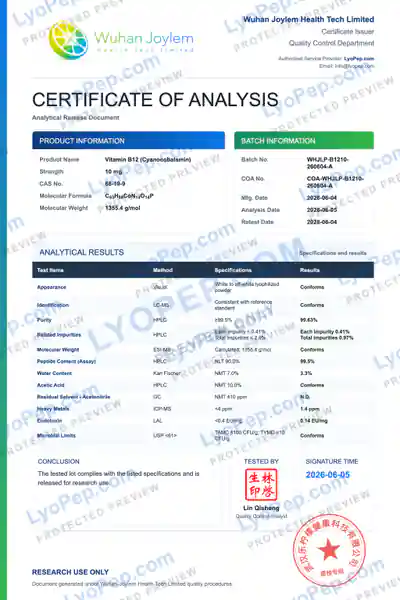
Vitamin B12 factory batch COAs

Representative records, refreshed periodically

Published COAs show representative factory batches and may not be the latest available. For a current quote or shipment, our sales team can confirm the applicable lot and provide its COA.

Independent testing, arranged on request

Third-party reports are not routinely published. If independent verification is required, we can agree the laboratory, method, acceptance criteria and remedy before testing. If the agreed specification is not met, an appropriate resolution—including a refund where applicable—can be discussed under the agreed terms. Unless otherwise agreed in writing, the buyer pays the cost of this optional testing.

Help reviewing your COA

Need help reading a factory COA or third-party report? Our sales team can clarify test items, specifications and how the results relate to the lot under discussion.

Ask for the current packet, not a generic certificate

  • Before quotation and release, identify the exact form by name, CAS, PubChem structure or equivalent structure record, formula and theoretical mass
  • The COA should report a form-appropriate identity method, measured mass, HPLC or UPLC assay and related-substance profile, water, residual solvents, counterion or salt where relevant, and trace metals or free cobalt when methodologically justified
  • Use an orthogonal identity method and a reference standard capable of distinguishing the four cobalamin forms
  • Define light exposure during sampling and analysis
  • If a lot is claimed for cell or sterile-process research, specify endotoxin, bioburden or sterility requirements separately
  • Color and solution clarity are supportive, form- and concentration-dependent observations; they do not replace identity, assay or impurity testing, and HPLC area purity alone does not establish content, sterility, clinical grade or interchangeability.
Released-batch COARP-HPLC result and method contextIdentity result appropriate to the moleculeWater / counter-ion context where relevantSDS and handling statementAdditional testing scoped on request

Available fills

Quote the fill and pack configuration you need

Reference SKUFillBase pack
B12-10MG10 mg10 vials

Handling

Storage in the lab and temperature during transit are different decisions

Follow the released-batch storage statement and SDS. Confirm post-opening or prepared-sample stability against the laboratory's validated protocol.

State destination, season, acceptable transit exposure and whether your protocol requires insulated or cold-chain service. Additional temperature-control cost is quoted explicitly.

Buyer FAQ

Terms to settle before the purchase order

Can a buyer arrange third-party testing?+

Yes. Testing must be performed by a mutually accepted, established specialist laboratory. Fee allocation, specification, sampling, method and acceptance rule must be agreed before testing; if an agreed independent result shows nonconformance, the remedy follows the signed order terms. Unless otherwise agreed in writing, the buyer pays the cost of this optional testing.

Does HPLC purity prove peptide content?+

No. Chromatographic purity describes the relative peak profile under a stated method. Identity, water, counter-ion, residual solvents and assay/content may require separate methods.

Is cold-chain shipping always required?+

Not always. Heat can accelerate degradation, especially during summer and long transit. Cold-chain reduces exposure but raises cost. State the destination and stability risk so the right service can be quoted.

How are payment terms handled?+

Available methods and milestones depend on order value, destination and project type. The pro forma invoice should state currency, bank details, fees, payment milestones and the release condition.

Why must the testing laboratory understand peptide chemistry?+

Free-base and salt forms, hydrophilic and hydrophobic sequences, aggregation and adsorption can change sample preparation and method suitability. Use a laboratory experienced with the molecule class.

These are buyer-qualification references, not claims that this RUO material is regulated, certified or released under those frameworks. Applicability depends on the buyer's workflow and jurisdiction.

Selected sources

Literature behind the research context

  • 1) NIH Office of Dietary Supplements. Vitamin B12 Fact Sheet for Health Professionals, updated July 2, 2025; 2) PubChem CIDs 16058087 and 16212801 for cyanocobalamin, CID 6474321 for methylcobalamin, CID 44475014 for hydroxocobalamin, CID 6436143 for cobamamide, and CID 71306319 for the distinct charged MeCbl representation; 3) Current DailyMed cyanocobalamin injection labels for form- and finished-product-specific storage and route information; 4) Green R, et al. Vitamin B12 deficiency. Nat Rev Dis Primers. 2017;3:17040; 5) Stabler SP. Vitamin B12 Deficiency. N Engl J Med. 2013;368:149-160; 6) Wang H, et al. Oral vitamin B12 versus intramuscular vitamin B12 for vitamin B12 deficiency. Cochrane Database Syst Rev. 2018;CD004655; 7) Markun S, et al. Effects of Vitamin B12 Supplementation on Cognitive Function, Depressive Symptoms, and Fatigue. Nutrients. 2021;13:923. PMID 33809274; PMCID PMC8000524; 8) Juzeniene A, Nizauskaite Z. Photodegradation of cobalamins in aqueous solutions and in human blood. J Photochem Photobiol B. 2013;122:7-14. PMID 23558034.
  1. 01

    Vitamin B12 deficiency

    Nature Reviews Disease Primers · 2017 · peer-reviewed review (Nature Reviews Primer)

    Open source
  2. 02

    Vitamin B12 Deficiency

    New England Journal of Medicine · 2013 · peer-reviewed clinical practice review

    Open source
  3. 03

    Oral vitamin B12 versus intramuscular vitamin B12 for vitamin B12 deficiency

    Cochrane Database of Systematic Reviews · 2018 · Cochrane systematic review of randomized controlled trials

    Open source
  4. 04

    Effects of Vitamin B12 Supplementation on Cognitive Function, Depressive Symptoms, and Fatigue: A Systematic Review, Meta-Analysis, and Meta-Regression

    Nutrients · 2021 · peer-reviewed systematic review and meta-analysis

    Open source
  5. 05

    Vitamin B12 deficiency in diabetic patients treated with metformin: A cross-sectional study

    PLoS One · 2024 · peer-reviewed original research (cross-sectional study)

    Open source
  6. 06

    Vitamin B12 - Health Professional Fact Sheet

    NIH Office of Dietary Supplements · 2025 · government/regulatory body reference fact sheet

    Open source
  7. 07

    Oral vs. Intramuscular Vitamin B12 for Treating Vitamin B12 Deficiency

    American Family Physician (American Academy of Family Physicians) · 2022 · professional organization clinical inquiry/evidence summary

    Open source
  8. 08

    Pernicious Anemia

    StatPearls (NCBI Bookshelf, National Library of Medicine) · 2023 · government/institutional clinical reference (peer-reviewed textbook chapter)

    Open source

Product FAQ

Questions buyers ask about Vitamin B12

Why must the exact Vitamin B12 form be specified before quotation?+

“Vitamin B12” names a cobalamin family, not one interchangeable substance. Cyanocobalamin, methylcobalamin, hydroxocobalamin and adenosylcobalamin have different upper axial ligands, CAS numbers, formulas, masses, photostability and experimental roles. The RFQ and quote should state the selected form, and the released-lot COA should match that identity. A generic B12 SKU or red color is not sufficient.

What should a cobalamin COA contain?+

Require the exact form name, CAS, structure reference, formula, theoretical and measured mass, identity method, HPLC or UPLC assay, related-substance profile, water, residual solvents, and counterion or salt where relevant. An orthogonal method should distinguish the selected form from other cobalamins. HPLC area purity alone does not prove content, sterility, clinical grade or interchangeability.