Recent Confirmed OrdersLast 7 days
Australia520 mgTirzepatide 40 mg · Semaglutide 2 mg · Dihexa 10 mg
View all

Other research materials

Matrixyl

Cosmetic formulation research lipopeptide · Palmitoyl Pentapeptide-4 (Pal-KTTKS)

≥ 99.0% chromatographic purity; peptide content reported separately · target, verify batch COACAS 214047-00-4RUO
Research statusDefined Cosmetic Ingredient / Independent Clinical Replication Limited
Supplied formN-terminally palmitoylated pentapeptide reference material
Lead timeConfirmed with quote
Matrixyl — Lyophilized material; confirm released-lot appearance on the COA
Matrixyl — Lyophilized material; confirm released-lot appearance on the COA · Representative packaging image · verify the ordered lot
Representative packaging image · verify the ordered lot

Decision summary

Key benefits

  • Supported research value includes a defined signal-lipopeptide identity, a documented KTTKS extracellular-matrix research lineage, one controlled 3 ppm finished-moisturizer study and formulation/delivery research
  • Collagen, wrinkle, firmness, retinol-equivalence and superiority claims are dependent on the specific formula and evidence source
  • Manufacturer comparisons and results from other Matrixyl-family blends cannot be transferred to Pal-KTTKS powder.
Published research context is presented for literature orientation only. It is not a dosing, treatment or human-use instruction.
Qualification data

Specifications to confirm against the released lot

CAS
214047-00-4
Formula
C39H75N7O10
Molecular weight
Approximately 802.1 Da
Appearance
Lyophilized material; confirm released-lot appearance on the COA
Purity
≥ 99.0% chromatographic purity; peptide content reported separately · target, verify batch COA
Storage
Follow the lot COA and form-specific stability data. Dry Pal-KTTKS, Croda's glycerin/water/butylene-glycol Matrixyl trade preparation and a finished emulsion are different matrices and must not share an assumed storage condition. Control heat, light, moisture, microbial growth in aqueous systems and repeated freeze-thaw exposure, and confirm peptide recovery throughout the claimed shelf life.
MOQ
On request
Lead time
Confirmed with quote

Qualification matrix

Identity, purity and content are separate release questions.

Identity

Confirm the stated molecule and supplied form. Start with the matching batch COA; request sequence-level evidence only when the buyer's written procedure requires it and availability or a separate scope has been agreed.

Purity

Review RP-HPLC method conditions, wavelength, integration and related-peak handling. A percentage without the method is not enough.

Content

Net peptide content is not the same as gross lyophilized powder weight. Ask which assay supports the stated amount and whether water/counter-ion is addressed.

Stability

Define long-term storage and transit exposure separately. Cold-chain can be quoted when the buyer’s risk assessment requires it and adds cost.

Research context

What researchers study about Matrixyl

This SKU is intended to represent Palmitoyl Pentapeptide-4 with the Pal-KTTKS sequence, the lipopeptide associated with the original Matrixyl trade product. KTTKS is a type-I-procollagen-derived matrikine motif; N-terminal palmitoylation was introduced to alter lipophilicity, stability and skin retention. One 93-subject, 12-week split-face study reported improvement from a moisturizer containing 3 ppm Pal-KTTKS, and a small 21-subject study compared related peptide creams. Independent replication remains limited, and results from a tested finished formula do not validate every raw material or marketed Matrixyl-family product. Matrixyl 3000, synthe'6 and Morphomics must not be presented as the same active.

  • Appropriate uses include cosmetic formulation screening, extracellular-matrix signaling assays, peptide stability and recovery studies, skin-delivery model development and analytical-method validation
  • Human wrinkle data are limited to specific tested creams; no injectable, oral, wound-healing or drug indication is established for this raw material.

Mechanism context

The question the literature is testing

KTTKS was identified as a procollagen-derived motif capable of changing extracellular-matrix production in cultured cells. Palmitoylation increases lipophilicity and improved retention and stability relative to free KTTKS in an ex vivo hairless-mouse skin model. In that model, Pal-KTTKS was detected in skin layers and only a trace below quantification was reported in receptor fluid; this neither proves human delivery to a therapeutic target nor establishes zero systemic absorption. Finished-formula penetration, active recovery and clinically relevant target engagement remain formulation-dependent.

Evidence map

Research routes and exposure context

Evidence tierHuman clinical research
Routes reported in sources
Topical
Dose / exposure contextProtocol-specific; verify the cited primary source
Routes and exposure contexts summarize cited studies or approved finished-product labels. They are not instructions for administering this RUO material; no customer dose is provided.

Evidence boundaries

Compatibility, limitations and decision context

  • CIR concluded that Myristoyl Pentapeptide-4, Palmitoyl Pentapeptide-4 and Pentapeptide-4 are safe in cosmetics under the present practices of use and concentrations described in its final report
  • That conclusion applies to cosmetic exposure conditions, not direct use of a concentrated raw powder or injection
  • The dossier contains negative dermal irritation and sensitization results at tested concentrations, mixed in vitro ocular-screening signals and a non-irritating rabbit-eye study; these findings must be interpreted by test article and concentration
  • They do not establish universal periocular tolerance, pregnancy safety or zero systemic absorption
  • Finished products still require regional safety, microbiological, preservative, stability, packaging and human compatibility assessment.

Interactions reported in the literature

  • No validated universal clinical synergy matrix exists for vitamin C, niacinamide, hyaluronic acid, retinoids, copper peptides or other Matrixyl-family actives
  • Test pH, ionic strength, surfactants, preservatives, adsorption, oxidation, hydrolysis, peptide recovery and analytical interference in the complete formulation
  • Co-occurrence in marketed products is not proof of synergy or compatibility.
Literature context is not a supplier release result or human-use instruction. Follow your institution's approved laboratory risk assessment.

Factory batch documentation

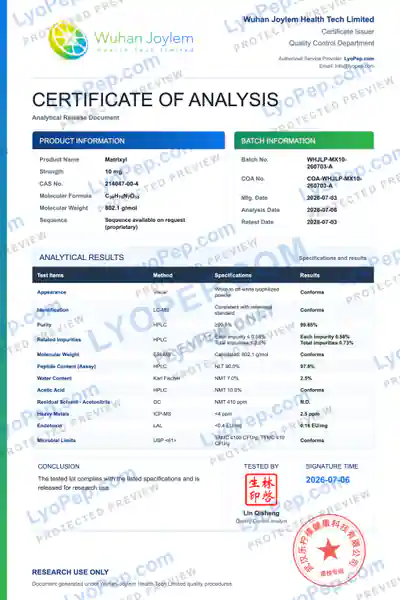
Matrixyl factory batch COAs

Representative records, refreshed periodically

Published COAs show representative factory batches and may not be the latest available. For a current quote or shipment, our sales team can confirm the applicable lot and provide its COA.

Independent testing, arranged on request

Third-party reports are not routinely published. If independent verification is required, we can agree the laboratory, method, acceptance criteria and remedy before testing. If the agreed specification is not met, an appropriate resolution—including a refund where applicable—can be discussed under the agreed terms. Unless otherwise agreed in writing, the buyer pays the cost of this optional testing.

Help reviewing your COA

Need help reading a factory COA or third-party report? Our sales team can clarify test items, specifications and how the results relate to the lot under discussion.

Ask for the current packet, not a generic certificate

  • Require high-resolution intact mass plus MS/MS or peptide mapping to confirm Pal-KTTKS rather than KTSKS, chromatographic purity with impurity profile, quantitative peptide content, free palmitate and incomplete acylation controls, water, counterion, residual solvents, elemental impurities and lot-specific stability
  • For aqueous trade preparations or finished cosmetics also require microbial limits, preservative efficacy, active recovery and packaging compatibility
  • Appearance, nominal HPLC area and the word Matrixyl alone are insufficient for release.
Released-batch COARP-HPLC result and method contextIdentity result appropriate to the moleculeWater / counter-ion context where relevantSDS and handling statementAdditional testing scoped on request

Available fills

Quote the fill and pack configuration you need

Reference SKUFillBase pack
KTTKS-10MG10 mg10 vials

Handling

Storage in the lab and temperature during transit are different decisions

Follow the lot COA and form-specific stability data. Dry Pal-KTTKS, Croda's glycerin/water/butylene-glycol Matrixyl trade preparation and a finished emulsion are different matrices and must not share an assumed storage condition. Control heat, light, moisture, microbial growth in aqueous systems and repeated freeze-thaw exposure, and confirm peptide recovery throughout the claimed shelf life.

State destination, season, acceptable transit exposure and whether your protocol requires insulated or cold-chain service. Additional temperature-control cost is quoted explicitly.

Buyer FAQ

Terms to settle before the purchase order

Can a buyer arrange third-party testing?+

Yes. Testing must be performed by a mutually accepted, established specialist laboratory. Fee allocation, specification, sampling, method and acceptance rule must be agreed before testing; if an agreed independent result shows nonconformance, the remedy follows the signed order terms. Unless otherwise agreed in writing, the buyer pays the cost of this optional testing.

Does HPLC purity prove peptide content?+

No. Chromatographic purity describes the relative peak profile under a stated method. Identity, water, counter-ion, residual solvents and assay/content may require separate methods.

Is cold-chain shipping always required?+

Not always. Heat can accelerate degradation, especially during summer and long transit. Cold-chain reduces exposure but raises cost. State the destination and stability risk so the right service can be quoted.

How are payment terms handled?+

Available methods and milestones depend on order value, destination and project type. The pro forma invoice should state currency, bank details, fees, payment milestones and the release condition.

Why must the testing laboratory understand peptide chemistry?+

Free-base and salt forms, hydrophilic and hydrophobic sequences, aggregation and adsorption can change sample preparation and method suitability. Use a laboratory experienced with the molecule class.

These are buyer-qualification references, not claims that this RUO material is regulated, certified or released under those frameworks. Applicability depends on the buyer's workflow and jurisdiction.

Selected sources

Literature behind the research context

  • Katayama 1993 establishes the KTTKS motif in cell models, not topical Pal-KTTKS efficacy. Robinson 2005 reports a 93-subject, 12-week split-face study of a finished moisturizer containing 3 ppm Pal-KTTKS. Choi 2014 is an ex vivo hairless-mouse skin study and cannot establish human absorption. Park 2017 and Vitali 2024 are cell/formulation studies. Aruan 2023 enrolled only 21 participants and did not report the active concentrations in the abstracted comparison. CIR's September 2024 final report supports safety only under described cosmetic use conditions. Croda is the primary source for original Matrixyl trade composition and manufacturer claims; PubChem and FDA GSRS-linked identifiers support chemical identity but not regulatory approval or batch conformity.
  1. 01

    A pentapeptide from type I procollagen promotes extracellular matrix production

    Journal of Biological Chemistry · 1993 · peer-reviewed original research (foundational/landmark)

    Open source
  2. 02

    Topical palmitoyl pentapeptide provides improvement in photoaged human facial skin

    International Journal of Cosmetic Science · 2005 · peer-reviewed original research (randomized controlled clinical trial)

    Open source
  3. 03

    Dermal Stability and In Vitro Skin Permeation of Collagen Pentapeptides (KTTKS and palmitoyl-KTTKS)

    Biomolecules & Therapeutics (Seoul) · 2014 · peer-reviewed original research

    Open source
  4. 04

    Effect of Palmitoyl-Pentapeptide (Pal-KTTKS) on Wound Contractile Process in Relation with Connective Tissue Growth Factor and alpha-Smooth Muscle Actin Expression

    Tissue Engineering and Regenerative Medicine · 2017 · peer-reviewed original research

    Open source
  5. 05

    Double-blind, Randomized Trial on the Effectiveness of Acetylhexapeptide-3 Cream and Palmitoyl Pentapeptide-4 Cream for Crow's Feet

    Journal of Clinical and Aesthetic Dermatology · 2023 · peer-reviewed original research (randomized controlled trial)

    Open source
  6. 06

    Liposome Encapsulation of the Palmitoyl-KTTKS Peptide: Structural and Functional Characterization

    Pharmaceutics · 2024 · peer-reviewed original research

    Open source
  7. 07

    Matrixyl

    Croda Beauty · 2026 · original manufacturer technical source

    Open source
  8. 08

    Safety Assessment of Myristoyl Pentapeptide-4, Palmitoyl Pentapeptide-4, and Pentapeptide-4 as Used in Cosmetics

    Cosmetic Ingredient Review · 2024 · independent cosmetic ingredient safety assessment

    Open source

Product FAQ

Questions buyers ask about Matrixyl

Which active does “Matrixyl” identify in this SKU?+

This SKU is intended to be Palmitoyl Pentapeptide-4 with the Pal-KTTKS sequence, historically called Palmitoyl Pentapeptide-3. The order and COA must state Pal-Lys-Thr-Thr-Lys-Ser-OH, N-terminal palmitoylation, terminal state and stereochemistry. Matrixyl 3000, Matrixyl synthe'6 and Matrixyl Morphomics are different trade products with different actives; their specifications and evidence cannot be assigned to this material.

Is a 10 mg vial equivalent to the original commercial Matrixyl trade preparation?+

No. Pure dry Pal-KTTKS, Croda's original glycerin/water/butylene-glycol Matrixyl preparation and a finished emulsion are different matrices. A trade-product addition rate cannot be copied to pure powder, and a published 3 ppm finished-product concentration is not a raw-material instruction. Calculate target active concentration from released-lot peptide content, actual batch size and complete formula, then verify recovery and stability analytically.

What should a Pal-KTTKS batch COA and qualification package contain?+

Require high-resolution intact mass and sequence-confirming MS/MS or mapping, chromatographic purity with impurity profile, quantitative Pal-KTTKS content, free palmitate and incomplete-acylation controls, water, counterion, residual solvents and lot-specific stability. For aqueous trade preparations or finished formulas, additionally qualify microbial limits, preservative efficacy, active recovery, pH and packaging compatibility. Appearance, the Matrixyl name or HPLC area purity alone is insufficient.