Recent Confirmed OrdersLast 7 days
Australia520 mgTirzepatide 40 mg · Semaglutide 2 mg · Dihexa 10 mg
View all

Khavinson bioregulators

Bronchogen

AEDL tetrapeptide research reference · sequence-resolved identity is essential

Lot-specific chromatographic purity and quantitative peptide content; confirm both on the released-lot COA · target, verify batch COACAS Confirm per batch COARUO
Research statusLimited and sequence-inconsistent preclinical evidence; laboratory Research Use Only
Supplied formLinear tetrapeptide; H-Ala-Glu-Asp-Leu-OH (AEDL)
Lead time14–21 days
Bronchogen — Lot-specific lyophilized research peptide; confirm colour and cake condition on the released-lot COA
Bronchogen — Lot-specific lyophilized research peptide; confirm colour and cake condition on the released-lot COA · Representative packaging image · verify the ordered lot
Representative packaging image · verify the ordered lot

Decision summary

Key benefits

  • Useful laboratory questions include sequence-isomer discrimination, bronchial-cell gene-expression and promoter-methylation assays, and replication of preclinical respiratory-tissue findings with sequence-confirmed material
  • The record deliberately separates AEDL evidence from ADEL studies and from brand-only reports.
Published research context is presented for literature orientation only. It is not a dosing, treatment or human-use instruction.
Qualification data

Specifications to confirm against the released lot

CAS
Confirm per batch COA
Formula
C18H30N4O9
Molecular weight
Approximately 446.44-446.5 Da
Appearance
Lot-specific lyophilized research peptide; confirm colour and cake condition on the released-lot COA
Purity
Lot-specific chromatographic purity and quantitative peptide content; confirm both on the released-lot COA · target, verify batch COA
Storage
Follow the released-lot COA, SDS and formulation-specific stability statement. Temperature, light protection, container, shipping range and any post-preparation hold time require evidence for the exact AEDL form, matrix and concentration; generic vendor instructions are not a stability study.
MOQ
On request
Lead time
14–21 days
PubChem CID 11690869

Qualification matrix

Identity, purity and content are separate release questions.

Identity

Confirm the stated molecule and supplied form. Start with the matching batch COA; request sequence-level evidence only when the buyer's written procedure requires it and availability or a separate scope has been agreed.

Purity

Review RP-HPLC method conditions, wavelength, integration and related-peak handling. A percentage without the method is not enough.

Content

Net peptide content is not the same as gross lyophilized powder weight. Ask which assay supports the stated amount and whether water/counter-ion is addressed.

Stability

Define long-term storage and transit exposure separately. Cold-chain can be quoted when the buyer’s risk assessment requires it and adds cost.

Research context

What researchers study about Bronchogen

Bronchogen is marketed within the Khavinson research lineage and is specified here as H-Ala-Glu-Asp-Leu-OH, AEDL. PubChem CID 11690869 supports formula C₁₈H₃₀N₄O₉ and molecular weight approximately 446.5 Da for AEDL. The literature is chemically inconsistent: PMID 25761685 explicitly studies AEDL, whereas PMID 21240358 and PMID 25015171 explicitly study ADEL, an order isomer with the same composition and intact mass. PMID 26468022 names Bronchogen in a rat model but its accessible abstract does not state the sequence. These materials cannot be assumed equivalent. The evidence is mainly in vitro or animal based, concentrated in one research lineage and not independently replicated as a sequence-confirmed human programme.

  • Sequence-resolved in-vitro bronchial epithelial gene-expression and promoter-methylation research; analytical comparison of AEDL, ADEL and related tetrapeptides; and carefully qualified preclinical replication
  • These are research applications, not clinical indications.

Mechanism context

The question the literature is testing

PMID 25761685 reports AEDL-associated changes in bronchial-cell gene expression and selected promoter methylation. More detailed DNA-binding findings often attributed to Bronchogen derive from ADEL papers and are related-programme hypotheses, not direct proof for AEDL. A causal chain from sequence-confirmed AEDL binding through chromatin regulation to organism-level outcomes has not been independently demonstrated. Cell entry, promoter recognition and durable transcriptional effects remain testable hypotheses.

Evidence map

Research routes and exposure context

Evidence tierMixed evidence context
Routes reported in sources
No administration route applies
Dose / exposure contextProtocol-specific; verify the cited primary source
Routes and exposure contexts summarize cited studies or approved finished-product labels. They are not instructions for administering this RUO material; no customer dose is provided.

Evidence boundaries

Compatibility, limitations and decision context

  • Not for human or veterinary use
  • Small preclinical reports without an observed severe signal do not establish human tolerability, long-term safety, sterility or administration suitability
  • Follow the SDS and institutional controls; keep sequence identity and RUO status explicit in procurement and laboratory records.

Interactions reported in the literature

  • No controlled combination or interaction evidence was identified for sequence-confirmed AEDL
  • Supplier “stacks” and other Khavinson products are not validated combinations and no patient interaction advice is provided.
Literature context is not a supplier release result or human-use instruction. Follow your institution's approved laboratory risk assessment.

Factory batch documentation

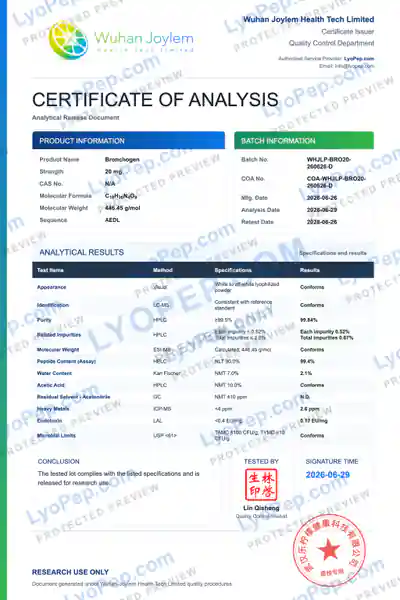
Bronchogen factory batch COAs

Representative records, refreshed periodically

Published COAs show representative factory batches and may not be the latest available. For a current quote or shipment, our sales team can confirm the applicable lot and provide its COA.

Independent testing, arranged on request

Third-party reports are not routinely published. If independent verification is required, we can agree the laboratory, method, acceptance criteria and remedy before testing. If the agreed specification is not met, an appropriate resolution—including a refund where applicable—can be discussed under the agreed terms. Unless otherwise agreed in writing, the buyer pays the cost of this optional testing.

Help reviewing your COA

Need help reading a factory COA or third-party report? Our sales team can clarify test items, specifications and how the results relate to the lot under discussion.

Ask for the current packet, not a generic certificate

  • Require exact N-to-C AEDL sequence, termini, supplied form and counterion; theoretical and observed high-resolution intact mass
  • LC-MS/MS fragment-ion evidence that distinguishes ADEL and other order isomers; stability-indicating HPLC purity and impurity profile; quantitative peptide content; water, counterion and relevant residuals; and a lot-specific stability basis
  • Sterility, bacterial endotoxin and bioburden are separate tests
  • Colour, a trade name or a single HPLC area percentage cannot establish identity or fitness for a method.
Released-batch COARP-HPLC result and method contextIdentity result appropriate to the moleculeWater / counter-ion context where relevantSDS and handling statementAdditional testing scoped on request

Available fills

Quote the fill and pack configuration you need

Reference SKUFillBase pack
BRON-20MG20 mg10 vials

Handling

Storage in the lab and temperature during transit are different decisions

Follow the released-lot COA, SDS and formulation-specific stability statement. Temperature, light protection, container, shipping range and any post-preparation hold time require evidence for the exact AEDL form, matrix and concentration; generic vendor instructions are not a stability study.

State destination, season, acceptable transit exposure and whether your protocol requires insulated or cold-chain service. Additional temperature-control cost is quoted explicitly.

Buyer FAQ

Terms to settle before the purchase order

Can a buyer arrange third-party testing?+

Yes. Testing must be performed by a mutually accepted, established specialist laboratory. Fee allocation, specification, sampling, method and acceptance rule must be agreed before testing; if an agreed independent result shows nonconformance, the remedy follows the signed order terms. Unless otherwise agreed in writing, the buyer pays the cost of this optional testing.

Does HPLC purity prove peptide content?+

No. Chromatographic purity describes the relative peak profile under a stated method. Identity, water, counter-ion, residual solvents and assay/content may require separate methods.

Is cold-chain shipping always required?+

Not always. Heat can accelerate degradation, especially during summer and long transit. Cold-chain reduces exposure but raises cost. State the destination and stability risk so the right service can be quoted.

How are payment terms handled?+

Available methods and milestones depend on order value, destination and project type. The pro forma invoice should state currency, bank details, fees, payment milestones and the release condition.

Why must the testing laboratory understand peptide chemistry?+

Free-base and salt forms, hydrophilic and hydrophobic sequences, aggregation and adsorption can change sample preparation and method suitability. Use a laboratory experienced with the molecule class.

These are buyer-qualification references, not claims that this RUO material is regulated, certified or released under those frameworks. Applicability depends on the buyer's workflow and jurisdiction.

Selected sources

Literature behind the research context

  • Identity: PubChem CID 11690869 for AEDL, formula C₁₈H₃₀N₄O₉ and molecular weight approximately 446.5 Da. Sequence-matched context: PMID 25761685 explicitly identifies AEDL. Identity-conflicted context: PMID 21240358 and PMID 25015171 explicitly identify ADEL; PMID 26468022 names Bronchogen but does not state a sequence in the accessible abstract. No sequence-confirmed human pharmacokinetic or randomized clinical study was identified.
  1. 01

    Peptide regulation of gene expression and protein synthesis in bronchial epithelium

    Lung · 2014 · peer-reviewed original research (in vitro, human bronchial epithelial cell culture)

    Open source
  2. 02

    Modulating effect of peptide therapy on the morphofunctional state of bronchial epithelium in rats with obstructive lung pathology

    Bulletin of Experimental Biology and Medicine · 2015 · peer-reviewed original research (in vivo, rat model of COPD)

    Open source
  3. 03

    Epigenetic mechanisms of peptidergic regulation of gene expression during aging of human cells

    Biochemistry (Moscow) · 2015 · peer-reviewed review/research article

    Open source
  4. 04

    Effect of the peptide bronchogen (Ala-Asp-Glu-Leu) on DNA thermostability

    Bulletin of Experimental Biology and Medicine · 2011 · peer-reviewed original research (biophysical/in vitro)

    Open source
  5. 05

    Peptide regulation of gene expression: a systematic review

    Molecules · 2021 · peer-reviewed systematic review

    Open source

Product FAQ

Questions buyers ask about Bronchogen

How can AEDL Bronchogen be distinguished from related tetrapeptides and sequence isomers?+

Bronchogen is specified here as AEDL. Epitalon is AEDG and Cortagen is AEDP, so adequately resolved intact mass can distinguish those different compositions. Intact mass alone cannot distinguish AEDL from ADEL or other order isomers with the same elemental composition. Qualification therefore requires the exact N-to-C sequence, termini and supplied form plus LC-MS/MS evidence covering diagnostic fragment ions; a trade name, formula or generic purity result is insufficient.

What does the published Bronchogen evidence actually support?+

The sequence-matched AEDL literature is limited mainly to in-vitro bronchial-cell gene-expression and promoter-methylation research. Other papers explicitly study ADEL, while a rat obstructive-lung abstract names Bronchogen without stating the sequence. These records support sequence-resolved preclinical investigation, not interchangeable attribution across isomers and not a human efficacy or safety claim.

Which released-lot evidence is most important for Bronchogen?+

Request the exact AEDL sequence written N-to-C, terminal state, salt/counterion and theoretical mass; high-resolution intact mass; LC-MS/MS sequence-ion coverage able to distinguish ADEL; stability-indicating HPLC purity and impurity profile; quantitative peptide content; water, counterion and relevant residuals; and the lot-specific storage basis. Sterility and bacterial endotoxin are separate attributes and should be claimed only with named methods and acceptance limits.