Recent Confirmed OrdersLast 7 days
Australia520 mgTirzepatide 40 mg · Semaglutide 2 mg · Dihexa 10 mg
View all

Khavinson bioregulators

Vesugen

Linear Lys-Glu-Asp (KED) tripeptide research standard

≥ 99.0% · target, verify batch COACAS 204271-66-9RUO
Research statusLimited, predominantly preclinical evidence from a concentrated research network. This catalog material is Research Use Only and is not an approved therapeutic product. reference context · supplied material is RUO
Supplied formLinear unmodified L-tripeptide
Lead time14–21 days
Vesugen — White to off-white lyophilized powder
Vesugen — White to off-white lyophilized powder · Representative packaging image · verify the ordered lot
Representative packaging image · verify the ordered lot

Decision summary

Key benefits

  • Published research contexts, not benefits claimed for this RUO material: KED has been studied in vascular-cell aging, endothelial-marker and atherosclerosis-related models; same-network studies report changes in Ki-67, p53, E-selectin, endothelin-1, connexin expression and SIRT1 in model-specific settings; the 41-participant vascular report and the small polymorbidity report are uncontrolled and cannot establish efficacy; exploratory neuroplasticity findings come from cell and mouse models, and the 5xFAD publication has a formal correction
  • No reliable evidence reviewed here supports claims of established anti-aging, neuroprotective, physical-recovery or cardiovascular benefit in humans.
Published research context is presented for literature orientation only. It is not a dosing, treatment or human-use instruction.
Qualification data

Specifications to confirm against the released lot

CAS
204271-66-9
Formula
C15H26N4O8
Molecular weight
390.39 Da
Appearance
White to off-white lyophilized powder
Purity
≥ 99.0% · target, verify batch COA
Storage
Follow the released-lot COA and supplier instructions. Unless batch documentation specifies otherwise, keep sealed lyophilized KED desiccated, protected from light, and at or below -20°C. The receiving laboratory should validate solvent, concentration, container compatibility and solution hold time, and should minimize repeated freeze-thaw cycles. No universal 7-10-day solution life or 24-month retest period was verified for every lot.
MOQ
On request
Lead time
14–21 days
PubChem CID 87571363

Qualification matrix

Identity, purity and content are separate release questions.

Identity

Confirm the stated molecule and supplied form. Start with the matching batch COA; request sequence-level evidence only when the buyer's written procedure requires it and availability or a separate scope has been agreed.

Purity

Review RP-HPLC method conditions, wavelength, integration and related-peak handling. A percentage without the method is not enough.

Content

Net peptide content is not the same as gross lyophilized powder weight. Ask which assay supports the stated amount and whether water/counter-ion is addressed.

Stability

Define long-term storage and transit exposure separately. Cold-chain can be quoted when the buyer’s risk assessment requires it and adds cost.

Research context

What researchers study about Vesugen

Vesugen is a trade name associated with the linear tripeptide Lys-Glu-Asp (KED). PubChem CID 87571363 identifies lysyl-glutamyl-aspartic acid with formula C₁₅H₂₆N₄O₈ and molecular weight 390.39 Da. Published work covers cell-culture, organotypic-culture and rodent models, plus two small uncontrolled human reports; it is heavily concentrated in the Khavinson research network and does not constitute an independently replicated therapeutic evidence base. PMID 25051774 describes a 41-participant pre/post study without a reported randomized or placebo-controlled design. PMID 26390612 states 32 participants, although its reported sex counts—18 men and 12 women—sum to 30; this source discrepancy remains unresolved. The 2021 5xFAD mouse paper (PMID 34071923) received a 2025 correction for duplicated imagery in Figures 5 and 8 (PMID 39861198). The correction says the conclusions were unaffected, but the correction must accompany citation of the original paper. This bulk product is an analytical and experimental research material, not a registered medicine or finished dietary supplement.

  • Research contexts include identity and impurity-method development; vascular endothelial-cell proliferation and senescence models; endothelin-1, connexin, SIRT1, E-selectin, Ki-67 and p53 assay systems; organotypic and rodent neuroplasticity models; and critical appraisal or replication of the small human observational reports
  • These contexts do not establish a clinical indication, recommended route, or therapeutic use.

Mechanism context

The question the literature is testing

No validated receptor or human mechanism has been established for KED. Khavinson-network studies report model-specific changes in proliferation, senescence and vascular markers, and some papers use computational peptide-DNA docking to propose promoter-level regulation. These are hypotheses from in vitro, in silico, organotypic or animal systems, not direct structural proof of target binding or a demonstrated human causal pathway. The PubMed abstract for the 2021 5xFAD study attributes specific promoter-sequence matches to EDR, not to KED, so the earlier claim that KED was proven to bind CASP3, MAPT or PSEN1 promoter regions has been removed. No human pharmacokinetic study was identified.

Evidence map

Research routes and exposure context

Evidence tierApproved finished-product context
Routes reported in sources
Intraperitoneal
Dose / exposure contextProtocol-specific; verify the cited primary source
Routes and exposure contexts summarize cited studies or approved finished-product labels. They are not instructions for administering this RUO material; no customer dose is provided.

Evidence boundaries

Compatibility, limitations and decision context

  • This bulk peptide is Research Use Only and is not sterile or qualified for human or veterinary administration
  • No formal Phase I safety program was identified
  • The two small human reports are uncontrolled and do not provide the prospective adverse-event ascertainment needed to establish safety; the second report also contains an unresolved sample-count discrepancy and describes pro-oxidant activity and reduced CD34+ hematopoietic-cell counts alongside its favorable claims
  • Pregnancy, lactation, pediatric use, organ impairment, contraindications and drug interactions have not been adequately studied
  • The 2021 mouse paper must be cited with its 2025 correction
  • Laboratories should follow the SDS, use appropriate PPE, perform a documented risk assessment and obtain the institutional approvals required for the intended model.

Interactions reported in the literature

  • No authoritative clinical interaction data or validated combination regimen was identified
  • Claims that KED is synergistic or compatible with Epitalon, Pinealon, Cartalax, Cardiogen or other peptides are vendor or community hypotheses, not established safety or efficacy guidance
  • In experimental systems, treatments that alter endothelial signaling, proliferation, oxidative stress, gene expression or assay readouts may confound interpretation and should be prespecified as controls where relevant
  • This catalog does not provide medication-management or combination advice.
Literature context is not a supplier release result or human-use instruction. Follow your institution's approved laboratory risk assessment.

Factory batch documentation

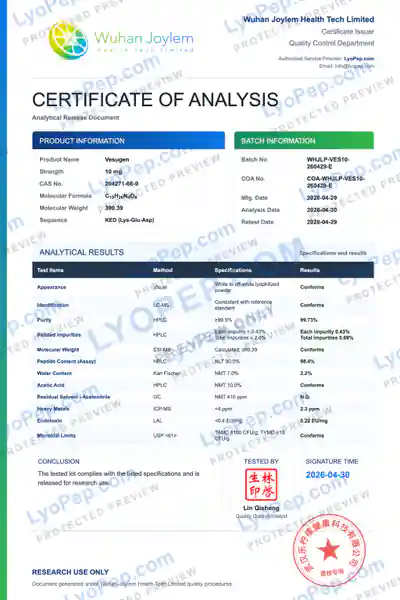
Vesugen factory batch COAs

Representative records, refreshed periodically

Published COAs show representative factory batches and may not be the latest available. For a current quote or shipment, our sales team can confirm the applicable lot and provide its COA.

Independent testing, arranged on request

Third-party reports are not routinely published. If independent verification is required, we can agree the laboratory, method, acceptance criteria and remedy before testing. If the agreed specification is not met, an appropriate resolution—including a refund where applicable—can be discussed under the agreed terms. Unless otherwise agreed in writing, the buyer pays the cost of this optional testing.

Help reviewing your COA

Need help reading a factory COA or third-party report? Our sales team can clarify test items, specifications and how the results relate to the lot under discussion.

Ask for the current packet, not a generic certificate

  • Require a released-lot COA that states the exact H-Lys-Glu-Asp-OH identity, molecular formula, theoretical mass, measured intact mass and identity method; chromatographic purity and impurity profile; counterion or salt content; water, residual solvents and net peptide assay
  • Use an orthogonal identity method such as LC-MS/MS sequence confirmation in addition to intact mass and HPLC
  • For cell or animal research, define endotoxin and bioburden acceptance criteria in the receiving laboratory's protocol
  • HPLC area purity alone does not establish peptide content, sequence identity, sterility, clinical grade or equivalence to a marketed product
  • Appearance and solution clarity are supportive observations, not substitutes for analytical release testing.
Released-batch COARP-HPLC result and method contextIdentity result appropriate to the moleculeWater / counter-ion context where relevantSDS and handling statementAdditional testing scoped on request

Available fills

Quote the fill and pack configuration you need

Reference SKUFillBase pack
VESU-10MG10 mg10 vials

Handling

Storage in the lab and temperature during transit are different decisions

Follow the released-lot COA and supplier instructions. Unless batch documentation specifies otherwise, keep sealed lyophilized KED desiccated, protected from light, and at or below -20°C. The receiving laboratory should validate solvent, concentration, container compatibility and solution hold time, and should minimize repeated freeze-thaw cycles. No universal 7-10-day solution life or 24-month retest period was verified for every lot.

State destination, season, acceptable transit exposure and whether your protocol requires insulated or cold-chain service. Additional temperature-control cost is quoted explicitly.

Buyer FAQ

Terms to settle before the purchase order

Can a buyer arrange third-party testing?+

Yes. Testing must be performed by a mutually accepted, established specialist laboratory. Fee allocation, specification, sampling, method and acceptance rule must be agreed before testing; if an agreed independent result shows nonconformance, the remedy follows the signed order terms. Unless otherwise agreed in writing, the buyer pays the cost of this optional testing.

Does HPLC purity prove peptide content?+

No. Chromatographic purity describes the relative peak profile under a stated method. Identity, water, counter-ion, residual solvents and assay/content may require separate methods.

Is cold-chain shipping always required?+

Not always. Heat can accelerate degradation, especially during summer and long transit. Cold-chain reduces exposure but raises cost. State the destination and stability risk so the right service can be quoted.

How are payment terms handled?+

Available methods and milestones depend on order value, destination and project type. The pro forma invoice should state currency, bank details, fees, payment milestones and the release condition.

Why must the testing laboratory understand peptide chemistry?+

Free-base and salt forms, hydrophilic and hydrophobic sequences, aggregation and adsorption can change sample preparation and method suitability. Use a laboratory experienced with the molecule class.

These are buyer-qualification references, not claims that this RUO material is regulated, certified or released under those frameworks. Applicability depends on the buyer's workflow and jurisdiction.

Selected sources

Literature behind the research context

  • 1) PubChem CID 87571363, Lysyl-glutamyl-aspartic acid: C₁₅H₂₆N₄O₈, 390.39 Da and the recorded IUPAC structure; 2) Khavinson V, et al. Neuroprotective Effects of Tripeptides-Epigenetic Regulators in Mouse Model of Alzheimer's Disease. Pharmaceuticals. 2021;14:515. PMID 34071923; PMCID PMC8227791; doi:10.3390/ph14060515; 3) Khavinson V, et al. Correction to the 2021 5xFAD paper. Pharmaceuticals. 2025;18:111. PMID 39861198; PMCID PMC11769113; doi:10.3390/ph18010111; 4) Khavinson VKh, et al. Epigenetic aspects of peptidergic regulation of vascular endothelial cell proliferation during aging. Adv Gerontol. 2014. PMID 25051766; 5) Kozlov KL, et al. Molecular aspects of vasoprotective peptide KED activity during atherosclerosis and restenosis. Adv Gerontol. 2016. PMID 28539025; 6) Khavinson VKh, et al. Molecular aspects of anti-atherosclerotic effects of short peptides. Bull Exp Biol Med. 2014. PMID 25408528; doi:10.1007/s10517-014-2713-8; 7) Study of peptide bioregulators in lower-limb chronic arterial insufficiency and vasculogenic erectile dysfunction. Adv Gerontol. 2014. PMID 25051774; 8) Meshchaninov VN, et al. Synthetic peptides in chronic polymorbidity and organic brain syndrome. Adv Gerontol. 2015. PMID 26390612.
  1. 01

    Neuroprotective Effects of Tripeptides-Epigenetic Regulators in Mouse Model of Alzheimer's Disease

    Pharmaceuticals (Basel) · 2021 · peer-reviewed original research (5xFAD mouse and computational models)

    Open source
  2. 02

    Correction to Neuroprotective Effects of Tripeptides-Epigenetic Regulators in Mouse Model of Alzheimer's Disease

    Pharmaceuticals (Basel) · 2025 · published correction

    Open source
  3. 03

    Epigenetic aspects of peptidergic regulation of vascular endothelial cell proliferation during aging

    Advances in Gerontology (Uspekhi Gerontologii) · 2014 · peer-reviewed original research (in vitro / molecular docking)

    Open source
  4. 04

    Molecular aspects of anti-atherosclerotic effects of short peptides

    Bulletin of Experimental Biology and Medicine · 2014 · peer-reviewed original research (in vitro)

    Open source
  5. 05

    Molecular aspects of vasoprotective peptide KED activity during atherosclerosis and restenosis

    Advances in Gerontology (Uspekhi Gerontologii) · 2016 · peer-reviewed original research / review

    Open source
  6. 06

    Effect of tripeptide Lys-Glu-Asp on physiological activity of neuroimmunoendocrine system cells

    Bulletin of Experimental Biology and Medicine · 2012 · peer-reviewed original research (organotypic culture / animal model)

    Open source
  7. 07

    Peptides tissue-specifically stimulate cell differentiation during their aging

    Bulletin of Experimental Biology and Medicine · 2012 · peer-reviewed original research (in vitro, human cell culture)

    Open source
  8. 08

    Peptide KED: molecular-genetic aspects of neurogenesis regulation in Alzheimer's disease

    Bulletin of Experimental Biology and Medicine · 2021 · peer-reviewed review article

    Open source

Product FAQ

Questions buyers ask about Vesugen

How should the identity of a Vesugen/KED lot be confirmed?+

Specify H-Lys-Glu-Asp-OH rather than relying on the trade name alone. PubChem CID 87571363 records lysyl-glutamyl-aspartic acid as C₁₅H₂₆N₄O₈ with molecular weight 390.39 Da. The released-lot COA should state the sequence, theoretical and measured intact mass, identity method, counterion, water and net peptide content. Intact mass plus LC-MS/MS sequence confirmation or another orthogonal method is stronger than HPLC area purity alone.

How should a KED research lot be stored and qualified for an experiment?+

Follow the released-lot COA and supplier instructions. Unless the batch documents say otherwise, keep the sealed lyophilized material dry, protected from light and at or below -20°C. Validate solvent, concentration, container compatibility and solution hold time in the receiving laboratory, and minimize freeze-thaw cycles. Do not assume a universal 24-month retest period, a 7-10-day solution life or a human-use diluent. HPLC purity does not demonstrate sterility or clinical grade.