Recent Confirmed OrdersLast 7 days
Australia2 gTirzepatide 100 mg · CagriSema 20 mg · BPC-157 10 mg · TB-500 5 mg · Melanotan II 10 mg · PT-141 10 mg · Bacteriostatic Water 3 ml
View all

Neurocognitive research

Pinealon

Khavinson neuroprotective tripeptide (Glu-Asp-Arg, EDR)

≥ 99.0% · target, verify batch COACAS 175175-23-2RUO
Research statusPreclinical Research / Limited Historical Clinical Reporting
Supplied formTripeptide (linear)
Lead time14–21 days
Pinealon — White to off-white lyophilized powder
Pinealon — White to off-white lyophilized powder · Representative packaging image · verify the ordered lot
Representative packaging image · verify the ordered lot

Decision summary

Key benefits

  • Evidence-supported research topics are oxidative-stress and cell-viability assays, neuronal morphology, neuroprotection hypotheses and peptide-nucleic-acid interaction
  • Rat, 5xFAD mouse and induced-neuron results are preclinical and cannot establish treatment of traumatic brain injury, Alzheimer's disease, cognitive decline, sleep disturbance or aging in humans
  • A 2020 review summarizes historical oral observations in 72 patients, but the underlying original reports are not sufficiently accessible here for independent appraisal and do not justify a clinical efficacy claim.
Published research context is presented for literature orientation only. It is not a dosing, treatment or human-use instruction.
Qualification data

Specifications to confirm against the released lot

CAS
175175-23-2
Formula
C15H26N6O8
Molecular weight
418.40 Da
Appearance
White to off-white lyophilized powder
Purity
≥ 99.0% · target, verify batch COA
Storage
Store the unopened lyophilized material according to the batch COA and lot-specific stability statement, protected from moisture and light. Reconstituted stability depends on counterion, buffer, concentration, container, temperature and microbial controls; do not assign a universal dating period without validated data. Minimize unvalidated freeze-thaw cycles and document temperature excursions.
MOQ
On request
Lead time
14–21 days
PubChem CID 10273502

Qualification matrix

Identity, purity and content are separate release questions.

Identity

Confirm the stated molecule and supplied form. Start with the matching batch COA; request sequence-level evidence only when the buyer's written procedure requires it and availability or a separate scope has been agreed.

Purity

Review RP-HPLC method conditions, wavelength, integration and related-peak handling. A percentage without the method is not enough.

Content

Net peptide content is not the same as gross lyophilized powder weight. Ask which assay supports the stated amount and whether water/counter-ion is addressed.

Stability

Define long-term storage and transit exposure separately. Cold-chain can be quoted when the buyer’s risk assessment requires it and adds cost.

Research context

What researchers study about Pinealon

Pinealon is the defined tripeptide Glu-Asp-Arg (EDR) investigated in a body of short-peptide bioregulator research associated primarily with the St. Petersburg Khavinson group. Peer-reviewed studies report antioxidant and cell-survival observations in vitro, effects in rat and transgenic mouse models, nuclear localization or nucleic-acid interaction experiments, and induced-neuron morphology findings. These studies support research hypotheses, not established therapeutic efficacy. The literature is concentrated within a connected research lineage, independent replication is limited, and no qualifying completed randomized controlled human trial was identified in this review. Cortexin is a heterogeneous animal-tissue polypeptide preparation; Pinealon is a single defined synthetic sequence and must not be represented as the same product.

  • Appropriate research contexts include oxidative-stress and cell-viability assays, neuronal morphology and dendritogenesis models, peptide-nucleic-acid interaction studies, and exploratory neurodegeneration models
  • Published rat, mouse and induced-neuron observations are not clinical indications
  • Historical human observations cited by reviews are low-certainty context and do not establish efficacy for traumatic brain injury, cognitive impairment, Alzheimer's disease, sleep or anti-aging use.

Mechanism context

The question the literature is testing

Proposed mechanisms include reduced reactive-oxygen-species accumulation, altered ERK1/2 timing, changes in apoptosis-related and antioxidant markers, dendritic-spine preservation in model systems, and sequence-dependent interaction with nucleic-acid structures. Some papers propose effects on gene-expression regulation, but direct binding observations and model-specific biomarker changes do not by themselves prove a clinically relevant epigenetic mechanism in humans. Formal human pharmacokinetic, target-engagement and dose-response evidence remains unavailable.

Evidence map

Research routes and exposure context

Evidence tierMixed evidence context
Routes reported in sources
OralIn vitro
Dose / exposure contextProtocol-specific; verify the cited primary source
Routes and exposure contexts summarize cited studies or approved finished-product labels. They are not instructions for administering this RUO material; no customer dose is provided.

Evidence boundaries

Compatibility, limitations and decision context

  • A complete human safety, immunogenicity, reproductive-toxicity, genotoxicity and long-term exposure profile has not been established
  • Preclinical publications and limited historical reports cannot support a general safety conclusion
  • This commercial material is for research use only and is not for human or veterinary administration, diagnosis or treatment
  • Laboratory handling requires the SDS, institutional risk assessment and appropriate containment.

Interactions reported in the literature

  • No validated human interaction, combination or stacking evidence was identified
  • Mentions of Epitalon, Cortexin, Semax, Selank, melatonin, BPC-157, NAD+ or other peptides in community protocols do not establish pharmacologic synergy, compatibility or safety
  • In laboratory mixtures, assess solubility, adsorption, oxidation, counterion, pH and analytical interference for each design rather than assuming compatibility.
Literature context is not a supplier release result or human-use instruction. Follow your institution's approved laboratory risk assessment.

Factory batch documentation

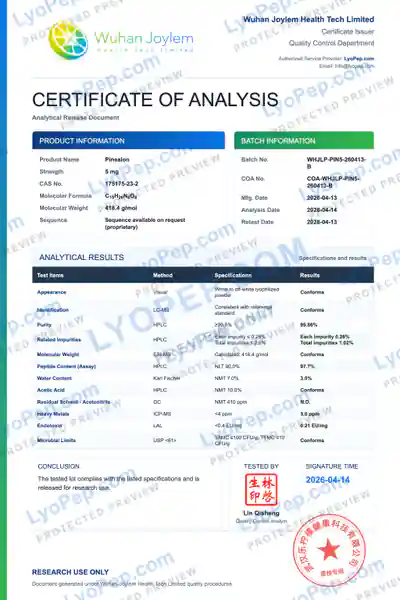
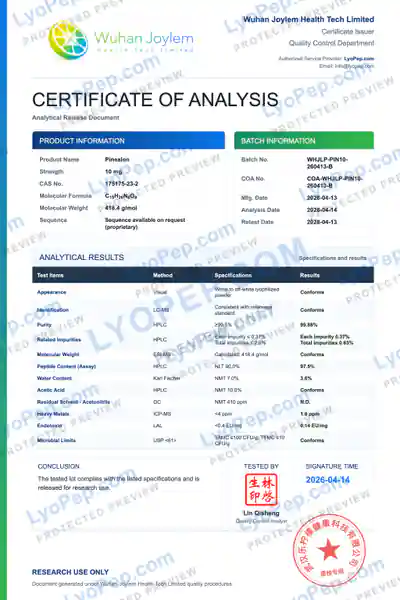
Pinealon factory batch COAs

Representative records, refreshed periodically

Published COAs show representative factory batches and may not be the latest available. For a current quote or shipment, our sales team can confirm the applicable lot and provide its COA.

Independent testing, arranged on request

Third-party reports are not routinely published. If independent verification is required, we can agree the laboratory, method, acceptance criteria and remedy before testing. If the agreed specification is not met, an appropriate resolution—including a refund where applicable—can be discussed under the agreed terms. Unless otherwise agreed in writing, the buyer pays the cost of this optional testing.

Help reviewing your COA

Need help reading a factory COA or third-party report? Our sales team can clarify test items, specifications and how the results relate to the lot under discussion.

Ask for the current packet, not a generic certificate

  • Appearance is only a preliminary check and cannot establish identity, purity, peptide content, counterion or sterility
  • Procurement should require the full sequence and terminal state, counterion identity and quantity, high-resolution intact mass, sequence-confirming MS/MS or peptide mapping, chromatographic purity with raw data and impurity profile, quantitative peptide content, water, residual solvents and lot-specific stability
  • If sterility, endotoxin or bioburden is claimed, require separate validated results
  • A clear solution after reconstitution does not prove batch conformity.
Released-batch COARP-HPLC result and method contextIdentity result appropriate to the moleculeWater / counter-ion context where relevantSDS and handling statementAdditional testing scoped on request

Available fills

Quote the fill and pack configuration you need

Reference SKUFillBase pack
EDR-05MG5 mg10 vials
EDR-10MG10 mg10 vials

Handling

Storage in the lab and temperature during transit are different decisions

Store the unopened lyophilized material according to the batch COA and lot-specific stability statement, protected from moisture and light. Reconstituted stability depends on counterion, buffer, concentration, container, temperature and microbial controls; do not assign a universal dating period without validated data. Minimize unvalidated freeze-thaw cycles and document temperature excursions.

State destination, season, acceptable transit exposure and whether your protocol requires insulated or cold-chain service. Additional temperature-control cost is quoted explicitly.

Buyer FAQ

Terms to settle before the purchase order

Can a buyer arrange third-party testing?+

Yes. Testing must be performed by a mutually accepted, established specialist laboratory. Fee allocation, specification, sampling, method and acceptance rule must be agreed before testing; if an agreed independent result shows nonconformance, the remedy follows the signed order terms. Unless otherwise agreed in writing, the buyer pays the cost of this optional testing.

Does HPLC purity prove peptide content?+

No. Chromatographic purity describes the relative peak profile under a stated method. Identity, water, counter-ion, residual solvents and assay/content may require separate methods.

Is cold-chain shipping always required?+

Not always. Heat can accelerate degradation, especially during summer and long transit. Cold-chain reduces exposure but raises cost. State the destination and stability risk so the right service can be quoted.

How are payment terms handled?+

Available methods and milestones depend on order value, destination and project type. The pro forma invoice should state currency, bank details, fees, payment milestones and the release condition.

Why must the testing laboratory understand peptide chemistry?+

Free-base and salt forms, hydrophilic and hydrophobic sequences, aggregation and adsorption can change sample preparation and method suitability. Use a laboratory experienced with the molecule class.

These are buyer-qualification references, not claims that this RUO material is regulated, certified or released under those frameworks. Applicability depends on the buyer's workflow and jurisdiction.

Selected sources

Literature behind the research context

  • The evidence set comprises the 2011 cell-viability paper, the 2012 prenatal-hyperhomocysteinemia rat study, the 2011 HeLa-cell/nucleic-acid interaction paper, the 2020 EDR review, the 2021 5xFAD mouse study and its 2025 correction, the 2022 neuroepigenetics review, the 2024 induced-neuron study and a 2013 Russian-language review with an English abstract. These sources are useful for research context but are largely connected to the same research lineage. No source reviewed validates the commonly marketed 5 mg subcutaneous protocol or a completed randomized controlled human efficacy trial.
  1. 01

    Pinealon increases cell viability by suppression of free radical levels and activating proliferative processes

    Rejuvenation Research · 2011 · peer-reviewed original research (in vitro)

    Open source
  2. 02

    Pinealon protects the rat offspring from prenatal hyperhomocysteinemia

    International Journal of Clinical and Experimental Medicine · 2012 · peer-reviewed original research (in vivo, rat model)

    Open source
  3. 03

    Penetration of short fluorescence-labeled peptides into the nucleus in HeLa cells and in vitro specific interaction of the peptides with deoxyribooligonucleotides and DNA

    Biochemistry (Moscow) · 2011 · peer-reviewed original research (in vitro, mechanistic)

    Open source
  4. 04

    EDR Peptide: Possible Mechanism of Gene Expression and Protein Synthesis Regulation Involved in the Pathogenesis of Alzheimer's Disease

    Molecules · 2020 · peer-reviewed review article

    Open source
  5. 05

    Neuroepigenetic Mechanisms of Action of Ultrashort Peptides in Alzheimer's Disease

    International Journal of Molecular Sciences · 2022 · peer-reviewed review article

    Open source
  6. 06

    Short Peptides Protect Fibroblast-Derived Induced Neurons from Age-Related Changes

    International Journal of Molecular Sciences · 2024 · peer-reviewed original research (in vitro)

    Open source
  7. 07

    Neuroprotective Effects of Peptide Bioregulators in People of Various Age

    Advances in Gerontology (Uspekhi Gerontologii) · 2013 · peer-reviewed review article

    Open source
  8. 08

    PubChem Compound Summary: Pinealon

    PubChem · 2026 · authoritative chemical identity database

    Open source

Product FAQ

Questions buyers ask about Pinealon

How should Pinealon be understood within the Khavinson peptide literature?+

Pinealon is the short sequence Glu-Asp-Arg (EDR) studied within the Khavinson peptide-bioregulator literature. Publications relate it to the research lineage of Cortexin, a heterogeneous cortex-derived polypeptide preparation, but Pinealon is a defined synthetic tripeptide rather than Cortexin itself. Proposed DNA-, gene-expression- and neuroprotection mechanisms remain research hypotheses supported mainly by one connected research network; they are not proof of an endogenous human regulatory role or an approved clinical effect.

How can a laboratory distinguish EDR Pinealon from other short Khavinson peptides?+

Specify H-Glu-Asp-Arg-OH, terminal state and counter-ion rather than ordering only by the trade name. Intact mass can exclude many wrong sequences, but it may not resolve every isomeric or near-isobaric short peptide. Use retention against a qualified reference plus LC-MS/MS or another sequence-informative method, and report peptide content separately from HPLC area purity, water and counter-ion.