Recent Confirmed OrdersLast 7 days
Australia520 mgTirzepatide 40 mg · Semaglutide 2 mg · Dihexa 10 mg
View all

Mitochondrial research

Amino-1MQ

5-Amino-1-methylquinolinium iodide · preclinical NNMT-inhibitor research probe

≥ 99.0% · target, verify batch COACAS 42464-96-0RUO
Research statusPreclinical research probe; no established human use
Supplied formQuinolinium small-molecule salt; confirm iodide or alternative counterion per released lot
Lead time10–18 days
Amino-1MQ — Lot-specific crystalline research material; confirm colour, solid form and water content on the released-batch COA
Amino-1MQ — Lot-specific crystalline research material; confirm colour, solid form and water content on the released-batch COA · Representative packaging image · verify the ordered lot
Representative packaging image · verify the ordered lot

Decision summary

Key benefits

  • Research applications include NNMT enzyme inhibition, nicotinamide and methyl-donor metabolism, adipocyte biology, diet-induced-obesity models, muscle-function models and preclinical pharmacokinetics
  • Reported metabolic or body-composition findings are model-specific animal results, not demonstrated human benefits.
Published research context is presented for literature orientation only. It is not a dosing, treatment or human-use instruction.
Qualification data

Specifications to confirm against the released lot

CAS
42464-96-0
Formula
C10H11IN2 (iodide reference form; confirm the supplied counterion on the batch COA)
Molecular weight
286.11 Da
Appearance
Lot-specific crystalline research material; confirm colour, solid form and water content on the released-batch COA
Purity
≥ 99.0% · target, verify batch COA
Storage
Follow the released lot COA, SDS and form-specific stability statement. Temperature, humidity protection, shipping range, solvent, concentration, container and any solution hold time require supporting data for the exact salt and formulation. Do not assign room-temperature, refrigerated, frozen or DMSO shelf life from generic vendor statements.
MOQ
On request
Lead time
10–18 days
PubChem CID 66522933

Qualification matrix

Identity, purity and content are separate release questions.

Identity

Confirm the stated molecule and supplied form. Start with the matching batch COA; request sequence-level evidence only when the buyer's written procedure requires it and availability or a separate scope has been agreed.

Purity

Review RP-HPLC method conditions, wavelength, integration and related-peak handling. A percentage without the method is not enough.

Content

Net peptide content is not the same as gross lyophilized powder weight. Ask which assay supports the stated amount and whether water/counter-ion is addressed.

Stability

Define long-term storage and transit exposure separately. Cold-chain can be quoted when the buyer’s risk assessment requires it and adds cost.

Research context

What researchers study about Amino-1MQ

5-Amino-1MQ is the common research name for 5-amino-1-methylquinolinium, a small-molecule inhibitor of nicotinamide N-methyltransferase (NNMT). The frequently used iodide reference form is PubChem CID 66522933, C₁₀H₁₁IN₂, molecular weight 286.11 Da and CAS 42464-96-0; the free cation is PubChem CID 950107, C₁₀H₁₁N₂+, molecular weight 159.21 Da. Product-specific evidence is preclinical and includes biochemical, cell, mouse and rat studies. It does not establish human anti-ageing, weight-loss, metabolic, safety or dosing claims.

  • Laboratory topics include NNMT enzymology, nicotinamide metabolism, adipocyte and liver-cell models, diet-induced-obesity mouse models, aged-mouse muscle-function research and rat bioanalytical/pharmacokinetic methods
  • These are research contexts, not approved indications or ranked treatment claims.

Mechanism context

The question the literature is testing

5-Amino-1-methylquinolinium inhibits NNMT at the nicotinamide-binding site; published biochemical work reports an IC50 of approximately 1.2 μM under the stated assay conditions. Inhibiting NNMT can reduce formation of 1-MNA and alter nicotinamide/SAM-related metabolic readouts. Claims that it necessarily raises whole-body NAD+, activates longevity pathways or improves mitochondrial function in humans go beyond the available evidence. Mechanistic interpretation should include direct target-engagement and off-target controls.

Evidence map

Research routes and exposure context

Evidence tierMixed evidence context
Routes reported in sources
In vitro
Dose / exposure contextProtocol-specific; verify the cited primary source
Routes and exposure contexts summarize cited studies or approved finished-product labels. They are not instructions for administering this RUO material; no customer dose is provided.

Evidence boundaries

Compatibility, limitations and decision context

  • No product-specific human clinical safety package or approved use was identified
  • Cell, mouse and rat studies cannot establish human tolerability, reproductive safety, contraindications or adverse-event frequency
  • This RUO material must not be self-administered
  • Laboratory handling should follow the lot SDS and an institution-approved risk assessment; animal work requires ethics approval and veterinary oversight
  • This catalogue provides no starting amount, frequency, food instruction, monitoring rule or discontinuation advice.

Interactions reported in the literature

  • No controlled human interaction or combination study was identified
  • Proposed combinations with NAD+ precursors, resveratrol, metformin, berberine, peptides or anticoagulants are speculative and are not recommendations
  • Experimental co-exposure requires a study-specific rationale, compatibility assessment and direct pathway and toxicity controls.
Literature context is not a supplier release result or human-use instruction. Follow your institution's approved laboratory risk assessment.

Factory batch documentation

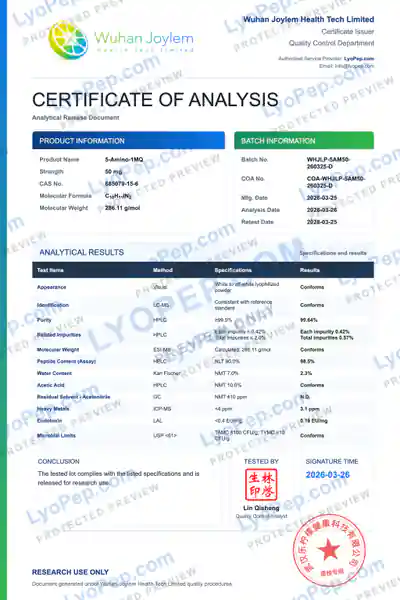
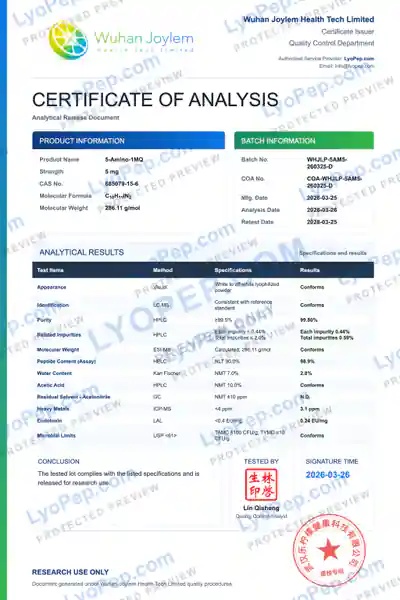
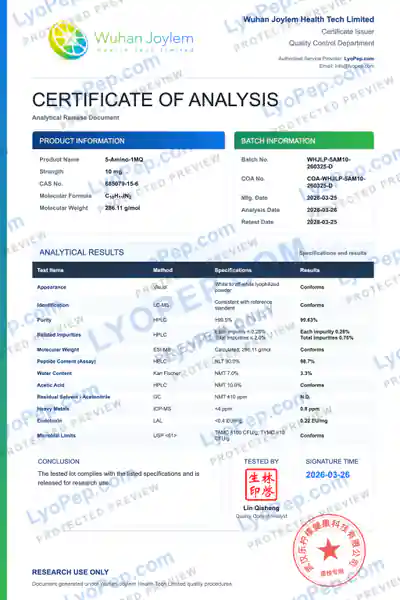
Amino-1MQ factory batch COAs

Representative records, refreshed periodically

Published COAs show representative factory batches and may not be the latest available. For a current quote or shipment, our sales team can confirm the applicable lot and provide its COA.

Independent testing, arranged on request

Third-party reports are not routinely published. If independent verification is required, we can agree the laboratory, method, acceptance criteria and remedy before testing. If the agreed specification is not met, an appropriate resolution—including a refund where applicable—can be discussed under the agreed terms. Unless otherwise agreed in writing, the buyer pays the cost of this optional testing.

Help reviewing your COA

Need help reading a factory COA or third-party report? Our sales team can clarify test items, specifications and how the results relate to the lot under discussion.

Ask for the current packet, not a generic certificate

  • The released-batch package should state the exact cation and counterion, formula, molecular-weight and assay basis, lot identity and traceability, orthogonal identity evidence such as LC-MS and NMR where appropriate, chromatographic purity and impurity profile, quantitative assay, water, residual solvents, elemental or counterion confirmation and lot-specific stability
  • Appearance, capsule presentation, an HPLC area percentage or a generic third-party COA alone cannot establish salt identity, quantitative content, sterility or suitability for human use.
Released-batch COARP-HPLC result and method contextIdentity result appropriate to the moleculeWater / counter-ion context where relevantSDS and handling statementAdditional testing scoped on request

Available fills

Quote the fill and pack configuration you need

Reference SKUFillBase pack
AM-05MG5 mg10 vials
AM-10MG10 mg10 vials
AM-50MG50 mg10 vials

Handling

Storage in the lab and temperature during transit are different decisions

Follow the released lot COA, SDS and form-specific stability statement. Temperature, humidity protection, shipping range, solvent, concentration, container and any solution hold time require supporting data for the exact salt and formulation. Do not assign room-temperature, refrigerated, frozen or DMSO shelf life from generic vendor statements.

State destination, season, acceptable transit exposure and whether your protocol requires insulated or cold-chain service. Additional temperature-control cost is quoted explicitly.

Buyer FAQ

Terms to settle before the purchase order

Can a buyer arrange third-party testing?+

Yes. Testing must be performed by a mutually accepted, established specialist laboratory. Fee allocation, specification, sampling, method and acceptance rule must be agreed before testing; if an agreed independent result shows nonconformance, the remedy follows the signed order terms. Unless otherwise agreed in writing, the buyer pays the cost of this optional testing.

Does HPLC purity prove peptide content?+

No. Chromatographic purity describes the relative peak profile under a stated method. Identity, water, counter-ion, residual solvents and assay/content may require separate methods.

Is cold-chain shipping always required?+

Not always. Heat can accelerate degradation, especially during summer and long transit. Cold-chain reduces exposure but raises cost. State the destination and stability risk so the right service can be quoted.

How are payment terms handled?+

Available methods and milestones depend on order value, destination and project type. The pro forma invoice should state currency, bank details, fees, payment milestones and the release condition.

Why must the testing laboratory understand peptide chemistry?+

Free-base and salt forms, hydrophilic and hydrophobic sequences, aggregation and adsorption can change sample preparation and method suitability. Use a laboratory experienced with the molecule class.

These are buyer-qualification references, not claims that this RUO material is regulated, certified or released under those frameworks. Applicability depends on the buyer's workflow and jurisdiction.

Selected sources

Literature behind the research context

  • PubChem CID 66522933 identifies the iodide reference form as C₁₀H₁₁IN₂, molecular weight 286.11 Da and CAS 42464-96-0; PubChem CID 950107 identifies the free cation as C₁₀H₁₁N₂+ and 159.21 Da. Neelakantan et al., Biochemical Pharmacology 2018, PMC5826726, reports biochemical/cellular NNMT inhibition and an 11-day diet-induced-obesity mouse experiment; its animal administration and outcomes are not human-use guidance. Awosemo et al., Journal of Pharmaceutical and Biomedical Analysis 2021, PMID 34304009, reports the validated LC-MS/MS method and rat intravenous/oral pharmacokinetics. Other mouse studies provide additional preclinical metabolic and muscle-function context but no clinical efficacy or safety conclusion.
  1. 01

    Selective and membrane-permeable small molecule inhibitors of nicotinamide N-methyltransferase reverse high fat diet-induced obesity in mice

    Biochemical Pharmacology · 2018 · peer-reviewed original research

    Open source
  2. 02

    Nicotinamide N-methyltransferase knockdown protects against diet-induced obesity

    Nature · 2014 · peer-reviewed original research

    Open source
  3. 03

    Nicotinamide N-methyltransferase inhibition mitigates obesity-related metabolic dysfunction

    Diabetes, Obesity and Metabolism · 2024 · peer-reviewed original research

    Open source
  4. 04

    Development & validation of LC-MS/MS assay for 5-amino-1-methyl quinolinium in rat plasma: Application to pharmacokinetic and oral bioavailability studies

    Journal of Pharmaceutical and Biomedical Analysis · 2021 · peer-reviewed original research (bioanalytical/pharmacokinetic)

    Open source
  5. 05

    Nicotinamide N-methyltransferase (NNMT): a novel therapeutic target for metabolic syndrome

    Frontiers in Pharmacology · 2024 · peer-reviewed review

    Open source
  6. 06

    Roles of Nicotinamide N-Methyltransferase in Obesity and Type 2 Diabetes

    BioMed Research International · 2021 · peer-reviewed review

    Open source
  7. 07

    How To Use Testosterone, Peptide Stacks That Will Blow Your Mind, The Truth About Getting Peptides On The Internet, & Much More With Jay Campbell

    Ben Greenfield Life (podcast/blog) · 2023 · KOL podcast / biohacker blog (verified authoritative account in the longevity/biohacking space)

    Open source

Product FAQ

Questions buyers ask about Amino-1MQ

What is NNMT and why is 5-Amino-1MQ useful in metabolic research?+

NNMT (nicotinamide N-methyltransferase) transfers a methyl group from S-adenosylmethionine (SAM) to nicotinamide, producing 1-methylnicotinamide (1-MNA) and S-adenosylhomocysteine (SAH). 5-Amino-1MQ is a substrate-site NNMT inhibitor used to examine how this pathway relates to nicotinamide handling, methyl-donor balance and metabolic phenotypes. Published findings are predominantly biochemical, cellular and animal data; they do not establish an anti-ageing, weight-loss or other human treatment benefit.

Why must the iodide salt and molecular-mass basis be confirmed?+

The 5-amino-1-methylquinolinium cation requires a counterion. PubChem CID 66522933 represents the iodide, C₁₀H₁₁IN₂, molecular weight 286.11 Da and CAS 42464-96-0; PubChem CID 950107 represents the free cation, C₁₀H₁₁N₂+, molecular weight 159.21 Da. Mixing those mass bases creates major assay and procurement errors. The quotation and COA should identify the counterion, formula, molecular-weight basis, assay basis and water content.

How should a working concentration be selected for an NNMT experiment?+

There is no universal working range. Published studies used model-specific concentrations and exposure times, but potency, permeability, cell type, medium, endpoint and off-target controls all affect interpretation. Start from the exact peer-reviewed method being replicated, run an appropriate concentration-response design, confirm NNMT engagement with 1-MNA or another qualified readout, and normalize calculations to released-lot quantitative content. Do not use unvalidated online concentration or DMSO shelf-life claims.

Can 5-Amino-1MQ be treated as an NAD+ supplement or combined-use recommendation?+

No. It is an NNMT research inhibitor, not NAD+, NMN or NR, and mechanistic complementarity does not demonstrate additive benefit or safety. No controlled human combination evidence was identified. Combination hypotheses should be tested only within an approved laboratory protocol using appropriate analytical, pathway and toxicity controls.