Recent Confirmed OrdersLast 7 days
Australia520 mgTirzepatide 40 mg · Semaglutide 2 mg · Dihexa 10 mg
View all

Mitochondrial research

SLU-PP-332

Pan-ERR agonist chemical probe for exercise-response transcription research

≥ 99.0% · target, verify batch COACAS 303760-60-3RUO
Research statusPreclinical chemical probe; no approved human use reference context · supplied material is RUO
Supplied formSmall molecule (synthetic hydrazone, pan-ERR agonist)
Lead time14–21 days
SLU-PP-332 — Solid material; confirm released-lot appearance on the COA
SLU-PP-332 — Solid material; confirm released-lot appearance on the COA · Representative packaging image · verify the ordered lot
Representative packaging image · verify the ordered lot

Decision summary

Key benefits

  • Research value includes ERR pathway activation, mitochondrial and oxidative-metabolism assays, exercise-response gene programs, mouse metabolic and cardiovascular models, human-primary-cell experiments, structure-activity relationship work and LC-HRMS/MS method development
  • Reported weight, endurance, heart and kidney outcomes are preclinical and are not human benefits.
Published research context is presented for literature orientation only. It is not a dosing, treatment or human-use instruction.
Qualification data

Specifications to confirm against the released lot

CAS
303760-60-3
Formula
C18H14N2O2
Molecular weight
290.3 g/mol
Appearance
Solid material; confirm released-lot appearance on the COA
Purity
≥ 99.0% · target, verify batch COA
Storage
Follow the released lot's COA and technical data sheet. Specify powder and solution conditions separately, including temperature, light, moisture, solvent, concentration, container and validated hold time. Do not transfer a different supplier's DMSO solubility or stability claim without confirming the actual lot and method.
MOQ
On request
Lead time
14–21 days
PubChem CID 5338394

Qualification matrix

Identity, purity and content are separate release questions.

Identity

Confirm the stated molecule and supplied form. Start with the matching batch COA; request sequence-level evidence only when the buyer's written procedure requires it and availability or a separate scope has been agreed.

Purity

Review RP-HPLC method conditions, wavelength, integration and related-peak handling. A percentage without the method is not enough.

Content

Net peptide content is not the same as gross lyophilized powder weight. Ask which assay supports the stated amount and whether water/counter-ion is addressed.

Stability

Define long-term storage and transit exposure separately. Cold-chain can be quoted when the buyer’s risk assessment requires it and adds cost.

Research context

What researchers study about SLU-PP-332

SLU-PP-332 is a defined non-peptide small molecule and pan-agonist of estrogen-related receptors ERRα, ERRβ and ERRγ. It is used as a chemical probe for exercise-responsive transcription and mitochondrial metabolism. Published work reports cell and mouse phenotypes in endurance, obesity/metabolic syndrome, pressure-overload heart failure and aged-kidney models. A 2025 pilot exposed human-biopsy-derived myoblasts in vitro; no participant received the compound. No administered human efficacy, safety or pharmacokinetic evidence was identified.

  • Appropriate research contexts include ERR target biology, exercise-responsive transcription, mitochondrial metabolism, mouse obesity/metabolic-syndrome models, pressure-overload heart-failure models, aged-kidney models, primary human myoblast experiments, SAR optimization and anti-doping analytical method development
  • None constitutes an approved indication or demonstrated human benefit.

Mechanism context

The question the literature is testing

SLU-PP-332 activates ERRα, ERRβ and ERRγ, with the highest reported potency at ERRα in the foundational assay series. ERR-dependent transcription affects mitochondrial biogenesis, oxidative phosphorylation and fatty-acid metabolism. Genetic-dependency results vary by model: ERRα was required for the acute skeletal-muscle exercise-response phenotype, whereas ERRγ was prominent in the pressure-overload cardiac model. This does not make SLU-PP-332 a substitute for exercise or establish a therapeutic mechanism in humans.

Evidence map

Research routes and exposure context

Evidence tierApproved finished-product context
Routes reported in sources
OralIntraperitoneal
Dose / exposure contextProtocol-specific; verify the cited primary source
Routes and exposure contexts summarize cited studies or approved finished-product labels. They are not instructions for administering this RUO material; no customer dose is provided.

Evidence boundaries

Compatibility, limitations and decision context

  • Research-use-only chemical; not for human or veterinary administration
  • No administered human safety, PK or toxicology dataset was identified
  • Limited tolerability observations in individual animal studies cannot establish systemic, reproductive, genotoxic, carcinogenic or chronic safety and should not be summarized as a generally favorable safety profile
  • Assess jurisdiction, institutional approval, exposure controls and waste handling before laboratory use.

Interactions reported in the literature

  • No human drug-interaction data exist
  • Experimental combinations with insulin, metformin or other metabolic agents require protocol-specific justification, factorial controls and independent interpretation
  • Solvent and vehicle selection must be based on measured lot/formulation compatibility and the chosen model; supplier examples are not universal recipes.
Literature context is not a supplier release result or human-use instruction. Follow your institution's approved laboratory risk assessment.

Factory batch documentation

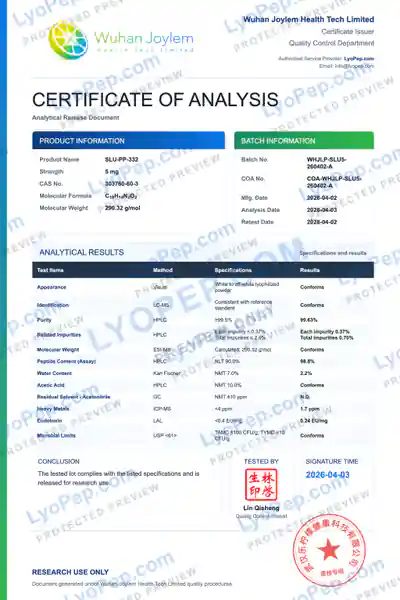
SLU-PP-332 factory batch COAs

Representative records, refreshed periodically

Published COAs show representative factory batches and may not be the latest available. For a current quote or shipment, our sales team can confirm the applicable lot and provide its COA.

Independent testing, arranged on request

Third-party reports are not routinely published. If independent verification is required, we can agree the laboratory, method, acceptance criteria and remedy before testing. If the agreed specification is not met, an appropriate resolution—including a refund where applicable—can be discussed under the agreed terms. Unless otherwise agreed in writing, the buyer pays the cost of this optional testing.

Help reviewing your COA

Need help reading a factory COA or third-party report? Our sales team can clarify test items, specifications and how the results relate to the lot under discussion.

Ask for the current packet, not a generic certificate

  • For this non-peptide small molecule, require identity by at least two appropriate methods such as LC-HRMS and NMR, chromatographic purity with an impurity profile, quantitative assay, water, residual solvents and lot-specific stability/solubility information
  • Confirm the (E)-configured identity
  • Peptide sequence, peptide content and peptide-specific aggregate tests are not applicable.
Released-batch COARP-HPLC result and method contextIdentity result appropriate to the moleculeWater / counter-ion context where relevantSDS and handling statementAdditional testing scoped on request

Available fills

Quote the fill and pack configuration you need

Reference SKUFillBase pack
SLUPP332-5MG5 mg10 vials

Handling

Storage in the lab and temperature during transit are different decisions

Follow the released lot's COA and technical data sheet. Specify powder and solution conditions separately, including temperature, light, moisture, solvent, concentration, container and validated hold time. Do not transfer a different supplier's DMSO solubility or stability claim without confirming the actual lot and method.

State destination, season, acceptable transit exposure and whether your protocol requires insulated or cold-chain service. Additional temperature-control cost is quoted explicitly.

Buyer FAQ

Terms to settle before the purchase order

Can a buyer arrange third-party testing?+

Yes. Testing must be performed by a mutually accepted, established specialist laboratory. Fee allocation, specification, sampling, method and acceptance rule must be agreed before testing; if an agreed independent result shows nonconformance, the remedy follows the signed order terms. Unless otherwise agreed in writing, the buyer pays the cost of this optional testing.

Does HPLC purity prove peptide content?+

No. Chromatographic purity describes the relative peak profile under a stated method. Identity, water, counter-ion, residual solvents and assay/content may require separate methods.

Is cold-chain shipping always required?+

Not always. Heat can accelerate degradation, especially during summer and long transit. Cold-chain reduces exposure but raises cost. State the destination and stability risk so the right service can be quoted.

How are payment terms handled?+

Available methods and milestones depend on order value, destination and project type. The pro forma invoice should state currency, bank details, fees, payment milestones and the release condition.

Why must the testing laboratory understand peptide chemistry?+

Free-base and salt forms, hydrophilic and hydrophobic sequences, aggregation and adsorption can change sample preparation and method suitability. Use a laboratory experienced with the molecule class.

These are buyer-qualification references, not claims that this RUO material is regulated, certified or released under those frameworks. Applicability depends on the buyer's workflow and jurisdiction.

Selected sources

Literature behind the research context

  • Key primary studies: Billon et al. 2023 (PMID 36988910), foundational ERR agonism and mouse exercise-response work; Billon et al. 2024 (PMID 37739806), mouse obesity/metabolic-syndrome models; Xu et al. 2024 (PMID 37961903), mouse pressure-overload heart-failure model; Wang et al. 2023 (PMID 37717940), aged-mouse kidney model; Bonanni et al. 2025 (PMID 40692696), human-biopsy-derived myoblasts treated in vitro; Billon et al. 2026 (PMID 41421047), distinct orally active analogue SLU-PP-915; Okda et al. 2026 (PMID 41850449), SLU-PP-332 scaffold SAR; and the 2026 analytical characterization study (PMID 41588687).
  1. 01

    Synthetic ERRα/β/γ Agonist Induces an ERRα-Dependent Acute Aerobic Exercise Response and Enhances Exercise Capacity

    ACS Chemical Biology · 2023 · peer-reviewed original research

    Open source
  2. 02

    A Synthetic ERR Agonist Alleviates Metabolic Syndrome

    Journal of Pharmacology and Experimental Therapeutics · 2024 · peer-reviewed original research

    Open source
  3. 03

    Novel Pan-ERR Agonists Ameliorate Heart Failure Through Enhancing Cardiac Fatty Acid Metabolism and Mitochondrial Function

    Circulation · 2024 · peer-reviewed original research

    Open source
  4. 04

    Estrogen-Related Receptor Agonism Reverses Mitochondrial Dysfunction and Inflammation in the Aging Kidney

    American Journal of Pathology · 2023 · peer-reviewed original research

    Open source
  5. 05

    An orally active estrogen receptor-related receptor agonist, SLU-PP-915, enhances aerobic exercise capacity

    Journal of Pharmacology and Experimental Therapeutics · 2026 · peer-reviewed original research

    Open source
  6. 06

    Targeting ERRs to counteract age-related muscle atrophy associated with physical inactivity: a pilot study

    Frontiers in Physiology · 2025 · peer-reviewed original research (pilot study)

    Open source
  7. 07

    Chemical optimization of the exercise mimetic SLU-PP-332 enables insight into estrogen-related receptor signaling

    International Journal of Biological Macromolecules · 2026 · peer-reviewed original research

    Open source
  8. 08

    Exercise-mimicking drug sheds weight, boosts muscle activity in mice

    University of Florida News · 2023 · university press release

    Open source

Product FAQ

Questions buyers ask about SLU-PP-332

What are estrogen-related receptors, and does estrogen activate them?+

ERRα, ERRβ and ERRγ are nuclear receptors related by sequence to classical estrogen receptors but with distinct ligand and target-gene biology. They are classified as orphan nuclear receptors because no generally accepted endogenous ligand has been established; estradiol is not their activating ligand. Together with context-dependent co-regulators such as PGC-1 proteins, ERRs participate in transcriptional control of mitochondrial and oxidative-metabolism programs. “Master switch” is an oversimplification, and SLU-PP-332-induced transcription must be interpreted with isoform, cell-type and genetic controls.

How does SLU-PP-332 differ from AICAR as a research tool?+

AICAR is converted intracellularly to ZMP, an AMP analogue that can activate AMPK and affect other AMP-sensitive processes. SLU-PP-332 directly agonizes ERR nuclear receptors in the reported assays. The tools therefore enter metabolism-related signaling at different levels, even when some downstream readouts overlap. They are not interchangeable exercise substitutes, and no qualified combination study identified here establishes that co-exposure is additive, compatible or safe; any factorial experiment needs single-agent, vehicle and interaction controls.

How should an in vitro concentration range for SLU-PP-332 be selected?+

Use the assay that supports the research question rather than a universal 0.1–10 µM recipe. In the foundational full-length receptor reporter assay, reported EC₅₀ values were 98 nM for ERRα, 230 nM for ERRβ and 430 nM for ERRγ; these values are assay-specific and do not predict every cell system. Establish solubility and stability for the actual lot and medium, hold vehicle concentration constant, include vehicle and cytotoxicity controls, and bracket the response with an adequately spaced concentration series.

Is SLU-PP-332 isoform-selective among ERRα, ERRβ and ERRγ?+

It is described as a pan-ERR agonist because it activates all three isoforms, but it is not equipotent or free of bias. The foundational full-length reporter assay showed about 2.3-fold greater potency at ERRα than ERRβ and 4.4-fold greater potency at ERRα than ERRγ. Isoform contributions also differed across skeletal-muscle and cardiac models. Use genetic loss-of-function, isoform-selective comparators and matched expression controls when an experiment needs to assign an effect to one ERR subtype.