Recent Confirmed OrdersLast 7 days
United States11.8 gGHK-Cu 100 mg · Semaglutide 50 mg · AOD-9604 10 mg · Ipamorelin 10 mg · CJC-1295 + Ipamorelin 10 mg · Bacteriostatic Water 10 ml
View all

Mitochondrial research

AICAR

AICAr/acadesine · intracellular ZMP precursor and AMPK-pathway research probe

≥ 99.0% · target, verify batch COACAS 2627-69-2RUO
Research statusExtensively studied research probe with important AMPK-independent effects; no approved finished-drug use is established reference context · supplied material is RUO
Supplied formSmall-molecule nucleoside; distinguish the supplied riboside from phosphorylated AICAR/ZMP
Lead time10–18 days
AICAR — Lot-specific research material; confirm released-lot solid form and appearance on the COA
AICAR — Lot-specific research material; confirm released-lot solid form and appearance on the COA · Representative packaging image · verify the ordered lot
Representative packaging image · verify the ordered lot

Decision summary

Key benefits

  • AMPK signaling, cellular energy homeostasis and controlled pathway-engagement studies
  • Skeletal-muscle fatty-acid oxidation, glycogen metabolism, insulin-sensitivity and glucose-uptake research
  • The 2008 Cell study reported a 44% increase in treadmill running endurance in sedentary mice after four weeks, a preclinical result that does not establish an exercise substitute or performance benefit in humans
  • Earlier cardiac-surgery trials suggested benefit, but Phase 3 RED-CABG stopped for futility after 3,080 of a planned 7,500 participants were randomized and the primary endpoint occurred in 5.1% of the acadesine group versus 5.0% of the placebo group
  • Autophagy research includes an in-vitro CML model in which the reported cell-death effect was AMPK-independent and PKC-dependent (PMC2775681)
  • A multicenter Phase I/II Acadra study in 24 patients with relapsed or refractory CLL reported preliminary biological responses but did not establish an approved oncology use (PMC3579463)
  • Mitochondrial-biogenesis, ischemia-reperfusion, metabolic and cytotoxicity findings remain model- and mechanism-specific research contexts
  • A 2021 systematic review found that many effects historically attributed to AMPK activation are AMPK-independent, including effects on nucleoside transport, adenosine deaminase, purine-nucleotide synthesis and PKC signaling (PMC8147799).
Published research context is presented for literature orientation only. It is not a dosing, treatment or human-use instruction.
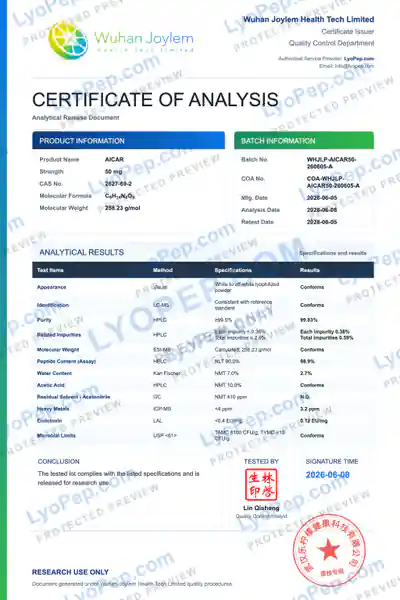
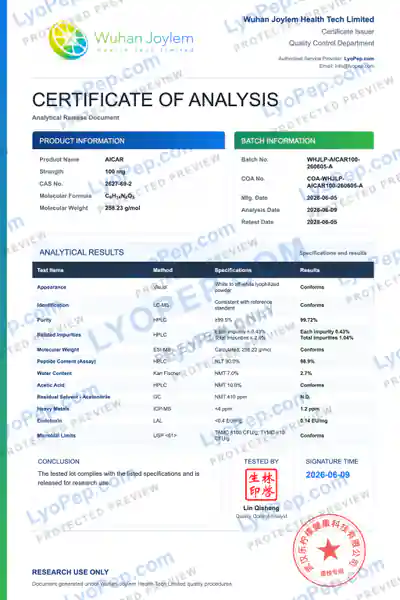
Qualification data

Specifications to confirm against the released lot

CAS
2627-69-2
Formula
C9H14N4O5
Molecular weight
258.23-258.24 Da
Appearance
Lot-specific research material; confirm released-lot solid form and appearance on the COA
Purity
≥ 99.0% · target, verify batch COA
Storage
Store and ship according to the lot COA and validated stability data for the exact solid form, solvent, concentration, pH, container and intended assay. Generic minus 20 degrees Celsius, two-year and post-solution dating claims are not interchangeable. Use validated aliquoting where appropriate, avoid unvalidated freeze-thaw cycles and document excursions.
MOQ
On request
Lead time
10–18 days
PubChem CID 17513

Qualification matrix

Identity, purity and content are separate release questions.

Identity

Confirm the stated molecule and supplied form. Start with the matching batch COA; request sequence-level evidence only when the buyer's written procedure requires it and availability or a separate scope has been agreed.

Purity

Review RP-HPLC method conditions, wavelength, integration and related-peak handling. A percentage without the method is not enough.

Content

Net peptide content is not the same as gross lyophilized powder weight. Ask which assay supports the stated amount and whether water/counter-ion is addressed.

Stability

Define long-term storage and transit exposure separately. Cold-chain can be quoted when the buyer’s risk assessment requires it and adds cost.

Research context

What researchers study about AICAR

The catalogue name AICAR commonly refers to AICAr/acadesine, 5-aminoimidazole-4-carboxamide ribonucleoside. Cells convert this riboside through adenosine kinase to the phosphorylated ribotide AICAR/ZMP (PubChem CID 65110), an AMP mimic that can activate AMPK. A 2008 mouse study reported increased treadmill endurance after four weeks, but it did not establish an exercise substitute in humans. The Phase 3 RED-CABG trial stopped for futility and found no improvement in its primary clinical endpoint. The current 2026 WADA list includes AICAR in S4.4.1 among AMPK activators prohibited at all times. This material remains RUO and is not for human or athletic use.

  • AICAR is a classic experimental probe for AMPK and energy-metabolism pathways, but it also has important AMPK-independent effects
  • The 2008 Cell mouse study reported improved endurance in sedentary mice and does not establish an exercise substitute in humans
  • RED-CABG did not improve its primary clinical endpoint, and the small CLL Phase 1/2 study did not establish an approved oncology use
  • Autophagy, mitochondrial, diabetes and cytotoxicity findings remain model- and mechanism-specific.

Mechanism context

The question the literature is testing

AICAr enters cells through nucleoside transporters and is phosphorylated by adenosine kinase to AICAR/ZMP. ZMP binds the AMPK gamma subunit, promotes AMPKα Thr172 phosphorylation and protects it from dephosphorylation, but is substantially less potent than physiological AMP and may accumulate at high intracellular concentrations. AICAr/ZMP also affects nucleoside transport, purine metabolism and other AMPK-independent pathways. Mechanistic studies therefore require direct pathway readouts, genetic controls and appropriate comparator agonists rather than treating AICAr as a selective AMPK switch.

Evidence map

Research routes and exposure context

Evidence tierApproved finished-product context
Routes reported in sources
Intravenous
Dose / exposure contextProtocol-specific; verify the cited primary source
Routes and exposure contexts summarize cited studies or approved finished-product labels. They are not instructions for administering this RUO material; no customer dose is provided.

Evidence boundaries

Compatibility, limitations and decision context

  • AICAR/acadesine is not an approved medicine and this material is not for human use
  • RED-CABG enrolled thousands of surgical patients but stopped for futility rather than demonstrating clinical benefit
  • The small CLL trial explored high intravenous doses and dose-limiting toxicity; it does not define a safe exposure for healthy people or an RUO batch
  • Lactate, uric-acid and other metabolic effects, along with incomplete long-term, reproductive and carcinogenic evidence, require conservative laboratory controls
  • WADA's 2026 Prohibited List explicitly includes AICAR under S4.4.1 AMPK activators, prohibited at all times
  • Anti-doping prohibition does not establish chemical quality.

Interactions reported in the literature

  • AICAR is often combined with metformin, GW501516, dorsomorphin or chemotherapy agents as an experimental comparator or pathway probe
  • Such combinations are research designs, not validated stacks
  • Because AICAR has AMPK-independent effects, reversal by one AMPK inhibitor is not sufficient proof of pathway specificity
  • AICAR and relevant PPAR-delta agonists are prohibited in sport; combining them compounds compliance concerns rather than establishing safety or efficacy.
Literature context is not a supplier release result or human-use instruction. Follow your institution's approved laboratory risk assessment.

Factory batch documentation

AICAR factory batch COAs

Representative records, refreshed periodically

Published COAs show representative factory batches and may not be the latest available. For a current quote or shipment, our sales team can confirm the applicable lot and provide its COA.

Independent testing, arranged on request

Third-party reports are not routinely published. If independent verification is required, we can agree the laboratory, method, acceptance criteria and remedy before testing. If the agreed specification is not met, an appropriate resolution—including a refund where applicable—can be discussed under the agreed terms. Unless otherwise agreed in writing, the buyer pays the cost of this optional testing.

Help reviewing your COA

Need help reading a factory COA or third-party report? Our sales team can clarify test items, specifications and how the results relate to the lot under discussion.

Ask for the current packet, not a generic certificate

  • A white powder and HPLC area percentage do not establish correct nucleoside identity, assay or absence of ZMP and related impurities
  • Require orthogonal identity such as high-resolution LC-MS plus spectroscopic confirmation, chromatographic purity and impurity profile with raw data, quantitative assay, water, residual solvents and elemental impurities where relevant, and lot-specific stability
  • The COA must distinguish AICAR/acadesine from phosphorylated ZMP by mass, retention and structural evidence
  • A third-party logo or RUO label alone is not quality evidence.
Released-batch COARP-HPLC result and method contextIdentity result appropriate to the moleculeWater / counter-ion context where relevantSDS and handling statementAdditional testing scoped on request

Available fills

Quote the fill and pack configuration you need

Reference SKUFillBase pack
AICAR-050MG50 mg10 vials
AICAR-100MG100 mg10 vials

Handling

Storage in the lab and temperature during transit are different decisions

Store and ship according to the lot COA and validated stability data for the exact solid form, solvent, concentration, pH, container and intended assay. Generic minus 20 degrees Celsius, two-year and post-solution dating claims are not interchangeable. Use validated aliquoting where appropriate, avoid unvalidated freeze-thaw cycles and document excursions.

State destination, season, acceptable transit exposure and whether your protocol requires insulated or cold-chain service. Additional temperature-control cost is quoted explicitly.

Buyer FAQ

Terms to settle before the purchase order

Can a buyer arrange third-party testing?+

Yes. Testing must be performed by a mutually accepted, established specialist laboratory. Fee allocation, specification, sampling, method and acceptance rule must be agreed before testing; if an agreed independent result shows nonconformance, the remedy follows the signed order terms. Unless otherwise agreed in writing, the buyer pays the cost of this optional testing.

Does HPLC purity prove peptide content?+

No. Chromatographic purity describes the relative peak profile under a stated method. Identity, water, counter-ion, residual solvents and assay/content may require separate methods.

Is cold-chain shipping always required?+

Not always. Heat can accelerate degradation, especially during summer and long transit. Cold-chain reduces exposure but raises cost. State the destination and stability risk so the right service can be quoted.

How are payment terms handled?+

Available methods and milestones depend on order value, destination and project type. The pro forma invoice should state currency, bank details, fees, payment milestones and the release condition.

Why must the testing laboratory understand peptide chemistry?+

Free-base and salt forms, hydrophilic and hydrophobic sequences, aggregation and adsorption can change sample preparation and method suitability. Use a laboratory experienced with the molecule class.

These are buyer-qualification references, not claims that this RUO material is regulated, certified or released under those frameworks. Applicability depends on the buyer's workflow and jurisdiction.

Selected sources

Literature behind the research context

  • PubChem CID 17513 and related standardized records support AICAR/acadesine chemistry, while PubChem CID 65110 supports ZMP distinction. Narkar et al. 2008 is a mouse exercise-metabolism study. The 2012 RED-CABG randomized trial is decisive negative Phase 3 clinical evidence, while the earlier JAMA meta-analysis explains why development proceeded. The CLL Phase 1/2 study supplies limited high-dose oncology safety data. The 2021 systematic review is essential for AMPK-independent effects. Salk's release is institutional context, USADA explains athlete risk, and the current official WADA list controls anti-doping status.
  1. 01

    AMPK and PPARdelta agonists are exercise mimetics

    Cell · 2008 · peer-reviewed original research

    Open source
  2. 02

    Effect of Adenosine-Regulating Agent Acadesine on Morbidity and Mortality Associated With Coronary Artery Bypass Grafting: The RED-CABG Randomized Controlled Trial

    JAMA · 2012 · randomized controlled trial (peer-reviewed)

    Open source
  3. 03

    Effects of Acadesine on Myocardial Infarction, Stroke, and Death Following Surgery: A Meta-analysis of the 5 International Randomized Trials

    JAMA · 1997 · meta-analysis of randomized controlled trials (peer-reviewed)

    Open source
  4. 04

    Acadesine for patients with relapsed/refractory chronic lymphocytic leukemia (CLL): a multicenter phase I/II study

    Cancer Chemotherapy and Pharmacology · 2013 · phase I/II clinical trial (peer-reviewed)

    Open source
  5. 05

    AICAr, a Widely Used AMPK Activator with Important AMPK-Independent Effects: A Systematic Review

    Cells · 2021 · systematic review (peer-reviewed)

    Open source
  6. 06

    Exercise in a Pill

    Salk Institute for Biological Studies · 2008 · institutional press release

    Open source
  7. 07

    What Athletes Should Know About AICAR and Other Prohibited AMP-Activated Protein Kinase Activators

    U.S. Anti-Doping Agency (USADA) · 2023 · regulatory/anti-doping body educational article

    Open source

Product FAQ

Questions buyers ask about AICAR

How does AICAR activate AMPK, and why is that mechanistically interesting?+

The catalogue name AICAR commonly refers to AICAr/acadesine, the cell-permeable riboside. Cells phosphorylate it through adenosine kinase to AICAR/ZMP, the ribotide that binds the AMPK γ subunit, promotes Thr172 phosphorylation and protects against dephosphorylation. ZMP is substantially less potent than AMP, can accumulate to high concentrations and affects additional pathways, so AICAr is a useful AMPK-pathway probe but not a specific substitute for energy stress. Pair it with direct agonists, genetic AMPK controls and pathway readouts when mechanism matters.

Why didn't AICAR achieve regulatory approval despite Phase 3 development?+

In the Phase 3 RED-CABG trial, a prespecified futility analysis led to early stopping after 3,080 of a planned 7,500 participants were randomized. The primary composite outcome occurred in 5.1% of the acadesine group and 5.0% of the placebo group, with no benefit in key secondary endpoints. This negative result did not establish an approved cardioprotective use. Separately, the current WADA list names AICAR in class S4.4.1 among AMPK activators prohibited both in and out of competition.

How should an AICAr concentration be selected for a cell or animal study?+

There is no universal working concentration or exposure. Uptake, adenosine-kinase activity, ZMP accumulation, cell type, medium composition, species and endpoint all change the response. Start from the exact peer-reviewed protocol being replicated, define a model-specific concentration-response range, measure AMPK engagement and relevant off-target readouts, and normalize to released-lot quantitative content. Historical animal or intravenous clinical exposures are evidence context, not instructions for this RUO material.

What's the difference between AICAR and other AMPK activators (metformin, A-769662, MK-8722)?+

AICAr is converted to the AMP-mimetic ZMP and has important AMPK-independent effects. Metformin influences cellular energy state indirectly and also has mechanisms that cannot be reduced to AMPK alone. A-769662 and MK-8722 are direct allosteric AMPK activators with different binding and isoform profiles. The appropriate comparator depends on whether the question concerns nucleotide sensing, direct AMPK activation or a translational drug mechanism; use matched conditions and genetic or orthogonal controls rather than interpreting agreement between two compounds as proof of pathway specificity.