Recent Confirmed OrdersLast 7 days
Australia520 mgTirzepatide 40 mg · Semaglutide 2 mg · Dihexa 10 mg
View all

Mitochondrial research

SS-31

Elamipretide/SS-31 cardiolipin-binding tetrapeptide reference material

≥ 99.0% · target, verify batch COACAS 736992-21-5RUO
Research statusFDA accelerated approval applies to FORZINITY for a defined Barth-syndrome indication; this RUO material is not an approved drug reference context · supplied material is RUO
Supplied formTetrapeptide (linear, C-terminally amidated, D-amino acid + non-proteinogenic Dmt residue)
Lead time14–21 days
SS-31 — Lyophilized material; confirm released-lot appearance on the COA
SS-31 — Lyophilized material; confirm released-lot appearance on the COA · Representative packaging image · verify the ordered lot
Representative packaging image · verify the ordered lot

Decision summary

Key benefits

  • Research value includes cardiolipin and mitochondrial-membrane binding, mitochondrial morphology and bioenergetics, proteomic interaction mapping, Barth-syndrome translational research and investigation of mixed clinical outcomes across mitochondrial, cardiac and ophthalmic programs
  • Only FORZINITY's defined Barth-syndrome muscle-strength indication is FDA approved; other proposed benefits remain indication-specific and investigational.
Published research context is presented for literature orientation only. It is not a dosing, treatment or human-use instruction.
Qualification data

Specifications to confirm against the released lot

CAS
736992-21-5
Formula
C32H49N9O5 (free peptide; FORZINITY uses the trihydrochloride salt)
Molecular weight
639.8 g/mol
Appearance
Lyophilized material; confirm released-lot appearance on the COA
Purity
≥ 99.0% · target, verify batch COA
Storage
Use this released lot's COA and stability instructions. Confirm whether the material is free peptide or hydrochloride salt and document powder/solution temperature, light, moisture, matrix, concentration, container, freeze-thaw limits and validated hold time. The opened-vial storage rule for ready-to-use FORZINITY must not be transferred to a lyophilized or differently formulated RUO lot.
MOQ
On request
Lead time
14–21 days
PubChem CID 11764719

Qualification matrix

Identity, purity and content are separate release questions.

Identity

Confirm the stated molecule and supplied form. Start with the matching batch COA; request sequence-level evidence only when the buyer's written procedure requires it and availability or a separate scope has been agreed.

Purity

Review RP-HPLC method conditions, wavelength, integration and related-peak handling. A percentage without the method is not enough.

Content

Net peptide content is not the same as gross lyophilized powder weight. Ask which assay supports the stated amount and whether water/counter-ion is addressed.

Stability

Define long-term storage and transit exposure separately. Cold-chain can be quoted when the buyer’s risk assessment requires it and adds cost.

Research context

What researchers study about SS-31

SS-31 (elamipretide) is a synthetic mitochondria-associated tetrapeptide with sequence D-Arg-2,6-dimethyl-Tyr-Lys-Phe-NH2. FDA granted accelerated approval to the distinct sterile prescription product FORZINITY on September 19, 2025 to improve muscle strength in adults and children with Barth syndrome weighing at least 30 kg. Approval was based on an intermediate knee-extensor-strength endpoint and remains subject to confirmation of clinical benefit. This listing is research material and is not FORZINITY or an FDA-approved substitute.

  • Approved context: FORZINITY for muscle-strength improvement in Barth syndrome patients weighing at least 30 kg under accelerated approval, with confirmatory benefit required
  • Research contexts include mitochondrial cardiolipin/membrane biology, primary mitochondrial myopathy, heart failure, ischemia-reperfusion, geographic atrophy and aging-related models
  • Several indication-specific randomized trials missed prespecified primary endpoints; the Barth-syndrome approval must not be generalized.

Mechanism context

The question the literature is testing

FDA describes elamipretide as a mitochondrial cardiolipin binder that localizes to the inner mitochondrial membrane and improves mitochondrial morphology and function. Mechanistic studies also report membrane partitioning, altered surface electrostatics and interactions with cardiolipin-associated proteins. These mechanisms do not by themselves establish clinical benefit outside the approved indication or verify another supplier's lot.

Evidence map

Research routes and exposure context

Evidence tierApproved finished-product context
Routes reported in sources
SubcutaneousIntravenous
Dose / exposure contextProtocol-specific; verify the cited primary source
Routes and exposure contexts summarize cited studies or approved finished-product labels. They are not instructions for administering this RUO material; no customer dose is provided.

Evidence boundaries

Compatibility, limitations and decision context

  • Research-use-only material; not for human or veterinary administration
  • FORZINITY's most common labeled adverse reactions are injection-site reactions, and serious reactions have also been reported
  • Its accelerated approval requires a confirmatory trial
  • The approved product's safety database, sterile manufacturing, preservative system and renal dosing do not establish the safety, sterility or equivalence of this RUO material.

Interactions reported in the literature

  • No peptide-stacking compatibility has been established
  • Do not infer synergy or safety with NAD+ precursors, MOTS-c, Humanin, GHK-Cu, BPC-157 or thymosin beta-4 from marketing or pathway overlap
  • The interaction information in the FORZINITY label is formulation- and prescribing-specific and does not validate experimental combinations involving this RUO lot.
Literature context is not a supplier release result or human-use instruction. Follow your institution's approved laboratory risk assessment.

Factory batch documentation

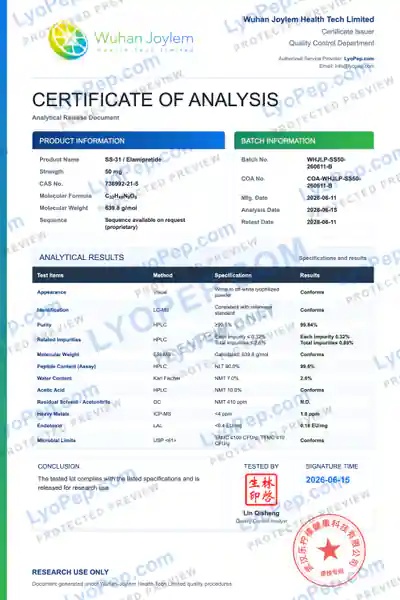
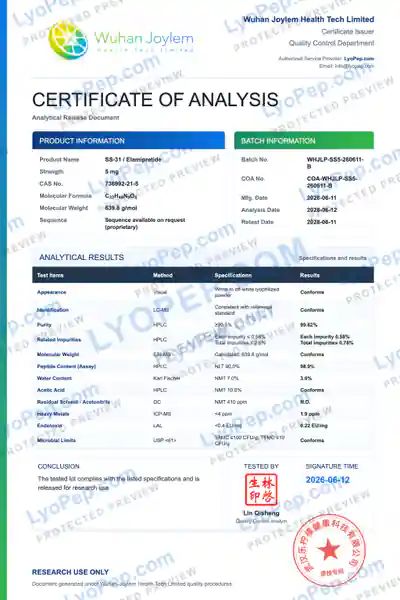
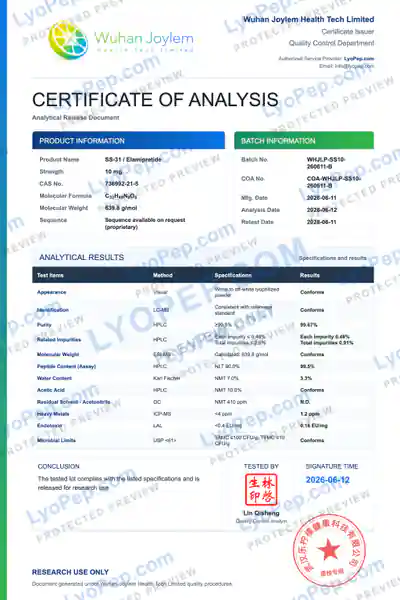
SS-31 factory batch COAs

Representative records, refreshed periodically

Published COAs show representative factory batches and may not be the latest available. For a current quote or shipment, our sales team can confirm the applicable lot and provide its COA.

Independent testing, arranged on request

Third-party reports are not routinely published. If independent verification is required, we can agree the laboratory, method, acceptance criteria and remedy before testing. If the agreed specification is not met, an appropriate resolution—including a refund where applicable—can be discussed under the agreed terms. Unless otherwise agreed in writing, the buyer pays the cost of this optional testing.

Help reviewing your COA

Need help reading a factory COA or third-party report? Our sales team can clarify test items, specifications and how the results relate to the lot under discussion.

Ask for the current packet, not a generic certificate

  • First identify the supplied form: free peptide or defined hydrochloride salt
  • Require complete stereochemical sequence, C-terminal amidation, intact mass, peptide content, chromatographic related-peptide profile, aggregates, counterion stoichiometry/assay, water and residual solvents
  • Add validated bioburden, endotoxin and sterility controls only when the research protocol requires them
  • HPLC area purity, appearance and an unspecified third-party COA do not establish equivalence to FORZINITY.
Released-batch COARP-HPLC result and method contextIdentity result appropriate to the moleculeWater / counter-ion context where relevantSDS and handling statementAdditional testing scoped on request

Available fills

Quote the fill and pack configuration you need

Reference SKUFillBase pack
SS31-05MG5 mg10 vials
SS31-10MG10 mg10 vials
SS31-50MG50 mg10 vials

Handling

Storage in the lab and temperature during transit are different decisions

Use this released lot's COA and stability instructions. Confirm whether the material is free peptide or hydrochloride salt and document powder/solution temperature, light, moisture, matrix, concentration, container, freeze-thaw limits and validated hold time. The opened-vial storage rule for ready-to-use FORZINITY must not be transferred to a lyophilized or differently formulated RUO lot.

State destination, season, acceptable transit exposure and whether your protocol requires insulated or cold-chain service. Additional temperature-control cost is quoted explicitly.

Buyer FAQ

Terms to settle before the purchase order

Can a buyer arrange third-party testing?+

Yes. Testing must be performed by a mutually accepted, established specialist laboratory. Fee allocation, specification, sampling, method and acceptance rule must be agreed before testing; if an agreed independent result shows nonconformance, the remedy follows the signed order terms. Unless otherwise agreed in writing, the buyer pays the cost of this optional testing.

Does HPLC purity prove peptide content?+

No. Chromatographic purity describes the relative peak profile under a stated method. Identity, water, counter-ion, residual solvents and assay/content may require separate methods.

Is cold-chain shipping always required?+

Not always. Heat can accelerate degradation, especially during summer and long transit. Cold-chain reduces exposure but raises cost. State the destination and stability risk so the right service can be quoted.

How are payment terms handled?+

Available methods and milestones depend on order value, destination and project type. The pro forma invoice should state currency, bank details, fees, payment milestones and the release condition.

Why must the testing laboratory understand peptide chemistry?+

Free-base and salt forms, hydrophilic and hydrophobic sequences, aggregation and adsorption can change sample preparation and method suitability. Use a laboratory experienced with the molecule class.

These are buyer-qualification references, not claims that this RUO material is regulated, certified or released under those frameworks. Applicability depends on the buyer's workflow and jurisdiction.

Selected sources

Literature behind the research context

  • Regulatory sources: FDA FORZINITY announcement, approval letter and Integrated Review for NDA 215244, current DailyMed label, FDA Drug Trials Snapshot and ongoing accelerated-approval table. Key clinical evidence includes TAZPOWER (PMID 33077895) and its 168-week open-label extension, MMPOWER-3, the early HFrEF study (PMID 28866242) and ReCLAIM-2 (PMID 39605874). Mechanistic evidence includes Chavez et al. 2020 (PMID 32554501) and Mitchell et al. 2020 (PMID 32273339).
  1. 01

    A phase 2/3 randomized clinical trial followed by an open-label extension to evaluate the effectiveness of elamipretide in Barth syndrome, a genetic disorder of mitochondrial cardiolipin metabolism

    Genetics in Medicine · 2021 · peer-reviewed original research (randomized controlled trial with open-label extension)

    Open source
  2. 02

    Long-term efficacy and safety of elamipretide in patients with Barth syndrome: 168-week open-label extension results of TAZPOWER

    Genetics in Medicine · 2024 · peer-reviewed original research (long-term open-label extension)

    Open source
  3. 03

    Efficacy and Safety of Elamipretide in Individuals With Primary Mitochondrial Myopathy: The MMPOWER-3 Randomized Clinical Trial

    Neurology · 2023 · peer-reviewed original research (phase 3 randomized controlled trial)

    Open source
  4. 04

    Novel Mitochondria-Targeting Peptide in Heart Failure Treatment: A Randomized, Placebo-Controlled Trial of Elamipretide

    Circulation: Heart Failure · 2017 · peer-reviewed original research (randomized, placebo-controlled, ascending-dose trial)

    Open source
  5. 05

    ReCLAIM-2: A Randomized Phase II Clinical Trial Evaluating Elamipretide in Age-related Macular Degeneration, Geographic Atrophy Growth, Visual Function, and Ellipsoid Zone Preservation

    Ophthalmology Science · 2025 · peer-reviewed original research (phase 2 randomized, double-masked, placebo-controlled trial)

    Open source
  6. 06

    Mitochondrial protein interaction landscape of SS-31

    Proceedings of the National Academy of Sciences (PNAS) · 2020 · peer-reviewed original research (mechanistic/proteomics study)

    Open source
  7. 07

    The mitochondria-targeted peptide SS-31 binds lipid bilayers and modulates surface electrostatics as a key component of its mechanism of action

    Journal of Biological Chemistry · 2020 · peer-reviewed original research (biophysical/mechanistic study)

    Open source
  8. 08

    Elamipretide: A Review of Its Structure, Mechanism of Action, and Therapeutic Potential

    International Journal of Molecular Sciences · 2025 · peer-reviewed review article

    Open source

Product FAQ

Questions buyers ask about SS-31

What exact SS-31 identity and salt form should be specified?+

The FDA elamipretide sequence is D-Arg-2,6-dimethyl-Tyr-Lys-Phe-NH₂; all residues other than arginine have the L configuration. The approved FORZINITY product contains elamipretide trihydrochloride, whereas an RUO lot may be free peptide or a defined salt. The order and COA should state full stereochemistry, terminal amidation, counterion identity and stoichiometry, and whether content is reported as elamipretide equivalent or total salt mass.

How should mitochondrial targeting of SS-31 be described?+

SS-31 is a cationic-aromatic tetrapeptide that partitions into negatively charged membrane interfaces and interacts with cardiolipin-rich inner-mitochondrial membranes. Biophysical work reports surface-charge-dependent binding, changes in membrane packing and electrostatics, and interactions with cardiolipin-associated proteins. This is not adequately described as simple membrane-potential-driven accumulation like a triphenylphosphonium conjugate, and no universal 100- to 1,000-fold enrichment or lower off-target-effect claim should be assigned across models.