Recent Confirmed OrdersLast 7 days
United States8 gEpithalon 50 mg · TB-500 10 mg · CJC-1295 + Ipamorelin 10 mg · Melanotan II 10 mg · Bacteriostatic Water 10 ml
View all

Other research materials

AHK-Cu

Copper-complexed Ala-His-Lys tripeptide · dermal papilla and follicle research material

≥ 99.0% · target, verify batch COACAS 767286-83-9RUO
Research statusProduct-specific evidence is limited to a 2007 in vitro/ex vivo study; no controlled human efficacy or safety study was identified
Supplied formMetallopeptide complex; confirm copper stoichiometry, protonation state and counterion per released lot
Lead timeConfirmed with quote
AHK-Cu — Lot-specific lyophilized copper-peptide research material; confirm released-lot appearance on the COA
AHK-Cu — Lot-specific lyophilized copper-peptide research material; confirm released-lot appearance on the COA · Representative packaging image · verify the ordered lot
Representative packaging image · verify the ordered lot

Decision summary

Key benefits

  • The 2007 study reported hair-follicle elongation and dermal papilla-cell proliferation at 10⁻¹² to 10⁻⁹ M
  • At 10⁻⁹ M, the reduction in apoptotic cells was not statistically significant, although the Bcl-2/Bax ratio increased and cleaved caspase-3 and PARP levels decreased
  • These are model-specific exploratory findings, not evidence of human hair regrowth, clinical safety or a validated route.
Published research context is presented for literature orientation only. It is not a dosing, treatment or human-use instruction.
Qualification data

Specifications to confirm against the released lot

CAS
767286-83-9
Formula
C15H24CuN6O4 (reference neutral representation; confirm exact supplied form on the COA)
Molecular weight
Approximately 414.9-415.9 Da
Appearance
Lot-specific lyophilized copper-peptide research material; confirm released-lot appearance on the COA
Purity
≥ 99.0% · target, verify batch COA
Storage
Store and ship according to the batch COA and validated stability data for the exact copper complex, counterion, buffer, concentration and container. Protect from conditions shown to promote oxidation or metal-complex disruption, avoid unvalidated freeze-thaw cycles and record excursions. A generic refrigerated instruction does not establish post-preparation dating.
MOQ
On request
Lead time
Confirmed with quote
PubChem CID 169450582

Qualification matrix

Identity, purity and content are separate release questions.

Identity

Confirm the stated molecule and supplied form. Start with the matching batch COA; request sequence-level evidence only when the buyer's written procedure requires it and availability or a separate scope has been agreed.

Purity

Review RP-HPLC method conditions, wavelength, integration and related-peak handling. A percentage without the method is not enough.

Content

Net peptide content is not the same as gross lyophilized powder weight. Ask which assay supports the stated amount and whether water/counter-ion is addressed.

Stability

Define long-term storage and transit exposure separately. Cold-chain can be quoted when the buyer’s risk assessment requires it and adds cost.

Research context

What researchers study about AHK-Cu

AHK-Cu is a copper complex of the Ala-His-Lys tripeptide. It is distinct from GHK-Cu, whose sequence is Gly-His-Lys; generic copper-tripeptide naming does not make the two interchangeable. The principal product-specific evidence is a 2007 in vitro/ex vivo study of isolated human hair follicles and cultured dermal papilla cells (PMID 17703734), not a controlled human efficacy or safety study.

  • Appropriate laboratory contexts include isolated hair-follicle elongation and cultured dermal papilla-cell proliferation, apoptosis-marker readouts, and controlled investigation of VEGF/TGF-β1-related signalling
  • Broader skin-barrier, tissue-repair or hair-regrowth claims require AHK-Cu-specific confirmation and cannot be inferred from GHK-Cu or generic copper-peptide literature.

Mechanism context

The question the literature is testing

In the 2007 laboratory study, AHK-Cu increased dermal papilla-cell proliferation and altered apoptosis-related readouts at the highest tested concentration. The measured reduction in apoptotic cell count was not statistically significant, so an anti-apoptotic mechanism remains suggestive rather than established. Broader claims about extracellular-matrix remodeling, antioxidant activity or hair-cycle transition are often extrapolated from copper-peptide biology and require AHK-Cu-specific confirmation.

Evidence map

Research routes and exposure context

Evidence tierMixed evidence context
Routes reported in sources
TopicalIn vitro
Dose / exposure contextProtocol-specific; verify the cited primary source
Routes and exposure contexts summarize cited studies or approved finished-product labels. They are not instructions for administering this RUO material; no customer dose is provided.

Evidence boundaries

Compatibility, limitations and decision context

  • AHK-Cu lacks adequate human safety data
  • The principal product-specific paper is an in vitro/ex vivo follicle study and cannot establish clinical skin, systemic, reproductive or injection safety
  • Seller reports of irritation or copper-related contraindications are plausible considerations but are not a substitute for product-specific toxicology
  • This material is not for human use; laboratory work should follow institutional risk assessment and batch-specific safety documentation.

Interactions reported in the literature

  • No dedicated AHK-Cu interaction or combination study establishes synergy with GHK-Cu, minoxidil or other scalp materials
  • Experimental designs should control free copper, competing chelators, oxidants/reductants, pH, buffer, serum proteins and total metal load because these variables can alter complex integrity and assay interpretation.
Literature context is not a supplier release result or human-use instruction. Follow your institution's approved laboratory risk assessment.

Factory batch documentation

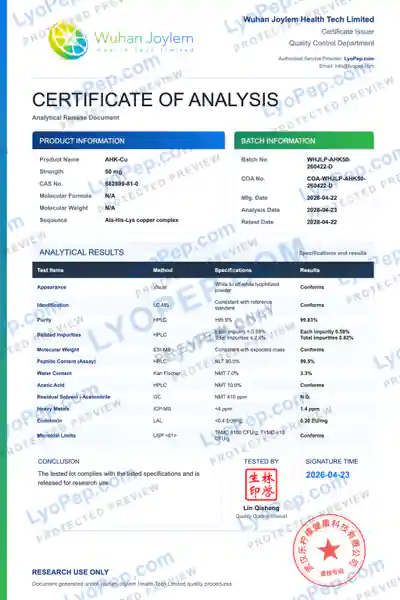
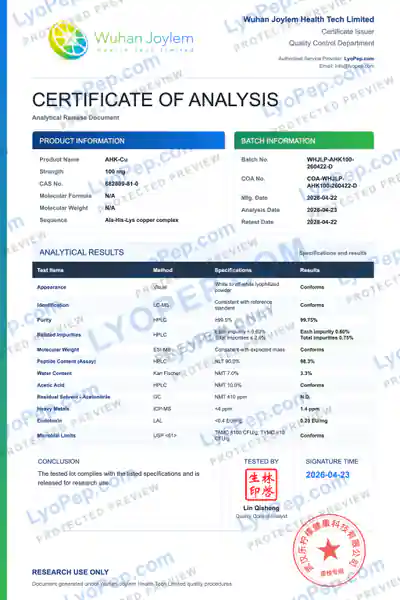
AHK-Cu factory batch COAs

Representative records, refreshed periodically

Published COAs show representative factory batches and may not be the latest available. For a current quote or shipment, our sales team can confirm the applicable lot and provide its COA.

Independent testing, arranged on request

Third-party reports are not routinely published. If independent verification is required, we can agree the laboratory, method, acceptance criteria and remedy before testing. If the agreed specification is not met, an appropriate resolution—including a refund where applicable—can be discussed under the agreed terms. Unless otherwise agreed in writing, the buyer pays the cost of this optional testing.

Help reviewing your COA

Need help reading a factory COA or third-party report? Our sales team can clarify test items, specifications and how the results relate to the lot under discussion.

Ask for the current packet, not a generic certificate

  • Color is influenced by copper coordination and formulation, so a pale blue or blue-green appearance does not prove identity, purity or intact chelation
  • A useful COA should state the complete complex and counterion, copper-to-peptide stoichiometry, intact mass and an orthogonal identity method, chromatographic purity with method and impurity profile, peptide and copper content, water/counterion where relevant, residual solvents and lot-specific stability
  • Sterility and endotoxin require separate validated tests when claimed
  • A single HPLC area percentage or clear solution is insufficient.
Released-batch COARP-HPLC result and method contextIdentity result appropriate to the moleculeWater / counter-ion context where relevantSDS and handling statementAdditional testing scoped on request

Available fills

Quote the fill and pack configuration you need

Reference SKUFillBase pack
AHK-CU-020MG20 mg10 vials
AHK-CU-050MG50 mg10 vials
AHK-CU-100MG100 mg10 vials

Handling

Storage in the lab and temperature during transit are different decisions

Store and ship according to the batch COA and validated stability data for the exact copper complex, counterion, buffer, concentration and container. Protect from conditions shown to promote oxidation or metal-complex disruption, avoid unvalidated freeze-thaw cycles and record excursions. A generic refrigerated instruction does not establish post-preparation dating.

State destination, season, acceptable transit exposure and whether your protocol requires insulated or cold-chain service. Additional temperature-control cost is quoted explicitly.

Buyer FAQ

Terms to settle before the purchase order

Can a buyer arrange third-party testing?+

Yes. Testing must be performed by a mutually accepted, established specialist laboratory. Fee allocation, specification, sampling, method and acceptance rule must be agreed before testing; if an agreed independent result shows nonconformance, the remedy follows the signed order terms. Unless otherwise agreed in writing, the buyer pays the cost of this optional testing.

Does HPLC purity prove peptide content?+

No. Chromatographic purity describes the relative peak profile under a stated method. Identity, water, counter-ion, residual solvents and assay/content may require separate methods.

Is cold-chain shipping always required?+

Not always. Heat can accelerate degradation, especially during summer and long transit. Cold-chain reduces exposure but raises cost. State the destination and stability risk so the right service can be quoted.

How are payment terms handled?+

Available methods and milestones depend on order value, destination and project type. The pro forma invoice should state currency, bank details, fees, payment milestones and the release condition.

Why must the testing laboratory understand peptide chemistry?+

Free-base and salt forms, hydrophilic and hydrophobic sequences, aggregation and adsorption can change sample preparation and method suitability. Use a laboratory experienced with the molecule class.

These are buyer-qualification references, not claims that this RUO material is regulated, certified or released under those frameworks. Applicability depends on the buyer's workflow and jurisdiction.

Selected sources

Literature behind the research context

  • PubChem records Copper tripeptide-3 under CID 169450582 as a deprotonated representation, while supplier catalogue records commonly use neutral or hydrochloride forms; resolve the exact supplied representation on the COA. The principal product-specific study is Pyo HK et al., The effect of tripeptide-copper complex on human hair growth in vitro, Archives of Pharmacal Research, 2007;30(7):834-839, PMID 17703734, DOI 10.1007/BF02978833. Its PubMed abstract reports ex vivo follicle elongation and dermal papilla-cell proliferation at 10⁻¹² to 10⁻⁹ M and states that the reduction in apoptotic cells at 10⁻⁹ M was not statistically significant.
  1. 01

    The effect of tripeptide-copper complex on human hair growth in vitro

    Archives of Pharmacal Research · 2007 · peer-reviewed original research (ex vivo human hair follicle organ culture + in vitro dermal papilla cell assay)

    Open source
  2. 02

    Stimulation of hair growth by peptide copper complexes

    United States Patent and Trademark Office (US Patent 5,538,945) · 1996 · regulatory/industry document (issued US patent, via Google Patents)

    Open source
  3. 03

    Stimulation of hair growth by peptide copper complexes

    United States Patent and Trademark Office (US Patent 6,017,888) · 2000 · regulatory/industry document (issued US patent, via Google Patents)

    Open source

Product FAQ

Questions buyers ask about AHK-Cu

How does AHK-Cu differ from GHK-Cu?+

AHK-Cu is based on the Ala-His-Lys sequence, whereas GHK-Cu is based on Gly-His-Lys. They are different copper-peptide complexes and are not interchangeable merely because both are marketed as copper tripeptides. Confirm the full peptide sequence, copper-to-peptide stoichiometry, counterion, theoretical form and observed lot identity rather than relying on a generic ‘Copper Tripeptide’ name.

What should an AHK-Cu lot-qualification package contain?+

Request the complete complex identity and counterion, Ala-His-Lys sequence evidence, copper-to-peptide stoichiometry, theoretical and observed intact mass, an orthogonal identity method, chromatographic purity and impurity profile, quantitative peptide and copper content, water and residual solvents, methods, acceptance criteria and lot-specific stability. Colour or an HPLC area percentage alone cannot prove intact copper coordination, content, sterility or suitability.