Recent Confirmed OrdersLast 7 days
Australia520 mgTirzepatide 40 mg · Semaglutide 2 mg · Dihexa 10 mg
View all

Other research materials

L-Carnitine liquid

Aqueous L-carnitine research preparation · metabolic small molecule

Confirm concentration and component specification on released-lot COA · target, verify batch COACAS 541-15-1RUO
Research statusEstablished metabolite supplied as an aqueous research preparation; solution attributes and released-lot testing control suitability.
Supplied formAqueous L-carnitine preparation (quaternary-ammonium small molecule; non-peptide)
Lead timeConfirmed with quote
L-Carnitine liquid — Clear, colorless to slightly yellow aqueous solution; confirm released-lot appearance on the COA
L-Carnitine liquid — Clear, colorless to slightly yellow aqueous solution; confirm released-lot appearance on the COA · Representative packaging image · verify the ordered lot
Representative packaging image · verify the ordered lot

Decision summary

Key benefits

  • Research value includes ready-to-use matrix or method-development work, concentration recovery, transport and metabolism studies, and solution stability or container-compatibility evaluation
  • Liquid presentation does not by itself establish faster absorption, sterility or clinical suitability.
Published research context is presented for literature orientation only. It is not a dosing, treatment or human-use instruction.
Qualification data

Specifications to confirm against the released lot

CAS
541-15-1
Formula
Not applicable to the supplied material
Molecular weight
161.20 g/mol
Appearance
Clear, colorless to slightly yellow aqueous solution; confirm released-lot appearance on the COA
Purity
Confirm concentration and component specification on released-lot COA · target, verify batch COA
Storage
Follow the released-lot label and COA. Do not freeze or refrigerate merely by analogy to another formulation; after-opening and in-use stability require product-specific data. Protect the container from contamination and incompatible light or temperature exposure as specified.
MOQ
On request
Lead time
Confirmed with quote

Qualification matrix

Identity, purity and content are separate release questions.

Identity

Confirm the stated molecule and supplied form. Start with the matching batch COA; request sequence-level evidence only when the buyer's written procedure requires it and availability or a separate scope has been agreed.

Purity

Review RP-HPLC method conditions, wavelength, integration and related-peak handling. A percentage without the method is not enough.

Content

Net peptide content is not the same as gross lyophilized powder weight. Ask which assay supports the stated amount and whether water/counter-ion is addressed.

Stability

Define long-term storage and transit exposure separately. Cold-chain can be quoted when the buyer’s risk assessment requires it and adds cost.

Research context

What researchers study about L-Carnitine liquid

This item is an aqueous research preparation containing L-carnitine, the physiologic (R)-enantiomer involved in mitochondrial acyl-group transport. A solution record must identify the solute form, concentration, solvent, pH, excipients and container rather than relying on the ingredient identity alone.

  • Solution assay and recovery; analytical method development; transport and mitochondrial-metabolism models; formulation, pH, freeze-thaw, container and short-term stability studies; matrix-spike controls.

Mechanism context

The question the literature is testing

The dissolved L-carnitine molecule participates in carnitine-acyltransferase and transporter systems. Experimental interpretation depends on verified concentration, matrix, pH, transporters and metabolic context; the liquid presentation does not change the compound into an approved drug.

Evidence map

Research routes and exposure context

Evidence tierAnalytical / laboratory context
Routes reported in sources
IntravenousOral
Dose / exposure contextProtocol-specific; verify the cited primary source
Routes and exposure contexts summarize cited studies or approved finished-product labels. They are not instructions for administering this RUO material; no customer dose is provided.

Evidence boundaries

Compatibility, limitations and decision context

  • Research Use Only; not represented as a sterile injectable or oral finished drug
  • Do not use in humans or animals
  • Handle according to the SDS and the documented solvent/excipient hazards
  • A sealed vial or clear appearance does not prove sterility.

Interactions reported in the literature

  • In bench studies, evaluate solvent, pH, ionic strength, temperature, container adsorption and co-solutes
  • No wellness stack or clinical drug-interaction advice is provided.
Literature context is not a supplier release result or human-use instruction. Follow your institution's approved laboratory risk assessment.

Factory batch documentation

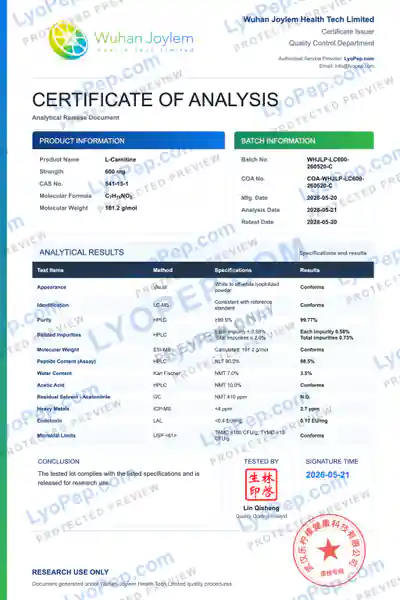
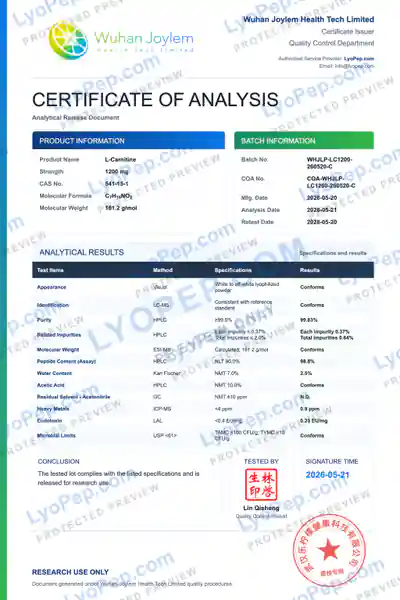
L-Carnitine liquid factory batch COAs

Representative records, refreshed periodically

Published COAs show representative factory batches and may not be the latest available. For a current quote or shipment, our sales team can confirm the applicable lot and provide its COA.

Independent testing, arranged on request

Third-party reports are not routinely published. If independent verification is required, we can agree the laboratory, method, acceptance criteria and remedy before testing. If the agreed specification is not met, an appropriate resolution—including a refund where applicable—can be discussed under the agreed terms. Unless otherwise agreed in writing, the buyer pays the cost of this optional testing.

Help reviewing your COA

Need help reading a factory COA or third-party report? Our sales team can clarify test items, specifications and how the results relate to the lot under discussion.

Ask for the current packet, not a generic certificate

  • Require identity, assay or concentration, related substances, enantiomeric identity, pH, solvent/excipient composition, fill-volume control and stability conditions
  • Bioburden, endotoxin and sterility are separate tests and may be claimed only when included in the released-lot specification and COA.
Released-batch COARP-HPLC result and method contextIdentity result appropriate to the moleculeWater / counter-ion context where relevantSDS and handling statementAdditional testing scoped on request

Available fills

Quote the fill and pack configuration you need

Reference SKUFillBase pack
LC-0600MG600 mg10 vials
LC-1200MG1200 mg10 vials

Handling

Storage in the lab and temperature during transit are different decisions

Follow the released-lot label and COA. Do not freeze or refrigerate merely by analogy to another formulation; after-opening and in-use stability require product-specific data. Protect the container from contamination and incompatible light or temperature exposure as specified.

State destination, season, acceptable transit exposure and whether your protocol requires insulated or cold-chain service. Additional temperature-control cost is quoted explicitly.

Buyer FAQ

Terms to settle before the purchase order

Can a buyer arrange third-party testing?+

Yes. Testing must be performed by a mutually accepted, established specialist laboratory. Fee allocation, specification, sampling, method and acceptance rule must be agreed before testing; if an agreed independent result shows nonconformance, the remedy follows the signed order terms. Unless otherwise agreed in writing, the buyer pays the cost of this optional testing.

Does HPLC purity prove peptide content?+

No. Chromatographic purity describes the relative peak profile under a stated method. Identity, water, counter-ion, residual solvents and assay/content may require separate methods.

Is cold-chain shipping always required?+

Not always. Heat can accelerate degradation, especially during summer and long transit. Cold-chain reduces exposure but raises cost. State the destination and stability risk so the right service can be quoted.

How are payment terms handled?+

Available methods and milestones depend on order value, destination and project type. The pro forma invoice should state currency, bank details, fees, payment milestones and the release condition.

Why must the testing laboratory understand peptide chemistry?+

Free-base and salt forms, hydrophilic and hydrophobic sequences, aggregation and adsorption can change sample preparation and method suitability. Use a laboratory experienced with the molecule class.

These are buyer-qualification references, not claims that this RUO material is regulated, certified or released under those frameworks. Applicability depends on the buyer's workflow and jurisdiction.

Selected sources

Literature behind the research context

  • Authoritative identity: PubChem CID 10917. Evidence context: NIH Office of Dietary Supplements. Regulatory comparison only: FDA/DailyMed oral-solution and injection labels. Linked peer-reviewed sources address specific mechanisms, populations and endpoints.
  1. 01

    The Role of l-Carnitine in Mitochondria, Prevention of Metabolic Inflexibility and Disease Initiation

    International Journal of Molecular Sciences · 2022 · peer-reviewed narrative review

    Open source
  2. 02

    Carnitine transport and fatty acid oxidation

    Biochimica et Biophysica Acta (BBA) - Molecular Cell Research · 2016 · peer-reviewed review

    Open source
  3. 03

    Comprehensive review of the expanding roles of the carnitine pool in metabolic physiology: beyond fatty acid oxidation

    Journal of Translational Medicine · 2025 · peer-reviewed comprehensive review

    Open source
  4. 04

    Effect of Acute and Chronic Oral l-Carnitine Supplementation on Exercise Performance Based on the Exercise Intensity: A Systematic Review

    Nutrients · 2021 · systematic review

    Open source
  5. 05

    Clinical Effects of L-Carnitine Supplementation on Physical Performance in Healthy Subjects, the Key to Success in Rehabilitation: A Systematic Review and Meta-Analysis from the Rehabilitation Point of View

    Journal of Functional Morphology and Kinesiology · 2021 · systematic review and meta-analysis

    Open source
  6. 06

    Effects of Levocarnitine on Brachial-Ankle Pulse Wave Velocity in Hemodialysis Patients: A Randomized Controlled Trial

    Nutrients · 2014 · randomized controlled trial

    Open source
  7. 07

    Efficacy and Safety of L-Carnitine Treatment for Chronic Heart Failure: A Meta-Analysis of Randomized Controlled Trials

    BioMed Research International · 2017 · meta-analysis of randomized controlled trials

    Open source
  8. 08

    Progression of atherosclerosis with carnitine supplementation: a randomized controlled trial in the metabolic syndrome

    Nutrition & Metabolism · 2022 · randomized controlled trial

    Open source

Product FAQ

Questions buyers ask about L-Carnitine liquid

Which COA attributes should be qualified for an aqueous L-carnitine lot?+

Require solute identity and stereochemical identity, quantitative concentration or assay, related substances, pH, appearance and particulates, fill volume, solvent and excipient disclosure, container information and a lot-specific stability statement. Bioburden, bacterial endotoxins and sterility are different tests; request them only when the study requires them and accept a claim only when the method, limit and result appear in the released-lot documentation.