Recent Confirmed OrdersLast 7 days
Australia520 mgTirzepatide 40 mg · Semaglutide 2 mg · Dihexa 10 mg
View all

Mitochondrial research

L-Carnitine

Fatty-acid-transport small-molecule reference standard

≥ 99.0% · target, verify batch COACAS 541-15-1RUO
Research statusEstablished endogenous metabolite and analytical reference material; human evidence outside defined deficiency indications is mixed and formulation-specific.
Supplied formSmall molecule (quaternary ammonium compound)
Lead time7–14 days
L-Carnitine — Solid reference material; confirm released-lot form and appearance on the COA
L-Carnitine — Solid reference material; confirm released-lot form and appearance on the COA · Representative packaging image · verify the ordered lot
Representative packaging image · verify the ordered lot

Decision summary

Key benefits

  • Research value includes use as an identity or assay reference, an analytical calibrant, and a controlled reagent in studies of carnitine transport, acylcarnitine balance and mitochondrial metabolism
  • These research applications are not claims of weight loss, athletic performance or disease treatment.
Published research context is presented for literature orientation only. It is not a dosing, treatment or human-use instruction.
Qualification data

Specifications to confirm against the released lot

CAS
541-15-1
Formula
C7H15NO3
Molecular weight
161.20 g/mol
Appearance
Solid reference material; confirm released-lot form and appearance on the COA
Purity
≥ 99.0% · target, verify batch COA
Storage
Store the unopened powder under the conditions printed on the released-lot label and COA, tightly closed and protected from moisture. Do not transfer storage or after-opening instructions from a prescription solution to this powder.
MOQ
On request
Lead time
7–14 days
PubChem CID 10917

Qualification matrix

Identity, purity and content are separate release questions.

Identity

Confirm the stated molecule and supplied form. Start with the matching batch COA; request sequence-level evidence only when the buyer's written procedure requires it and availability or a separate scope has been agreed.

Purity

Review RP-HPLC method conditions, wavelength, integration and related-peak handling. A percentage without the method is not enough.

Content

Net peptide content is not the same as gross lyophilized powder weight. Ask which assay supports the stated amount and whether water/counter-ion is addressed.

Stability

Define long-term storage and transit exposure separately. Cold-chain can be quoted when the buyer’s risk assessment requires it and adds cost.

Research context

What researchers study about L-Carnitine

L-Carnitine is the physiologic (R)-enantiomer of carnitine and a highly polar zwitterionic small molecule. It participates in the carnitine shuttle that transfers long-chain acyl groups across the inner mitochondrial membrane for beta-oxidation. The free compound must be distinguished from D-carnitine, acylcarnitines, hydrochloride salts and L-tartrate material.

  • Analytical method development; identity and content reference work; carnitine-transporter and acylcarnitine studies; mitochondrial fatty-acid-oxidation models; matrix recovery, stability and formulation research.

Mechanism context

The question the literature is testing

Carnitine accepts and donates acyl groups through carnitine acyltransferases and supports transport of long-chain acyl moieties through the mitochondrial carnitine shuttle. Biological interpretation depends on transporter expression, metabolic state, matrix and experimental exposure.

Evidence map

Research routes and exposure context

Evidence tierMixed evidence context
Routes reported in sources
IntravenousOral
Dose / exposure contextProtocol-specific; verify the cited primary source
Routes and exposure contexts summarize cited studies or approved finished-product labels. They are not instructions for administering this RUO material; no customer dose is provided.

Evidence boundaries

Compatibility, limitations and decision context

  • Research Use Only; not a sterile finished drug and not for human or veterinary use
  • Handle according to the SDS and institutional risk assessment
  • Human adverse-effect and interaction information in NIH or FDA sources describes dietary supplements or labeled drug products, not this lot.

Interactions reported in the literature

  • For bench work, control pH, ionic strength, matrix, transporter expression and competing carnitine/acylcarnitine species
  • No peptide stack or clinical drug-interaction recommendation is made for this research material.
Literature context is not a supplier release result or human-use instruction. Follow your institution's approved laboratory risk assessment.

Factory batch documentation

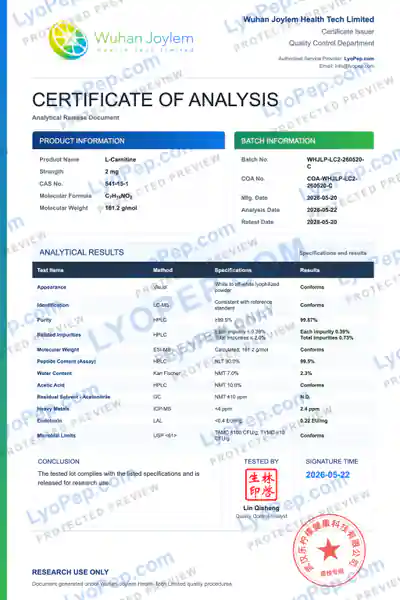
L-Carnitine factory batch COAs

Representative records, refreshed periodically

Published COAs show representative factory batches and may not be the latest available. For a current quote or shipment, our sales team can confirm the applicable lot and provide its COA.

Independent testing, arranged on request

Third-party reports are not routinely published. If independent verification is required, we can agree the laboratory, method, acceptance criteria and remedy before testing. If the agreed specification is not met, an appropriate resolution—including a refund where applicable—can be discussed under the agreed terms. Unless otherwise agreed in writing, the buyer pays the cost of this optional testing.

Help reviewing your COA

Need help reading a factory COA or third-party report? Our sales team can clarify test items, specifications and how the results relate to the lot under discussion.

Ask for the current packet, not a generic certificate

  • Confirm identity, stereochemical identity, assay/content, related substances, water and residual solvents against the released-lot COA
  • A suitable polar-analyte method such as validated HILIC, ion-exchange or an appropriately qualified alternative may be needed
  • Appearance alone cannot establish identity, purity or sterility.
Released-batch COARP-HPLC result and method contextIdentity result appropriate to the moleculeWater / counter-ion context where relevantSDS and handling statementAdditional testing scoped on request

Available fills

Quote the fill and pack configuration you need

Reference SKUFillBase pack
LC-2MG2 mg10 vials

Handling

Storage in the lab and temperature during transit are different decisions

Store the unopened powder under the conditions printed on the released-lot label and COA, tightly closed and protected from moisture. Do not transfer storage or after-opening instructions from a prescription solution to this powder.

State destination, season, acceptable transit exposure and whether your protocol requires insulated or cold-chain service. Additional temperature-control cost is quoted explicitly.

Buyer FAQ

Terms to settle before the purchase order

Can a buyer arrange third-party testing?+

Yes. Testing must be performed by a mutually accepted, established specialist laboratory. Fee allocation, specification, sampling, method and acceptance rule must be agreed before testing; if an agreed independent result shows nonconformance, the remedy follows the signed order terms. Unless otherwise agreed in writing, the buyer pays the cost of this optional testing.

Does HPLC purity prove peptide content?+

No. Chromatographic purity describes the relative peak profile under a stated method. Identity, water, counter-ion, residual solvents and assay/content may require separate methods.

Is cold-chain shipping always required?+

Not always. Heat can accelerate degradation, especially during summer and long transit. Cold-chain reduces exposure but raises cost. State the destination and stability risk so the right service can be quoted.

How are payment terms handled?+

Available methods and milestones depend on order value, destination and project type. The pro forma invoice should state currency, bank details, fees, payment milestones and the release condition.

Why must the testing laboratory understand peptide chemistry?+

Free-base and salt forms, hydrophilic and hydrophobic sequences, aggregation and adsorption can change sample preparation and method suitability. Use a laboratory experienced with the molecule class.

These are buyer-qualification references, not claims that this RUO material is regulated, certified or released under those frameworks. Applicability depends on the buyer's workflow and jurisdiction.

Selected sources

Literature behind the research context

  • Authoritative identity: PubChem CID 10917. Evidence and safety context: NIH Office of Dietary Supplements Carnitine Fact Sheet. Formulation-specific regulatory context: FDA/DailyMed levocarnitine labeling. See the linked peer-reviewed records for model- and endpoint-specific evidence.
  1. 01

    Effects of l-carnitine supplementation on weight loss and body composition: A systematic review and meta-analysis of 37 randomized controlled clinical trials with dose-response analysis

    Clinical Nutrition ESPEN · 2020 · systematic review and meta-analysis of RCTs

    Open source
  2. 02

    Effect of Acute and Chronic Oral l-Carnitine Supplementation on Exercise Performance Based on the Exercise Intensity: A Systematic Review

    Nutrients · 2021 · systematic review

    Open source
  3. 03

    Clinical Effects of L-Carnitine Supplementation on Physical Performance in Healthy Subjects, the Key to Success in Rehabilitation: A Systematic Review and Meta-Analysis from the Rehabilitation Point of View

    Journal of Functional Morphology and Kinesiology · 2021 · systematic review and meta-analysis

    Open source
  4. 04

    l-Carnitine supplementation for adults with end-stage kidney disease requiring maintenance hemodialysis: a systematic review and meta-analysis

    American Journal of Clinical Nutrition · 2014 · systematic review and meta-analysis of RCTs

    Open source
  5. 05

    Practice recommendations for the use of L-carnitine in dialysis-related carnitine disorder. National Kidney Foundation Carnitine Consensus Conference

    American Journal of Kidney Diseases · 2003 · consensus conference practice recommendations (professional society)

    Open source
  6. 06

    L-carnitine, a friend or foe for cardiovascular disease? A Mendelian randomization study

    BMC Medicine · 2022 · Mendelian randomization study (genetic epidemiology)

    Open source
  7. 07

    Role of L-carnitine in Cardiovascular Health: Literature Review

    Cureus · 2024 · literature review

    Open source
  8. 08

    The effects of L-carnitine supplementation on lipid concentrations in patients with type 2 diabetes: A systematic review and meta-analysis of randomized clinical trials

    Journal of Cardiovascular and Thoracic Research · 2020 · systematic review and meta-analysis of RCTs

    Open source

Product FAQ

Questions buyers ask about L-Carnitine

How should L-Carnitine be characterized as an analytical reference material?+

Because L-Carnitine is a highly polar zwitterionic quaternary-ammonium compound, a validated HILIC, ion-exchange, derivatization or other qualified polar-analyte method may be more suitable than unmodified reversed-phase HPLC. Mass-spectrometric precursor ions depend on ionization and adduct conditions; 161.20 g/mol is the neutral molecular weight, not a universal observed m/z. Use a qualified chiral method against appropriate references to control D-carnitine and report chemical assay separately from enantiomeric purity.

Which chemical form does this SKU represent?+

The current catalogue fill is a 2 mg research-standard presentation. The quotation and released-lot COA must confirm that it is free L-Carnitine, CAS 541-15-1, and state water or solvation, assay basis and packaging. Acetyl-L-carnitine, propionyl-L-carnitine, L-carnitine L-tartrate and hydrochloride forms are distinct standards with different identities and masses; their availability must be confirmed separately and must never be inferred from this listing.

Why must purity, assay and water be reported separately for L-Carnitine?+

Chromatographic area purity describes the relative detector response of resolved substances; it does not establish the mass of L-Carnitine in a hygroscopic or solvated material. For quantitative standard preparation, require identity, chiral purity, an assay/content value with traceability and uncertainty where needed, water, related substances and residual solvents, and state whether the result is as-is, anhydrous or dry basis. Appearance and nominal fill mass alone cannot establish concentration.