Recent Confirmed OrdersLast 7 days
Australia2 gTirzepatide 100 mg · CagriSema 20 mg · BPC-157 10 mg · TB-500 5 mg · Melanotan II 10 mg · PT-141 10 mg · Bacteriostatic Water 3 ml
View all

Neurocognitive research

Semax

ACTH(4-7)-PGP heptapeptide · neurobiology research reagent

≥ 99.0% · target, verify batch COACAS 80714-61-0RUO
Research statusPreclinical evidence and small or methodologically limited human studies; no FDA-approved use reference context · supplied material is RUO
Supplied formLinear heptapeptide
Lead time7–14 days
Semax — White lyophilized powder
Semax — White lyophilized powder · Representative packaging image · verify the ordered lot
Representative packaging image · verify the ordered lot

Decision summary

Key benefits

  • Research themes include neurotrophin transcription, monoaminergic signalling, ischemia-related molecular responses and neurobiology models
  • Most evidence is preclinical, and these themes are not clinical benefit claims.
Published research context is presented for literature orientation only. It is not a dosing, treatment or human-use instruction.
Qualification data

Specifications to confirm against the released lot

CAS
80714-61-0
Formula
C37H51N9O10S
Molecular weight
About 813.9 Da
Appearance
White lyophilized powder
Purity
≥ 99.0% · target, verify batch COA
Storage
Store and ship according to the batch-specific COA, SDS and stability statement for the exact supplied form. Do not infer bulk-powder or solution stability from a foreign finished product; request matrix-specific solution-stability data when required.
MOQ
On request
Lead time
7–14 days
PubChem CID 9811102

Qualification matrix

Identity, purity and content are separate release questions.

Identity

Confirm the stated molecule and supplied form. Start with the matching batch COA; request sequence-level evidence only when the buyer's written procedure requires it and availability or a separate scope has been agreed.

Purity

Review RP-HPLC method conditions, wavelength, integration and related-peak handling. A percentage without the method is not enough.

Content

Net peptide content is not the same as gross lyophilized powder weight. Ask which assay supports the stated amount and whether water/counter-ion is addressed.

Stability

Define long-term storage and transit exposure separately. Cold-chain can be quoted when the buyer’s risk assessment requires it and adds cost.

Research context

What researchers study about Semax

Semax is the synthetic linear heptapeptide Met-Glu-His-Phe-Pro-Gly-Pro (MEHFPGP), commonly described as an ACTH(4-7) fragment extended with Pro-Gly-Pro. It has a long Russian research history and substantial preclinical literature, but the available human studies are small, methodologically limited or focused on exploratory biomarkers and imaging. FDA's May 11, 2026 briefing review found insufficient evidence of effectiveness for the evaluated uses. Historical or foreign-market use does not establish FDA approval or suitability of this RUO lot for administration.

  • Reported research topics include neurotrophin signalling, cognition-related models, ischemia and neural-injury models
  • FDA's 2026 evaluation found insufficient evidence of effectiveness for cerebral ischemia, migraine or trigeminal neuralgia
  • No FDA-approved or broadly validated therapeutic indication is established.

Mechanism context

The question the literature is testing

Animal and in-vitro studies report changes in BDNF/NGF-related transcription, dopaminergic and serotonergic readouts, and gene expression after experimental ischemia. Literature also discusses melanocortin-receptor interactions, but FDA's 2026 review found no clearly identified target receptor and notes that the contribution of metabolites remains unresolved. Exploratory biomarker or imaging changes do not establish direct nose-to-brain transport, a clinical mechanism or efficacy for an independently supplied RUO lot.

Evidence map

Research routes and exposure context

Evidence tierApproved finished-product context
Routes reported in sources
Intranasal
Dose / exposure contextProtocol-specific; verify the cited primary source
Routes and exposure contexts summarize cited studies or approved finished-product labels. They are not instructions for administering this RUO material; no customer dose is provided.

Evidence boundaries

Compatibility, limitations and decision context

  • This material is an RUO reagent, not a finished drug or sterile preparation
  • FDA's 2026 review found no human pharmacokinetic study for either evaluated form and identified unresolved safety concerns, including potential aggregation- and impurity-related immunogenicity and a possible bleeding signal that could not be characterized from the available evidence
  • Comprehensive long-term human safety is not established, and no human or veterinary administration guidance is provided.

Interactions reported in the literature

  • No controlled interaction dataset supports combination recommendations for this RUO material
  • Any co-exposure or formulation study requires its own compatibility, assay-interference and safety assessment.
Literature context is not a supplier release result or human-use instruction. Follow your institution's approved laboratory risk assessment.

Factory batch documentation

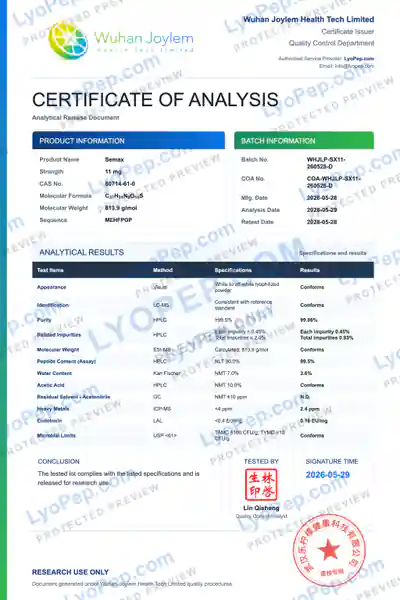
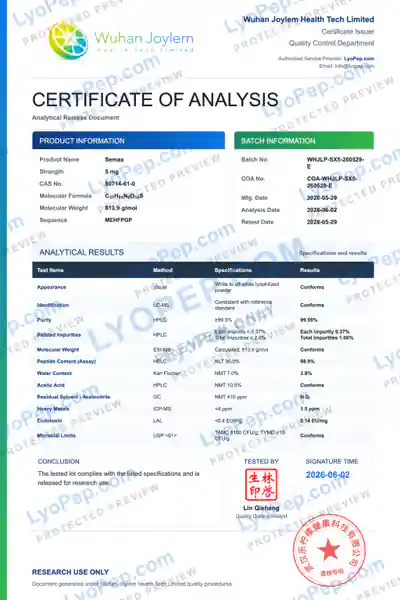
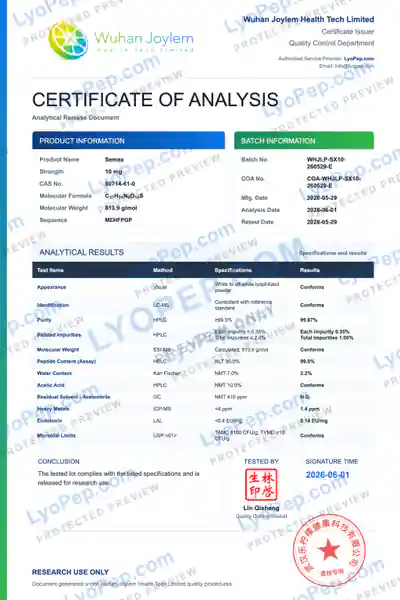
Semax factory batch COAs

Representative records, refreshed periodically

Published COAs show representative factory batches and may not be the latest available. For a current quote or shipment, our sales team can confirm the applicable lot and provide its COA.

Independent testing, arranged on request

Third-party reports are not routinely published. If independent verification is required, we can agree the laboratory, method, acceptance criteria and remedy before testing. If the agreed specification is not met, an appropriate resolution—including a refund where applicable—can be discussed under the agreed terms. Unless otherwise agreed in writing, the buyer pays the cost of this optional testing.

Help reviewing your COA

Need help reading a factory COA or third-party report? Our sales team can clarify test items, specifications and how the results relate to the lot under discussion.

Ask for the current packet, not a generic certificate

  • Request any additional sequence, content, aggregate, solvent or storage evidence only when the buyer's written procedure requires it and the scope has been agreed
  • FDA specifically noted gaps in publicly available aggregate, bacterial-endotoxin and microbial-bioburden controls
  • HPLC area purity alone does not establish identity, content, sterility, endotoxin status, immunogenicity risk or solution stability.
Released-batch COARP-HPLC result and method contextIdentity result appropriate to the moleculeWater / counter-ion context where relevantSDS and handling statementAdditional testing scoped on request

Available fills

Quote the fill and pack configuration you need

Reference SKUFillBase pack
SEMAX-05MG5 mg10 vials
SEMAX-10MG10 mg10 vials
SEMAX-11MG11 mg10 vials

Handling

Storage in the lab and temperature during transit are different decisions

Store and ship according to the batch-specific COA, SDS and stability statement for the exact supplied form. Do not infer bulk-powder or solution stability from a foreign finished product; request matrix-specific solution-stability data when required.

State destination, season, acceptable transit exposure and whether your protocol requires insulated or cold-chain service. Additional temperature-control cost is quoted explicitly.

Buyer FAQ

Terms to settle before the purchase order

Can a buyer arrange third-party testing?+

Yes. Testing must be performed by a mutually accepted, established specialist laboratory. Fee allocation, specification, sampling, method and acceptance rule must be agreed before testing; if an agreed independent result shows nonconformance, the remedy follows the signed order terms. Unless otherwise agreed in writing, the buyer pays the cost of this optional testing.

Does HPLC purity prove peptide content?+

No. Chromatographic purity describes the relative peak profile under a stated method. Identity, water, counter-ion, residual solvents and assay/content may require separate methods.

Is cold-chain shipping always required?+

Not always. Heat can accelerate degradation, especially during summer and long transit. Cold-chain reduces exposure but raises cost. State the destination and stability risk so the right service can be quoted.

How are payment terms handled?+

Available methods and milestones depend on order value, destination and project type. The pro forma invoice should state currency, bank details, fees, payment milestones and the release condition.

Why must the testing laboratory understand peptide chemistry?+

Free-base and salt forms, hydrophilic and hydrophobic sequences, aggregation and adsorption can change sample preparation and method suitability. Use a laboratory experienced with the molecule class.

These are buyer-qualification references, not claims that this RUO material is regulated, certified or released under those frameworks. Applicability depends on the buyer's workflow and jurisdiction.

Selected sources

Literature behind the research context

  • 1) FDA briefing evaluation dated May 11, 2026 (PCAC, Semax free base and Semax acetate): neither form is a component of an FDA-approved drug; FDA found insufficient evidence of effectiveness for cerebral ischemia, migraine or trigeminal neuralgia and concluded that the characterization, effectiveness and safety criteria weigh against 503A Bulks List inclusion. The scheduled advisory discussion is not a final determination. 2) Gusev et al. (2018, Zhurnal Nevrologii i Psikhiatrii, PMID 29798983): a 110-person post-ischemic-stroke rehabilitation study reported plasma BDNF and functional associations, but the abstract does not report randomization or blinding, so it does not establish broad clinical efficacy. 3) Lebedeva et al. (2018, Bull Exp Biol Med, PMID 30225715): a small resting-state fMRI study of 24 healthy volunteers (14 Semax, 10 placebo) reported a default-mode-network imaging difference after one exposure; this exploratory surrogate endpoint is not a clinical outcome. 4) Medvedeva et al. (2014, BMC Genomics 15:228, PMC3987924): a rat focal-cerebral-ischemia transcriptomic study reported 96 altered genes at 3 hours and 68 at 24 hours, supporting a preclinical research hypothesis rather than human efficacy.
  1. 01

    Semax, an analogue of adrenocorticotropin (4-10), binds specifically and increases levels of brain-derived neurotrophic factor protein in rat basal forebrain

    Journal of Neurochemistry · 2006 · peer-reviewed original research

    Open source
  2. 02

    Semax, an ACTH(4-10) analogue with nootropic properties, activates dopaminergic and serotoninergic brain systems in rodents

    Neurochemical Research · 2005 · peer-reviewed original research

    Open source
  3. 03

    Semax and Pro-Gly-Pro Activate the Transcription of Neurotrophins and Their Receptor Genes after Cerebral Ischemia

    Cellular and Molecular Neurobiology · 2010 · peer-reviewed original research

    Open source
  4. 04

    Novel Insights into the Protective Properties of ACTH(4-7)PGP (Semax) Peptide at the Transcriptome Level Following Cerebral Ischaemia-Reperfusion in Rats

    Genes (Basel) · 2020 · peer-reviewed original research

    Open source
  5. 05

    Semax, an analogue of adrenocorticotropin (4-10), is a potential agent for the treatment of attention-deficit hyperactivity disorder and Rett syndrome

    Medical Hypotheses · 2007 · hypothesis/opinion paper (peer-reviewed journal)

    Open source
  6. 06

    The Potential of the Peptide Drug Semax and Its Derivative for Correcting Pathological Impairments in the Animal Model of Alzheimer's Disease

    Acta Naturae · 2025 · peer-reviewed original research

    Open source
  7. 07

    Semax peptide targets the μ opioid receptor gene Oprm1 to promote deubiquitination and functional recovery after spinal cord injury in female mice

    British Journal of Pharmacology · 2025 · peer-reviewed original research

    Open source
  8. 08

    FDA Evaluation of Semax-Related Bulk Drug Substances

    U.S. Food and Drug Administration · 2026 · regulatory scientific evaluation / government advisory committee briefing

    Open source

Product FAQ

Questions buyers ask about Semax

What identity should a Semax lot document?+

The free-peptide reference is the linear sequence Met-Glu-His-Phe-Pro-Gly-Pro (MEHFPGP), CAS 80714-61-0, PubChem CID 9811102, formula C₃₇H₅₁N₉O₁₀S and average molecular weight about 813.9 Da. FDA's 2026 briefing table separately lists Semax acetate as C₃₉H₅₅N₉O₁₂S with molecular weight 874.0 g/mol and notes inconsistent CAS usage. The label and batch COA must therefore identify the supplied form rather than treating free peptide and acetate as interchangeable.

What does the published evidence establish for Semax?+

Peer-reviewed animal and in-vitro studies report effects on neurotrophin transcription, monoaminergic systems and ischemia-related molecular readouts, and a few small or methodologically limited human studies report biomarker or imaging outcomes. FDA's 2026 review found insufficient evidence of effectiveness for cerebral ischemia, migraine or trigeminal neuralgia. The precise receptor-level mechanism and broad clinical efficacy are not established by high-quality, independently replicated human trials, so preclinical or exploratory findings must not be presented as clinical outcomes.

What is the current US regulatory context for Semax?+

Neither Semax free base nor Semax acetate is a component of an FDA-approved drug. FDA's May 11, 2026 briefing evaluation recommends against adding either substance to the 503A Bulks List based on unresolved characterization, effectiveness and safety limitations. The substances are scheduled for PCAC discussion on July 24, 2026; committee advice is non-binding, and FDA states that no final determination will be issued until the advisory process and reviews are complete.