Recent Confirmed OrdersLast 7 days
Australia520 mgTirzepatide 40 mg · Semaglutide 2 mg · Dihexa 10 mg
View all

Repair and regenerative research

PEG-MGF

PEG-conjugated MGF E-peptide research material · architecture must be defined by lot

Architecture- and lot-specific; require peptide identity/content, PEG distribution, conjugation-site evidence, free peptide/free PEG and aggregate results · target, verify batch COACAS 108174-48-7RUO
Research statusLimited and conflicting nonclinical evidence; no standardized conjugate or qualifying human study
Supplied formHeterogeneous PEG–peptide conjugate unless PEG size, attachment site, linker and substitution ratio are explicitly fixed
Lead time14–21 days
PEG-MGF — Lot-specific lyophilized conjugate; appearance alone does not establish PEG architecture, identity or content
PEG-MGF — Lot-specific lyophilized conjugate; appearance alone does not establish PEG architecture, identity or content · Representative packaging image · verify the ordered lot
Representative packaging image · verify the ordered lot

Decision summary

Key benefits

  • Defensible research value includes PEG-conjugate characterization, free-versus-conjugated peptide comparison, architecture–activity studies, myoblast or progenitor assay replication, stability and analytical method development
  • Muscle repair, hypertrophy, recovery or anti-ageing claims are not established and direct human evidence is absent.
Published research context is presented for literature orientation only. It is not a dosing, treatment or human-use instruction.
Qualification data

Specifications to confirm against the released lot

CAS
108174-48-7
Formula
Confirm supplied form on batch COA
Molecular weight
Confirm supplied form on batch COA
Appearance
Lot-specific lyophilized conjugate; appearance alone does not establish PEG architecture, identity or content
Purity
Architecture- and lot-specific; require peptide identity/content, PEG distribution, conjugation-site evidence, free peptide/free PEG and aggregate results · target, verify batch COA
Storage
Follow released-lot label, COA and conjugate-specific stability data. Generic 2–8°C or reconstituted-storage advice is not transferable across PEG architectures and matrices.
MOQ
On request
Lead time
14–21 days

Qualification matrix

Identity, purity and content are separate release questions.

Identity

Confirm the stated molecule and supplied form. Start with the matching batch COA; request sequence-level evidence only when the buyer's written procedure requires it and availability or a separate scope has been agreed.

Purity

Review RP-HPLC method conditions, wavelength, integration and related-peak handling. A percentage without the method is not enough.

Content

Net peptide content is not the same as gross lyophilized powder weight. Ask which assay supports the stated amount and whether water/counter-ion is addressed.

Stability

Define long-term storage and transit exposure separately. Cold-chain can be quoted when the buyer’s risk assessment requires it and adds cost.

Research context

What researchers study about PEG-MGF

PEG-MGF is a supplier-dependent PEG conjugate of an MGF/IGF-1Ec E-domain-related peptide. Without fixed PEG size, dispersity, linker, attachment site and substitution ratio, it is not one defined compound and has no universal formula, mass or CAS. Non-PEGylated MGF-E peptide cell studies are conflicting: Kandalla et al. reported effects in human muscle progenitor cells, whereas Fornaro/Brace et al. found no apparent effect in myoblasts or primary muscle stem cells. Those studies do not establish performance or efficacy of an unspecified PEG conjugate.

  • Appropriate laboratory contexts include conjugate identity and mass-distribution methods, PEG architecture comparison, free-versus-conjugated peptide assays, replication of conflicting muscle-cell findings, stability and recovery studies
  • No approved clinical indication applies.

Mechanism context

The question the literature is testing

MGF E-peptide mechanisms remain disputed, and PEGylation can alter target access as well as exposure. It is therefore incorrect to state that PEG only changes half-life while leaving activity unchanged. Experiments require matched unconjugated controls, architecture-resolved characterization, quantitative recovery and activity assays.

Evidence map

Research routes and exposure context

Evidence tierHuman clinical research
Routes reported in sources
No administration route applies
Dose / exposure contextProtocol-specific; verify the cited primary source
Routes and exposure contexts summarize cited studies or approved finished-product labels. They are not instructions for administering this RUO material; no customer dose is provided.

Evidence boundaries

Compatibility, limitations and decision context

  • Not for human or veterinary administration
  • Human safety data are absent, conjugate identity may vary, and growth-factor-related mitogenic risk cannot be excluded
  • MGFs are prohibited under the 2026 WADA Prohibited List
  • Incorrect architecture, free PEG or peptide, aggregates, impurities, contamination and unsupported content assignment are material risks.

Interactions reported in the literature

  • No human combination guidance applies
  • BPC-157, TB-500, IGF-1 LR3, GH, CJC-1295, ipamorelin, MK-677 and insulin claims were removed because no controlled co-administration evidence supports them.
Literature context is not a supplier release result or human-use instruction. Follow your institution's approved laboratory risk assessment.

Factory batch documentation

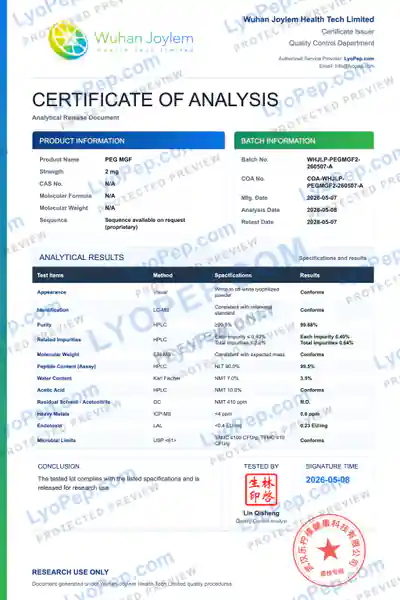
PEG-MGF factory batch COAs

Representative records, refreshed periodically

Published COAs show representative factory batches and may not be the latest available. For a current quote or shipment, our sales team can confirm the applicable lot and provide its COA.

Independent testing, arranged on request

Third-party reports are not routinely published. If independent verification is required, we can agree the laboratory, method, acceptance criteria and remedy before testing. If the agreed specification is not met, an appropriate resolution—including a refund where applicable—can be discussed under the agreed terms. Unless otherwise agreed in writing, the buyer pays the cost of this optional testing.

Help reviewing your COA

Need help reading a factory COA or third-party report? Our sales team can clarify test items, specifications and how the results relate to the lot under discussion.

Ask for the current packet, not a generic certificate

  • Require peptide identity and content, PEG nominal mass and dispersity, linker, conjugation site, substitution distribution, intact-mass envelope or conjugate mapping, free peptide, free PEG, aggregates, related peptides, water, residual solvents, container integrity and lot-specific stability
  • No single CAS, formula, nominal mass or HPLC purity can qualify the conjugate.
Released-batch COARP-HPLC result and method contextIdentity result appropriate to the moleculeWater / counter-ion context where relevantSDS and handling statementAdditional testing scoped on request

Available fills

Quote the fill and pack configuration you need

Reference SKUFillBase pack
PEGMGF-2MG2 mg10 vials

Handling

Storage in the lab and temperature during transit are different decisions

Follow released-lot label, COA and conjugate-specific stability data. Generic 2–8°C or reconstituted-storage advice is not transferable across PEG architectures and matrices.

State destination, season, acceptable transit exposure and whether your protocol requires insulated or cold-chain service. Additional temperature-control cost is quoted explicitly.

Buyer FAQ

Terms to settle before the purchase order

Can a buyer arrange third-party testing?+

Yes. Testing must be performed by a mutually accepted, established specialist laboratory. Fee allocation, specification, sampling, method and acceptance rule must be agreed before testing; if an agreed independent result shows nonconformance, the remedy follows the signed order terms. Unless otherwise agreed in writing, the buyer pays the cost of this optional testing.

Does HPLC purity prove peptide content?+

No. Chromatographic purity describes the relative peak profile under a stated method. Identity, water, counter-ion, residual solvents and assay/content may require separate methods.

Is cold-chain shipping always required?+

Not always. Heat can accelerate degradation, especially during summer and long transit. Cold-chain reduces exposure but raises cost. State the destination and stability risk so the right service can be quoted.

How are payment terms handled?+

Available methods and milestones depend on order value, destination and project type. The pro forma invoice should state currency, bank details, fees, payment milestones and the release condition.

Why must the testing laboratory understand peptide chemistry?+

Free-base and salt forms, hydrophilic and hydrophobic sequences, aggregation and adsorption can change sample preparation and method suitability. Use a laboratory experienced with the molecule class.

These are buyer-qualification references, not claims that this RUO material is regulated, certified or released under those frameworks. Applicability depends on the buyer's workflow and jurisdiction.

Selected sources

Literature behind the research context

  • 1) Kandalla PK, Goldspink G, Butler-Browne G, Mouly V. (2011) "Mechano Growth Factor E peptide (MGF-E), derived from an isoform of IGF-1, activates human muscle progenitor cells and induces an increase in their fusion potential at different ages." Mechanisms of Ageing and Development 132(4):154-162, PMID 21354439, doi:10.1016/j.mad.2011.02.007. This in-vitro study used non-PEGylated MGF-E peptide in human muscle progenitor cells; it is not direct evidence for an unspecified PEG conjugate.
  • 2) Fornaro M, Hinken AC, Needle S, et al. (2014) "Mechano-growth factor peptide, the COOH terminus of unprocessed insulin-like growth factor 1, has no apparent effect on myoblasts or primary muscle stem cells." American Journal of Physiology-Endocrinology and Metabolism 306(2):E150-E156, PMID 24253050, doi:10.1152/ajpendo.00408.2013. Concentrations up to 500 ng/ml produced no proliferative or anti-differentiation effect in the reported cell models, directly conflicting with earlier positive findings.
  • 3) Rotwein P. (2014) "Editorial: The Fall of Mechanogrowth Factor?" Molecular Endocrinology 28(2):155-156, PMID 24460193, PMC3896639, doi:10.1210/me.2013-1411. The contemporaneous editorial discusses the conflicting MGF literature, possible confirmation bias and the need for independent replication.
  • 4) Mills P, Lafrenière JF, Benabdallah BF, El Fahime EM, Tremblay JP. (2007) "A new pro-migratory activity on human myogenic precursor cells for a synthetic peptide within the E domain of the mechano growth factor." Experimental Cell Research 313(3):527-537, PMID 17156777, doi:10.1016/j.yexcr.2006.10.032. This is non-PEGylated peptide evidence in cell and transplantation models, not qualification of a PEG-MGF material.
  • 5) Sun KT, Cheung KK, Au SWN, Yeung SS, Yeung EW. (2018) "Overexpression of Mechano-Growth Factor Modulates Inflammatory Cytokine Expression and Macrophage Resolution in Skeletal Muscle Injury." Frontiers in Physiology 9:999, PMID 30140235, PMC6094977, doi:10.3389/fphys.2018.00999. This mouse model studied MGF overexpression rather than a chemically defined PEG-MGF conjugate.
  1. 01

    Different roles of the IGF-I Ec peptide (MGF) and mature IGF-I in myoblast proliferation and differentiation

    FEBS Letters · 2002 · peer-reviewed original research

    Open source
  2. 02

    Mechano-growth factor reduces loss of cardiac function in acute myocardial infarction

    Heart, Lung and Circulation · 2008 · peer-reviewed original research (animal model)

    Open source
  3. 03

    The E-domain region of mechano-growth factor inhibits cellular apoptosis and preserves cardiac function during myocardial infarction

    Molecular and Cellular Biochemistry · 2013 · peer-reviewed original research (in vitro and murine model)

    Open source
  4. 04

    Minireview: Mechano-Growth Factor: A Putative Product of IGF-I Gene Expression Involved in Tissue Repair and Regeneration

    Endocrinology · 2010 · peer-reviewed minireview (critical/skeptical)

    Open source
  5. 05

    Mechano-growth factor peptide, the COOH terminus of unprocessed insulin-like growth factor 1, has no apparent effect on myoblasts or primary muscle stem cells

    American Journal of Physiology-Endocrinology and Metabolism · 2014 · peer-reviewed original research (contradicting findings)

    Open source
  6. 06

    Editorial: The Fall of Mechanogrowth Factor?

    Molecular Endocrinology · 2014 · peer-reviewed editorial (critical/skeptical)

    Open source
  7. 07

    The role of mechano growth factor in chondrocytes and cartilage defects: a concise review

    Acta Biochimica et Biophysica Sinica (Shanghai) · 2023 · peer-reviewed review

    Open source
  8. 08

    Mechano growth factor E peptide regulates migration and differentiation of bone marrow mesenchymal stem cells

    Journal of Molecular Endocrinology · 2014 · peer-reviewed original research

    Open source

Product FAQ

Questions buyers ask about PEG-MGF

Why can two PEG-MGF materials with the same name be non-equivalent?+

PEG molecular mass, dispersity, linear or branched architecture, linker, attachment site and PEG-to-peptide substitution distribution can all differ. These variables change intact-mass distribution, chromatography, recovery, activity and clearance. The name alone does not define a molecule; compare complete released-lot specifications and orthogonal analytical data.

What should a decision-ready PEG-MGF COA include?+

Require the exact MGF-related peptide sequence and terminal state, PEG identity, nominal mass and dispersity, linker and conjugation site, substitution distribution, intact-mass or conjugate-mapping evidence, peptide content, free peptide, free PEG, aggregates, related peptides, water, residual solvents, container and lot-specific stability. A single HPLC area purity or nominal PEG mass is insufficient.