Recent Confirmed OrdersLast 7 days
Australia520 mgTirzepatide 40 mg · Semaglutide 2 mg · Dihexa 10 mg
View all

Growth-hormone axis research

IGF-1 LR3

Long R3 IGF-I · 83-residue IGF-I analogue for cell-culture and receptor research

≥ 99.0% · target, verify batch COACAS 143045-27-6RUO
Research statusLimited Research
Supplied form83-residue engineered, three-disulfide IGF-I protein analogue
Lead time14–21 days
IGF-1 LR3 — Lyophilized material; confirm released-lot appearance on the COA
IGF-1 LR3 — Lyophilized material; confirm released-lot appearance on the COA · Representative packaging image · verify the ordered lot
Representative packaging image · verify the ordered lot

Decision summary

Key benefits

  • Research value: IGF-1 LR3 supports controlled studies of IGF1R signaling, IGFBP resistance, mitogenic/anti-apoptotic pathways, cell-line growth and bioprocess optimization
  • Animal anabolic, organ-growth and metabolic results do not establish human muscle growth, fat loss, recovery, tissue repair or anti-aging benefits.
Published research context is presented for literature orientation only. It is not a dosing, treatment or human-use instruction.
Qualification data

Specifications to confirm against the released lot

CAS
143045-27-6
Formula
C400H619N111O115S9 (three disulfides; reduced chain C400H625N111O115S9)
Molecular weight
About 9111.6 Da
Appearance
Lyophilized material; confirm released-lot appearance on the COA
Purity
≥ 99.0% · target, verify batch COA
Storage
Use the released-lot COA and stability statement for the supplied recombinant form. Define temperature, container closure, freeze-thaw allowance, adsorption controls, solvent, concentration and microbiological limits. Repligen instructions apply to its own qualified cell-culture formulations and are not automatically transferable to another lot.
MOQ
On request
Lead time
14–21 days

Qualification matrix

Identity, purity and content are separate release questions.

Identity

Confirm the stated molecule and supplied form. Start with the matching batch COA; request sequence-level evidence only when the buyer's written procedure requires it and availability or a separate scope has been agreed.

Purity

Review RP-HPLC method conditions, wavelength, integration and related-peak handling. A percentage without the method is not enough.

Content

Net peptide content is not the same as gross lyophilized powder weight. Ask which assay supports the stated amount and whether water/counter-ion is addressed.

Stability

Define long-term storage and transit exposure separately. Cold-chain can be quoted when the buyer’s risk assessment requires it and adds cost.

Research context

What researchers study about IGF-1 LR3

IGF-1 LR3 (Long R3 IGF-I) is an 83-residue recombinant analogue of human IGF-I, engineered with a 13-residue N-terminal extension and an Arg substitution at position 3 to reduce binding to IGF-binding proteins. Its established commercial role is as a mammalian cell-culture supplement and research reagent. Direct evidence is predominantly in vitro and animal research; no qualifying interventional human trial of LR3 IGF-I was identified. FDA GSRS records the substance identity but explicitly states that UNII availability does not imply regulatory review or approval. This catalog material is RUO and not a finished dosage form.

  • Evidence contexts include recombinant cell-culture supplementation, IGF1R/IGFBP mechanism research, and animal studies of growth, endocrine feedback and tissue biology
  • Native IGF-I studies, epidemiology, veterinary case series and other analogues are indirect context and cannot establish LR3 human efficacy or safety.

Mechanism context

The question the literature is testing

IGF-1 LR3 activates the type 1 IGF receptor. Its N-terminal extension and Arg3 substitution markedly reduce affinity for IGF-binding proteins, increasing receptor availability in relevant in vitro systems. Downstream signaling can include PI3K/Akt/mTOR and MAPK/ERK pathways, but pathway activation does not establish a clinical outcome or lot-specific biological potency without a qualified assay.

Evidence map

Research routes and exposure context

Evidence tierAnalytical / laboratory context
Routes reported in sources
No administration route applies
Dose / exposure contextProtocol-specific; verify the cited primary source
Routes and exposure contexts summarize cited studies or approved finished-product labels. They are not instructions for administering this RUO material; no customer dose is provided.

Evidence boundaries

Compatibility, limitations and decision context

  • IGF-1 LR3 has no established administered-human safety profile
  • Mitogenic and glucose-regulatory activity creates material experimental hazards, and animal findings show strong species and protocol dependence
  • WADA prohibits IGF-1 and its analogues for athletes subject to the Code
  • Handle as an RUO recombinant growth factor under institutional risk controls; this record provides no injection, hypoglycaemia-management, cancer-screening or athletic-use advice.

Interactions reported in the literature

  • No human combination-use guidance is provided
  • Cell-culture co-supplementation with insulin is a process-development question requiring cell-line-specific titration and controls; it is not evidence for co-administration
  • Vendor stacking claims involving HGH, insulin, secretagogues, anabolic agents or other peptides are excluded.
Literature context is not a supplier release result or human-use instruction. Follow your institution's approved laboratory risk assessment.

Factory batch documentation

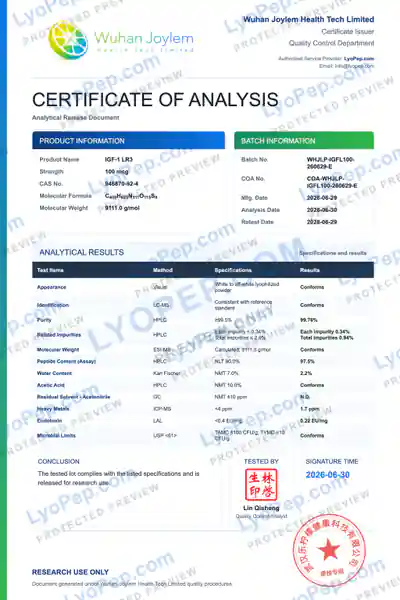
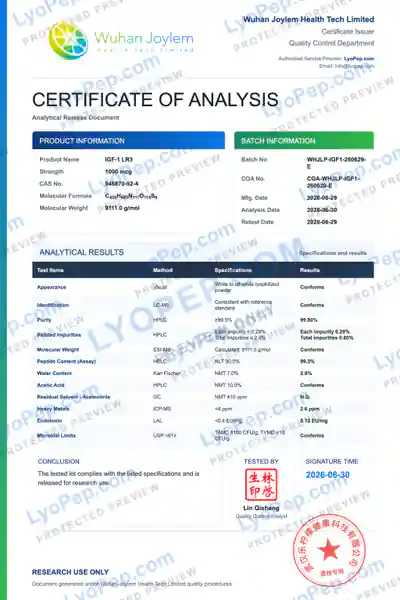
IGF-1 LR3 factory batch COAs

Representative records, refreshed periodically

Published COAs show representative factory batches and may not be the latest available. For a current quote or shipment, our sales team can confirm the applicable lot and provide its COA.

Independent testing, arranged on request

Third-party reports are not routinely published. If independent verification is required, we can agree the laboratory, method, acceptance criteria and remedy before testing. If the agreed specification is not met, an appropriate resolution—including a refund where applicable—can be discussed under the agreed terms. Unless otherwise agreed in writing, the buyer pays the cost of this optional testing.

Help reviewing your COA

Need help reading a factory COA or third-party report? Our sales team can clarify test items, specifications and how the results relate to the lot under discussion.

Ask for the current packet, not a generic certificate

  • Require the complete 83-residue sequence, correct disulfide connectivity, high-resolution intact and reduced mass, orthogonal identity, protein-content assay, aggregate and fragment profile, residual host-cell proteins/DNA where relevant, endotoxin or bioburden limits appropriate to the model, water and residual process impurities
  • HPLC area purity or intact mass alone does not establish correct folding or biological activity.
Released-batch COARP-HPLC result and method contextIdentity result appropriate to the moleculeWater / counter-ion context where relevantSDS and handling statementAdditional testing scoped on request

Available fills

Quote the fill and pack configuration you need

Reference SKUFillBase pack
IGF1-0100MCG100 mcg10 vials
IGF1-1000MCG1000 mcg10 vials

Handling

Storage in the lab and temperature during transit are different decisions

Use the released-lot COA and stability statement for the supplied recombinant form. Define temperature, container closure, freeze-thaw allowance, adsorption controls, solvent, concentration and microbiological limits. Repligen instructions apply to its own qualified cell-culture formulations and are not automatically transferable to another lot.

State destination, season, acceptable transit exposure and whether your protocol requires insulated or cold-chain service. Additional temperature-control cost is quoted explicitly.

Buyer FAQ

Terms to settle before the purchase order

Can a buyer arrange third-party testing?+

Yes. Testing must be performed by a mutually accepted, established specialist laboratory. Fee allocation, specification, sampling, method and acceptance rule must be agreed before testing; if an agreed independent result shows nonconformance, the remedy follows the signed order terms. Unless otherwise agreed in writing, the buyer pays the cost of this optional testing.

Does HPLC purity prove peptide content?+

No. Chromatographic purity describes the relative peak profile under a stated method. Identity, water, counter-ion, residual solvents and assay/content may require separate methods.

Is cold-chain shipping always required?+

Not always. Heat can accelerate degradation, especially during summer and long transit. Cold-chain reduces exposure but raises cost. State the destination and stability risk so the right service can be quoted.

How are payment terms handled?+

Available methods and milestones depend on order value, destination and project type. The pro forma invoice should state currency, bank details, fees, payment milestones and the release condition.

Why must the testing laboratory understand peptide chemistry?+

Free-base and salt forms, hydrophilic and hydrophobic sequences, aggregation and adsorption can change sample preparation and method suitability. Use a laboratory experienced with the molecule class.

These are buyer-qualification references, not claims that this RUO material is regulated, certified or released under those frameworks. Applicability depends on the buyer's workflow and jurisdiction.

Selected sources

Literature behind the research context

  • Key sources: FDA GSRS UNII M9L22Y19H9; Repligen LONG R3 IGF-I product and FAQ/quality documents; WADA 2026 Prohibited List; Tomas et al. 1992 (PMID 1378742); the 1995 guinea-pig study (PMID 7561636); the 1999 satellite-cell study (PMID 10632630); and the listed IGF-1 signaling, anti-doping and tendon reviews. Evidence is labelled as direct LR3, parent-pathway, animal, veterinary or secondary context.
  1. 01

    Novel recombinant fusion protein analogues of insulin-like growth factor (IGF)-I indicate the relative importance of IGF-binding protein and receptor binding for enhanced biological potency

    Journal of Molecular Endocrinology · 1992 · peer-reviewed original research

    Open source
  2. 02

    Long R3 insulin-like growth factor-I (IGF-I) infusion stimulates organ growth but reduces plasma IGF-I, IGF-II and IGF binding protein concentrations in the guinea pig

    Journal of Endocrinology · 1995 · peer-reviewed original research (animal study)

    Open source
  3. 03

    Contribution of satellite cells to IGF-I induced hypertrophy of skeletal muscle

    Acta Physiologica Scandinavica · 1999 · peer-reviewed original research (animal study)

    Open source
  4. 04

    Mechanisms of IGF-1-Mediated Regulation of Skeletal Muscle Hypertrophy and Atrophy

    Cells · 2020 · peer-reviewed review

    Open source
  5. 05

    Insulin-Like Growth Factor-1 (IGF-1) and Its Monitoring in Medical Diagnostic and in Sports

    Biomolecules · 2021 · peer-reviewed review

    Open source
  6. 06

    Doping and sports endocrinology: growth hormone, IGF-1, insulin, and erythropoietin

    Revista Clínica Española (Barcelona) · 2023 · peer-reviewed review

    Open source
  7. 07

    Insulin-like growth factor-1 (IGF-1) empowering tendon regenerative therapies

    Frontiers in Bioengineering and Biotechnology · 2025 · peer-reviewed review

    Open source
  8. 08

    Intralesional injection of insulin-like growth factor-I for treatment of superficial digital flexor tendonitis in Thoroughbred racehorses: 40 cases (2000-2004)

    Journal of the American Veterinary Medical Association · 2011 · peer-reviewed original research (veterinary clinical case series)

    Open source

Product FAQ

Questions buyers ask about IGF-1 LR3

What analytical package is appropriate for IGF-1 LR3?+

Confirm the complete 83-residue sequence, intact and reduced mass, peptide mapping or another orthogonal identity method, the three native disulfide bonds, chromatographic and electrophoretic purity, aggregates and fragments, and protein content. A qualified receptor or cell-based potency assay is needed if biological activity matters. If the lot is made in E. coli, set appropriate endotoxin, host-cell protein and residual host-cell DNA limits; do not infer the expression system from the product name alone.

Why can two molecular masses be reported for the same 83-residue sequence?+

The reduced free-thiol chain has composition C₄₀₀H₆₂₅N₁₁₁O₁₁₅S₉ and an average mass of about 9,117.6 Da. Formation of three intramolecular disulfide bonds removes six hydrogens, giving C₄₀₀H₆₁₉N₁₁₁O₁₁₅S₉ and about 9,111.6 Da; Repligen’s current freeze-dried product COA uses a 9,108–9,112 Da mass-spectrometry acceptance range. A COA should state whether a theoretical or measured value is average or monoisotopic and whether it refers to reduced or disulfide-bonded material.