Recent Confirmed OrdersLast 7 days
Australia520 mgTirzepatide 40 mg · Semaglutide 2 mg · Dihexa 10 mg
View all

Immune signaling research

Thymalin

Bovine-thymus polypeptide extract for analytical research

Not expressible as a single-compound percentage; release by quantitative content plus validated multi-method compositional fingerprint and safety specifications. · target, verify batch COACAS 79621-14-0RUO
Research statusComposition Heterogeneous / Clinical Evidence Low Certainty
Supplied formHeterogeneous animal-tissue-derived peptide and protein extract. No single sequence, formula, molecular weight or small-molecule purity applies. This SKU is Thymalin only; it does not include Thymulin/FTS.
Lead time14–21 days
Thymalin — Lot-specific lyophilized research material, commonly off-white to white. Appearance or solution clarity cannot establish identity, composition, sterility or suitability.
Thymalin — Lot-specific lyophilized research material, commonly off-white to white. Appearance or solution clarity cannot establish identity, composition, sterility or suitability. · Representative packaging image · verify the ordered lot
Representative packaging image · verify the ordered lot

Decision summary

Key benefits

  • The supported B2B value is for research on animal-derived thymic extract fingerprints, cell-response assays and historical thymic-bioregulator literature
  • Claims of immune restoration, infection reduction, mortality reduction, anti-ageing, cancer benefit or COVID-19 treatment arise from poorly reported long-term cohorts, small single-centre trials, preclinical work or closely affiliated studies and must not be presented as established benefits of this lot.
Published research context is presented for literature orientation only. It is not a dosing, treatment or human-use instruction.
Qualification data

Specifications to confirm against the released lot

CAS
79621-14-0
Formula
Not applicable to the supplied material
Molecular weight
858.9 g/mol
Appearance
Lot-specific lyophilized research material, commonly off-white to white. Appearance or solution clarity cannot establish identity, composition, sterility or suitability.
Purity
Not expressible as a single-compound percentage; release by quantitative content plus validated multi-method compositional fingerprint and safety specifications. · target, verify batch COA
Storage
Follow the lot COA and validated stability protocol for the exact extract. Protect from heat, moisture and repeated temperature cycling. Because this is an animal-derived multicomponent material, stability must monitor fingerprint similarity, total content, degradation and microbial attributes rather than relying on appearance alone.
MOQ
On request
Lead time
14–21 days

Qualification matrix

Identity, purity and content are separate release questions.

Identity

Confirm the stated molecule and supplied form. Start with the matching batch COA; request sequence-level evidence only when the buyer's written procedure requires it and availability or a separate scope has been agreed.

Purity

Review RP-HPLC method conditions, wavelength, integration and related-peak handling. A percentage without the method is not enough.

Content

Net peptide content is not the same as gross lyophilized powder weight. Ask which assay supports the stated amount and whether water/counter-ion is addressed.

Stability

Define long-term storage and transit exposure separately. Cold-chain can be quoted when the buyer’s risk assessment requires it and adds cost.

Research context

What researchers study about Thymalin

Thymalin is described in the literature as a polypeptide complex isolated from calf or bovine thymus, not a single defined peptide. Published work is concentrated within the Khavinson-linked research network and includes cell studies, two small single-centre randomized COVID-19 reports and long-term geroprotector reports with insufficient methods detail in their abstracts for independent causal appraisal. These studies do not define a universal composition or demonstrate equivalence of a new 10 mg research lot. Literature discusses KE, EW and EDP short peptides in relation to Thymalin, but their presence and amount in a supplied batch must be analytically demonstrated. Thymulin/FTS is a separate defined nonapeptide and has been removed from this SKU.

  • Appropriate work includes raw-material fingerprinting, lot-comparability studies, identification and quantification of peptide components, cell-based immune-signaling assays and evaluation of extraction or degradation variables
  • Historical immune, ageing, oncology and COVID-19 reports define literature context only; they do not create a drug indication or human-use protocol for this SKU.

Mechanism context

The question the literature is testing

Cell and molecular studies from the principal research network report changes in hematopoietic-cell markers, cytokines and gene-expression models after exposure to Thymalin or selected short peptides. Because the extract is heterogeneous, those findings cannot be assigned to a single active molecule or assumed for an uncharacterized batch. Molecular docking and in vitro cytokine results are hypothesis-generating and do not establish human mechanism, exposure or clinical efficacy.

Evidence map

Research routes and exposure context

Evidence tierHuman clinical research
Routes reported in sources
No administration route applies
Dose / exposure contextProtocol-specific; verify the cited primary source
Routes and exposure contexts summarize cited studies or approved finished-product labels. They are not instructions for administering this RUO material; no customer dose is provided.

Evidence boundaries

Compatibility, limitations and decision context

  • Animal-tissue origin introduces source traceability, adventitious-agent, TSE/BSE, microbial, endotoxin and batch-variability concerns
  • Published claims of few side effects do not substitute for modern adverse-event collection or product-specific toxicology
  • The material is not FDA-approved, and FDA warned in 2024 that marketing a Thymalin research product for human conditions, including use in children, constituted unapproved-new-drug and misbranding violations
  • This RUO extract is not sterile or qualified for injection and no pregnancy, paediatric, autoimmune, transplant or oncology safety conclusion is made.

Interactions reported in the literature

  • No reliable clinical interaction or synergy matrix is established for this extract with Thymulin, Epitalon, Thymosin Alpha-1, Thymogen, Pinealon, corticosteroids, immunosuppressants, chemotherapy or radiotherapy
  • Apparent antagonism or synergy based on mechanism is speculative
  • Research combinations require component characterization and protocol-specific controls.
Literature context is not a supplier release result or human-use instruction. Follow your institution's approved laboratory risk assessment.

Factory batch documentation

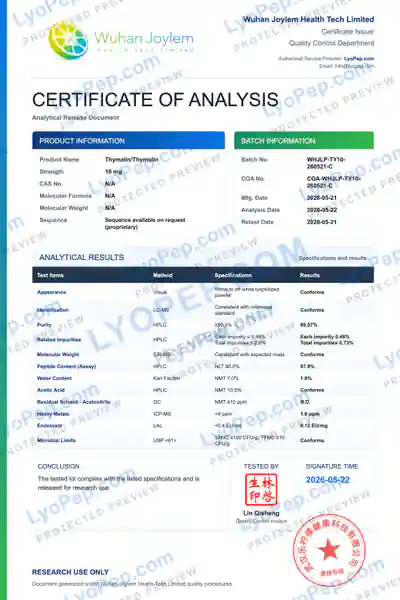
Thymalin factory batch COAs

Representative records, refreshed periodically

Published COAs show representative factory batches and may not be the latest available. For a current quote or shipment, our sales team can confirm the applicable lot and provide its COA.

Independent testing, arranged on request

Third-party reports are not routinely published. If independent verification is required, we can agree the laboratory, method, acceptance criteria and remedy before testing. If the agreed specification is not met, an appropriate resolution—including a refund where applicable—can be discussed under the agreed terms. Unless otherwise agreed in writing, the buyer pays the cost of this optional testing.

Help reviewing your COA

Need help reading a factory COA or third-party report? Our sales team can clarify test items, specifications and how the results relate to the lot under discussion.

Ask for the current packet, not a generic certificate

  • Require declared bovine species, thymus tissue and country/establishment traceability; veterinary health and TSE/BSE documentation; controlled extraction, clarification and inactivation records; total peptide and protein content; orthogonal SEC, RP-HPLC and LC-MS fingerprints with reference-lot similarity ranges; targeted confirmation of claimed KE, EW or EDP components; residual process chemicals, water, elemental impurities, bioburden, endotoxin and form-specific stability
  • If sterility is claimed, require a validated sterile process and compendial testing, but this RUO listing makes no sterile-use claim
  • A white powder, clear reconstitution or nominal 99% HPLC result is not adequate release evidence.
Released-batch COARP-HPLC result and method contextIdentity result appropriate to the moleculeWater / counter-ion context where relevantSDS and handling statementAdditional testing scoped on request

Available fills

Quote the fill and pack configuration you need

Reference SKUFillBase pack
THYMA-10MG10 mg10 vials

Handling

Storage in the lab and temperature during transit are different decisions

Follow the lot COA and validated stability protocol for the exact extract. Protect from heat, moisture and repeated temperature cycling. Because this is an animal-derived multicomponent material, stability must monitor fingerprint similarity, total content, degradation and microbial attributes rather than relying on appearance alone.

State destination, season, acceptable transit exposure and whether your protocol requires insulated or cold-chain service. Additional temperature-control cost is quoted explicitly.

Buyer FAQ

Terms to settle before the purchase order

Can a buyer arrange third-party testing?+

Yes. Testing must be performed by a mutually accepted, established specialist laboratory. Fee allocation, specification, sampling, method and acceptance rule must be agreed before testing; if an agreed independent result shows nonconformance, the remedy follows the signed order terms. Unless otherwise agreed in writing, the buyer pays the cost of this optional testing.

Does HPLC purity prove peptide content?+

No. Chromatographic purity describes the relative peak profile under a stated method. Identity, water, counter-ion, residual solvents and assay/content may require separate methods.

Is cold-chain shipping always required?+

Not always. Heat can accelerate degradation, especially during summer and long transit. Cold-chain reduces exposure but raises cost. State the destination and stability risk so the right service can be quoted.

How are payment terms handled?+

Available methods and milestones depend on order value, destination and project type. The pro forma invoice should state currency, bank details, fees, payment milestones and the release condition.

Why must the testing laboratory understand peptide chemistry?+

Free-base and salt forms, hydrophilic and hydrophobic sequences, aggregation and adsorption can change sample preparation and method suitability. Use a laboratory experienced with the molecule class.

These are buyer-qualification references, not claims that this RUO material is regulated, certified or released under those frameworks. Applicability depends on the buyer's workflow and jurisdiction.

Selected sources

Literature behind the research context

  • PMID 14523363 and PMID 12577695 are overlapping 6-8-year geroprotector reports whose abstracts do not provide enough allocation, blinding, attrition or baseline detail for independent causal appraisal. PMID 33575961/PMCID PMC7877506 reports a small single-centre open-label randomized COVID-19 comparison, while PMCID PMC8654498 reports a separate small prospective randomized single-blind severe-COVID comparison; neither provides independent replication or proves equivalence of this lot. PMCID PMC8365293 is a narrative review by the same network. PMCID PMC10488166 combines docking, bioinformatics and in vitro work. PMCID PMC7686446 reports in vitro hematopoietic-cell-marker changes, and PMID 29797130 is a rat sarcoma study. FDA's 2024 warning letter is the primary U.S. regulatory source; the 2011 EMA TSE guidance supplies the relevant quality framework for bovine-derived materials.
  1. 01

    Peptides of pineal gland and thymus prolong human life

    Neuroendocrinology Letters · 2003 · original long-term clinical report (PubMed-indexed as a randomized controlled trial; allocation methods not reported in the abstract)

    Open source
  2. 02

    Geroprotective effect of thymalin and epithalamin

    Advances in Gerontology · 2002 · Russian-language review and earlier report of the same 266-person geroprotector program

    Open source
  3. 03

    The Use of Thymalin for Immunocorrection and Molecular Aspects of Biological Activity

    Biology Bulletin Reviews · 2021 · peer-reviewed review article

    Open source
  4. 04

    Results and Prospects of Using Activator of Hematopoietic Stem Cell Differentiation in Complex Therapy for Patients with COVID-19

    Stem Cell Reviews and Reports · 2021 · peer-reviewed clinical report (single-centre, open-label, prospective randomized controlled study)

    Open source
  5. 05

    Peptide Drug Thymalin Regulates Immune Status in Severe COVID-19 Older Patients

    Advances in Gerontology · 2021 · peer-reviewed clinical report (prospective randomized single-blind controlled study)

    Open source
  6. 06

    The Influence of KE and EW Dipeptides in the Composition of the Thymalin Drug on Gene Expression and Protein Synthesis Involved in the Pathogenesis of COVID-19

    International Journal of Molecular Sciences · 2023 · peer-reviewed original research (molecular docking, bioinformatics, and in vitro study)

    Open source
  7. 07

    Thymalin: Activation of Differentiation of Human Hematopoietic Stem Cells

    Bulletin of Experimental Biology and Medicine · 2020 · peer-reviewed original research (in vitro/ex vivo)

    Open source
  8. 08

    Effect of Thymalin on the Tumor and Thymus under Conditions of Activation Therapy In Vivo

    Bulletin of Experimental Biology and Medicine · 2018 · peer-reviewed original research (animal study)

    Open source

Product FAQ

Questions buyers ask about Thymalin

Why must Thymalin and Thymulin be ordered as separate products?+

Thymalin is a heterogeneous bovine-thymus extract released by a compositional fingerprint; Thymulin/FTS is a defined zinc-dependent nonapeptide associated with CAS 63958-90-7 and PubChem CID 3085284. A single-peptide HPLC purity or mass result for Thymulin cannot release Thymalin, and a Thymalin extract fingerprint cannot identify Thymulin. This SKU and COA must state Thymalin only.

What documentation should accompany a Thymalin research lot?+

Require animal species and tissue, country and establishment traceability, veterinary and TSE/BSE risk documentation, extraction and inactivation process summary, total peptide/protein content, orthogonal SEC/RP-HPLC and LC-MS fingerprint comparison, lot-to-lot similarity, water, residual process chemicals, bioburden, endotoxin and stability. A generic purity percentage is not sufficient.

Can a heterogeneous Thymalin extract be described as at least 99% pure?+

No single-compound 99% purity claim is scientifically meaningful for an intentionally multicomponent extract. Report total content and a validated compositional fingerprint with defined acceptance ranges. Any stated HPLC percentage must identify the measured analyte and method rather than imply that the whole extract is one molecule.