Recent Confirmed OrdersLast 7 days
United States8 gEpithalon 50 mg · TB-500 10 mg · CJC-1295 + Ipamorelin 10 mg · Melanotan II 10 mg · Bacteriostatic Water 10 ml
View all

Immune signaling research

ARA 290 (Cibinetide)

EPO-derived 11-mer · cytoprotective research peptide

≥ 99.0% · target, verify batch COACAS 1208243-50-8RUO
Research statusInvestigational; phase 2 evidence exists, but cibinetide is not an approved medicine reference context · supplied material is RUO
Supplied formUndecapeptide (linear, N-terminal pyroglutamate)
Lead time14–21 days
ARA 290 (Cibinetide) — Lot-specific lyophilized research peptide; confirm released-lot appearance on the COA
ARA 290 (Cibinetide) — Lot-specific lyophilized research peptide; confirm released-lot appearance on the COA · Representative packaging image · verify the ordered lot
Representative packaging image · verify the ordered lot

Decision summary

Key benefits

  • Research relevance includes proposed innate-repair-receptor signaling, neuroinflammation models, nerve-fiber biomarkers and peptide analytical characterization
  • Early clinical biomarker signals and preclinical tissue-protection findings must not be presented as approved therapeutic benefits.
Published research context is presented for literature orientation only. It is not a dosing, treatment or human-use instruction.
Qualification data

Specifications to confirm against the released lot

CAS
1208243-50-8
Formula
C51H84N16O21
Molecular weight
1257.3 g/mol
Appearance
Lot-specific lyophilized research peptide; confirm released-lot appearance on the COA
Purity
≥ 99.0% · target, verify batch COA
Storage
Follow the released-lot COA and manufacturer stability instructions. Keep sealed and protected from moisture, heat and light; do not infer prepared-solution stability from the lyophilized-powder specification.
MOQ
On request
Lead time
14–21 days
PubChem CID 91810664

Qualification matrix

Identity, purity and content are separate release questions.

Identity

Confirm the stated molecule and supplied form. Start with the matching batch COA; request sequence-level evidence only when the buyer's written procedure requires it and availability or a separate scope has been agreed.

Purity

Review RP-HPLC method conditions, wavelength, integration and related-peak handling. A percentage without the method is not enough.

Content

Net peptide content is not the same as gross lyophilized powder weight. Ask which assay supports the stated amount and whether water/counter-ion is addressed.

Stability

Define long-term storage and transit exposure separately. Cold-chain can be quoted when the buyer’s risk assessment requires it and adds cost.

Research context

What researchers study about ARA 290 (Cibinetide)

ARA 290 (cibinetide) is an engineered 11-residue peptide derived from the helix-B surface of erythropoietin. It was developed to investigate proposed tissue-protective signaling without classical erythropoiesis. Small phase 2 studies evaluated neuropathy and other conditions, with mixed and often exploratory outcomes. Trial designations and orphan or Fast Track status do not constitute marketing authorization; this lot is Research Use Only.

  • Laboratory studies of peptide-receptor signaling, neuroinflammation and tissue-protection models, nerve-fiber biomarkers and analytical method development
  • These are research applications, not clinical indications.

Mechanism context

The question the literature is testing

Cibinetide is reported to engage a tissue-protective receptor complex involving EPOR and CD131 and to trigger downstream survival and anti-inflammatory signaling without classical erythropoietic activity. Mechanistic conclusions depend on the model and assay; unverified claims that effects persist for 24-72 hours are not used.

Evidence map

Research routes and exposure context

Evidence tierApproved finished-product context
Routes reported in sources
No administration route applies
Dose / exposure contextProtocol-specific; verify the cited primary source
Routes and exposure contexts summarize cited studies or approved finished-product labels. They are not instructions for administering this RUO material; no customer dose is provided.

Evidence boundaries

Compatibility, limitations and decision context

  • Not for human or veterinary use
  • Follow the SDS and institutional laboratory controls
  • Small clinical studies cannot establish broad or long-term safety, and trial eligibility criteria are not product warnings
  • Chemical purity does not establish sterility, injectable suitability or clinical safety.

Interactions reported in the literature

  • Not established for this Research Use Only reagent
  • Trial exclusion criteria are protocol-specific and are not generalized into patient interaction or combination advice.
Literature context is not a supplier release result or human-use instruction. Follow your institution's approved laboratory risk assessment.

Factory batch documentation

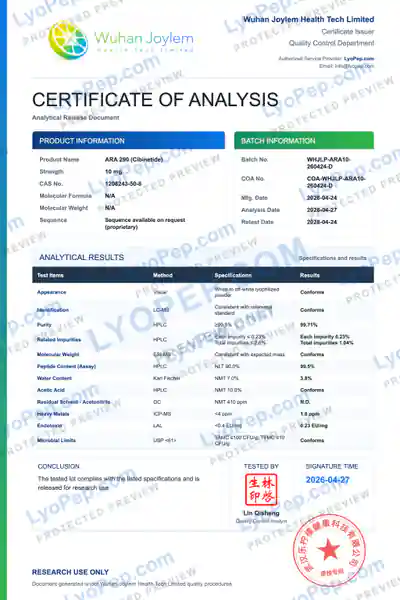
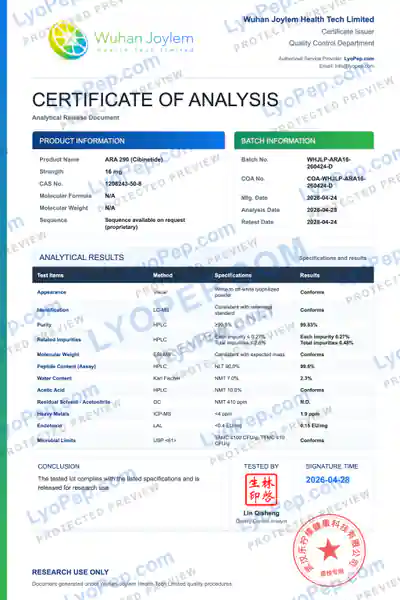
ARA 290 (Cibinetide) factory batch COAs

Representative records, refreshed periodically

Published COAs show representative factory batches and may not be the latest available. For a current quote or shipment, our sales team can confirm the applicable lot and provide its COA.

Independent testing, arranged on request

Third-party reports are not routinely published. If independent verification is required, we can agree the laboratory, method, acceptance criteria and remedy before testing. If the agreed specification is not met, an appropriate resolution—including a refund where applicable—can be discussed under the agreed terms. Unless otherwise agreed in writing, the buyer pays the cost of this optional testing.

Help reviewing your COA

Need help reading a factory COA or third-party report? Our sales team can clarify test items, specifications and how the results relate to the lot under discussion.

Ask for the current packet, not a generic certificate

  • Require exact sequence and termini, supplied form and counterion, theoretical and observed intact mass, LC-MS identity, RP-HPLC purity with method, peptide content, water and residual solvents
  • Sterility, endotoxin and bioburden are separate claims requiring released-lot tests.
Released-batch COARP-HPLC result and method contextIdentity result appropriate to the moleculeWater / counter-ion context where relevantSDS and handling statementAdditional testing scoped on request

Available fills

Quote the fill and pack configuration you need

Reference SKUFillBase pack
ARA-10MG10 mg10 vials
ARA-16MG16 mg10 vials

Handling

Storage in the lab and temperature during transit are different decisions

Follow the released-lot COA and manufacturer stability instructions. Keep sealed and protected from moisture, heat and light; do not infer prepared-solution stability from the lyophilized-powder specification.

State destination, season, acceptable transit exposure and whether your protocol requires insulated or cold-chain service. Additional temperature-control cost is quoted explicitly.

Buyer FAQ

Terms to settle before the purchase order

Can a buyer arrange third-party testing?+

Yes. Testing must be performed by a mutually accepted, established specialist laboratory. Fee allocation, specification, sampling, method and acceptance rule must be agreed before testing; if an agreed independent result shows nonconformance, the remedy follows the signed order terms. Unless otherwise agreed in writing, the buyer pays the cost of this optional testing.

Does HPLC purity prove peptide content?+

No. Chromatographic purity describes the relative peak profile under a stated method. Identity, water, counter-ion, residual solvents and assay/content may require separate methods.

Is cold-chain shipping always required?+

Not always. Heat can accelerate degradation, especially during summer and long transit. Cold-chain reduces exposure but raises cost. State the destination and stability risk so the right service can be quoted.

How are payment terms handled?+

Available methods and milestones depend on order value, destination and project type. The pro forma invoice should state currency, bank details, fees, payment milestones and the release condition.

Why must the testing laboratory understand peptide chemistry?+

Free-base and salt forms, hydrophilic and hydrophobic sequences, aggregation and adsorption can change sample preparation and method suitability. Use a laboratory experienced with the molecule class.

These are buyer-qualification references, not claims that this RUO material is regulated, certified or released under those frameworks. Applicability depends on the buyer's workflow and jurisdiction.

Selected sources

Literature behind the research context

  • Identity: PubChem CID 91810664. Trial context: ClinicalTrials.gov NCT02039687 and the other cited records. Evidence: the listed peer-reviewed Molecular Medicine, IOVS, Scientific Reports, PLOS ONE and Kidney International papers. Sponsor releases and trade media are secondary chronology only.
  1. 01

    Safety and Efficacy of ARA 290 in Sarcoidosis Patients with Symptoms of Small Fiber Neuropathy: A Randomized, Double-Blind Pilot Study

    Molecular Medicine · 2012 · peer-reviewed original research (randomized, double-blind, placebo-controlled pilot trial)

    Open source
  2. 02

    ARA 290, a Nonerythropoietic Peptide Engineered from Erythropoietin, Improves Metabolic Control and Neuropathic Symptoms in Patients with Type 2 Diabetes

    Molecular Medicine · 2015 · peer-reviewed original research (randomized, double-blind, placebo-controlled trial)

    Open source
  3. 03

    Cibinetide Improves Corneal Nerve Fiber Abundance in Patients With Sarcoidosis-Associated Small Nerve Fiber Loss and Neuropathic Pain

    Investigative Ophthalmology & Visual Science (IOVS) · 2017 · peer-reviewed original research (Phase 2b randomized, double-blind, placebo-controlled, two-center trial)

    Open source
  4. 04

    A Phase 2 Clinical Trial on the Use of Cibinetide for the Treatment of Diabetic Macular Edema

    Journal of Clinical Medicine · 2020 · peer-reviewed original research (open-label Phase 2 trial)

    Open source
  5. 05

    Corneal nerve fiber size adds utility to the diagnosis and assessment of therapeutic response in patients with small fiber neuropathy

    Scientific Reports · 2018 · peer-reviewed original research (secondary/methodological analysis of prior trial data)

    Open source
  6. 06

    Cibinetide dampens innate immune cell functions thus ameliorating the course of experimental colitis

    Scientific Reports · 2017 · peer-reviewed original research (preclinical, murine model)

    Open source
  7. 07

    Erythropoietin-Derived Nonerythropoietic Peptide Ameliorates Experimental Autoimmune Neuritis by Inflammation Suppression and Tissue Protection

    PLOS ONE · 2014 · peer-reviewed original research (preclinical, rodent model)

    Open source
  8. 08

    Discovering erythropoietin's extra-hematopoietic functions: biology and clinical promise

    Kidney International · 2006 · peer-reviewed review article

    Open source

Product FAQ

Questions buyers ask about ARA 290 (Cibinetide)

Why is ARA-290 studied separately from erythropoietin?+

ARA-290 is an 11-residue peptide engineered from the helix-B surface of erythropoietin to investigate proposed tissue-protective signaling without classical erythropoiesis. Preclinical and small clinical studies report non-erythropoietic readouts and propose an EPOR/CD131-containing receptor complex, but receptor composition, selectivity and downstream effects remain assay- and model-dependent. These data do not show that the peptide retains every protective effect of EPO or eliminates cardiovascular and other safety risks in humans.

What's the typical research context for ARA-290?+

Published work includes preclinical tissue-injury models and small exploratory clinical studies in diabetic or sarcoidosis-associated small-fiber neuropathy, diabetic macular edema and related nerve or ocular biomarkers. Outcomes, populations and endpoints differ, and phase 2 biomarker or symptom signals have not established an approved indication. Laboratory studies should define the receptor system, comparator, concentration, exposure, masking and endpoint rather than treating ‘tissue protection’ as a universal effect.

Which identity and quality controls matter for an ARA-290 lot?+

Confirm the 11-residue sequence, N-terminal pyroglutamate, C-terminal form, counterion, theoretical and high-resolution observed intact mass, sequence-level evidence, stability-indicating chromatographic purity and impurity profile, quantitative peptide content, water and residual solvents. Sterility, endotoxin and bioburden are separate batch claims and cannot be inferred from HPLC purity or a white powder appearance.