Recent Confirmed OrdersLast 7 days
Australia520 mgTirzepatide 40 mg · Semaglutide 2 mg · Dihexa 10 mg
View all

Immune signaling research

LL-37

Human cathelicidin LL-37 host-defence peptide research reference

Lot-specific chromatographic purity plus quantitative peptide content; confirm supplied terminal form, counterion, water and endotoxin separately · target, verify batch COACAS 154947-66-7RUO
Research statusExtensive preclinical literature and limited investigational human topical studies; no approved LL-37 medicine reference context · supplied material is RUO
Supplied formLinear 37-residue cationic amphipathic peptide; secondary structure is environment-dependent
Lead time14–21 days
LL-37 — Lot-specific lyophilized peptide; confirm colour and physical form on the released-batch COA
LL-37 — Lot-specific lyophilized peptide; confirm colour and physical form on the released-batch COA · Representative packaging image · verify the ordered lot
Representative packaging image · verify the ordered lot

Decision summary

Key benefits

  • Defensible research value includes host-defence peptide mechanism, membrane and biofilm models, immune-signalling studies, wound-biology models, formulation and proteolytic-stability work, adsorption and recovery methods, and analytical comparison of analogues
  • Human wound evidence remains investigational and formulation-specific; antimicrobial or wound-healing activity in vitro cannot be presented as established clinical efficacy
  • Context-dependent pro-inflammatory, cytotoxic and tumour-related findings remain relevant to experimental design and buyer qualification.
Published research context is presented for literature orientation only. It is not a dosing, treatment or human-use instruction.
Qualification data

Specifications to confirm against the released lot

CAS
154947-66-7
Formula
Confirm supplied form on batch COA
Molecular weight
4493 g/mol
Appearance
Lot-specific lyophilized peptide; confirm colour and physical form on the released-batch COA
Purity
Lot-specific chromatographic purity plus quantitative peptide content; confirm supplied terminal form, counterion, water and endotoxin separately · target, verify batch COA
Storage
Follow the released-lot label, COA and stability data for the supplied terminal form and counterion. Protect dry material from moisture and incompatible temperature or light exposure. After reconstitution, adsorption, proteolysis, oxidation and matrix effects require experiment-specific recovery and stability checks; do not assume a generic 2–8°C in-use period.
MOQ
On request
Lead time
14–21 days
PubChem CID 134611881

Qualification matrix

Identity, purity and content are separate release questions.

Identity

Confirm the stated molecule and supplied form. Start with the matching batch COA; request sequence-level evidence only when the buyer's written procedure requires it and availability or a separate scope has been agreed.

Purity

Review RP-HPLC method conditions, wavelength, integration and related-peak handling. A percentage without the method is not enough.

Content

Net peptide content is not the same as gross lyophilized powder weight. Ask which assay supports the stated amount and whether water/counter-ion is addressed.

Stability

Define long-term storage and transit exposure separately. Cold-chain can be quoted when the buyer’s risk assessment requires it and adds cost.

Research context

What researchers study about LL-37

LL-37 is the linear 37-residue C-terminal peptide released from human hCAP18 and is also indexed by PubChem as ropocamptide. It is cationic and amphipathic, while its secondary structure and measurable activity depend on membrane mimic, salt, concentration, matrix, proteases, aggregation and adsorption. Human evidence remains formulation- and protocol-specific: a small 2014 venous-leg-ulcer trial reported a signal; a larger 2021 Phase IIb trial did not meet its primary endpoint in the overall population; and a 2023 randomized diabetic-foot-ulcer study reported improved granulation-index change but not significant reductions in inflammatory markers or aerobic bacterial colonization. None makes bulk LL-37 an approved medicine.

  • Appropriate laboratory contexts include peptide identity and form qualification, membrane-disruption and biofilm models, innate-immune signalling, protease susceptibility, adsorption and recovery, formulation and delivery systems, wound-biology models and analogue comparison
  • Published human trials remain investigational evidence and no approved clinical indication applies.

Mechanism context

The question the literature is testing

LL-37 can associate with microbial membranes and modulate host signalling, cell migration and angiogenesis, but its conformation and the direction and magnitude of measurable effects depend on concentration, salt, membrane mimic, matrix and disease context. Proteinase 3 releases mature LL-37 from hCAP18 after extracellular degranulation; it is not simply a clearance enzyme. Bacterial and host proteases, serum components, oxidation, aggregation and surface adsorption can reduce or alter recovery and activity. These mechanisms do not justify a universal therapeutic claim or exposure regimen.

Evidence map

Research routes and exposure context

Evidence tierApproved finished-product context
Routes reported in sources
Topical
Dose / exposure contextProtocol-specific; verify the cited primary source
Routes and exposure contexts summarize cited studies or approved finished-product labels. They are not instructions for administering this RUO material; no customer dose is provided.

Evidence boundaries

Compatibility, limitations and decision context

  • Not for human or veterinary administration
  • LL-37 can be cytotoxic or pro-inflammatory depending on concentration and context; dysregulated LL-37 is implicated in inflammatory skin disease, melanoma research has reported tumour-promoting mechanisms, and intratumoral investigational administration produced reversible dermatologic toxicity in a published case
  • Limited topical trials cannot establish safety for other formulations, routes, populations or combinations.

Interactions reported in the literature

  • No human combination or compatibility guidance applies
  • Claims of synergy with BPC-157, TB-500, antibiotics, vitamin D3 or lactoferrin were removed because they were not supported by rigorous combination studies
  • Laboratory combination work requires single-agent controls, authenticated materials, matrix controls and quantitative recovery.
Literature context is not a supplier release result or human-use instruction. Follow your institution's approved laboratory risk assessment.

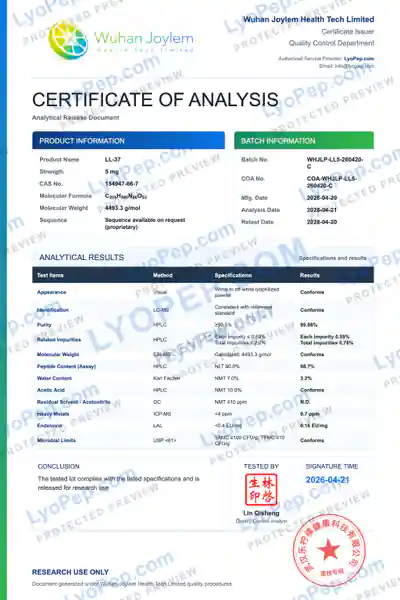
Factory batch documentation

LL-37 factory batch COAs

Representative records, refreshed periodically

Published COAs show representative factory batches and may not be the latest available. For a current quote or shipment, our sales team can confirm the applicable lot and provide its COA.

Independent testing, arranged on request

Third-party reports are not routinely published. If independent verification is required, we can agree the laboratory, method, acceptance criteria and remedy before testing. If the agreed specification is not met, an appropriate resolution—including a refund where applicable—can be discussed under the agreed terms. Unless otherwise agreed in writing, the buyer pays the cost of this optional testing.

Help reviewing your COA

Need help reading a factory COA or third-party report? Our sales team can clarify test items, specifications and how the results relate to the lot under discussion.

Ask for the current packet, not a generic certificate

  • Require terminal form and sequence, intact mass and peptide mapping where appropriate, chromatographic purity, quantitative peptide content, counterion, water, residual solvents, oxidation or related peptides, aggregation, recovery from intended containers, and lot-specific stability
  • For immune or cell work, require matrix-appropriate endotoxin testing with interference controls
  • Sterility, bioburden and endotoxin are separate attributes and require separate evidence.
Released-batch COARP-HPLC result and method contextIdentity result appropriate to the moleculeWater / counter-ion context where relevantSDS and handling statementAdditional testing scoped on request

Available fills

Quote the fill and pack configuration you need

Reference SKUFillBase pack
LL37-05MG5 mg10 vials

Handling

Storage in the lab and temperature during transit are different decisions

Follow the released-lot label, COA and stability data for the supplied terminal form and counterion. Protect dry material from moisture and incompatible temperature or light exposure. After reconstitution, adsorption, proteolysis, oxidation and matrix effects require experiment-specific recovery and stability checks; do not assume a generic 2–8°C in-use period.

State destination, season, acceptable transit exposure and whether your protocol requires insulated or cold-chain service. Additional temperature-control cost is quoted explicitly.

Buyer FAQ

Terms to settle before the purchase order

Can a buyer arrange third-party testing?+

Yes. Testing must be performed by a mutually accepted, established specialist laboratory. Fee allocation, specification, sampling, method and acceptance rule must be agreed before testing; if an agreed independent result shows nonconformance, the remedy follows the signed order terms. Unless otherwise agreed in writing, the buyer pays the cost of this optional testing.

Does HPLC purity prove peptide content?+

No. Chromatographic purity describes the relative peak profile under a stated method. Identity, water, counter-ion, residual solvents and assay/content may require separate methods.

Is cold-chain shipping always required?+

Not always. Heat can accelerate degradation, especially during summer and long transit. Cold-chain reduces exposure but raises cost. State the destination and stability risk so the right service can be quoted.

How are payment terms handled?+

Available methods and milestones depend on order value, destination and project type. The pro forma invoice should state currency, bank details, fees, payment milestones and the release condition.

Why must the testing laboratory understand peptide chemistry?+

Free-base and salt forms, hydrophilic and hydrophobic sequences, aggregation and adsorption can change sample preparation and method suitability. Use a laboratory experienced with the molecule class.

These are buyer-qualification references, not claims that this RUO material is regulated, certified or released under those frameworks. Applicability depends on the buyer's workflow and jurisdiction.

Selected sources

Literature behind the research context

  • Identity and sequence: NIH PubChem CID 16198951 and RCSB PDB 2K6O; confirm the released-lot terminal form and mass independently.
  • Maturation mechanism: Sørensen et al., Blood 2001, PMID 11389039, identifies proteinase 3 as the extracellular hCAP18-cleaving protease.
  • Venous-leg-ulcer evidence: Grönberg et al. 2014, PMID 25041740; Mahlapuu et al. 2021, PMID 34687253 and PMCID PMC9298190. The larger Phase IIb trial did not meet its primary endpoint in the overall population.
  • Diabetic-foot-ulcer evidence: Miranda et al. 2023, PMID 37480520, PMCID PMC10514151 and NCT04098562. The study reported greater granulation-index improvement, but no significant reduction in IL-1α, TNF-α or aerobic bacterial colonization.
  • Other investigational context: ClinicalTrials.gov NCT02225366 reports a completed intratumoral melanoma study with four enrolled participants; it does not establish approval, general safety or an administration protocol for this RUO lot.
  1. 01

    FALL-39, a putative human peptide antibiotic, is cysteine-free and expressed in bone marrow and testis

    Proceedings of the National Academy of Sciences of the United States of America (PNAS) · 1995 · peer-reviewed original research (landmark discovery paper)

    Open source
  2. 02

    LL-37, the only human member of the cathelicidin family of antimicrobial peptides

    Biochimica et Biophysica Acta (BBA) - Biomembranes · 2006 · peer-reviewed review (canonical structure-function reference)

    Open source
  3. 03

    The peptide antibiotic LL-37/hCAP-18 is expressed in epithelia of the human lung where it has broad antimicrobial activity at the airway surface

    Proceedings of the National Academy of Sciences of the United States of America (PNAS) · 1998 · peer-reviewed original research (landmark)

    Open source
  4. 04

    An angiogenic role for the human peptide antibiotic LL-37/hCAP-18

    Journal of Clinical Investigation · 2003 · peer-reviewed original research (landmark, mechanistic basis for wound-healing use)

    Open source
  5. 05

    Significance of LL-37 on Immunomodulation and Disease Outcome

    BioMed Research International · 2020 · peer-reviewed review

    Open source
  6. 06

    LL-37 Might Promote Local Invasion of Melanoma by Activating Melanoma Cells and Tumor-Associated Macrophages

    Cancers (Basel) · 2023 · peer-reviewed original research (cautionary/safety-relevant)

    Open source
  7. 07

    Dermatologic toxicity from novel therapy using antimicrobial peptide LL-37 in melanoma: A detailed examination of the clinicopathologic features

    Journal of Cutaneous Pathology · 2018 · peer-reviewed case report / clinicopathologic study (safety-relevant, tied to NCT02225366 trial)

    Open source
  8. 08

    Treatment with LL-37 is safe and effective in enhancing healing of hard-to-heal venous leg ulcers: a randomized, placebo-controlled clinical trial

    Wound Repair and Regeneration · 2014 · randomized controlled clinical trial (first-in-human)

    Open source

Product FAQ

Questions buyers ask about LL-37

Why should surface adsorption be assessed when preparing LL-37 experiments?+

LL-37 is strongly cationic and amphipathic, so recovery can depend on vessel material, concentration, buffer, ionic strength and contact time. Validate recovery in the actual workflow with low-binding consumables and matrix-appropriate controls rather than assuming the nominal concentration is delivered. Carrier proteins or surfactants can also change biological readouts and must not be added without compatibility controls.

Which LL-37 chemical form is being supplied?+

Free-acid LL-37 and C-terminally amidated LL-37 are distinct materials, and supplier records may also use different counterions such as TFA or acetate. The released-lot COA should state terminal form, sequence, intact mass, counterion, peptide-content basis and water. CAS number or product name alone is insufficient to establish interchangeability.

Why is endotoxin control especially important in LL-37 cell assays?+

LL-37 is studied in innate-immune and inflammatory systems, so endotoxin contamination can imitate or distort cytokine and activation readouts. Require a released-lot endotoxin result in EU/mg with the method, sample preparation, interference or recovery controls and an acceptance limit justified for the experiment. Sterility, bioburden and endotoxin are different attributes; one result does not prove the others.