Recent Confirmed OrdersLast 7 days
Australia520 mgTirzepatide 40 mg · Semaglutide 2 mg · Dihexa 10 mg
View all

Khavinson bioregulators

Cartalax

AED tripeptide research reference · sequence identity frequently mislabelled in market listings

Lot-specific chromatographic purity and quantitative peptide content; confirm both on the released-lot COA · target, verify batch COACAS 205640-90-0RUO
Research statusLimited, mainly in-vitro evidence; laboratory Research Use Only
Supplied formLinear tripeptide; H-Ala-Glu-Asp-OH (AED)
Lead time14–21 days
Cartalax — Lot-specific lyophilized research peptide; confirm colour and cake condition on the released-lot COA
Cartalax — Lot-specific lyophilized research peptide; confirm colour and cake condition on the released-lot COA · Representative packaging image · verify the ordered lot
Representative packaging image · verify the ordered lot

Decision summary

Key benefits

  • Research applications include AED identity qualification, stem-cell differentiation or senescence-marker assays, renal-cell models and analytical discrimination from related short peptides
  • The evidence supports controlled laboratory questions, not cartilage-treatment, pain-reduction or rehabilitation claims.
Published research context is presented for literature orientation only. It is not a dosing, treatment or human-use instruction.
Qualification data

Specifications to confirm against the released lot

CAS
205640-90-0
Formula
C12H19N3O8
Molecular weight
333.29 Da
Appearance
Lot-specific lyophilized research peptide; confirm colour and cake condition on the released-lot COA
Purity
Lot-specific chromatographic purity and quantitative peptide content; confirm both on the released-lot COA · target, verify batch COA
Storage
Follow the released-lot COA, SDS and formulation-specific stability statement. Temperature, light protection, container, shipping range and prepared-solution hold time require direct evidence for the exact AED form, matrix and concentration.
MOQ
On request
Lead time
14–21 days
PubChem CID 87815447

Qualification matrix

Identity, purity and content are separate release questions.

Identity

Confirm the stated molecule and supplied form. Start with the matching batch COA; request sequence-level evidence only when the buyer's written procedure requires it and availability or a separate scope has been agreed.

Purity

Review RP-HPLC method conditions, wavelength, integration and related-peak handling. A percentage without the method is not enough.

Content

Net peptide content is not the same as gross lyophilized powder weight. Ask which assay supports the stated amount and whether water/counter-ion is addressed.

Stability

Define long-term storage and transit exposure separately. Cold-chain can be quoted when the buyer’s risk assessment requires it and adds cost.

Research context

What researchers study about Cartalax

Cartalax is specified here as the linear tripeptide H-Ala-Glu-Asp-OH, AED. The canonical structure, title and IUPAC record for PubChem CID 87815447 support formula C₁₂H₁₉N₃O₈, molecular weight 333.29 Da and Ala-Glu-Asp, and the synonym list includes Cartalax. However, that same synonym export also contains the contradictory string H-Asp-Glu-Asp-OH, so canonical structure and sequence-resolved lot evidence must override synonym text. No CAS number is displayed. Market pages that label Cartalax AEDL, AEDK or AEDG confuse it with distinct peptides. CAS 205640-90-0 identifies Orexin A, not Cartalax. Published evidence is mainly in-vitro work from the Khavinson research lineage or collaborators, with little independent replication and no adequate sequence-confirmed human randomized trial.

  • AED identity and method development; controlled stem-cell, renal-cell, differentiation and senescence-marker assays; and analytical comparison with AEDG, AEDL, AEDK or other short peptides
  • These are research applications, not clinical indications.

Mechanism context

The question the literature is testing

PMID 25946838 reports AED- and EDL-associated proliferation, lower p16/p21/p53 and higher SIRT-6 expression in young and aged rat renal-cell cultures. Its proposed minor-groove DNA complexes were computational models, not direct structural proof of AED-DNA binding. PMID 30791821 tested AED inside a mixture of AEDG, KE, AED and KED in human periodontal-ligament stem cells; the reported GAP43 and Nestin increases were associated with the mixture and KED alone, so that paper does not establish an AED-alone neuronal effect. Cartilage and chondrocyte reports remain mainly same-network in-vitro work. Direct target, pathway, sequence and concentration controls are required.

Evidence map

Research routes and exposure context

Evidence tierAnalytical / laboratory context
Routes reported in sources
OralSublingual
Dose / exposure contextProtocol-specific; verify the cited primary source
Routes and exposure contexts summarize cited studies or approved finished-product labels. They are not instructions for administering this RUO material; no customer dose is provided.

Evidence boundaries

Compatibility, limitations and decision context

  • Not for human or veterinary use
  • Russian-market history and absence of prominent reports do not establish systematic human safety, long-term tolerability, interaction safety, sterility or administration suitability
  • Follow the SDS and institutional controls.

Interactions reported in the literature

  • No controlled combination or drug-interaction evidence was identified
  • Claims of synergy or compatibility with collagen, glucosamine, BPC-157, TB-500, growth factors or other Khavinson peptides are not validated guidance.
Literature context is not a supplier release result or human-use instruction. Follow your institution's approved laboratory risk assessment.

Factory batch documentation

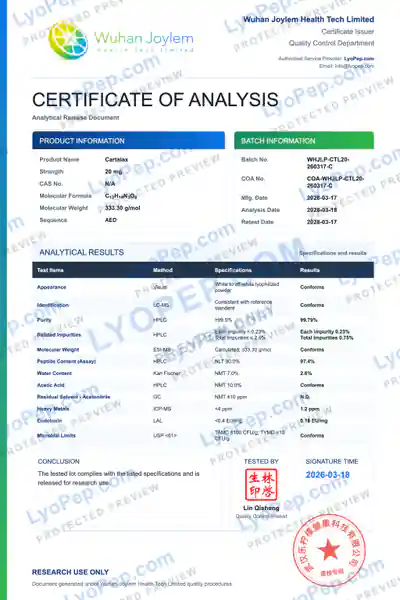
Cartalax factory batch COAs

Representative records, refreshed periodically

Published COAs show representative factory batches and may not be the latest available. For a current quote or shipment, our sales team can confirm the applicable lot and provide its COA.

Independent testing, arranged on request

Third-party reports are not routinely published. If independent verification is required, we can agree the laboratory, method, acceptance criteria and remedy before testing. If the agreed specification is not met, an appropriate resolution—including a refund where applicable—can be discussed under the agreed terms. Unless otherwise agreed in writing, the buyer pays the cost of this optional testing.

Help reviewing your COA

Need help reading a factory COA or third-party report? Our sales team can clarify test items, specifications and how the results relate to the lot under discussion.

Ask for the current packet, not a generic certificate

  • Require exact AED sequence and termini, supplied form/counterion, theoretical and observed intact mass, orthogonal sequence/identity evidence, stability-indicating HPLC purity and impurity profile, quantitative peptide content, water/counterion/residuals and lot-specific stability
  • Packaging holograms, dosing instructions, white appearance or a third-party purity percentage cannot replace chemical identity and content evidence.
Released-batch COARP-HPLC result and method contextIdentity result appropriate to the moleculeWater / counter-ion context where relevantSDS and handling statementAdditional testing scoped on request

Available fills

Quote the fill and pack configuration you need

Reference SKUFillBase pack
CART-20MG20 mg10 vials

Handling

Storage in the lab and temperature during transit are different decisions

Follow the released-lot COA, SDS and formulation-specific stability statement. Temperature, light protection, container, shipping range and prepared-solution hold time require direct evidence for the exact AED form, matrix and concentration.

State destination, season, acceptable transit exposure and whether your protocol requires insulated or cold-chain service. Additional temperature-control cost is quoted explicitly.

Buyer FAQ

Terms to settle before the purchase order

Can a buyer arrange third-party testing?+

Yes. Testing must be performed by a mutually accepted, established specialist laboratory. Fee allocation, specification, sampling, method and acceptance rule must be agreed before testing; if an agreed independent result shows nonconformance, the remedy follows the signed order terms. Unless otherwise agreed in writing, the buyer pays the cost of this optional testing.

Does HPLC purity prove peptide content?+

No. Chromatographic purity describes the relative peak profile under a stated method. Identity, water, counter-ion, residual solvents and assay/content may require separate methods.

Is cold-chain shipping always required?+

Not always. Heat can accelerate degradation, especially during summer and long transit. Cold-chain reduces exposure but raises cost. State the destination and stability risk so the right service can be quoted.

How are payment terms handled?+

Available methods and milestones depend on order value, destination and project type. The pro forma invoice should state currency, bank details, fees, payment milestones and the release condition.

Why must the testing laboratory understand peptide chemistry?+

Free-base and salt forms, hydrophilic and hydrophobic sequences, aggregation and adsorption can change sample preparation and method suitability. Use a laboratory experienced with the molecule class.

These are buyer-qualification references, not claims that this RUO material is regulated, certified or released under those frameworks. Applicability depends on the buyer's workflow and jurisdiction.

Selected sources

Literature behind the research context

  • Identity: PubChem CID 87815447 canonical structure, property and synonym records. Renal-cell context: PMID 25946838. Periodontal-ligament stem-cell mixture study: PMID 30791821, PMCID PMC6376556; this paper did not report an AED-alone neuronal-marker effect. Chondrogenic review: PMID 37176122, PMCID PMC10179481. Technical records from FUJIFILM Wako and IUPHAR/BPS confirm that CAS 205640-90-0 identifies Orexin A. No adequate human randomized trial or authoritative pharmacokinetic study was identified.
  1. 01

    Peptides of cartilage tissue: regulation of chondrocyte proliferation, geroprotection and prospects for use in osteoarthrosis

    Vrach (The Doctor) / Врач · 2023 · peer-reviewed original research (in vitro/animal)

    Open source
  2. 02

    Peptide Regulation of Chondrogenic Stem Cell Differentiation

    International Journal of Molecular Sciences (MDPI) · 2023 · peer-reviewed review article

    Open source
  3. 03

    Tripeptides slow down aging process in renal cell culture

    Advances in Gerontology · 2014 · peer-reviewed original research (Russian article with English abstract)

    Open source
  4. 04

    Effect of short peptides on neuronal differentiation of stem cells

    International Journal of Immunopathology and Pharmacology · 2019 · peer-reviewed original in-vitro research

    Open source
  5. 05

    Pharmaceutical substance normalizing cartilaginous tissue functions and method for producing the same

    Eurasian Patent Office (EAPO) — Eurasian Patent EA 010724 · 2008 · regulatory/patent document

    Open source
  6. 06

    Peptide normalizing osseous and cartilaginous tissue metabolism, pharmacological substance based thereon and method of its application

    Eurasian Patent Office (EAPO) — Eurasian Patent EA 010574/010575 · 2008 · regulatory/patent document

    Open source

Product FAQ

Questions buyers ask about Cartalax

Is Cartalax an AED tripeptide or an AEDL/AEDG tetrapeptide?+

The canonical PubChem CID 87815447 structure, title and IUPAC record identify H-Ala-Glu-Asp-OH, the AED tripeptide, formula C₁₂H₁₉N₃O₈ and molecular weight 333.29 Da. One PubChem synonym line conflicts by reading H-Asp-Glu-Asp-OH, so do not rely on a synonym export alone. AEDL, AEDK and AEDG are different peptides. Require the exact N-to-C sequence, canonical structure and mass evidence; a market name or unsupported CAS cannot resolve identity.

Which lot evidence matters for a short AED peptide?+

Require exact N-to-C AED sequence and termini, salt/counterion, theoretical and observed intact mass, sequence evidence, stability-indicating HPLC purity and impurity profile, quantitative peptide content, water/counterion/residuals and lot-specific stability. Because a short tripeptide has limited fragment complexity, use orthogonal identity controls and suitable reference standards where available.