Recent Confirmed OrdersLast 7 days
Australia2 gTirzepatide 100 mg · CagriSema 20 mg · BPC-157 10 mg · TB-500 5 mg · Melanotan II 10 mg · PT-141 10 mg · Bacteriostatic Water 3 ml
View all

Mitochondrial research

MOTS-c (Human)

Native human 16-residue mitochondrial-derived research peptide · evidence remains predominantly preclinical

Lot-specific chromatographic purity plus quantitative peptide content; confirm sequence, intact mass, counterion, water and methionine-oxidation profile separately · target, verify batch COACAS 1627580-64-6RUO
Research statusPredominantly preclinical cell and animal evidence; one recruiting Phase 2a native-MOTS-c trial has no posted results
Supplied formLinear 16-residue mitochondrial-derived peptide (MRWQEMGYIFYPRKLR)
Lead time10–18 days
MOTS-c (Human) — Lot-specific lyophilized research peptide; confirm appearance on the released-lot COA
MOTS-c (Human) — Lot-specific lyophilized research peptide; confirm appearance on the released-lot COA · Representative packaging image · verify the ordered lot
Representative packaging image · verify the ordered lot

Decision summary

Key benefits

  • Research strengths include a defined native 16-residue sequence, a well-cited mitochondrial open-reading-frame origin and multiple testable pathways across metabolic-stress, insulin-sensitivity, exercise-adaptation and aging models
  • Animal studies report effects on glucose homeostasis, diet-induced obesity, age-related muscle insulin resistance and physical performance, while human exercise studies describe endogenous MOTS-c measurements
  • The appropriate evidence classification is predominantly preclinical; the registered native-MOTS-c Phase 2a study will require posted results before it can inform human efficacy or safety conclusions.
Published research context is presented for literature orientation only. It is not a dosing, treatment or human-use instruction.
Qualification data

Specifications to confirm against the released lot

CAS
1627580-64-6
Formula
C101H152N28O22S2
Molecular weight
Approximately 2,174.6 Da
Appearance
Lot-specific lyophilized research peptide; confirm appearance on the released-lot COA
Purity
Lot-specific chromatographic purity plus quantitative peptide content; confirm sequence, intact mass, counterion, water and methionine-oxidation profile separately · target, verify batch COA
Storage
Store and ship according to the lot COA and validated stability data for the exact sequence, salt, formulation, solvent, concentration and container. Generic 2-8 degrees Celsius, minus 20 degrees Celsius and prompt-use statements are not interchangeable. Avoid unvalidated freeze-thaw cycles and document excursions.
MOQ
On request
Lead time
10–18 days
PubChem CID 155885767

Qualification matrix

Identity, purity and content are separate release questions.

Identity

Confirm the stated molecule and supplied form. Start with the matching batch COA; request sequence-level evidence only when the buyer's written procedure requires it and availability or a separate scope has been agreed.

Purity

Review RP-HPLC method conditions, wavelength, integration and related-peak handling. A percentage without the method is not enough.

Content

Net peptide content is not the same as gross lyophilized powder weight. Ask which assay supports the stated amount and whether water/counter-ion is addressed.

Stability

Define long-term storage and transit exposure separately. Cold-chain can be quoted when the buyer’s risk assessment requires it and adds cost.

Research context

What researchers study about MOTS-c (Human)

MOTS-c is a 16-amino-acid mitochondrial-derived peptide encoded by a short open reading frame within the mitochondrial MT-RNR1 / 12S rRNA region and first reported by Lee et al. in Cell Metabolism in 2015. Research has linked it to folate-purine metabolism, AICAR- and AMPK-associated responses, metabolic homeostasis and stress-dependent nuclear signaling. The evidence base is predominantly cellular and animal. NCT07505745 provides current human research context as a recruiting, randomized Phase 2a study in adults with prediabetes and overweight or obesity; results are not yet posted. CB4211 is a distinct synthetic MOTS-c-derived analogue with its own early-phase development record and must be assessed separately from native MOTS-c.

  • Relevant research domains include metabolic homeostasis, insulin sensitivity, exercise adaptation, aging biology, mitochondrial stress signaling and native-peptide versus analogue comparison
  • Human exercise-associated measurements are observational
  • NCT07505745 is recruiting 120 adults with prediabetes and overweight or obesity and has an estimated primary completion in 2027
  • CB4211 remains a distinct derivative, so its early human data must be interpreted under its own identity and protocol.

Mechanism context

The question the literature is testing

The foundational cell and mouse study linked MOTS-c exposure to inhibition of folate-cycle and de novo purine metabolism, accumulation of AICAR and AMPK-associated metabolic responses. A later study reported that metabolic stress can drive MOTS-c nuclear translocation and interaction with stress-responsive transcriptional programs. Exact timing, motif dependence and downstream readouts belong to those experimental systems; they do not establish an administered-human mechanism, clinical benefit or universal exposure-response relationship.

Evidence map

Research routes and exposure context

Evidence tierMixed evidence context
Routes reported in sources
SubcutaneousIn vitro
Dose / exposure contextProtocol-specific; verify the cited primary source
Routes and exposure contexts summarize cited studies or approved finished-product labels. They are not instructions for administering this RUO material; no customer dose is provided.

Evidence boundaries

Compatibility, limitations and decision context

  • Human safety and pharmacokinetic characterization of native MOTS-c remains an open research question
  • Animal tolerability and CB4211 Phase 1 observations belong to different evidence contexts and should be labelled accordingly
  • WADA's 2026 Prohibited List includes MOTS-c under S4.4.1 AMPK activators, prohibited at all times
  • TUE questions follow current official rules
  • This supplied material is for laboratory research only.

Interactions reported in the literature

  • Human co-administration evidence has not established compatibility with metformin, glucose-lowering medicines, NAD precursors, resveratrol, berberine, GH-axis peptides or other AMPK activators
  • Shared-pathway relationships are useful for hypothesis design, while combination compatibility, assay interference and monitoring requirements remain protocol-specific
  • Anti-doping status is a separate compliance consideration.
Literature context is not a supplier release result or human-use instruction. Follow your institution's approved laboratory risk assessment.

Factory batch documentation

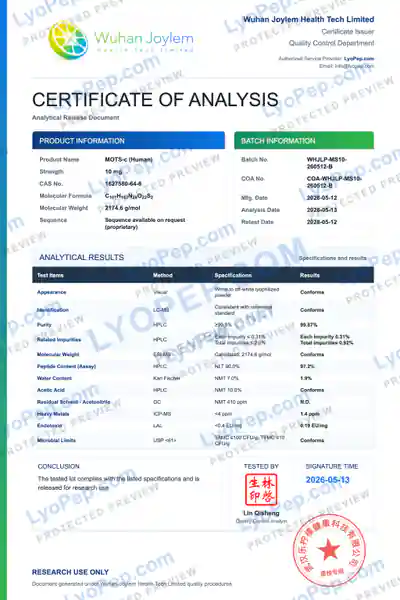
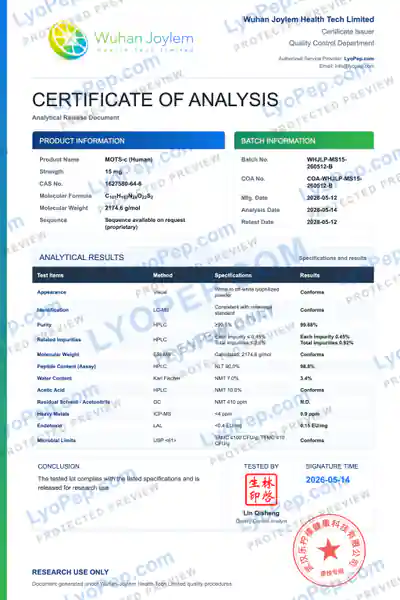
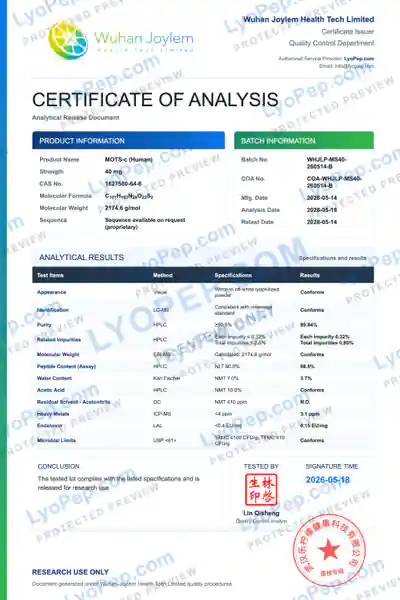
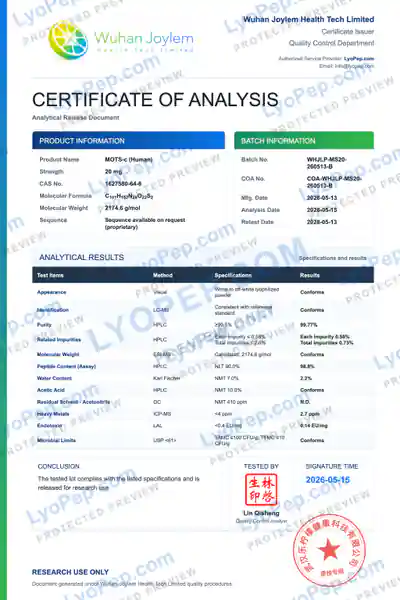
MOTS-c (Human) factory batch COAs

Representative records, refreshed periodically

Published COAs show representative factory batches and may not be the latest available. For a current quote or shipment, our sales team can confirm the applicable lot and provide its COA.

Independent testing, arranged on request

Third-party reports are not routinely published. If independent verification is required, we can agree the laboratory, method, acceptance criteria and remedy before testing. If the agreed specification is not met, an appropriate resolution—including a refund where applicable—can be discussed under the agreed terms. Unless otherwise agreed in writing, the buyer pays the cost of this optional testing.

Help reviewing your COA

Need help reading a factory COA or third-party report? Our sales team can clarify test items, specifications and how the results relate to the lot under discussion.

Ask for the current packet, not a generic certificate

  • A clear solution, white powder or HPLC area percentage cannot establish sequence identity, peptide content, sterility or biological equivalence to research material
  • Require complete sequence and terminal state, salt/counterion, high-resolution intact mass and sequence-confirming MS/MS, chromatographic purity with raw data and impurity profile, quantitative peptide content, water and counterion, residual solvents and lot-specific stability
  • Oxidation and other sequence-relevant degradants should be controlled
  • Sterility, endotoxin and particulates require separate validated tests when claimed.
Released-batch COARP-HPLC result and method contextIdentity result appropriate to the moleculeWater / counter-ion context where relevantSDS and handling statementAdditional testing scoped on request

Available fills

Quote the fill and pack configuration you need

Reference SKUFillBase pack
MOTSC-10MG10 mg10 vials
MOTSC-15MG15 mg10 vials
MOTSC-20MG20 mg10 vials
MOTSC-40MG40 mg10 vials

Handling

Storage in the lab and temperature during transit are different decisions

Store and ship according to the lot COA and validated stability data for the exact sequence, salt, formulation, solvent, concentration and container. Generic 2-8 degrees Celsius, minus 20 degrees Celsius and prompt-use statements are not interchangeable. Avoid unvalidated freeze-thaw cycles and document excursions.

State destination, season, acceptable transit exposure and whether your protocol requires insulated or cold-chain service. Additional temperature-control cost is quoted explicitly.

Buyer FAQ

Terms to settle before the purchase order

Can a buyer arrange third-party testing?+

Yes. Testing must be performed by a mutually accepted, established specialist laboratory. Fee allocation, specification, sampling, method and acceptance rule must be agreed before testing; if an agreed independent result shows nonconformance, the remedy follows the signed order terms. Unless otherwise agreed in writing, the buyer pays the cost of this optional testing.

Does HPLC purity prove peptide content?+

No. Chromatographic purity describes the relative peak profile under a stated method. Identity, water, counter-ion, residual solvents and assay/content may require separate methods.

Is cold-chain shipping always required?+

Not always. Heat can accelerate degradation, especially during summer and long transit. Cold-chain reduces exposure but raises cost. State the destination and stability risk so the right service can be quoted.

How are payment terms handled?+

Available methods and milestones depend on order value, destination and project type. The pro forma invoice should state currency, bank details, fees, payment milestones and the release condition.

Why must the testing laboratory understand peptide chemistry?+

Free-base and salt forms, hydrophilic and hydrophobic sequences, aggregation and adsorption can change sample preparation and method suitability. Use a laboratory experienced with the molecule class.

These are buyer-qualification references, not claims that this RUO material is regulated, certified or released under those frameworks. Applicability depends on the buyer's workflow and jurisdiction.

Selected sources

Literature behind the research context

  • The 2015 Cell Metabolism paper is the foundational discovery and metabolic-homeostasis study. Later work addresses exercise and age-dependent function, plasma metabolomics, stress and aging mechanisms, CK2 binding and diabetic-heart models, predominantly preclinically. NCT07505745 is an official recruiting Phase 2a registry record with no results posted, not proof of efficacy. The CohBar release reports CB4211, a distinct MOTS-c-derived analogue, and is company-reported early-phase evidence only. The current official WADA list controls anti-doping status.
  1. 01

    The mitochondrial-derived peptide MOTS-c promotes metabolic homeostasis and reduces obesity and insulin resistance

    Cell Metabolism · 2015 · peer-reviewed original research

    Open source
  2. 02

    MOTS-c is an exercise-induced mitochondrial-encoded regulator of age-dependent physical decline and muscle homeostasis

    Nature Communications · 2021 · peer-reviewed original research

    Open source
  3. 03

    The mitochondrial-derived peptide MOTS-c is a regulator of plasma metabolites and enhances insulin sensitivity

    Physiological Reports · 2019 · peer-reviewed original research

    Open source
  4. 04

    Mitochondria-derived peptide MOTS-c: effects and mechanisms related to stress, metabolism and aging

    Journal of Translational Medicine · 2023 · systematic review

    Open source
  5. 05

    MOTS-c modulates skeletal muscle function by directly binding and activating CK2

    iScience · 2024 · peer-reviewed original research

    Open source
  6. 06

    Mitochondria-derived peptide MOTS-c restores mitochondrial respiration in type 2 diabetic heart

    Frontiers in Physiology · 2025 · peer-reviewed original research

    Open source
  7. 07

    MOTS-c for Improving Insulin Sensitivity in Adults With Prediabetes and Overweight/Obesity (MOTS-MET)

    ClinicalTrials.gov · 2026 · clinical trial registry entry

    Open source
  8. 08

    CohBar Announces Positive Topline Results from the Phase 1a/1b Study of CB4211 Under Development for NASH and Obesity

    GlobeNewswire (CohBar, Inc. investor/media release) · 2021 · company press release

    Open source

Product FAQ

Questions buyers ask about MOTS-c (Human)

How is MOTS-c different from SS-31 (Elamipretide) within the mitochondrial category?+

MOTS-c is a 16-residue mitochondrially encoded sequence studied as a metabolic-stress signal involving AMPK-associated and nuclear responses. Elamipretide is a synthetic tetrapeptide that localizes to the inner mitochondrial membrane and interacts with cardiolipin-associated membrane biology. FDA approved the distinct sterile prescription product FORZINITY in 2025 for a defined Barth-syndrome indication; that approval does not apply to MOTS-c or to research-grade SS-31. The sequences, mechanisms, evidence bases, specifications and regulatory identities are not interchangeable.