Recent Confirmed OrdersLast 7 days
Australia520 mgTirzepatide 40 mg · Semaglutide 2 mg · Dihexa 10 mg
View all

Growth-hormone axis research

HGH Fragment176191

C-terminal fragment of human growth hormone (176–191)

≥ 99.0% · target, verify batch COACAS 66004-57-7RUO
Research statusLimited native-fragment research; later animal and human-development evidence mainly concerns distinct AOD-9604; laboratory Research Use Only
Supplied formHexadecapeptide (reduced free-thiol and intramolecular-disulfide states are distinct and must be specified)
Lead time10–18 days
HGH Fragment176191 — Lot-specific lyophilized research peptide; confirm colour, physical form and disulfide state on the released-lot COA
HGH Fragment176191 — Lot-specific lyophilized research peptide; confirm colour, physical form and disulfide state on the released-lot COA · Representative packaging image · verify the ordered lot
Representative packaging image · verify the ordered lot

Decision summary

Key benefits

  • Research value lies in distinguishing native hGH C-terminal-fragment biology from AOD-9604, characterizing reduced versus intramolecular-disulfide material, studying early metabolic observations in controlled models and developing analytical or anti-doping reference methods
  • No human fat-loss, glucose-neutral, body-composition or safety benefit is established for the native fragment.
Published research context is presented for literature orientation only. It is not a dosing, treatment or human-use instruction.
Qualification data

Specifications to confirm against the released lot

CAS
66004-57-7
Formula
C78H123N23O22S2
Molecular weight
1799.1 Da
Appearance
Lot-specific lyophilized research peptide; confirm colour, physical form and disulfide state on the released-lot COA
Purity
≥ 99.0% · target, verify batch COA
Storage
Store and ship according to the released-lot COA and validated data for the exact sequence, disulfide state, salt/counterion, formulation, solvent, concentration and container. A generic 2–8 °C or -20 °C rule does not establish solution life, freeze-thaw allowance or long-term stability for the supplied form.
MOQ
On request
Lead time
10–18 days
PubChem CID 16131230

Qualification matrix

Identity, purity and content are separate release questions.

Identity

Confirm the stated molecule and supplied form. Start with the matching batch COA; request sequence-level evidence only when the buyer's written procedure requires it and availability or a separate scope has been agreed.

Purity

Review RP-HPLC method conditions, wavelength, integration and related-peak handling. A percentage without the method is not enough.

Content

Net peptide content is not the same as gross lyophilized powder weight. Ask which assay supports the stated amount and whether water/counter-ion is addressed.

Stability

Define long-term storage and transit exposure separately. Cold-chain can be quoted when the buyer’s risk assessment requires it and adds cost.

Research context

What researchers study about HGH Fragment176191

HGH Fragment 176-191, PubChem CID 16131230 and CAS 66004-57-7, is the 16-amino-acid C-terminal segment corresponding to residues 176-191 of mature human growth hormone. The native sequence begins with phenylalanine and has formula C₇₈H₁₂₃N₂₃O₂₂S₂ and average molecular weight 1799.1 Da. AOD-9604, CAS 221231-10-3 and PubChem CID 71300630, is Tyr-hGH(177-191): a distinct 16-residue analogue beginning with tyrosine, with formula C₇₈H₁₂₃N₂₃O₂₃S₂ and molecular weight 1815.09 Da. It is therefore inaccurate to describe AOD-9604 simply as the full native 176-191 sequence with one extra amino acid; both peptides contain 16 residues and differ at their N-terminal residue context. Early studies tested several native C-terminal fragments, including hGH 176-191, whereas most later animal and all cited human development data concern AOD-9604. No independent human clinical trial of the native Phe176-starting fragment was identified. Because commercial naming is inconsistent, procurement should require released-batch mass spectrometry and sequence or identity evidence rather than relying on the product name alone.

  • Laboratory contexts include native-versus-AOD identity comparison, redox/disulfide-state characterization, controlled animal-model investigation of C-terminal hGH-fragment biology and anti-doping method development
  • These contexts are not weight-loss, bodybuilding or anti-aging indications.

Mechanism context

The question the literature is testing

Early rat experiments found that several native C-terminal hGH fragments, including 176-191, produced short-lived hyperglycaemia, increased plasma insulin and reduced insulin sensitivity. Later antilipogenic and fat-oxidation work largely used the modified analogue AOD-9604. In obese-mouse studies AOD-9604 affected fat oxidation and beta3-adrenergic-receptor expression without competing for the classical hGH receptor, but beta3-AR knockout experiments showed that the chronic weight effect was not mediated simply by direct beta3-AR activation. These AOD-9604 findings should not be converted into a proven mechanism for the native fragment. The direct mechanism, receptor pharmacology and human metabolic profile of native hGH 176-191 remain insufficiently characterized.

Evidence map

Research routes and exposure context

Evidence tierMixed evidence context
Routes reported in sources
Subcutaneous
Dose / exposure contextProtocol-specific; verify the cited primary source
Routes and exposure contexts summarize cited studies or approved finished-product labels. They are not instructions for administering this RUO material; no customer dose is provided.

Evidence boundaries

Compatibility, limitations and decision context

  • No systematic human safety data were identified for the native Phe176-starting hGH 176-191 fragment
  • The foundational 1978 rat study reported short-lived hyperglycaemia, sustained insulin elevation and reduced insulin sensitivity for active C-terminal fragments including 176-191, so glucose-neutral claims from AOD-9604 should not be transferred to this product
  • AOD-9604 was evaluated in several human trials, but FDA's December 2024 PCAC review found limited clinical safety information, no adequate information for the proposed subcutaneous and transdermal uses, unresolved impurity, aggregation, immunogenicity and bioavailability concerns, and concluded that the balance weighed against placing AOD-9604 free base or acetate on the 503A Bulks List
  • The nominations were later withdrawn
  • FDA's current withdrawn-substances table still records the potential immunogenicity, characterization and serious-adverse-event concerns
  • Withdrawal from Category 2 is not FDA approval, a finding of safety or authorization of native hGH 176-191
  • The official 2026 WADA Prohibited List names both AOD-9604 and hGH 176-191 as examples of prohibited growth-hormone fragments under S2.2.3
  • This material is not an FDA-approved drug and is offered for research use only, not for human administration.

Interactions reported in the literature

  • No validated compatibility, combination or stacking data were identified for native hGH 176-191
  • Pairings with BPC-157, CJC-1295, Ipamorelin or other compounds were removed as vendor practice rather than evidence
  • Any combination experiment requires independent analytical compatibility, controls and institutional review.
Literature context is not a supplier release result or human-use instruction. Follow your institution's approved laboratory risk assessment.

Factory batch documentation

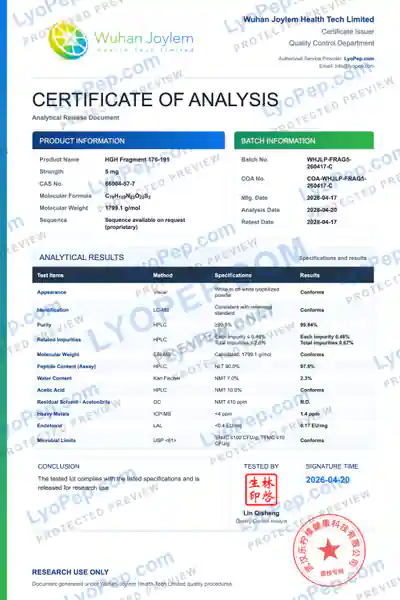
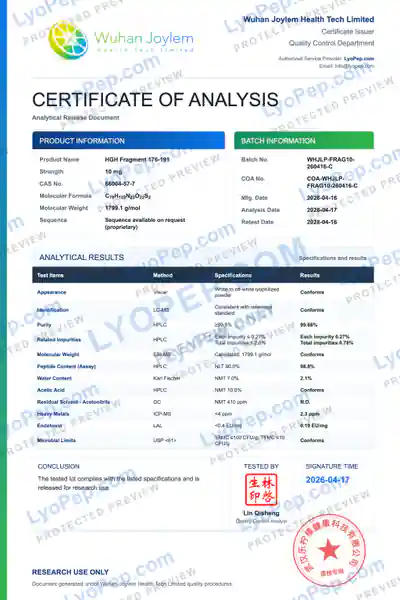
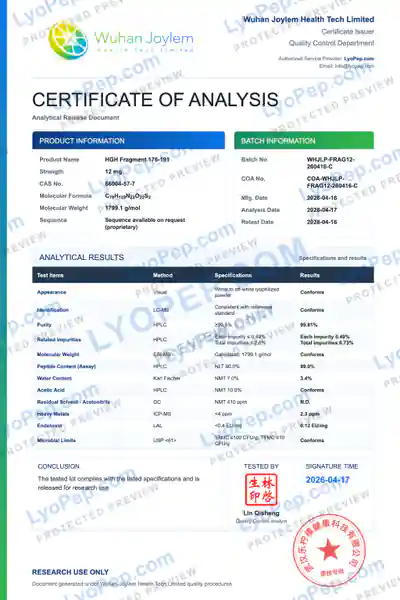
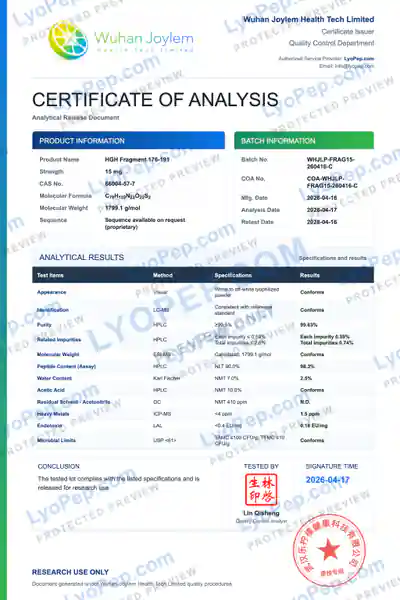
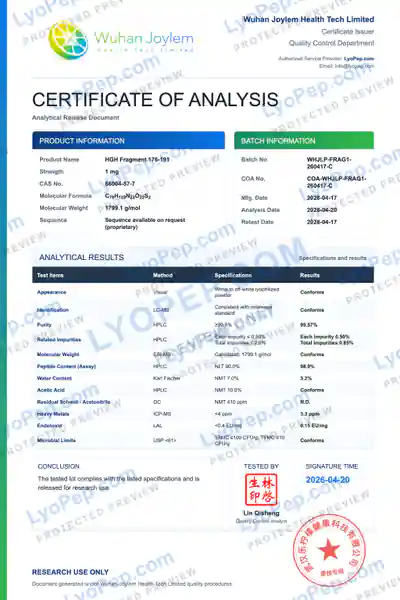
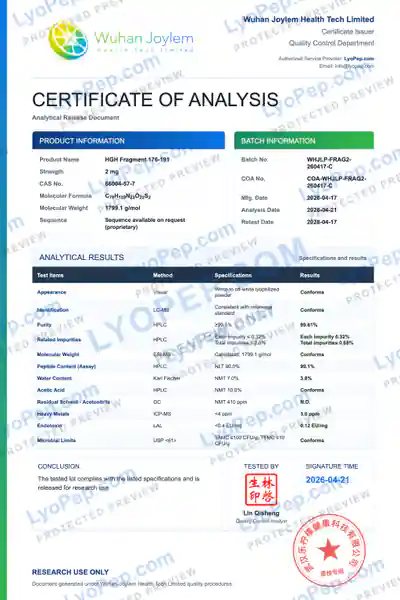
HGH Fragment176191 factory batch COAs

Representative records, refreshed periodically

Published COAs show representative factory batches and may not be the latest available. For a current quote or shipment, our sales team can confirm the applicable lot and provide its COA.

Independent testing, arranged on request

Third-party reports are not routinely published. If independent verification is required, we can agree the laboratory, method, acceptance criteria and remedy before testing. If the agreed specification is not met, an appropriate resolution—including a refund where applicable—can be discussed under the agreed terms. Unless otherwise agreed in writing, the buyer pays the cost of this optional testing.

Help reviewing your COA

Need help reading a factory COA or third-party report? Our sales team can clarify test items, specifications and how the results relate to the lot under discussion.

Ask for the current packet, not a generic certificate

  • Expected presentation is a white lyophilized powder
  • Released-batch documentation should state the exact sequence, native Phe-starting identity versus Tyr-starting AOD-9604, free-base or salt form, disulfide state, theoretical and observed mass, assay/content, peptide purity and analytical methods
  • For the oxidized native free peptide, an observed monoisotopic mass should be interpreted against the PubChem exact mass rather than the rounded average mass of 1799.1 Da
  • RP-HPLC purity alone cannot establish sequence identity, assay/content, aggregation, sterility or endotoxin control
  • Discoloration, unexplained clumping, a formula or CAS inconsistent with the tested mass, missing identity spectra, or a COA that reports only a generic 'HGH Frag' name are escalation signals
  • Sterility and bacterial-endotoxin results are required only when a batch is specifically manufactured and tested to those attributes; peptide purity does not imply either.
Released-batch COARP-HPLC result and method contextIdentity result appropriate to the moleculeWater / counter-ion context where relevantSDS and handling statementAdditional testing scoped on request

Available fills

Quote the fill and pack configuration you need

Reference SKUFillBase pack
HGHF-01MG1 mg10 vials
HGHF-02MG2 mg10 vials
HGHF-05MG5 mg10 vials
HGHF-10MG10 mg10 vials
HGHF-12MG12 mg10 vials
HGHF-15MG15 mg10 vials

Handling

Storage in the lab and temperature during transit are different decisions

Store and ship according to the released-lot COA and validated data for the exact sequence, disulfide state, salt/counterion, formulation, solvent, concentration and container. A generic 2–8 °C or -20 °C rule does not establish solution life, freeze-thaw allowance or long-term stability for the supplied form.

State destination, season, acceptable transit exposure and whether your protocol requires insulated or cold-chain service. Additional temperature-control cost is quoted explicitly.

Buyer FAQ

Terms to settle before the purchase order

Can a buyer arrange third-party testing?+

Yes. Testing must be performed by a mutually accepted, established specialist laboratory. Fee allocation, specification, sampling, method and acceptance rule must be agreed before testing; if an agreed independent result shows nonconformance, the remedy follows the signed order terms. Unless otherwise agreed in writing, the buyer pays the cost of this optional testing.

Does HPLC purity prove peptide content?+

No. Chromatographic purity describes the relative peak profile under a stated method. Identity, water, counter-ion, residual solvents and assay/content may require separate methods.

Is cold-chain shipping always required?+

Not always. Heat can accelerate degradation, especially during summer and long transit. Cold-chain reduces exposure but raises cost. State the destination and stability risk so the right service can be quoted.

How are payment terms handled?+

Available methods and milestones depend on order value, destination and project type. The pro forma invoice should state currency, bank details, fees, payment milestones and the release condition.

Why must the testing laboratory understand peptide chemistry?+

Free-base and salt forms, hydrophilic and hydrophobic sequences, aggregation and adsorption can change sample preparation and method suitability. Use a laboratory experienced with the molecule class.

These are buyer-qualification references, not claims that this RUO material is regulated, certified or released under those frameworks. Applicability depends on the buyer's workflow and jurisdiction.

Selected sources

Literature behind the research context

  • Primary identity sources: PubChem CID 16131230 for native Somatotropin (176-191), including formula C₇₈H₁₂₃N₂₃O₂₂S₂, molecular weight 1799.1 Da, CAS 66004-57-7, the Phe-starting chemical name and DTXSID10216216; PubChem CID 71300630 and FDA's December 2024 PCAC chemistry review for AOD-9604 free base, formula C₇₈H₁₂₃N₂₃O₂₃S₂, molecular weight 1815.09 Da, CAS 221231-10-3 and Tyr-hGH(177-191) identity. Biological evidence: Ng and Bornstein 1978, PMID 645904, tested native C-terminal fragments including 176-191 and reported hyperglycaemic and anti-insulin activity; later Heffernan studies examined the modified analogue AOD-9604 in animal models. Stier et al. 2013 and More and Kenley 2014 summarize AOD-9604 clinical or preclinical safety data and do not establish safety or efficacy of the native fragment. Regulatory sources: FDA's December 2024 PCAC briefing and current withdrawn-substances safety-risk table; WADA's official 2026 Prohibited List.
  1. 01

    Hyperglycemic action of synthetic C-terminal fragments of human growth hormone

    American Journal of Physiology (Endocrinology and Metabolism) · 1978 · peer-reviewed original research (foundational/landmark)

    Open source
  2. 02

    Effects of oral administration of a synthetic fragment of human growth hormone on lipid metabolism

    American Journal of Physiology - Endocrinology and Metabolism · 2000 · peer-reviewed original research (animal study)

    Open source
  3. 03

    The Effects of Human GH and Its Lipolytic Fragment (AOD9604) on Lipid Metabolism Following Chronic Treatment in Obese Mice and beta3-AR Knock-Out Mice

    Endocrinology · 2001 · peer-reviewed original research (animal study)

    Open source
  4. 04

    Increase of fat oxidation and weight loss in obese mice caused by chronic treatment with human growth hormone or a modified C-terminal fragment

    International Journal of Obesity and Related Metabolic Disorders · 2001 · peer-reviewed original research (animal study)

    Open source
  5. 05

    Safety and Tolerability of the Hexadecapeptide AOD9604 in Humans

    Journal of Endocrinology and Metabolism · 2013 · peer-reviewed review of clinical trial safety data

    Open source
  6. 06

    Safety and Metabolism of AOD9604, a Novel Nutraceutical Ingredient for Improved Metabolic Health

    Journal of Endocrinology and Metabolism · 2014 · peer-reviewed review of preclinical toxicology/pharmacokinetic data

    Open source
  7. 07

    Effect of Intra-articular Injection of AOD9604 with or without Hyaluronic Acid in Rabbit Osteoarthritis Model

    Annals of Clinical & Laboratory Science · 2015 · peer-reviewed original research (animal study)

    Open source
  8. 08

    Human Growth Hormone Fragment 176-191 Peptide Enhances the Toxicity of Doxorubicin-Loaded Chitosan Nanoparticles Against MCF-7 Breast Cancer Cells

    Drug Design, Development and Therapy · 2022 · peer-reviewed original research (in silico + in vitro)

    Open source

Product FAQ

Questions buyers ask about HGH Fragment176191

How can native hGH 176-191 be distinguished analytically from AOD-9604?+

Native hGH 176-191 is FLRIVQCRSVEGSCGF and starts with phenylalanine; AOD-9604 is Tyr-hGH(177-191), YLRIVQCRSVEGSCGF, and starts with tyrosine. Both contain 16 residues, but their formulas and masses differ by one oxygen atom, about 16 Da. Require released-lot high-resolution intact mass plus sequence-confirming or orthogonal identity evidence, and state the disulfide and salt form. A generic name, nominal CAS or HPLC retention time alone is insufficient.

Why must the disulfide state be specified for hGH 176-191?+

The sequence contains Cys7 and Cys14, which can exist as free thiols or form an intramolecular disulfide. Reduced and oxidized material differ in mass by about 2 Da and can differ in chromatographic behaviour, stability and experimental response. The order specification and COA should define the intended state, observed mass, oxidation or thiol method and handling conditions; appearance or total HPLC area cannot resolve it.

What evidence applies specifically to the native fragment?+

Early animal work included native C-terminal hGH fragments, but most later animal and cited human-development evidence concerns the distinct analogue AOD-9604. No independent human trial of the native Phe176-starting fragment was identified. AOD-9604 safety, pharmacokinetics or weight claims therefore cannot be transferred to native hGH 176-191.