Recent Confirmed OrdersLast 7 days
Australia2 gTirzepatide 100 mg · CagriSema 20 mg · BPC-157 10 mg · TB-500 5 mg · Melanotan II 10 mg · PT-141 10 mg · Bacteriostatic Water 3 ml
View all

Growth-hormone axis research

Sermorelin

Amidated human GHRH(1-29) research reference

Lot-specific chromatographic purity plus quantitative peptide content; confirm terminal form, counterion, water and related peptides separately · target, verify batch COACAS 86168-78-7RUO
Research statusHistorical approved-finished-product and human challenge literature; current bulk material is unapproved and for laboratory research only reference context · supplied material is RUO
Supplied formLinear amidated 29-residue peptide (human GHRH N-terminal active fragment)
Lead time7–14 days
Sermorelin — Lot-specific lyophilized research peptide; confirm colour and physical form on the released-lot COA
Sermorelin — Lot-specific lyophilized research peptide; confirm colour and physical form on the released-lot COA · Representative packaging image · verify the ordered lot
Representative packaging image · verify the ordered lot

Decision summary

Key benefits

  • Defensible research value includes GHRH-receptor pharmacology, pituitary signalling, pulse-response biology, protease susceptibility, analytical differentiation from modified GHRH analogues and historical-label comparison
  • Older human studies can inform hypothesis generation but do not establish anti-aging, body-composition, exercise, wellness or long-term safety claims for a current RUO lot.
Published research context is presented for literature orientation only. It is not a dosing, treatment or human-use instruction.
Qualification data

Specifications to confirm against the released lot

CAS
86168-78-7
Formula
C149H246N44O42S
Molecular weight
3357.9 Da
Appearance
Lot-specific lyophilized research peptide; confirm colour and physical form on the released-lot COA
Purity
Lot-specific chromatographic purity plus quantitative peptide content; confirm terminal form, counterion, water and related peptides separately · target, verify batch COA
Storage
Follow the released-lot label, COA and stability data for the supplied form. Do not transfer refrigeration, reconstitution or in-use instructions from discontinued Geref products or a compounding-pharmacy preparation to a bulk research lot.
MOQ
On request
Lead time
7–14 days
PubChem CID 16132413

Qualification matrix

Identity, purity and content are separate release questions.

Identity

Confirm the stated molecule and supplied form. Start with the matching batch COA; request sequence-level evidence only when the buyer's written procedure requires it and availability or a separate scope has been agreed.

Purity

Review RP-HPLC method conditions, wavelength, integration and related-peak handling. A percentage without the method is not enough.

Content

Net peptide content is not the same as gross lyophilized powder weight. Ask which assay supports the stated amount and whether water/counter-ion is addressed.

Stability

Define long-term storage and transit exposure separately. Cold-chain can be quoted when the buyer’s risk assessment requires it and adds cost.

Research context

What researchers study about Sermorelin

Sermorelin is an amidated 29-residue peptide corresponding to the N-terminal receptor-active region of human growth-hormone-releasing hormone. Specified sermorelin acetate finished products were historically approved under the Geref name and later discontinued; FDA determined that identified presentations were not withdrawn for reasons of safety or effectiveness. That determination does not make present-day bulk sermorelin an approved medicine. Free peptide and acetate descriptions, counterion burden and quantitative peptide content must be reconciled lot-specifically.

  • Appropriate laboratory contexts include GHRH-receptor binding and signalling, pituitary cell models, pulse-pattern experiments, proteolytic stability, analogue comparison, identity and salt-form methods, and historical regulatory analysis
  • No current approved clinical indication applies to this bulk RUO material.

Mechanism context

The question the literature is testing

Sermorelin activates the GHRH receptor and downstream cAMP-dependent signalling in appropriate experimental systems. Its unmodified N-terminal sequence is susceptible to proteolysis, producing shorter exposure than engineered analogues in historical studies. Protocol-specific endocrine responses and pharmacokinetic values cannot be converted into a universal bedtime schedule, dose or clinical benefit.

Evidence map

Research routes and exposure context

Evidence tierApproved finished-product context
Routes reported in sources
SubcutaneousIntravenousIntranasal
Dose / exposure contextProtocol-specific; verify the cited primary source
Routes and exposure contexts summarize cited studies or approved finished-product labels. They are not instructions for administering this RUO material; no customer dose is provided.

Evidence boundaries

Compatibility, limitations and decision context

  • Not for human or veterinary administration
  • Historical finished-product experience cannot establish safety for a different bulk material, formulation, route, population or long-term exposure
  • Endocrine effects, proliferative signalling, impurities, aggregation, contamination and incorrect salt or content assignment are relevant research risks
  • Sermorelin is explicitly prohibited as a GHRH analogue under the 2026 WADA Prohibited List.

Interactions reported in the literature

  • No human combination guidance applies
  • Claims of additive or synergistic use with ipamorelin, CJC-1295, GHRP-2 or other secretagogues were removed because mechanistic plausibility is not a controlled safety or interaction study
  • Laboratory combination work requires single-agent controls, authenticated materials and protocol-specific endocrine readouts.
Literature context is not a supplier release result or human-use instruction. Follow your institution's approved laboratory risk assessment.

Factory batch documentation

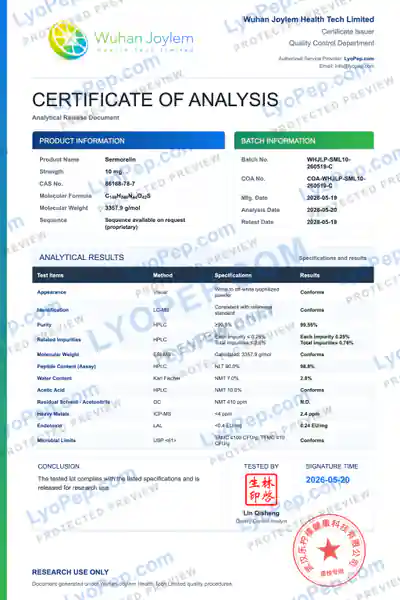
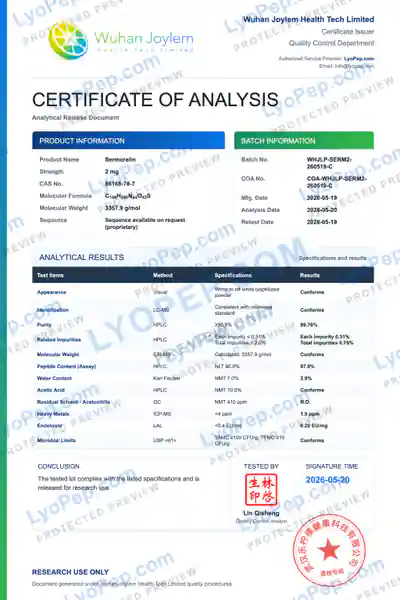
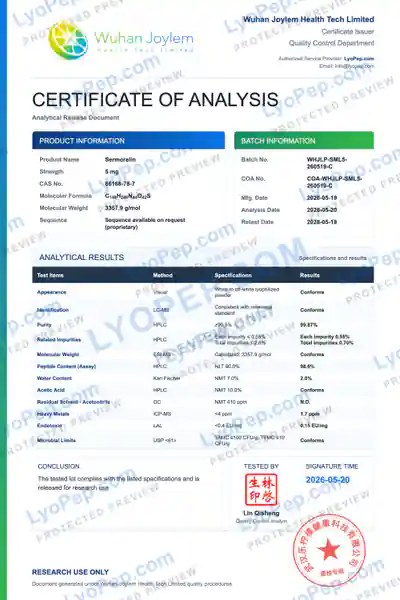
Sermorelin factory batch COAs

Representative records, refreshed periodically

Published COAs show representative factory batches and may not be the latest available. For a current quote or shipment, our sales team can confirm the applicable lot and provide its COA.

Independent testing, arranged on request

Third-party reports are not routinely published. If independent verification is required, we can agree the laboratory, method, acceptance criteria and remedy before testing. If the agreed specification is not met, an appropriate resolution—including a refund where applicable—can be discussed under the agreed terms. Unless otherwise agreed in writing, the buyer pays the cost of this optional testing.

Help reviewing your COA

Need help reading a factory COA or third-party report? Our sales team can clarify test items, specifications and how the results relate to the lot under discussion.

Ask for the current packet, not a generic certificate

  • Require sequence and C-terminal amide confirmation, intact mass, peptide mapping where appropriate, free peptide or acetate and counterion identity, chromatographic purity, quantitative peptide content, related peptides, water, residual solvents, aggregation or particulates where relevant, container integrity and lot-specific stability
  • Do not rely on CAS alone because commercial acetate identifiers are inconsistent.
Released-batch COARP-HPLC result and method contextIdentity result appropriate to the moleculeWater / counter-ion context where relevantSDS and handling statementAdditional testing scoped on request

Available fills

Quote the fill and pack configuration you need

Reference SKUFillBase pack
GHRH129-02MG2 mg10 vials
GHRH129-05MG5 mg10 vials
GHRH129-10MG10 mg10 vials

Handling

Storage in the lab and temperature during transit are different decisions

Follow the released-lot label, COA and stability data for the supplied form. Do not transfer refrigeration, reconstitution or in-use instructions from discontinued Geref products or a compounding-pharmacy preparation to a bulk research lot.

State destination, season, acceptable transit exposure and whether your protocol requires insulated or cold-chain service. Additional temperature-control cost is quoted explicitly.

Buyer FAQ

Terms to settle before the purchase order

Can a buyer arrange third-party testing?+

Yes. Testing must be performed by a mutually accepted, established specialist laboratory. Fee allocation, specification, sampling, method and acceptance rule must be agreed before testing; if an agreed independent result shows nonconformance, the remedy follows the signed order terms. Unless otherwise agreed in writing, the buyer pays the cost of this optional testing.

Does HPLC purity prove peptide content?+

No. Chromatographic purity describes the relative peak profile under a stated method. Identity, water, counter-ion, residual solvents and assay/content may require separate methods.

Is cold-chain shipping always required?+

Not always. Heat can accelerate degradation, especially during summer and long transit. Cold-chain reduces exposure but raises cost. State the destination and stability risk so the right service can be quoted.

How are payment terms handled?+

Available methods and milestones depend on order value, destination and project type. The pro forma invoice should state currency, bank details, fees, payment milestones and the release condition.

Why must the testing laboratory understand peptide chemistry?+

Free-base and salt forms, hydrophilic and hydrophobic sequences, aggregation and adsorption can change sample preparation and method suitability. Use a laboratory experienced with the molecule class.

These are buyer-qualification references, not claims that this RUO material is regulated, certified or released under those frameworks. Applicability depends on the buyer's workflow and jurisdiction.

Selected sources

Literature behind the research context

  • 1) FDA Federal Register notice published March 4, 2013: Geref NDA 019-863 was approved December 28, 1990 and NDA 020-443 on September 26, 1997; discontinuation notices were submitted in 2008, approvals were withdrawn effective June 18, 2009, and FDA determined the named products were not withdrawn for safety or effectiveness reasons. 2) PubChem: free peptide CID 16132413, C₁₄₉H₂₄₆N₄₄O₄₂S, 3357.9 Da; one-acetate CID 16132412, C₁₅₁H₂₅₀N₄₄O₄₄S, 3417.9 Da. 3) The 2026 WADA Prohibited List names sermorelin among prohibited GHRH analogues. 4) Memdouh et al., Drug Test Anal. 2021;13:1871-1887, PMID 34665524, DOI 10.1002/dta.3183: an in-vitro metabolism and UHPLC-MS/MS detection study included sermorelin and a sermorelin(3-29)-NH₂ metabolite, with target-peptide detection limits generally 1 ng/mL or lower. These analytical results do not authorize use of a current RUO lot.
  1. 01

    Growth hormone (GH)-releasing hormone-(1-29) twice daily reverses the decreased GH and insulin-like growth factor-I levels in old men

    Journal of Clinical Endocrinology & Metabolism · 1992 · peer-reviewed original research (randomized dose-comparison trial)

    Open source
  2. 02

    Effects of single nightly injections of growth hormone-releasing hormone (GHRH 1-29) in healthy elderly men

    Metabolism: Clinical and Experimental · 1997 · peer-reviewed original research (placebo-controlled trial)

    Open source
  3. 03

    Sermorelin: a review of its use in the diagnosis and treatment of children with idiopathic growth hormone deficiency

    BioDrugs · 1999 · peer-reviewed narrative review

    Open source
  4. 04

    Sermorelin: a better approach to management of adult-onset growth hormone insufficiency?

    Clinical Interventions in Aging · 2006 · peer-reviewed editorial/commentary

    Open source
  5. 05

    Evaluation and Treatment of Adult Growth Hormone Deficiency: An Endocrine Society Clinical Practice Guideline

    Journal of Clinical Endocrinology & Metabolism · 2011 · regulatory/professional-society clinical practice guideline

    Open source
  6. 06

    Advances in the detection of growth hormone releasing hormone synthetic analogs

    Drug Testing and Analysis · 2021 · peer-reviewed analytical validation study

    Open source
  7. 07

    Determination That GEREF (Sermorelin Acetate) Injection Products Were Not Withdrawn From Sale for Reasons of Safety or Effectiveness

    Federal Register (U.S. Government) · 2013 · regulatory document (FDA Federal Register notice)

    Open source
  8. 08

    The 2026 List of Prohibited Substances and Methods

    World Anti-Doping Agency · 2026 · official international sport regulation

    Open source

Product FAQ

Questions buyers ask about Sermorelin

How should sermorelin be distinguished from CJC-1295 and tesamorelin?+

All engage the GHRH receptor, but they are different chemical entities. Sermorelin is amidated human GHRH(1-29); CJC-1295 variants contain sequence substitutions and may or may not include a DAC group; tesamorelin contains an N-terminal trans-3-hexenoyl modification and is an active ingredient in approved finished drugs. Identity, molecular mass, salt form, evidence and regulatory status cannot be transferred among them.

What does the former Geref approval mean for a current research lot?+

FDA records show that specified Geref sermorelin acetate finished products were discontinued and were not withdrawn for reasons of safety or effectiveness. That historical determination does not approve a new supplier, bulk peptide, concentration, sterile presentation or clinical use. A current RUO lot must be qualified from its own manufacturing and release documents.

What should be checked on a sermorelin batch package?+

Request sequence and C-terminal amide confirmation, intact mass and peptide mapping where appropriate, free-peptide or acetate identity, chromatographic purity, quantitative peptide content, related peptides, counterion, water, residual solvents, aggregation or particulates where relevant, container integrity and lot-specific stability. PubChem lists the free peptide as CID 16132413, C₁₄₉H₂₄₆N₄₄O₄₂S, 3357.9 Da, and the one-acetate record as CID 16132412, C₁₅₁H₂₅₀N₄₄O₄₄S, 3417.9 Da. Endotoxin, bioburden and sterility are separate study-dependent attributes and require separate validated results.