Recent Confirmed OrdersLast 7 days
United States11.8 gGHK-Cu 100 mg · Semaglutide 50 mg · AOD-9604 10 mg · Ipamorelin 10 mg · CJC-1295 + Ipamorelin 10 mg · Bacteriostatic Water 10 ml
View all

Neurocognitive research

Melatonin

Pineal hormone · sleep / circadian-rhythm research compound

Lot-specific release specification; verify chromatographic purity, quantitative assay and degradants on the batch COA · target, verify batch COACAS 73-31-4RUO
Research statusExtensively studied endogenous small molecule; this material is Research Use Only
Supplied formSmall molecule (indoleamine hormone)
Lead timeConfirmed with quote
Melatonin — White to off-white crystalline powder; confirm the lot-specific solid form and appearance on the batch COA
Melatonin — White to off-white crystalline powder; confirm the lot-specific solid form and appearance on the batch COA · Representative packaging image · verify the ordered lot
Representative packaging image · verify the ordered lot

Decision summary

Key benefits

  • Best-established research relevance is circadian and sleep biology, but outcomes depend on timing, formulation, population and question
  • Antioxidant, neuroprotective, immune, oncology, bone and gastrointestinal findings are mechanistic, preclinical or indication-specific and must not be converted into broad therapeutic claims for this lot.
Published research context is presented for literature orientation only. It is not a dosing, treatment or human-use instruction.
Qualification data

Specifications to confirm against the released lot

CAS
73-31-4
Formula
C13H16N2O2
Molecular weight
232.28 g/mol
Appearance
White to off-white crystalline powder; confirm the lot-specific solid form and appearance on the batch COA
Purity
Lot-specific release specification; verify chromatographic purity, quantitative assay and degradants on the batch COA · target, verify batch COA
Storage
Store and ship according to the batch COA and validated stability data for the exact solid form, solvent, concentration, container and analytical use. Protect from identified light, moisture and oxidation risks. A 2026 HPLC-PDA/HPLC-HRMS/MS study mapped five degradants under forced oxidative conditions in solution and excipient-containing solid blends, but explicitly did not establish predictive real-time shelf life. Generic room-temperature, refrigerated, frozen and one-year claims are not interchangeable; record excursions and avoid unvalidated freeze-thaw cycles.
MOQ
On request
Lead time
Confirmed with quote
PubChem CID 896

Qualification matrix

Identity, purity and content are separate release questions.

Identity

Confirm the stated molecule and supplied form. Start with the matching batch COA; request sequence-level evidence only when the buyer's written procedure requires it and availability or a separate scope has been agreed.

Purity

Review RP-HPLC method conditions, wavelength, integration and related-peak handling. A percentage without the method is not enough.

Content

Net peptide content is not the same as gross lyophilized powder weight. Ask which assay supports the stated amount and whether water/counter-ion is addressed.

Stability

Define long-term storage and transit exposure separately. Cold-chain can be quoted when the buyer’s risk assessment requires it and adds cost.

Research context

What researchers study about Melatonin

Melatonin (N-acetyl-5-methoxytryptamine) is an endogenous indoleamine hormone whose dark-phase secretion helps signal circadian timing. It is a non-peptide small molecule used as an analytical reference or experimental reagent in circadian, neuroendocrine and related research. In the United States, melatonin is sold in dietary supplements, which do not receive FDA premarket approval; FDA separately considers melatonin added to conventional food an unapproved food additive. Other jurisdictions regulate specified finished medicinal products differently. None of those frameworks confers therapeutic approval on this Research Use Only raw material.

  • Appropriate laboratory contexts include MT1/MT2 receptor pharmacology, circadian phase and light-response models, redox and neuroendocrine assays, LC-MS or spectroscopic method development, degradation studies and finished-product content surveillance
  • Clinical sleep, jet-lag or paediatric findings remain formulation-, timing-, population- and protocol-specific and are not use instructions for this lot.

Mechanism context

The question the literature is testing

Melatonin signals primarily through the MT1 and MT2 G protein-coupled receptors and also participates in receptor-independent redox chemistry. A 2025 mouse preprint indexed in PubMed linked MT1 signalling to Slo1/BK-channel activity in the suprachiasmatic nucleus; because it is a preprint rather than peer-reviewed evidence, the finding remains provisional and is not a human-use instruction. Endogenous synthesis proceeds from tryptophan through serotonin and N-acetylserotonin, with AANAT and ASMT catalysing the final steps and light-dark signalling regulating the pathway.

Evidence map

Research routes and exposure context

Evidence tierAnalytical / laboratory context
Routes reported in sources
SubcutaneousIntravenousOralIntraperitonealIn vitro
Dose / exposure contextProtocol-specific; verify the cited primary source
Routes and exposure contexts summarize cited studies or approved finished-product labels. They are not instructions for administering this RUO material; no customer dose is provided.

Evidence boundaries

Compatibility, limitations and decision context

  • This catalogue material is not for human use
  • Clinical literature commonly reports drowsiness, headache, dizziness or next-day effects, but safety varies by age, formulation, dose, timing, medicines and duration
  • CDC surveillance documents emergency-department visits after unsupervised pediatric ingestion, and laboratory studies show that some gummies contain substantially different melatonin quantities from their labels
  • These findings highlight exposure and quality risks rather than define the safety of a chemically characterized research standard
  • Laboratory handling should follow the SDS and institutional risk assessment.

Interactions reported in the literature

  • A five-participant pharmacokinetic study found that coadministration of fluvoxamine, a potent CYP1A2 inhibitor, increased melatonin AUC about 17-fold and Cmax about 12-fold without a statistically significant change in terminal half-life
  • The small study supports a metabolism-mediated interaction signal, not general patient advice
  • A systematic review also reports context-dependent effects from age, caffeine, smoking, oral contraceptives and feeding status
  • Combining tryptophan, 5-HTP, GABAergic compounds or antioxidants in research does not establish safe or effective consumer stacks.
Literature context is not a supplier release result or human-use instruction. Follow your institution's approved laboratory risk assessment.

Factory batch documentation

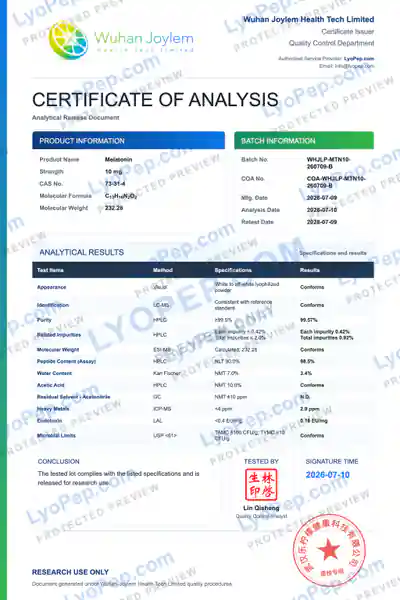
Melatonin factory batch COAs

Representative records, refreshed periodically

Published COAs show representative factory batches and may not be the latest available. For a current quote or shipment, our sales team can confirm the applicable lot and provide its COA.

Independent testing, arranged on request

Third-party reports are not routinely published. If independent verification is required, we can agree the laboratory, method, acceptance criteria and remedy before testing. If the agreed specification is not met, an appropriate resolution—including a refund where applicable—can be discussed under the agreed terms. Unless otherwise agreed in writing, the buyer pays the cost of this optional testing.

Help reviewing your COA

Need help reading a factory COA or third-party report? Our sales team can clarify test items, specifications and how the results relate to the lot under discussion.

Ask for the current packet, not a generic certificate

  • A white crystalline appearance or HPLC area percentage cannot alone establish identity, assay, degradation state or suitability
  • A useful COA should include orthogonal identity such as LC-MS plus a spectroscopic method, chromatographic purity and degradant profile with raw data, quantitative assay, water, residual solvents and elemental impurities where relevant, and lot-specific stability
  • A 2026 forced-degradation study resolved five oxidative degradants by HPLC-PDA/HPLC-HRMS/MS and demonstrates why stress specificity and mass balance matter; it does not establish this lot's shelf life
  • Microbial testing is formulation- and use-dependent; sterility cannot be inferred
  • For finished supplements, label-claim assay and dosage-unit uniformity are separate requirements.
Released-batch COARP-HPLC result and method contextIdentity result appropriate to the moleculeWater / counter-ion context where relevantSDS and handling statementAdditional testing scoped on request

Available fills

Quote the fill and pack configuration you need

Reference SKUFillBase pack
MELA-10MG10 mg10 vials

Handling

Storage in the lab and temperature during transit are different decisions

Store and ship according to the batch COA and validated stability data for the exact solid form, solvent, concentration, container and analytical use. Protect from identified light, moisture and oxidation risks. A 2026 HPLC-PDA/HPLC-HRMS/MS study mapped five degradants under forced oxidative conditions in solution and excipient-containing solid blends, but explicitly did not establish predictive real-time shelf life. Generic room-temperature, refrigerated, frozen and one-year claims are not interchangeable; record excursions and avoid unvalidated freeze-thaw cycles.

State destination, season, acceptable transit exposure and whether your protocol requires insulated or cold-chain service. Additional temperature-control cost is quoted explicitly.

Buyer FAQ

Terms to settle before the purchase order

Can a buyer arrange third-party testing?+

Yes. Testing must be performed by a mutually accepted, established specialist laboratory. Fee allocation, specification, sampling, method and acceptance rule must be agreed before testing; if an agreed independent result shows nonconformance, the remedy follows the signed order terms. Unless otherwise agreed in writing, the buyer pays the cost of this optional testing.

Does HPLC purity prove peptide content?+

No. Chromatographic purity describes the relative peak profile under a stated method. Identity, water, counter-ion, residual solvents and assay/content may require separate methods.

Is cold-chain shipping always required?+

Not always. Heat can accelerate degradation, especially during summer and long transit. Cold-chain reduces exposure but raises cost. State the destination and stability risk so the right service can be quoted.

How are payment terms handled?+

Available methods and milestones depend on order value, destination and project type. The pro forma invoice should state currency, bank details, fees, payment milestones and the release condition.

Why must the testing laboratory understand peptide chemistry?+

Free-base and salt forms, hydrophilic and hydrophobic sequences, aggregation and adsorption can change sample preparation and method suitability. Use a laboratory experienced with the molecule class.

These are buyer-qualification references, not claims that this RUO material is regulated, certified or released under those frameworks. Applicability depends on the buyer's workflow and jurisdiction.

Selected sources

Literature behind the research context

  • Chemical identity: PubChem CID 896. Pharmacokinetic variability: Harpsøe et al. 2015 (PMID 26008214). Fluvoxamine interaction: Härtter et al. 2000 (PMID 10668847). Oxidative degradants: Salles et al. 2026 (PMID 42341649). Provisional MT1–Slo1 mechanism: Vedantham et al. 2025 bioRxiv preprint (PMID 40475449). Public-health and regulatory context: CDC MMWR 2024, NIH NCCIH updated May 2024, and FDA's current post-market melatonin record and scientific memoranda. None of these sources replaces the batch COA or establishes a human-use protocol for this RUO lot.
  1. 01

    Optimizing the Time and Dose of Melatonin as a Sleep-Promoting Drug: A Systematic Review of Randomized Controlled Trials and Dose-Response Meta-Analysis

    Journal of Pineal Research · 2024 · systematic review and dose-response meta-analysis of randomized controlled trials

    Open source
  2. 02

    Melatonin for the prevention and treatment of jet lag

    Cochrane Database of Systematic Reviews · 2002 · Cochrane systematic review of randomized controlled trials

    Open source
  3. 03

    Clinical Practice Guideline for the Pharmacologic Treatment of Chronic Insomnia in Adults: An American Academy of Sleep Medicine Clinical Practice Guideline

    Journal of Clinical Sleep Medicine · 2017 · professional society clinical practice guideline (evidence-graded recommendations)

    Open source
  4. 04

    Melatonin as an antioxidant: under promises but over delivers

    Journal of Pineal Research · 2016 · peer-reviewed narrative review (highly cited, >1400 citations)

    Open source
  5. 05

    Notes from the Field: Emergency Department Visits for Unsupervised Pediatric Melatonin Ingestion — United States, 2019-2022

    MMWR Morbidity and Mortality Weekly Report (Centers for Disease Control and Prevention) · 2024 · CDC national surveillance data report

    Open source
  6. 06

    Quantity of Melatonin and CBD in Melatonin Gummies Sold in the US

    JAMA · 2023 · peer-reviewed research letter (laboratory analytical study)

    Open source
  7. 07

    Comparative Review of Approved Melatonin Agonists for the Treatment of Circadian Rhythm Sleep-Wake Disorders

    Pharmacotherapy: The Journal of Human Pharmacology and Drug Therapy · 2016 · peer-reviewed comparative pharmacology review

    Open source
  8. 08

    Clinical pharmacokinetics of melatonin: a systematic review

    European Journal of Clinical Pharmacology · 2015 · systematic review of human pharmacokinetic studies

    Open source

Product FAQ

Questions buyers ask about Melatonin

Is melatonin a peptide, and which identity tests are appropriate?+

No. Melatonin is the non-peptide indoleamine N-acetyl-5-methoxytryptamine. Qualification should therefore use structure-appropriate, orthogonal methods such as LC-MS accurate mass together with NMR or IR, plus chromatographic purity and degradant profiling, quantitative assay, water and residual solvents. A peptide sequence or peptide-content calculation does not apply.

Can Epitalon findings or a combined study be transferred to this melatonin lot?+

No. Melatonin and Epitalon are distinct chemical entities. A paper that studies pineal signalling, Epitalon or a combination is evidence only for its named material, formulation, model and protocol; it does not establish compatibility, benefit or a combined-use recommendation for this Research Use Only lot. Qualify each material independently and predefine the experimental controls.

Why must melatonin storage and solution hold time be lot-specific?+

Published stress studies show that light, temperature, pH, solvent and oxidative conditions can affect melatonin stability. A 2026 HPLC-PDA/HPLC-HRMS/MS study resolved five degradants under forced oxidative conditions in solutions and excipient-containing solid blends, but the authors explicitly describe the solid-state experiment as an accelerated worst-case mechanistic model rather than a predictive real-time stability study. Follow the batch COA and validated lot data; do not transfer shelf life or solution hold time between formulations.