Recent Confirmed OrdersLast 7 days
Australia520 mgTirzepatide 40 mg · Semaglutide 2 mg · Dihexa 10 mg
View all

Neurocognitive research

P21 (P021)

CNTF-region-derived DGGL peptidomimetic with an adamantane-containing terminus

Lot-specific chromatographic purity plus quantitative content; confirm the complete adamantane-containing structure, water, counterions and related substances separately · target, verify batch COACAS 1246751-68-7RUO
Research statusPreclinical cell and rodent literature only; no qualifying human study or approved use reference context · supplied material is RUO
Supplied formN-acetylated DGGL-derived peptidomimetic with a non-standard adamantane carboxamide terminus
Lead time14–21 days
P21 (P021) — Lot-specific lyophilized research material; confirm colour and physical form on the released-lot COA
P21 (P021) — Lot-specific lyophilized research material; confirm colour and physical form on the released-lot COA · Representative packaging image · verify the ordered lot
Representative packaging image · verify the ordered lot

Decision summary

Key benefits

  • Defensible research value includes CNTF-region-mimetic hypotheses, neurogenesis and synaptic-marker models, ageing and neurodevelopmental rodent models, stability/permeability method development and orthogonal structural qualification
  • Animal changes in cognition, tau, amyloid, survival or behaviour do not establish human efficacy or safety.
Published research context is presented for literature orientation only. It is not a dosing, treatment or human-use instruction.
Qualification data

Specifications to confirm against the released lot

CAS
1246751-68-7
Formula
C27H42N6O8
Molecular weight
578.3-578.7 Da
Appearance
Lot-specific lyophilized research material; confirm colour and physical form on the released-lot COA
Purity
Lot-specific chromatographic purity plus quantitative content; confirm the complete adamantane-containing structure, water, counterions and related substances separately · target, verify batch COA
Storage
Follow the released-lot label, COA and stability data. Do not infer 2–8°C or −20°C storage, solution hold time or light sensitivity without data for the supplied form, container and matrix.
MOQ
On request
Lead time
14–21 days
PubChem CID 56599151

Qualification matrix

Identity, purity and content are separate release questions.

Identity

Confirm the stated molecule and supplied form. Start with the matching batch COA; request sequence-level evidence only when the buyer's written procedure requires it and availability or a separate scope has been agreed.

Purity

Review RP-HPLC method conditions, wavelength, integration and related-peak handling. A percentage without the method is not enough.

Content

Net peptide content is not the same as gross lyophilized powder weight. Ask which assay supports the stated amount and whether water/counter-ion is addressed.

Stability

Define long-term storage and transit exposure separately. Cold-chain can be quoted when the buyer’s risk assessment requires it and adds cost.

Research context

What researchers study about P21 (P021)

P021/P21 is a DGGL-region-derived, adamantane-containing peptidomimetic studied in preclinical neurobiology models. PubChem CID 56599151 reports formula C₂₇H₄₂N₆O₈ and molecular weight 578.7. Its non-standard terminus means a simple amino-acid sequence does not fully define identity. Rodent studies have explored neurogenesis and disease models, but no qualifying human trial was identified and blood–brain-barrier exposure remains insufficiently documented.

  • Appropriate laboratory contexts include preclinical neurogenesis and signalling models, disease-model replication, permeability and stability methods, and structural identity qualification
  • No approved clinical indication applies.

Mechanism context

The question the literature is testing

Preclinical work proposes effects on LIF/STAT3 and BDNF-related signalling, but pathway direction and relevance depend on model and exposure. The adamantane-containing terminus was designed to alter stability and permeability; it does not itself prove brain exposure. Detailed human pharmacology, selectivity and target engagement remain unestablished.

Evidence map

Research routes and exposure context

Evidence tierApproved finished-product context
Routes reported in sources
OralIntraperitoneal
Dose / exposure contextProtocol-specific; verify the cited primary source
Routes and exposure contexts summarize cited studies or approved finished-product labels. They are not instructions for administering this RUO material; no customer dose is provided.

Evidence boundaries

Compatibility, limitations and decision context

  • Not for human or veterinary administration
  • No human safety data exist, and long rodent studies cannot establish human immunogenicity, carcinogenicity, reproductive safety or tolerability
  • Identity ambiguity, incorrect content, impurities, contamination and unsupported administration routes are material risks.

Interactions reported in the literature

  • No human or validated preclinical combination guidance applies
  • Claims involving Semax, Selank, BPC-157, NAD+ or Epitalon were removed because no qualifying interaction studies support them.
Literature context is not a supplier release result or human-use instruction. Follow your institution's approved laboratory risk assessment.

Factory batch documentation

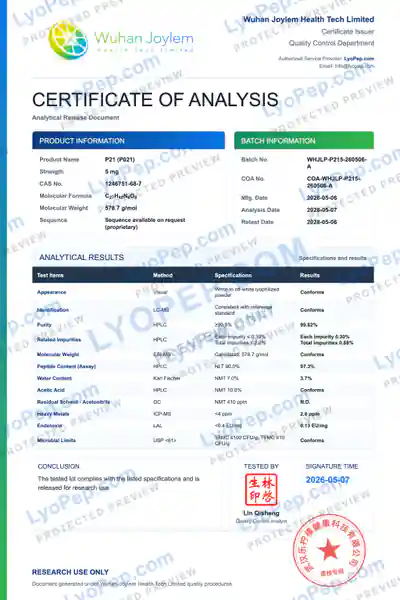
P21 (P021) factory batch COAs

Representative records, refreshed periodically

Published COAs show representative factory batches and may not be the latest available. For a current quote or shipment, our sales team can confirm the applicable lot and provide its COA.

Independent testing, arranged on request

Third-party reports are not routinely published. If independent verification is required, we can agree the laboratory, method, acceptance criteria and remedy before testing. If the agreed specification is not met, an appropriate resolution—including a refund where applicable—can be discussed under the agreed terms. Unless otherwise agreed in writing, the buyer pays the cost of this optional testing.

Help reviewing your COA

Need help reading a factory COA or third-party report? Our sales team can clarify test items, specifications and how the results relate to the lot under discussion.

Ask for the current packet, not a generic certificate

  • Require the complete adamantane-containing structure, intact mass, orthogonal structural or fragment evidence, chromatographic purity, quantitative content, water, counterions, residual solvents, related substances, container integrity and lot-specific stability
  • Endotoxin, bioburden and sterility are separate study-dependent attributes.
Released-batch COARP-HPLC result and method contextIdentity result appropriate to the moleculeWater / counter-ion context where relevantSDS and handling statementAdditional testing scoped on request

Available fills

Quote the fill and pack configuration you need

Reference SKUFillBase pack
P021-5MG5 mg10 vials

Handling

Storage in the lab and temperature during transit are different decisions

Follow the released-lot label, COA and stability data. Do not infer 2–8°C or −20°C storage, solution hold time or light sensitivity without data for the supplied form, container and matrix.

State destination, season, acceptable transit exposure and whether your protocol requires insulated or cold-chain service. Additional temperature-control cost is quoted explicitly.

Buyer FAQ

Terms to settle before the purchase order

Can a buyer arrange third-party testing?+

Yes. Testing must be performed by a mutually accepted, established specialist laboratory. Fee allocation, specification, sampling, method and acceptance rule must be agreed before testing; if an agreed independent result shows nonconformance, the remedy follows the signed order terms. Unless otherwise agreed in writing, the buyer pays the cost of this optional testing.

Does HPLC purity prove peptide content?+

No. Chromatographic purity describes the relative peak profile under a stated method. Identity, water, counter-ion, residual solvents and assay/content may require separate methods.

Is cold-chain shipping always required?+

Not always. Heat can accelerate degradation, especially during summer and long transit. Cold-chain reduces exposure but raises cost. State the destination and stability risk so the right service can be quoted.

How are payment terms handled?+

Available methods and milestones depend on order value, destination and project type. The pro forma invoice should state currency, bank details, fees, payment milestones and the release condition.

Why must the testing laboratory understand peptide chemistry?+

Free-base and salt forms, hydrophilic and hydrophobic sequences, aggregation and adsorption can change sample preparation and method suitability. Use a laboratory experienced with the molecule class.

These are buyer-qualification references, not claims that this RUO material is regulated, certified or released under those frameworks. Applicability depends on the buyer's workflow and jurisdiction.

Selected sources

Literature behind the research context

  • (1) Li et al., FEBS Lett 2010 (original discovery study, titled "Neurotrophic peptides incorporating adamantane improve learning and memory, promote neurogenesis and synaptic plasticity in mice"): subcutaneous extended-release implants (25 nM/day) in adult C57Bl6 mice for 35 days significantly improved object recognition and spatial reference memory, increased dentate gyrus neurogenesis and synaptophysin/synapsin I expression; in vitro, inhibited LIF-induced STAT3 phosphorylation by approximately 30%. (2) Kazim et al., 2014 (3xTg-AD model, dosing started at 9-10 months of age for 6-12 months, 60 nmol/g feed): reduced tau hyperphosphorylation and soluble amyloid-beta, restored neurogenesis, synaptic markers, and cognitive function, increased BDNF and pGSK3beta(Ser9). (3) Baazaoui & Iqbal 2017a/b (3xTg-AD model, dosing started at 3 months of age for 18 months): rescued dendritic/synaptic deficits, increased neurogenesis (approximately 4-fold), reversed cognitive impairment, reduced neurodegeneration and tau/amyloid-beta pathology, and raised 71-week survival from 41% (vehicle) to 87% (P21-treated). (4) Mottolese et al. 2024 (CDKL5 knockout mouse model, J Neurodev Disord, DOI 10.1186/s11689-024-09583-4; juvenile dietary dosing of 60 nmol/g feed for 70 days, adult (4-month-old) intraperitoneal dosing of 750 nmol/mouse/day for 30 days): limited in vivo efficacy (only muscular rigidity improved); in vitro cell experiments showed restored proliferation, survival, and neuronal maturation. Primary source: Alzheimer's Drug Discovery Foundation Cognitive Vitality Report (alzdiscovery.org), updated May 12, 2025, which systematically reviews the above and additional studies (Khatoon et al. 2015, Bolognin et al. 2014, Kazim et al. 2017, Wei et al. 2020/2021). Cross-checked against PubChem (CID 56599151, with CAS 1246751-68-7; CID 56589645 is an associated record for the same compound), Glixxlabs technical data sheet, and ChemicalBook technical data sheet.
  1. 01

    Neurotrophic peptides incorporating adamantane improve learning and memory, promote neurogenesis and synaptic plasticity in mice

    FEBS Letters · 2010 · peer-reviewed original research

    Open source
  2. 02

    Early neurotrophic pharmacotherapy rescues developmental delay and Alzheimer's-like memory deficits in the Ts65Dn mouse model of Down syndrome

    Scientific Reports · 2017 · peer-reviewed original research

    Open source
  3. 03

    Prevention of dendritic and synaptic deficits and cognitive impairment with a neurotrophic compound

    Alzheimer's Research & Therapy · 2017 · peer-reviewed original research

    Open source
  4. 04

    Effects of a ciliary neurotrophic factor (CNTF) small-molecule peptide mimetic in an in vitro and in vivo model of CDKL5 deficiency disorder

    Journal of Neurodevelopmental Disorders · 2024 · peer-reviewed original research

    Open source
  5. 05

    Diffusion MRI measures detect brain microstructure changes due to early treatment with neurotrophic peptide mimetic P021 in the 3xTg-AD mouse model of Alzheimer's disease

    Magnetic Resonance Imaging · 2026 · peer-reviewed original research

    Open source
  6. 06

    Cognitive Vitality Reports: P021

    Alzheimer's Drug Discovery Foundation (ADDF) - Cognitive Vitality · 2025 · nonprofit research-foundation evidence review

    Open source
  7. 07

    NIH Innovation Zone: Phanes Biotech addresses neurodegenerative disease with a groundbreaking approach

    Bio.News (Biotechnology Innovation Organization / BIO) · 2023 · industry trade publication

    Open source
  8. 08

    NIA Small Business Showcase: Phanes Biotech

    National Institute on Aging (NIA), National Institutes of Health (NIH) · 2024 · regulatory/federal-agency company profile

    Open source

Product FAQ

Questions buyers ask about P21 (P021)

How should the non-standard P021 structure be identified?+

The catalogue identity is PubChem CID 56599151, formula C₂₇H₄₂N₆O₈ and average molecular mass about 578.7 Da. Because the molecule contains an adamantane-derived non-standard terminus, a shorthand peptide sequence is insufficient. Request an explicit structure, intact mass and a sequence- or structure-capable orthogonal method, plus the supplier’s terminal and counterion conventions.

Does the adamantane-containing terminus prove oral or brain exposure?+

No. It changes physicochemical properties and was designed to improve stability and delivery, but the degree of blood–brain-barrier penetration has not been directly established by robust brain-concentration data. Solubility, permeability and exposure claims must remain attached to the exact model and method rather than being treated as a guaranteed product property.

What evidence level applies to P021?+

Published findings are from cells and rodent models, with no qualifying human clinical trial identified. Results in Alzheimer’s, ageing, Down-syndrome or CDKL5 models are preclinical hypotheses and cannot be presented as human cognitive, neuroprotective or safety benefits. Concentration, route and duration from those models are not customer instructions.