Recent Confirmed OrdersLast 7 days
Australia520 mgTirzepatide 40 mg · Semaglutide 2 mg · Dihexa 10 mg
View all

Other research materials

PTD-DBM

CXXC5-Dvl competitor fusion peptide · preclinical Wnt/β-catenin research

Per batch COACAS 1609454-11-6RUO
Research statusPreclinical cell and mouse research / no established human efficacy or safety
Supplied form25-residue fusion peptide (Arg8-Gly4-DBM)
Lead timeConfirmed with quote
PTD-DBM — Lyophilized material; confirm released-lot appearance on the COA
PTD-DBM — Lyophilized material; confirm released-lot appearance on the COA · Representative packaging image · verify the ordered lot
Representative packaging image · verify the ordered lot

Decision summary

Key benefits

  • Direct cell and mouse studies support use as a research tool for disrupting the CXXC5-Dvl interaction and measuring Wnt/β-catenin-related readouts in hair-regeneration and wound-repair models
  • The evidence does not establish human efficacy, delivery through intact skin, dose, durability or safety
  • Results from Cxxc5 knockout, VPA combinations, KY-02061 and KY19382 must be identified as separate model or molecule evidence rather than PTD-DBM monotherapy evidence.
Published research context is presented for literature orientation only. It is not a dosing, treatment or human-use instruction.
Qualification data

Specifications to confirm against the released lot

CAS
1609454-11-6
Formula
Confirm supplied form on batch COA
Molecular weight
3082.6 Da
Appearance
Lyophilized material; confirm released-lot appearance on the COA
Purity
Per batch COA
Storage
Follow released-lot stability data. Protect the dry peptide from moisture, light and repeated opening, and qualify temperature excursions. For solutions, validate solvent or buffer, pH, concentration, container, adsorption, cysteine oxidation or disulfide formation, aggregation and hold time; a generic freezer or refrigerator temperature does not establish shelf life.
MOQ
On request
Lead time
Confirmed with quote

Qualification matrix

Identity, purity and content are separate release questions.

Identity

Confirm the stated molecule and supplied form. Start with the matching batch COA; request sequence-level evidence only when the buyer's written procedure requires it and availability or a separate scope has been agreed.

Purity

Review RP-HPLC method conditions, wavelength, integration and related-peak handling. A percentage without the method is not enough.

Content

Net peptide content is not the same as gross lyophilized powder weight. Ask which assay supports the stated amount and whether water/counter-ion is addressed.

Stability

Define long-term storage and transit exposure separately. Cold-chain can be quoted when the buyer’s risk assessment requires it and adds cost.

Research context

What researchers study about PTD-DBM

PTD-DBM is the 25-residue fusion peptide RRRRRRRRGGGGRKTGHQICKFRKC developed in research led by Kang-Yell Choi's group at Yonsei University. It combines an Arg8-Gly4 protein-transduction segment with a CXXC5-derived Dishevelled-binding motif. Cell and mouse studies report disruption of the CXXC5-Dvl interaction and Wnt/β-catenin-related readouts in wound-repair and hair-regeneration models. The evidence remains preclinical. Bone and other platform extensions often involve Cxxc5 knockout or different small molecules such as KY-02061 or KY19382 and are not direct efficacy evidence for PTD-DBM. No qualifying human efficacy, safety, skin-penetration or pharmacokinetic dataset has been established.

  • Appropriate applications include CXXC5-Dvl binding or competition assays, cellular-uptake controls, Wnt/β-catenin reporter systems, cysteine-oxidation studies and controlled cell or mouse models of wound repair and hair regeneration
  • Published hair-regeneration and wound-repair results are preclinical and do not establish human treatment outcomes
  • Bone studies, knockout models and work with KY-02061 or KY19382 provide target or platform context but are not direct PTD-DBM efficacy evidence.

Mechanism context

The question the literature is testing

CXXC5 participates in negative feedback on Wnt/β-catenin signalling through interaction of its Dishevelled-binding motif with the PDZ domain of Dvl. The DBM segment of PTD-DBM is designed to compete for that interaction, while the N-terminal arginine-rich segment is intended to support cellular uptake. Cell and mouse experiments report increased β-catenin-related signalling after this perturbation. Those results do not prove reliable passage through intact human stratum corneum, clinical hair growth or a complete safety profile. Because Wnt/β-catenin signalling is also involved in proliferation and oncogenesis, pathway activation and off-target effects require model-specific controls.

Evidence map

Research routes and exposure context

Evidence tierMixed evidence context
Routes reported in sources
Topical
Dose / exposure contextProtocol-specific; verify the cited primary source
Routes and exposure contexts summarize cited studies or approved finished-product labels. They are not instructions for administering this RUO material; no customer dose is provided.

Evidence boundaries

Compatibility, limitations and decision context

  • Research use only (RUO) and not for administration to humans or animals or use as a food, drug or dietary supplement
  • No qualifying human safety, toxicology, carcinogenicity, skin-penetration or pharmacokinetic dataset was identified
  • Wnt/β-catenin signalling participates in proliferation and oncogenesis, so pathway activation and off-target effects require model-specific controls
  • Handle in a compliant laboratory, avoid skin or inhalation exposure and treat the peptide as a material of unknown toxicity.

Interactions reported in the literature

  • Published mouse work has evaluated PTD-DBM in experimental designs that also used valproic acid, a GSK3β inhibitor and Wnt-pathway activator
  • That result is model-specific evidence and not a general mixing, synergy or co-administration instruction
  • For laboratory compatibility, evaluate buffer, pH, redox conditions, surfaces, proteases, VPA or other pathway controls and assay interference under a prespecified protocol.
Literature context is not a supplier release result or human-use instruction. Follow your institution's approved laboratory risk assessment.

Factory batch documentation

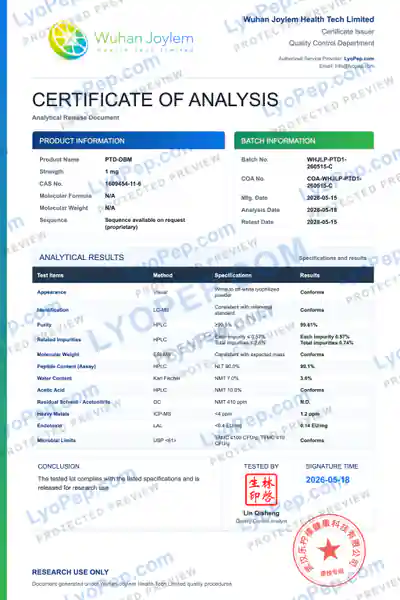
PTD-DBM factory batch COAs

Representative records, refreshed periodically

Published COAs show representative factory batches and may not be the latest available. For a current quote or shipment, our sales team can confirm the applicable lot and provide its COA.

Independent testing, arranged on request

Third-party reports are not routinely published. If independent verification is required, we can agree the laboratory, method, acceptance criteria and remedy before testing. If the agreed specification is not met, an appropriate resolution—including a refund where applicable—can be discussed under the agreed terms. Unless otherwise agreed in writing, the buyer pays the cost of this optional testing.

Help reviewing your COA

Need help reading a factory COA or third-party report? Our sales team can clarify test items, specifications and how the results relate to the lot under discussion.

Ask for the current packet, not a generic certificate

  • Require the complete 25-residue sequence, terminal groups, high-resolution intact mass and MS/MS or another orthogonal sequence method
  • The COA should state the reference standard, peptide-content assay, chromatographic purity with an identified impurity profile, water, residual solvents, counterions, aggregates and lot-specific stability
  • Because the sequence contains two cysteines, control free thiols, oxidation, intramolecular and intermolecular disulfide-linked species and handling conditions explicitly
  • Appearance, HPLC area percentage or a clear solution alone cannot establish identity, monomer state, content or experimental suitability.
Released-batch COARP-HPLC result and method contextIdentity result appropriate to the moleculeWater / counter-ion context where relevantSDS and handling statementAdditional testing scoped on request

Available fills

Quote the fill and pack configuration you need

Reference SKUFillBase pack
PTDBM-1MG1 mg10 vials

Handling

Storage in the lab and temperature during transit are different decisions

Follow released-lot stability data. Protect the dry peptide from moisture, light and repeated opening, and qualify temperature excursions. For solutions, validate solvent or buffer, pH, concentration, container, adsorption, cysteine oxidation or disulfide formation, aggregation and hold time; a generic freezer or refrigerator temperature does not establish shelf life.

State destination, season, acceptable transit exposure and whether your protocol requires insulated or cold-chain service. Additional temperature-control cost is quoted explicitly.

Buyer FAQ

Terms to settle before the purchase order

Can a buyer arrange third-party testing?+

Yes. Testing must be performed by a mutually accepted, established specialist laboratory. Fee allocation, specification, sampling, method and acceptance rule must be agreed before testing; if an agreed independent result shows nonconformance, the remedy follows the signed order terms. Unless otherwise agreed in writing, the buyer pays the cost of this optional testing.

Does HPLC purity prove peptide content?+

No. Chromatographic purity describes the relative peak profile under a stated method. Identity, water, counter-ion, residual solvents and assay/content may require separate methods.

Is cold-chain shipping always required?+

Not always. Heat can accelerate degradation, especially during summer and long transit. Cold-chain reduces exposure but raises cost. State the destination and stability risk so the right service can be quoted.

How are payment terms handled?+

Available methods and milestones depend on order value, destination and project type. The pro forma invoice should state currency, bank details, fees, payment milestones and the release condition.

Why must the testing laboratory understand peptide chemistry?+

Free-base and salt forms, hydrophilic and hydrophobic sequences, aggregation and adsorption can change sample preparation and method suitability. Use a laboratory experienced with the molecule class.

These are buyer-qualification references, not claims that this RUO material is regulated, certified or released under those frameworks. Applicability depends on the buyer's workflow and jurisdiction.

Selected sources

Literature behind the research context

  • PubChem CID 176453931 supports the 25-residue identity, formula C₁₂₄H₂₂₅N₆₁O₂₈S₂ and molecular weight 3082.6 g/mol. Lee et al. 2017, PMID 28595998, directly reports PTD-DBM in cell and mouse hair-regeneration models, while Lee et al. 2015, PMCID PMC4493411, provides direct wound-repair and CXXC5-Dvl evidence. Ryu et al. 2023, PMID 36831222, adds DHT- and PGD2-linked preclinical context. Studies using Cxxc5 knockout, KY-02061 or KY19382 are target or platform evidence and must not be represented as human or PTD-DBM monotherapy evidence.
  1. 01

    Targeting of CXXC5 by a Competing Peptide Stimulates Hair Regrowth and Wound-Induced Hair Neogenesis

    Journal of Investigative Dermatology · 2017 · peer-reviewed original research

    Open source
  2. 02

    The Negative Regulator CXXC5: Making WNT Look a Little Less Dishevelled

    Journal of Investigative Dermatology · 2017 · invited commentary (peer-reviewed)

    Open source
  3. 03

    CXXC5 Mediates DHT-Induced Androgenetic Alopecia via PGD2

    Cells (MDPI) · 2023 · peer-reviewed original research

    Open source
  4. 04

    CXXC5 is a negative-feedback regulator of the Wnt/β-catenin pathway involved in osteoblast differentiation

    Cell Death & Differentiation · 2015 · peer-reviewed original research

    Open source
  5. 05

    KY19382, a novel activator of Wnt/β-catenin signalling, promotes hair regrowth and hair follicle neogenesis

    British Journal of Pharmacology · 2021 · peer-reviewed original research

    Open source
  6. 06

    Revolutionary Approaches to Hair Regrowth: Follicle Neogenesis, Wnt/β-Catenin Signaling, and Emerging Therapies

    Cells (MDPI) · 2025 · peer-reviewed review

    Open source
  7. 07

    PTD-DBM Update: Q&A With Dr. Kang-Yell Choi

    Follicle Thought · 2019 · KOL interview / trade publication (independent hair-loss research news site)

    Open source
  8. 08

    CK Regeon and its PTD-DBM Peptide

    Hair Loss Cure 2020 · 2022 · trade publication (hair-loss research industry news/tracking site)

    Open source

Product FAQ

Questions buyers ask about PTD-DBM

What exact PTD-DBM identity should be written into an order specification?+

The research literature and PubChem record describe the 25-residue sequence RRRRRRRRGGGGRKTGHQICKFRKC, commonly written H-RRRRRRRR-GGGG-RKTGHQICKFRKC-OH. The specification should also state terminal groups, counter-ions, molecular-mass basis and whether any oxidized or disulfide-linked form is permitted. The name PTD-DBM alone is not enough to establish that a commercial lot matches the studied peptide.

What evidence directly supports PTD-DBM, and what must not be extrapolated?+

Direct evidence consists of cell and mouse studies of CXXC5-Dvl disruption, wound repair and hair-regeneration models. It is not human efficacy, safety, skin-penetration or pharmacokinetic evidence. Results from Cxxc5 knockout, valproic-acid combinations, KY-02061, KY19382 or other small-molecule mimetics provide target or platform context but must not be presented as PTD-DBM monotherapy data.

Which batch tests are especially important for this cysteine-containing peptide?+

Request complete sequence identity, high-resolution intact mass, an orthogonal sequence method, chromatographic purity and peptide content. Because the sequence contains two cysteines, the method should monitor cysteine oxidation, intramolecular or intermolecular disulfide species and other aggregates. Also define water, counter-ion, residual solvents, storage and retest conditions. HPLC area purity and appearance alone do not establish content, oxidation state or biological suitability.