Recent Confirmed OrdersLast 7 days
Australia520 mgTirzepatide 40 mg · Semaglutide 2 mg · Dihexa 10 mg
View all

Other research materials

Glutathione

Reduced glutathione (GSH) · redox-sensitive tripeptide reference material

≥ 99.0% · target, verify batch COACAS 70-18-8RUO
Research statusExtensively Studied Endogenous Metabolite / This SKU Is Research Use Only
Supplied formTripeptide (γ-glutamyl linkage)
Lead time7–14 days
Glutathione — White to off-white powder or cake; appearance alone cannot distinguish reduced GSH from oxidized or degraded material
Glutathione — White to off-white powder or cake; appearance alone cannot distinguish reduced GSH from oxidized or degraded material · Representative packaging image · verify the ordered lot
Representative packaging image · verify the ordered lot

Decision summary

Key benefits

  • The defensible B2B value is a form-defined reference or research material for GSH/GSSG method development, redox and oxidative-stress models, conjugation studies, stability testing and cell-free or controlled cell assays
  • Biological literature on endogenous GSH does not establish therapeutic performance, and results from oral, intranasal, topical or intravenous formulations are formulation- and route-specific rather than product claims for this SKU.
Published research context is presented for literature orientation only. It is not a dosing, treatment or human-use instruction.
Qualification data

Specifications to confirm against the released lot

CAS
70-18-8
Formula
C10H17N3O6S
Molecular weight
307.32-307.33 g/mol
Appearance
White to off-white powder or cake; appearance alone cannot distinguish reduced GSH from oxidized or degraded material
Purity
≥ 99.0% · target, verify batch COA
Storage
Use the released-lot storage and retest statement. Protect dry reduced GSH from oxygen, light, moisture and trace-metal contamination. For solutions, qualify concentration, pH, solvent or buffer, container, headspace, temperature and hold time because GSH can oxidize to GSSG; prepare small aliquots and avoid repeated opening or freeze-thaw cycles when redox state matters.
MOQ
On request
Lead time
7–14 days
PubChem CID 124886

Qualification matrix

Identity, purity and content are separate release questions.

Identity

Confirm the stated molecule and supplied form. Start with the matching batch COA; request sequence-level evidence only when the buyer's written procedure requires it and availability or a separate scope has been agreed.

Purity

Review RP-HPLC method conditions, wavelength, integration and related-peak handling. A percentage without the method is not enough.

Content

Net peptide content is not the same as gross lyophilized powder weight. Ask which assay supports the stated amount and whether water/counter-ion is addressed.

Stability

Define long-term storage and transit exposure separately. Cold-chain can be quoted when the buyer’s risk assessment requires it and adds cost.

Research context

What researchers study about Glutathione

Reduced glutathione is the endogenous tripeptide γ-L-glutamyl-L-cysteinylglycine. Its glutamate-to-cysteine linkage uses the glutamate γ-carboxyl group, while the cysteine thiol gives GSH its redox sensitivity. Oxidation produces glutathione disulfide (GSSG), so a material described only as 'glutathione' or '99% HPLC' is analytically incomplete unless the reduced form, assay and oxidized-glutathione limit are defined. This product is a chemical research material, not a sterile dosage form.

  • Appropriate work includes reduced-GSH identity and assay, GSSG and related-substance quantification, stability-indicating LC or LC-MS methods, oxidation kinetics, buffer and metal-ion compatibility, GSH/GSSG redox models, conjugation chemistry, and controlled biochemical or cell experiments. 'Detoxification', immune support, skin whitening, anti-ageing and neurological treatment are not validated indications for this RUO material.

Mechanism context

The question the literature is testing

In biological systems, the cysteine thiol participates in reduction and conjugation reactions; glutathione peroxidase uses GSH as a reducing substrate, glutathione reductase regenerates GSH from GSSG using NADPH, and glutathione S-transferases catalyse conjugation with electrophiles. In an analytical vial, the same thiol is vulnerable to oxidation. Oxygen, pH, temperature, transition metals and sample preparation can change GSH, GSSG and related-product results before analysis.

Evidence map

Research routes and exposure context

Evidence tierAnalytical / laboratory context
Routes reported in sources
Inhaled / nebulized
Dose / exposure contextProtocol-specific; verify the cited primary source
Routes and exposure contexts summarize cited studies or approved finished-product labels. They are not instructions for administering this RUO material; no customer dose is provided.

Evidence boundaries

Compatibility, limitations and decision context

  • Handle as a laboratory chemical under the SDS and institutional controls
  • The product is not qualified as sterile, pyrogen-free or suitable for administration
  • FDA documented adverse events after dietary-grade L-glutathione powder with excessive bacterial endotoxin was used to compound sterile injections; the episode shows that chemical identity or a translated COA cannot establish injection suitability
  • FDA's May 14, 2026 503A nomination document lists glutathione in Category 1, meaning that it remains under evaluation and may fall within an interim enforcement policy only when the policy conditions are met
  • Category 1 is not the final 503A Bulks List or drug approval
  • FDA's current supplier-quality page continues to cite dietary-ingredient glutathione as a compounding quality issue and urges qualification of supplier, testing, intended use and supply-chain transparency
  • FDA food-GRAS correspondence applies only to specified food uses and is not drug approval
  • Human-use, skin-whitening and wellness instructions were removed.

Interactions reported in the literature

  • For analytical work, evaluate oxygen exposure, pH, temperature, light, copper or iron, chelators, reducing agents, oxidants, proteins, media components and container surfaces
  • Copper(II) can accelerate GSH oxidation in model buffers
  • Derivatization and prompt stabilization may be necessary when the GSH/GSSG ratio is the endpoint
  • These are method and compatibility variables, not human combination advice.
Literature context is not a supplier release result or human-use instruction. Follow your institution's approved laboratory risk assessment.

Factory batch documentation

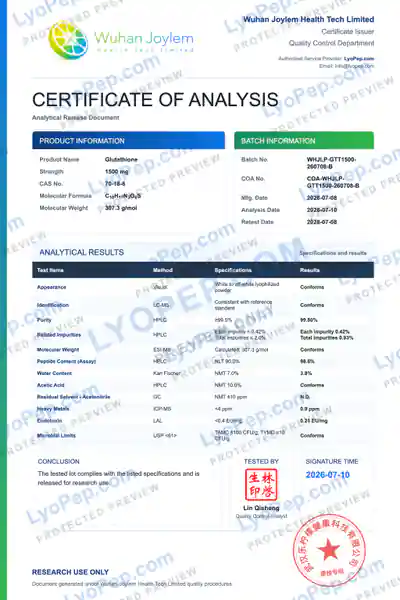
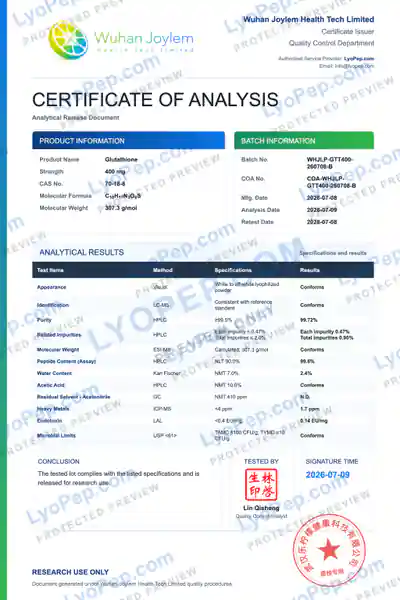
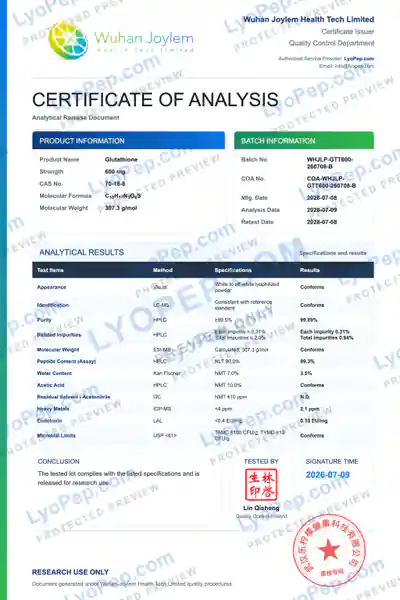
Glutathione factory batch COAs

Representative records, refreshed periodically

Published COAs show representative factory batches and may not be the latest available. For a current quote or shipment, our sales team can confirm the applicable lot and provide its COA.

Independent testing, arranged on request

Third-party reports are not routinely published. If independent verification is required, we can agree the laboratory, method, acceptance criteria and remedy before testing. If the agreed specification is not met, an appropriate resolution—including a refund where applicable—can be discussed under the agreed terms. Unless otherwise agreed in writing, the buyer pays the cost of this optional testing.

Help reviewing your COA

Need help reading a factory COA or third-party report? Our sales team can clarify test items, specifications and how the results relate to the lot under discussion.

Ask for the current packet, not a generic certificate

  • The batch specification should identify reduced L-glutathione and state the reference standard and assay basis
  • Require orthogonal identity such as LC-MS plus a second identity test; reduced-GSH assay
  • GSSG/oxidized-glutathione and related-substance limits using a stability-indicating separation; water; residual solvents; elemental impurities where relevant; appearance; and lot-specific storage and retest data
  • For redox-sensitive methods, review sample stabilization and system suitability
  • Bioburden, endotoxin and sterility are separate attributes and must never be inferred from chemical purity; this RUO material does not claim them.
Released-batch COARP-HPLC result and method contextIdentity result appropriate to the moleculeWater / counter-ion context where relevantSDS and handling statementAdditional testing scoped on request

Available fills

Quote the fill and pack configuration you need

Reference SKUFillBase pack
GSH-0400MG400 mg10 vials
GSH-0600MG600 mg10 vials
GSH-1500MG1500 mg10 vials

Handling

Storage in the lab and temperature during transit are different decisions

Use the released-lot storage and retest statement. Protect dry reduced GSH from oxygen, light, moisture and trace-metal contamination. For solutions, qualify concentration, pH, solvent or buffer, container, headspace, temperature and hold time because GSH can oxidize to GSSG; prepare small aliquots and avoid repeated opening or freeze-thaw cycles when redox state matters.

State destination, season, acceptable transit exposure and whether your protocol requires insulated or cold-chain service. Additional temperature-control cost is quoted explicitly.

Buyer FAQ

Terms to settle before the purchase order

Can a buyer arrange third-party testing?+

Yes. Testing must be performed by a mutually accepted, established specialist laboratory. Fee allocation, specification, sampling, method and acceptance rule must be agreed before testing; if an agreed independent result shows nonconformance, the remedy follows the signed order terms. Unless otherwise agreed in writing, the buyer pays the cost of this optional testing.

Does HPLC purity prove peptide content?+

No. Chromatographic purity describes the relative peak profile under a stated method. Identity, water, counter-ion, residual solvents and assay/content may require separate methods.

Is cold-chain shipping always required?+

Not always. Heat can accelerate degradation, especially during summer and long transit. Cold-chain reduces exposure but raises cost. State the destination and stability risk so the right service can be quoted.

How are payment terms handled?+

Available methods and milestones depend on order value, destination and project type. The pro forma invoice should state currency, bank details, fees, payment milestones and the release condition.

Why must the testing laboratory understand peptide chemistry?+

Free-base and salt forms, hydrophilic and hydrophobic sequences, aggregation and adsorption can change sample preparation and method suitability. Use a laboratory experienced with the molecule class.

These are buyer-qualification references, not claims that this RUO material is regulated, certified or released under those frameworks. Applicability depends on the buyer's workflow and jurisdiction.

Selected sources

Literature behind the research context

  • PubChem CID 124886 supports the reduced-glutathione identity, formula and mass. Forman 2009 summarizes biological roles and measurement. Monostori 2009 reviews GSH/GSSG sample preparation and analytical methods. Wang 2010 demonstrates temperature- and copper-dependent oxidation in a defined buffer. Aebi 1991 provides route-specific human plasma PK only. Mischley 2017 found intranasal GSH was not superior to placebo in a small Parkinson's disease trial. FDA GRN 293 is food-use correspondence, while FDA's 2019 compounding alert documents the danger of using dietary-grade material in sterile injections. FDA's May 14, 2026 503A category document lists glutathione in Category 1 under evaluation, not on the final 503A Bulks List, and FDA's February 4, 2026 supplier-quality page continues to identify dietary-ingredient glutathione as a compounding supply-chain example.
  1. 01

    Glutathione: overview of its protective roles, measurement, and biosynthesis

    Molecular Aspects of Medicine · 2009 · peer-reviewed foundational review

    Open source
  2. 02

    Determination of glutathione and glutathione disulfide in biological samples: an in-depth review

    Journal of Chromatography B · 2009 · peer-reviewed analytical-method review

    Open source
  3. 03

    Kinetic studies of the oxidation of glutathione in protein refolding buffer

    Bioprocess and Biosystems Engineering · 2010 · peer-reviewed solution-oxidation study

    Open source
  4. 04

    High-dose intravenous glutathione in man: pharmacokinetics and effects on cyst(e)ine in plasma and urine

    European Journal of Clinical Investigation · 1991 · peer-reviewed human pharmacokinetic study

    Open source
  5. 05

    Phase IIb Study of Intranasal Glutathione in Parkinson's Disease

    Journal of Parkinson's Disease · 2017 · randomized double-blind placebo-controlled phase IIb study

    Open source
  6. 06

    Glutathione and its antiaging and antimelanogenic effects

    Clinical, Cosmetic and Investigational Dermatology · 2017 · randomized double-blind placebo-controlled oral study

    Open source
  7. 07

    Oral supplementation with liposomal glutathione elevates body stores of glutathione and markers of immune function

    European Journal of Clinical Nutrition · 2018 · small open-label oral pilot study

    Open source
  8. 08

    GRAS Notice No. 293 — Glutathione

    FDA GRAS Notice Inventory · 2009 · U.S. government food-ingredient record

    Open source

Product FAQ

Questions buyers ask about Glutathione

What is the difference between GSH and GSSG, and why does the ratio matter on a reference standard?+

GSH is the reduced form with a free cysteine thiol; GSSG is the disulfide-linked oxidized dimer. Air, temperature, trace metals, pH and sample handling can change the measured ratio. The COA should report a direct GSH assay and an explicit GSSG or oxidized-glutathione limit using a stability-indicating method; total glutathione or nominal HPLC area alone is not equivalent.

How should GSH be stored to preserve the reduced form?+

Follow the released-lot stability statement and keep dry material sealed, protected from light, oxygen, moisture and trace-metal contamination. Do not infer a universal shelf life from a generic temperature. Qualify solution pH, concentration, container, headspace, temperature and hold time because dissolved GSH can oxidize to GSSG; prepare small aliquots and avoid repeated opening or freeze-thaw cycles where the method is redox-sensitive.