Recent Confirmed OrdersLast 7 days
United States8 gEpithalon 50 mg · TB-500 10 mg · CJC-1295 + Ipamorelin 10 mg · Melanotan II 10 mg · Bacteriostatic Water 10 ml
View all

Mitochondrial research

NAD+

Oxidized β-nicotinamide adenine dinucleotide · non-peptide biochemical research coenzyme

Lot-specific multi-attribute release; verify identity, chromatographic purity, quantitative assay, supplied form, water and degradants on the batch COA · target, verify batch COACAS 53-84-9RUO
Research statusExtensively studied endogenous coenzyme; this material is Research Use Only
Supplied formNon-peptide small-molecule dinucleotide cofactor
Lead timeConfirmed with quote
NAD+ — White to off-white powder or lyophilized cake; confirm the supplied form and lot appearance on the batch COA
NAD+ — White to off-white powder or lyophilized cake; confirm the supplied form and lot appearance on the batch COA · Representative packaging image · verify the ordered lot
Representative packaging image · verify the ordered lot

Decision summary

Key benefits

  • Research relevance includes redox biochemistry, enzyme assays, metabolomics and analytical-reference work
  • Mechanistic importance does not demonstrate that an NAD+ product produces anti-aging, energy, cognitive, exercise or disease-treatment benefits in people.
Published research context is presented for literature orientation only. It is not a dosing, treatment or human-use instruction.
Qualification data

Specifications to confirm against the released lot

CAS
53-84-9
Formula
C21H27N7O14P2
Molecular weight
663.4 g/mol
Appearance
White to off-white powder or lyophilized cake; confirm the supplied form and lot appearance on the batch COA
Purity
Lot-specific multi-attribute release; verify identity, chromatographic purity, quantitative assay, supplied form, water and degradants on the batch COA · target, verify batch COA
Storage
Follow the released-lot COA and manufacturer stability instructions. Protect from moisture, heat and light. Powder shelf life and prepared-solution stability are different attributes; do not assign a solution hold time without lot- and matrix-specific stability data.
MOQ
On request
Lead time
Confirmed with quote
PubChem CID 925

Qualification matrix

Identity, purity and content are separate release questions.

Identity

Confirm the stated molecule and supplied form. Start with the matching batch COA; request sequence-level evidence only when the buyer's written procedure requires it and availability or a separate scope has been agreed.

Purity

Review RP-HPLC method conditions, wavelength, integration and related-peak handling. A percentage without the method is not enough.

Content

Net peptide content is not the same as gross lyophilized powder weight. Ask which assay supports the stated amount and whether water/counter-ion is addressed.

Stability

Define long-term storage and transit exposure separately. Cold-chain can be quoted when the buyer’s risk assessment requires it and adds cost.

Research context

What researchers study about NAD+

Oxidized beta-NAD is an endogenous dinucleotide coenzyme central to cellular redox reactions and a substrate for NAD+-consuming enzymes such as PARPs and sirtuins. Direct administered-NAD+ human evidence is limited and must be separated from studies of the precursors NR and NMN. This lot is a biochemical Research Use Only reagent, not an approved anti-aging, metabolic or neurological therapy.

  • Laboratory redox and enzyme assays, NAD+/NADH metabolomics, analytical method development and other qualified biochemical research
  • These are research applications, not clinical indications.

Mechanism context

The question the literature is testing

NAD+ accepts hydride equivalents in oxidoreductase reactions and cycles with NADH across glycolysis, the TCA cycle and mitochondrial electron transfer. It is also consumed by PARPs, sirtuins and other NAD+-dependent enzymes. Assay interpretation must distinguish NAD+, NADH and related metabolites and account for extraction, matrix and degradation controls.

Evidence map

Research routes and exposure context

Evidence tierAnalytical / laboratory context
Routes reported in sources
No administration route applies
Dose / exposure contextProtocol-specific; verify the cited primary source
Routes and exposure contexts summarize cited studies or approved finished-product labels. They are not instructions for administering this RUO material; no customer dose is provided.

Evidence boundaries

Compatibility, limitations and decision context

  • Not for human or veterinary use
  • Follow the SDS and institutional laboratory controls
  • FDA has warned that food-grade NAD+ is unsuitable for sterile compounding without appropriate processing and has described adverse events consistent with endotoxin exposure
  • Chemical purity does not establish sterility, low endotoxin or injectable suitability.

Interactions reported in the literature

  • Not applicable as patient advice
  • Experimental compatibility depends on assay design, pH, ionic strength, enzymes, substrates and matrix; validate it within the research protocol.
Literature context is not a supplier release result or human-use instruction. Follow your institution's approved laboratory risk assessment.

Factory batch documentation

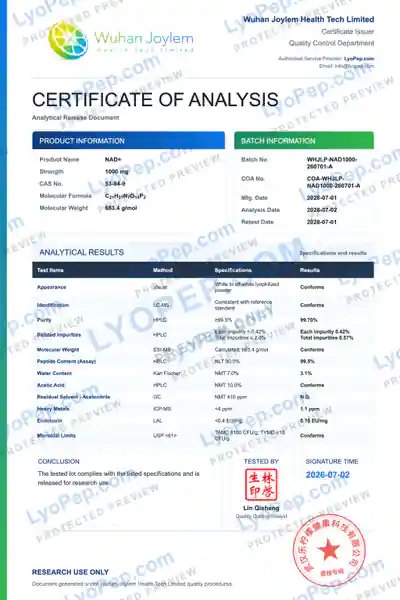
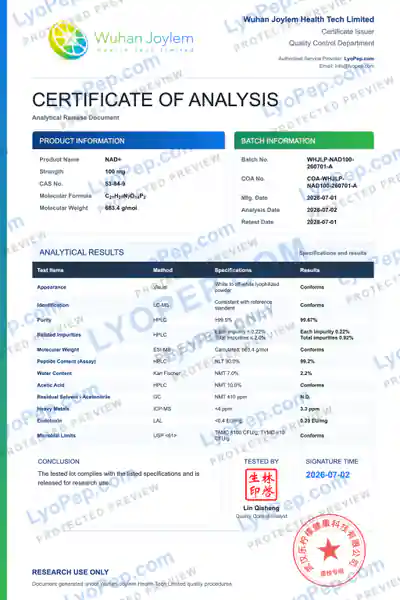
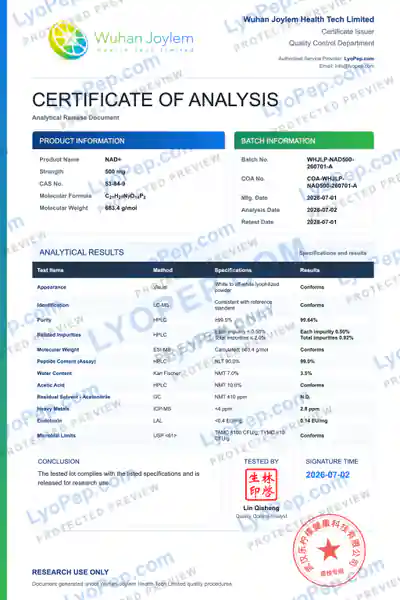
NAD+ factory batch COAs

Representative records, refreshed periodically

Published COAs show representative factory batches and may not be the latest available. For a current quote or shipment, our sales team can confirm the applicable lot and provide its COA.

Independent testing, arranged on request

Third-party reports are not routinely published. If independent verification is required, we can agree the laboratory, method, acceptance criteria and remedy before testing. If the agreed specification is not met, an appropriate resolution—including a refund where applicable—can be discussed under the agreed terms. Unless otherwise agreed in writing, the buyer pays the cost of this optional testing.

Help reviewing your COA

Need help reading a factory COA or third-party report? Our sales team can clarify test items, specifications and how the results relate to the lot under discussion.

Ask for the current packet, not a generic certificate

  • Require released-lot identity, chromatographic purity, assay/content, form or salt assignment, water, residual solvents and relevant degradation-product data
  • Define endotoxin, bioburden or sterility separately when the research application requires them
  • Appearance alone cannot establish identity or suitability.
Released-batch COARP-HPLC result and method contextIdentity result appropriate to the moleculeWater / counter-ion context where relevantSDS and handling statementAdditional testing scoped on request

Available fills

Quote the fill and pack configuration you need

Reference SKUFillBase pack
NADP-0100MG100 mg10 vials
NADP-0500MG500 mg10 vials
NADP-1000MG1000 mg10 vials

Handling

Storage in the lab and temperature during transit are different decisions

Follow the released-lot COA and manufacturer stability instructions. Protect from moisture, heat and light. Powder shelf life and prepared-solution stability are different attributes; do not assign a solution hold time without lot- and matrix-specific stability data.

State destination, season, acceptable transit exposure and whether your protocol requires insulated or cold-chain service. Additional temperature-control cost is quoted explicitly.

Buyer FAQ

Terms to settle before the purchase order

Can a buyer arrange third-party testing?+

Yes. Testing must be performed by a mutually accepted, established specialist laboratory. Fee allocation, specification, sampling, method and acceptance rule must be agreed before testing; if an agreed independent result shows nonconformance, the remedy follows the signed order terms. Unless otherwise agreed in writing, the buyer pays the cost of this optional testing.

Does HPLC purity prove peptide content?+

No. Chromatographic purity describes the relative peak profile under a stated method. Identity, water, counter-ion, residual solvents and assay/content may require separate methods.

Is cold-chain shipping always required?+

Not always. Heat can accelerate degradation, especially during summer and long transit. Cold-chain reduces exposure but raises cost. State the destination and stability risk so the right service can be quoted.

How are payment terms handled?+

Available methods and milestones depend on order value, destination and project type. The pro forma invoice should state currency, bank details, fees, payment milestones and the release condition.

Why must the testing laboratory understand peptide chemistry?+

Free-base and salt forms, hydrophilic and hydrophobic sequences, aggregation and adsorption can change sample preparation and method suitability. Use a laboratory experienced with the molecule class.

These are buyer-qualification references, not claims that this RUO material is regulated, certified or released under those frameworks. Applicability depends on the buyer's workflow and jurisdiction.

Selected sources

Literature behind the research context

  • Identity: PubChem CID 925, C₂₁H₂₇N₇O₁₄P₂, 663.4 g/mol and CAS 53-84-9 for the beta-NAD free-acid reference structure. Mechanistic and precursor context: the listed peer-reviewed reviews and trials. Direct administered-NAD+ context is limited. FDA's sterile-compounding reminder and January 2026 GenoGenix warning letter show why chemical purity cannot substitute for endotoxin, sterility and regulatory qualification.
  1. 01

    Hallmarks of aging: An expanding universe

    Cell · 2023 · peer-reviewed review (landmark/highly cited)

    Open source
  2. 02

    NAD+ and sirtuins in aging and disease

    Trends in Cell Biology · 2014 · peer-reviewed review (foundational/landmark)

    Open source
  3. 03

    SIRT1/PARP1 crosstalk: connecting DNA damage and metabolism

    Genome Integrity · 2013 · peer-reviewed review

    Open source
  4. 04

    Nicotinamide riboside is uniquely and orally bioavailable in mice and humans

    Nature Communications · 2016 · peer-reviewed original research (first-in-human pharmacokinetic trial)

    Open source
  5. 05

    Evaluation of safety and effectiveness of NAD in different clinical conditions: a systematic review

    American Journal of Physiology-Endocrinology and Metabolism · 2024 · peer-reviewed systematic review

    Open source
  6. 06

    Improved Physical Performance Parameters in Patients Taking Nicotinamide Mononucleotide (NMN): A Systematic Review of Randomized Control Trials

    Cureus · 2024 · peer-reviewed systematic review (PRISMA)

    Open source
  7. 07

    What is really known about the effects of nicotinamide riboside supplementation in humans

    Science Advances · 2023 · peer-reviewed critical review

    Open source
  8. 08

    Intravenous infusion of nicotinamide adenine dinucleotide (NAD+) versus nicotinamide riboside (NR): a retrospective tolerability pilot study in a real-world setting

    Frontiers in Aging · 2026 · peer-reviewed original research (retrospective pilot study)

    Open source

Product FAQ

Questions buyers ask about NAD+

Is NAD+ a peptide, and what should its analytical package contain?+

No. Oxidized beta-NAD is a dinucleotide coenzyme, not a peptide. Qualification should establish the exact free-acid, salt or hydrate form; orthogonal identity such as LC-MS and a spectroscopic method; chromatographic purity and relevant NADH or degradation-related species; quantitative assay; water and residual solvents. HPLC area purity alone does not establish content, sterility or suitability for a biological assay.

Are NAD+, NADH, NMN and NR interchangeable procurement names?+

No. NAD+ is the oxidized dinucleotide coenzyme, NADH is its reduced redox partner, and NMN and NR are distinct biosynthetic precursors. Their structures, registry identifiers, molecular weights, analytical methods, stability and evidence differ. Results from oral NR or NMN studies cannot be relabelled as direct NAD+ results, and a purchase specification must name the exact entity and supplied form.