Recent Confirmed OrdersLast 7 days
Australia520 mgTirzepatide 40 mg · Semaglutide 2 mg · Dihexa 10 mg
View all

Neurocognitive research

VIP

C-terminally amidated 28-residue VPAC1/VPAC2 ligand

≥ 99.0% · target, verify batch COACAS 40077-57-4RUO
Research statusNative-sequence amidated VIP is extensively studied; this catalog material is Research Use Only. Aviptadil has not been approved by the FDA for COVID-19 treatment. reference context · supplied material is RUO
Supplied formC-terminally amidated linear peptide (28 residues)
Lead time14–21 days
VIP — White to off-white lyophilized powder
VIP — White to off-white lyophilized powder · Representative packaging image · verify the ordered lot
Representative packaging image · verify the ordered lot

Decision summary

Key benefits

  • Published research context, not a benefit claimed for this RUO material: endogenous VIP is a well-characterized ligand for VPAC1/VPAC2 receptor pharmacology and cAMP signaling studies
  • VIP/VPAC systems participate in gastrointestinal secretion and motility, vasodilation, neuroendocrine signaling, immune regulation, and circadian-network research; receptor-selective analogues and antagonists can help distinguish VPAC1, VPAC2, and PAC1 pathway contributions; exploratory respiratory, inflammatory, neurologic, and metabolic findings remain model-, formulation-, and population-specific; the negative TESICO result and low-evidence intranasal CIRS case series must be retained when describing the human evidence base.
Published research context is presented for literature orientation only. It is not a dosing, treatment or human-use instruction.
Qualification data

Specifications to confirm against the released lot

CAS
40077-57-4
Formula
C147H238N44O42S
Molecular weight
approximately 3,325.8 Da
Appearance
White to off-white lyophilized powder
Purity
≥ 99.0% · target, verify batch COA
Storage
Follow the released-lot COA and supplier instructions. Unless batch documentation specifies otherwise, keep sealed lyophilized VIP desiccated, protected from light, and at or below -20°C. Establish reconstituted-solution stability in the receiving laboratory’s validated protocol and avoid repeated freeze-thaw cycles. Do not transfer handling instructions from a compounded nasal product or a clinical infusion formulation to this bulk RUO lot.
MOQ
On request
Lead time
14–21 days

Qualification matrix

Identity, purity and content are separate release questions.

Identity

Confirm the stated molecule and supplied form. Start with the matching batch COA; request sequence-level evidence only when the buyer's written procedure requires it and availability or a separate scope has been agreed.

Purity

Review RP-HPLC method conditions, wavelength, integration and related-peak handling. A percentage without the method is not enough.

Content

Net peptide content is not the same as gross lyophilized powder weight. Ask which assay supports the stated amount and whether water/counter-ion is addressed.

Stability

Define long-term storage and transit exposure separately. Cold-chain can be quoted when the buyer’s risk assessment requires it and adds cost.

Research context

What researchers study about VIP

Vasoactive intestinal peptide (VIP) is an endogenous 28-residue neuropeptide in the secretin/glucagon peptide family. Mature bioactive VIP is C-terminally amidated at Asn28 and activates the class B GPCRs VPAC1 and VPAC2. For the amidated sequence supplied as the intended catalog identity, the neutral formula is C₁₄₇H₂₃₈N₄₄O₄₂S and the average molecular mass is approximately 3,325.8 Da. PubChem CID 53314964 currently depicts the C-terminal free-acid form, C₁₄₇H₂₃₇N₄₃O₄₃S and 3,326.8 Da, so that record must not be used uncritically as the exact structure or intact-mass target for an amidated lot. Clinical evidence is formulation- and route-specific: the randomized TESICO trial found no significant day-90 clinical benefit of intravenous aviptadil for COVID-19 acute hypoxaemic respiratory failure. This bulk material is a Research Use Only reference, not a compounded nasal spray, sterile infusion, or approved finished drug.

  • Receptor pharmacology includes VPAC1/VPAC2 binding, signaling, desensitization, internalization, and receptor-selective control experiments; physiology and disease-model research includes gastrointestinal secretion and motility, smooth-muscle and vascular responses, circadian-network signaling, neuroendocrine biology, immune-cell signaling, and pulmonary models; translational evidence must remain formulation-specific—the 461-participant modified intention-to-treat TESICO comparison found no significant improvement in the day-90 primary outcome or mortality with intravenous aviptadil versus placebo; a smaller earlier intravenous trial reported a secondary survival signal, but its prespecified adjusted primary analysis was not statistically significant; intranasal VIP for CIRS is supported mainly by a small uncontrolled case series and is not an FDA-approved indication; no clinical route or exploratory indication qualifies this bulk RUO material for human use.

Mechanism context

The question the literature is testing

VIP is an endogenous agonist at VPAC1 and VPAC2, two class B G protein-coupled receptors that commonly signal through Gαs, adenylyl cyclase, cyclic AMP, and protein kinase A. Downstream responses vary by receptor density, cell type, species, ligand concentration, and assay design. VIP has much lower activity than PACAP at most PAC1 receptor isoforms, although receptor splice variants can alter pharmacology. Statements about anti-inflammatory, vasodilatory, secretory, circadian, or neuroprotective effects therefore describe biological research contexts and do not establish a therapeutic effect for a bulk RUO lot.

Evidence map

Research routes and exposure context

Evidence tierApproved finished-product context
Routes reported in sources
No administration route applies
Dose / exposure contextProtocol-specific; verify the cited primary source
Routes and exposure contexts summarize cited studies or approved finished-product labels. They are not instructions for administering this RUO material; no customer dose is provided.

Evidence boundaries

Compatibility, limitations and decision context

  • This bulk peptide is Research Use Only and is not sterile or qualified for human or veterinary administration; intravenous aviptadil trials reported hypotension and diarrhea as route- and formulation-specific tolerability concerns; in TESICO, the day-5 composite safety outcome occurred in 63% of aviptadil recipients versus 56% of placebo recipients, with an odds ratio of 1.40 (95% CI 0.94-2.08)
  • TESICO found no significant day-90 efficacy or mortality benefit, so larger randomized evidence does not support earlier promotional COVID-19 framing; safety observations from intravenous or compounded intranasal products cannot be used to infer safety of this RUO lot; laboratories should follow the SDS, use appropriate PPE, and establish institutional controls for the intended model and exposure route.

Interactions reported in the literature

  • No authoritative human evidence identified in this review establishes the safety or effectiveness of combining VIP with BPC-157, Thymosin Alpha-1, LL-37, KPV, Selank, DSIP, Cerebrolysin, GHK-Cu, or other research peptides; descriptions of those combinations as compatible or synergistic are unsupported; in experimental systems, VPAC/PAC1 agonists, antagonists, phosphodiesterase modifiers, adenylyl-cyclase modulators, and cAMP/PKA pathway interventions may confound or serve as controls depending on the protocol; receptor-selective tools and vehicle controls should be defined prospectively; this catalog does not recommend combinations or provide medication-management advice.
Literature context is not a supplier release result or human-use instruction. Follow your institution's approved laboratory risk assessment.

Factory batch documentation

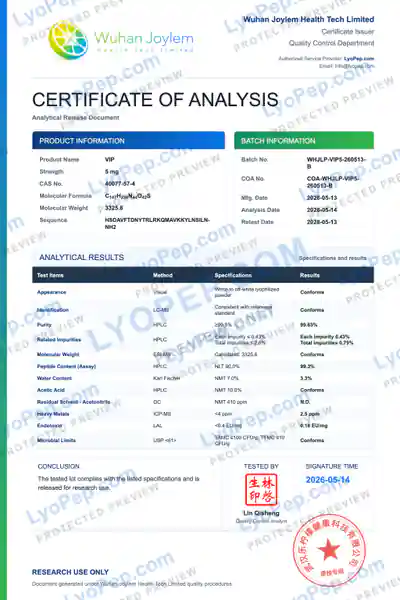
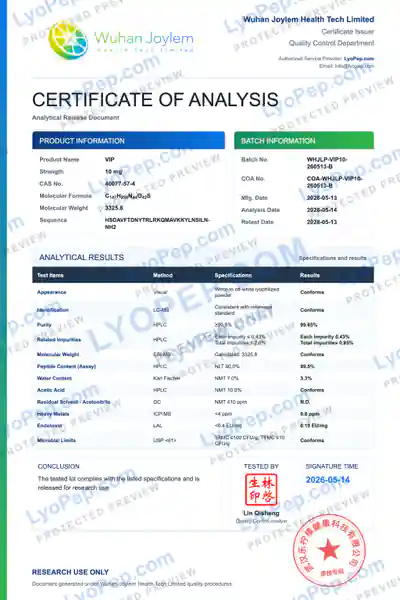
VIP factory batch COAs

Representative records, refreshed periodically

Published COAs show representative factory batches and may not be the latest available. For a current quote or shipment, our sales team can confirm the applicable lot and provide its COA.

Independent testing, arranged on request

Third-party reports are not routinely published. If independent verification is required, we can agree the laboratory, method, acceptance criteria and remedy before testing. If the agreed specification is not met, an appropriate resolution—including a refund where applicable—can be discussed under the agreed terms. Unless otherwise agreed in writing, the buyer pays the cost of this optional testing.

Help reviewing your COA

Need help reading a factory COA or third-party report? Our sales team can clarify test items, specifications and how the results relate to the lot under discussion.

Ask for the current packet, not a generic certificate

  • Require a released-lot COA stating the complete 28-residue sequence, C-terminal Asn-NH₂ amidation, exact formula and theoretical intact mass of the stated form, measured intact mass, identity method, chromatographic purity and impurity profile, counterion or salt content, water, residual solvents, and net peptide assay; use LC-MS/MS terminal coverage or another orthogonal method to distinguish amidated VIP from the free-acid analogue—the amidated molecule is approximately 0.984 Da lower in neutral mass, not higher; for cell or animal research, define endotoxin and bioburden acceptance criteria in the receiving laboratory’s protocol
  • HPLC area purity alone does not establish terminal amidation, peptide content, sterility, clinical grade, or equivalence to any compounded or investigational formulation.
Released-batch COARP-HPLC result and method contextIdentity result appropriate to the moleculeWater / counter-ion context where relevantSDS and handling statementAdditional testing scoped on request

Available fills

Quote the fill and pack configuration you need

Reference SKUFillBase pack
VIP-05MG5 mg10 vials
VIP-10MG10 mg10 vials

Handling

Storage in the lab and temperature during transit are different decisions

Follow the released-lot COA and supplier instructions. Unless batch documentation specifies otherwise, keep sealed lyophilized VIP desiccated, protected from light, and at or below -20°C. Establish reconstituted-solution stability in the receiving laboratory’s validated protocol and avoid repeated freeze-thaw cycles. Do not transfer handling instructions from a compounded nasal product or a clinical infusion formulation to this bulk RUO lot.

State destination, season, acceptable transit exposure and whether your protocol requires insulated or cold-chain service. Additional temperature-control cost is quoted explicitly.

Buyer FAQ

Terms to settle before the purchase order

Can a buyer arrange third-party testing?+

Yes. Testing must be performed by a mutually accepted, established specialist laboratory. Fee allocation, specification, sampling, method and acceptance rule must be agreed before testing; if an agreed independent result shows nonconformance, the remedy follows the signed order terms. Unless otherwise agreed in writing, the buyer pays the cost of this optional testing.

Does HPLC purity prove peptide content?+

No. Chromatographic purity describes the relative peak profile under a stated method. Identity, water, counter-ion, residual solvents and assay/content may require separate methods.

Is cold-chain shipping always required?+

Not always. Heat can accelerate degradation, especially during summer and long transit. Cold-chain reduces exposure but raises cost. State the destination and stability risk so the right service can be quoted.

How are payment terms handled?+

Available methods and milestones depend on order value, destination and project type. The pro forma invoice should state currency, bank details, fees, payment milestones and the release condition.

Why must the testing laboratory understand peptide chemistry?+

Free-base and salt forms, hydrophilic and hydrophobic sequences, aggregation and adsorption can change sample preparation and method suitability. Use a laboratory experienced with the molecule class.

These are buyer-qualification references, not claims that this RUO material is regulated, certified or released under those frameworks. Applicability depends on the buyer's workflow and jurisdiction.

Selected sources

Literature behind the research context

  • 1) KEGG DRUG D12127. Aviptadil: sequence HSDAVFTDNYTRLRKQMAVKKYLNSILN, formula C147H238N44O42S, molecular weight 3325.80, CAS 40077-57-4; 2) PubChem CID 53314964. Vasoactive intestinal peptide free-acid structure: formula C147H237N43O43S, molecular weight 3326.8, CAS 37221-79-7; 3) BPS/IUPHAR Guide to Pharmacology. VIP and PACAP receptors, family 67: VPAC1, VPAC2, and PAC1 nomenclature and pharmacology; 4) Harmar AJ, et al. Pharmacology and functions of receptors for VIP and PACAP: IUPHAR Review 1. Br J Pharmacol. 2012. PMID 22289055; 5) Brown SM, et al. Intravenous aviptadil and remdesivir for COVID-19-associated hypoxaemic respiratory failure (TESICO). Lancet Respir Med. 2023. PMID 37348524; PMCID PMC10527239; doi:10.1016/S2213-2600(23)00147-9; 6) Youssef JG, et al. IV vasoactive intestinal peptide in critical COVID-19 respiratory failure: 60-day randomized trial. Crit Care Med. 2022. PMID 36044317; 7) Shoemaker RC, House DE, Ryan JC. VIP corrects chronic inflammatory response syndrome markers: an open-label uncontrolled case series. Health. 2013;5:396-401; 8) Iwasaki M, et al. Recent advances in VIP physiology and pathophysiology: focus on the gastrointestinal system. F1000Research. 2019. PMCID PMC6743256.
  1. 01

    Polypeptide with broad biological activity: isolation from small intestine

    Science · 1970 · peer-reviewed original research (foundational discovery paper)

    Open source
  2. 02

    Structure of the porcine vasoactive intestinal octacosapeptide. The amino-acid sequence. Use of kallikrein in its determination

    European Journal of Biochemistry · 1974 · peer-reviewed original research (foundational structural characterization)

    Open source
  3. 03

    Immunomodulation of innate immune responses by vasoactive intestinal peptide (VIP): its therapeutic potential in inflammatory disease

    Clinical and Experimental Immunology · 2009 · peer-reviewed review

    Open source
  4. 04

    Recent advances in vasoactive intestinal peptide physiology and pathophysiology: focus on the gastrointestinal system

    F1000Research · 2019 · peer-reviewed review

    Open source
  5. 05

    A Clinical Approach for the Use of VIP Axis in Inflammatory and Autoimmune Diseases

    International Journal of Molecular Sciences · 2019 · peer-reviewed review

    Open source
  6. 06

    The Use of IV Vasoactive Intestinal Peptide (Aviptadil) in Patients With Critical COVID-19 Respiratory Failure: Results of a 60-Day Randomized Controlled Trial

    Critical Care Medicine · 2022 · randomized controlled clinical trial

    Open source
  7. 07

    Intravenous aviptadil and remdesivir for treatment of COVID-19-associated hypoxaemic respiratory failure in the USA (TESICO): a randomised, placebo-controlled trial

    The Lancet Respiratory Medicine · 2023 · randomized controlled clinical trial (Phase 3)

    Open source
  8. 08

    A negative trial for vasoactive intestinal peptide in COVID-19-associated acute hypoxaemic respiratory failure

    The Lancet Respiratory Medicine · 2023 · peer-reviewed editorial/commentary

    Open source

Product FAQ

Questions buyers ask about VIP

Why does the C-terminal amidation of VIP matter?+

Mature bioactive VIP terminates in Asn28-NH₂ rather than Asn28-COOH. That changes both identity and the intact-mass target: amidated VIP has neutral formula C₁₄₇H₂₃₈N₄₄O₄₂S and an average mass of about 3,325.8 Da, whereas the free acid is C₁₄₇H₂₃₇N₄₃O₄₃S and about 3,326.8 Da. Amidation therefore lowers neutral mass by approximately 0.984 Da; it is not a +1 Da product. Qualify the terminal form with intact mass plus C-terminal LC-MS/MS coverage or another orthogonal method rather than HPLC area alone.

Does native VIP distinguish VPAC1 from VPAC2?+

No. Native VIP is a high-affinity endogenous agonist at both VPAC1 and VPAC2. Receptor expression and downstream responses vary by tissue, species, cell model, and assay conditions, so simple tissue-distribution lists should not be treated as receptor-selectivity evidence. Studies that need subtype attribution should use validated receptor-selective agonists or antagonists, genetic controls, or both, and document cross-reactivity against VPAC1, VPAC2, and PAC1.

Why does the PubChem record differ from the intended VIP lot?+

PubChem CID 53314964 currently represents a C-terminal free-acid structure with formula C₁₄₇H₂₃₇N₄₃O₄₃S and mass 3,326.8 Da, while mature amidated VIP is C₁₄₇H₂₃₈N₄₄O₄₂S and about 3,325.8 Da. The page therefore treats PubChem as evidence for the free-acid record and the registry discrepancy, not as the exact structure target for the amidated catalog identity. The released-lot COA must state the actual terminal form, sequence, counterion, theoretical mass, and measured mass.