Recent Confirmed OrdersLast 7 days
Australia520 mgTirzepatide 40 mg · Semaglutide 2 mg · Dihexa 10 mg
View all

Neurocognitive research

Cerebrolysin

Porcine-brain protein-hydrolysate research reference · heterogeneous peptide/amino-acid mixture

Not expressible as a single percentage; require composition fingerprint, quantitative content and process-specific acceptance criteria · target, verify batch COACAS 12656-61-0RUO
Research statusFinished-product clinical literature exists, but the offered catalogue material is laboratory Research Use Only and not formulation-equivalent
Supplied formStructurally diverse biological mixture; no single sequence, formula, molecular weight or purity percentage
Lead time14–21 days
Cerebrolysin — Lot- and presentation-specific research material; confirm physical form, colour, clarity or cake condition on the released-lot documents
Cerebrolysin — Lot- and presentation-specific research material; confirm physical form, colour, clarity or cake condition on the released-lot documents · Representative packaging image · verify the ordered lot
Representative packaging image · verify the ordered lot

Decision summary

Key benefits

  • Scientifically supportable uses include hydrolysate fingerprint method development, peptide-size-distribution and amino-acid profiling, batch-comparability studies, cell-based neurobiology assays with appropriate reference material and evaluation of how source or process variables affect a complex mixture
  • Clinical trial outcomes apply only to the studied finished formulations and protocols.
Published research context is presented for literature orientation only. It is not a dosing, treatment or human-use instruction.
Qualification data

Specifications to confirm against the released lot

CAS
12656-61-0
Formula
Not applicable — mixture or multi-component material
Molecular weight
Confirm supplied form on batch COA
Appearance
Lot- and presentation-specific research material; confirm physical form, colour, clarity or cake condition on the released-lot documents
Purity
Not expressible as a single percentage; require composition fingerprint, quantitative content and process-specific acceptance criteria · target, verify batch COA
Storage
Follow the released-lot COA, SDS, label and stability statement for the actual physical form, concentration, container and grade. Do not transfer a ≤25°C finished-product label, freeze restriction or opened-ampoule rule unless the offered lot is that exact labelled presentation.
MOQ
On request
Lead time
14–21 days

Qualification matrix

Identity, purity and content are separate release questions.

Identity

Confirm the stated molecule and supplied form. Start with the matching batch COA; request sequence-level evidence only when the buyer's written procedure requires it and availability or a separate scope has been agreed.

Purity

Review RP-HPLC method conditions, wavelength, integration and related-peak handling. A percentage without the method is not enough.

Content

Net peptide content is not the same as gross lyophilized powder weight. Ask which assay supports the stated amount and whether water/counter-ion is addressed.

Stability

Define long-term storage and transit exposure separately. Cold-chain can be quoted when the buyer’s risk assessment requires it and adds cost.

Research context

What researchers study about Cerebrolysin

Cerebrolysin is an identity used for a porcine-brain-derived, enzymatically hydrolysed protein fraction containing a heterogeneous population of peptides and amino acids. NCATS/GSRS classifies CAS 12656-61-0 and UNII 37KZM6S21G as structurally diverse and does not assign one formula or molecular weight. Marketed finished products and their clinical literature provide background on a defined manufacturer process and formulation; this 60 mg catalogue item is not automatically equivalent to those products. Clinical reviews vary by indication: Cochrane found no clear all-cause mortality benefit in acute ischaemic stroke and a signal for increased non-fatal serious adverse events, while other indications remain limited by heterogeneity and risk of bias. These data must not be converted into efficacy or safety claims for an unqualified RUO lot.

  • Composition-fingerprint development, source/process comparability, molecular-size and amino-acid profiling, selected marker-peptide analysis and controlled cell-based neurobiology research
  • These are laboratory applications, not clinical indications.

Mechanism context

The question the literature is testing

Marketed Cerebrolysin is hypothesized to exert neurotrophic or neuroprotective effects through multiple low-molecular-weight components and downstream plasticity pathways. Specific BDNF-like, NGF-like or other named activities do not establish the identity or concentration of individual active ingredients in this lot. Blood-brain-barrier, structural-plasticity and prolonged-effect explanations remain mixture-level pharmacodynamic hypotheses and cannot substitute for component characterization or prove equivalence to a clinical formulation.

Evidence map

Research routes and exposure context

Evidence tierHuman clinical research
Routes reported in sources
No administration route applies
Dose / exposure contextProtocol-specific; verify the cited primary source
Routes and exposure contexts summarize cited studies or approved finished-product labels. They are not instructions for administering this RUO material; no customer dose is provided.

Evidence boundaries

Compatibility, limitations and decision context

  • Not for human or veterinary use
  • Porcine origin requires documented source-animal, tissue, transmissible-agent and process controls appropriate to the material and destination
  • Chemical or fingerprint similarity does not establish sterility, bacterial-endotoxin control, injectable suitability or clinical safety
  • Clinical systematic reviews of finished Cerebrolysin formulations include an acute-stroke signal for non-fatal serious adverse events; those data reinforce the need not to present this RUO lot as a treatment.

Interactions reported in the literature

  • No patient drug-interaction or infusion-compatibility guidance is provided for this RUO material
  • Finished-product label restrictions and clinical co-medication observations cannot be transferred without proving formulation equivalence
  • Laboratory compatibility and assay interference must be tested in the exact matrix.
Literature context is not a supplier release result or human-use instruction. Follow your institution's approved laboratory risk assessment.

Factory batch documentation

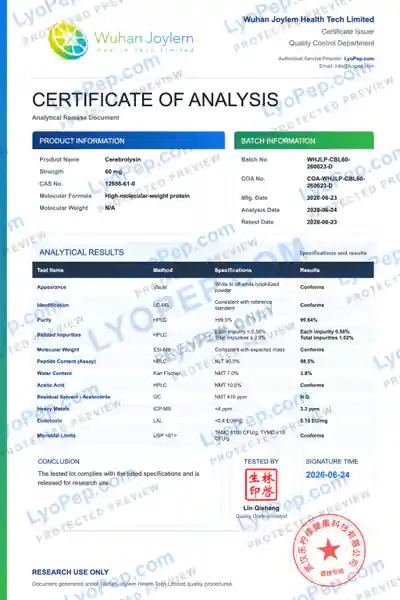
Cerebrolysin factory batch COAs

Representative records, refreshed periodically

Published COAs show representative factory batches and may not be the latest available. For a current quote or shipment, our sales team can confirm the applicable lot and provide its COA.

Independent testing, arranged on request

Third-party reports are not routinely published. If independent verification is required, we can agree the laboratory, method, acceptance criteria and remedy before testing. If the agreed specification is not met, an appropriate resolution—including a refund where applicable—can be discussed under the agreed terms. Unless otherwise agreed in writing, the buyer pays the cost of this optional testing.

Help reviewing your COA

Need help reading a factory COA or third-party report? Our sales team can clarify test items, specifications and how the results relate to the lot under discussion.

Ask for the current packet, not a generic certificate

  • Require source species/tissue and manufacturing traceability, process controls, molecular-size distribution, orthogonal chromatographic and/or LC-MS fingerprint similarity to a qualified reference, amino-acid profile, quantitative peptide/protein or nitrogen content with its calculation basis, pH and relevant physicochemical attributes, residual process reagents, contaminants and lot-specific stability
  • Specify bioburden, sterility, bacterial endotoxin and viral/transmissible-agent controls separately where applicable
  • Appearance, one HPLC trace or “≥99%” cannot qualify a heterogeneous hydrolysate.
Released-batch COARP-HPLC result and method contextIdentity result appropriate to the moleculeWater / counter-ion context where relevantSDS and handling statementAdditional testing scoped on request

Available fills

Quote the fill and pack configuration you need

Reference SKUFillBase pack
CBL-60MG60 mg10 vials

Handling

Storage in the lab and temperature during transit are different decisions

Follow the released-lot COA, SDS, label and stability statement for the actual physical form, concentration, container and grade. Do not transfer a ≤25°C finished-product label, freeze restriction or opened-ampoule rule unless the offered lot is that exact labelled presentation.

State destination, season, acceptable transit exposure and whether your protocol requires insulated or cold-chain service. Additional temperature-control cost is quoted explicitly.

Buyer FAQ

Terms to settle before the purchase order

Can a buyer arrange third-party testing?+

Yes. Testing must be performed by a mutually accepted, established specialist laboratory. Fee allocation, specification, sampling, method and acceptance rule must be agreed before testing; if an agreed independent result shows nonconformance, the remedy follows the signed order terms. Unless otherwise agreed in writing, the buyer pays the cost of this optional testing.

Does HPLC purity prove peptide content?+

No. Chromatographic purity describes the relative peak profile under a stated method. Identity, water, counter-ion, residual solvents and assay/content may require separate methods.

Is cold-chain shipping always required?+

Not always. Heat can accelerate degradation, especially during summer and long transit. Cold-chain reduces exposure but raises cost. State the destination and stability risk so the right service can be quoted.

How are payment terms handled?+

Available methods and milestones depend on order value, destination and project type. The pro forma invoice should state currency, bank details, fees, payment milestones and the release condition.

Why must the testing laboratory understand peptide chemistry?+

Free-base and salt forms, hydrophilic and hydrophobic sequences, aggregation and adsorption can change sample preparation and method suitability. Use a laboratory experienced with the molecule class.

These are buyer-qualification references, not claims that this RUO material is regulated, certified or released under those frameworks. Applicability depends on the buyer's workflow and jurisdiction.

Selected sources

Literature behind the research context

  • Identity: NCATS Inxight Drugs/GSRS for CAS 12656-61-0 and UNII 37KZM6S21G. Clinical-evidence context for finished formulations: 2023 Cochrane acute-ischaemic-stroke review, PMID 37818733/CD007026.pub7/PMC10565895; 2021 ESO/EAN post-stroke-cognitive-impairment guideline, PMID 34476868/PMC8564156; 2019 Cochrane vascular-dementia review, CD008900.pub3; 2023 TBI systematic review, PMID 36979317/PMC10046100; and the contrasting 2025 stroke meta-analysis, PMID 41018475/PMC12465088. Manufacturer product information defines its own 215.2 mg/ml prescription finished concentrate but does not qualify this separate 60 mg RUO lot.
  1. 01

    Cerebrolysin for acute ischaemic stroke

    Cochrane Database of Systematic Reviews · 2023 · Cochrane systematic review (highest-tier evidence synthesis)

    Open source
  2. 02

    European Stroke Organisation and European Academy of Neurology joint guidelines on post-stroke cognitive impairment

    European Journal of Neurology · 2021 · clinical practice guideline (joint society statement)

    Open source
  3. 03

    Cerebrolysin and Recovery After Stroke (CARS): A Randomized, Placebo-Controlled, Double-Blind, Multicenter Trial

    Stroke · 2016 · randomized controlled trial

    Open source
  4. 04

    Cerebrolysin in Patients With Acute Ischemic Stroke in Asia: Results of a Double-Blind, Placebo-Controlled Randomized Trial

    Stroke · 2012 · randomized controlled trial (large multicenter, N>1000)

    Open source
  5. 05

    Neuroprotective Treatment With Cerebrolysin in Patients With Acute Stroke: A Randomised Controlled Trial

    Journal of Neural Transmission · 2005 · randomized controlled trial

    Open source
  6. 06

    Cerebrolysin in Mild-to-Moderate Alzheimer's Disease: A Meta-Analysis of Randomized Controlled Clinical Trials

    Dementia and Geriatric Cognitive Disorders · 2015 · meta-analysis of randomized controlled trials

    Open source
  7. 07

    Cerebrolysin in Patients with TBI: Systematic Review and Meta-Analysis

    Brain Sciences · 2023 · systematic review and meta-analysis

    Open source
  8. 08

    Safety and Efficacy of Cerebrolysin for Neurorecovery After Acute Ischemic Stroke: A Systematic Review and Meta-Analysis of 14 Randomized Controlled Trials

    Cureus · 2025 · systematic review and meta-analysis

    Open source

Product FAQ

Questions buyers ask about Cerebrolysin

Is Cerebrolysin one peptide with a defined formula?+

No. Authoritative substance records describe Cerebrolysin as a structurally diverse porcine-brain protein fraction, and marketed preparations are complex hydrolysates containing amino acids and many low-molecular-weight peptide fragments. A single formula, sequence, molecular weight or “≥99% purity” value is chemically inappropriate. Identity depends on source and process traceability plus an orthogonal composition fingerprint against a qualified reference.

Does approval of a finished Cerebrolysin medicine apply to this catalogue lot?+

No. Regulatory status, indications, concentration, route, container, sterility and labelling belong to a specific finished product in a specific market. A 60 mg catalogue label does not establish equivalence to an EVER Pharma concentrate or any approved presentation. Require the quote and released-lot records to state the actual material, physical form, composition basis, grade and intended laboratory use.

How should a heterogeneous hydrolysate be qualified batch to batch?+

Use a predefined panel rather than a single HPLC peak: animal-tissue and manufacturing traceability; peptide molecular-size distribution; chromatographic and/or LC-MS fingerprint similarity to a qualified reference; amino-acid profile; total peptide/protein or nitrogen content with a stated basis; pH and relevant physicochemical attributes; impurities, residual process reagents and microbiological controls appropriate to the grade. Sterility and bacterial endotoxin require separate validated methods and limits.