Recent Confirmed OrdersLast 7 days
Australia2 gTirzepatide 100 mg · CagriSema 20 mg · BPC-157 10 mg · TB-500 5 mg · Melanotan II 10 mg · PT-141 10 mg · Bacteriostatic Water 3 ml
View all

Laboratory ancillaries

Bacteriostatic Water

Benzyl-alcohol-preserved aqueous laboratory diluent · nominal composition must be verified per lot

Component-specific released results; confirm water grade and benzyl-alcohol assay on the batch COA · target, verify batch COACAS 7732-18-5RUO
Research statusRUO laboratory ancillary; finished-product grade must not be assumed
Supplied formNon-peptide aqueous ancillary; water plus a lot-specified benzyl-alcohol preservative concentration
Lead time7–14 days
Bacteriostatic Water — Lot-specific clear aqueous material; confirm colour, clarity and particulate specification on the released-batch COA
Bacteriostatic Water — Lot-specific clear aqueous material; confirm colour, clarity and particulate specification on the released-batch COA · Representative packaging image · verify the ordered lot
Representative packaging image · verify the ordered lot

Decision summary

Key benefits

  • Laboratory applications include preserved aqueous diluent studies, formulation screening, container-closure workflows and method development where a defined benzyl-alcohol concentration is appropriate
  • Preservative activity may reduce microbial proliferation under validated conditions, but it does not sterilize a contaminated vial or establish analyte stability.
Published research context is presented for literature orientation only. It is not a dosing, treatment or human-use instruction.
Qualification data

Specifications to confirm against the released lot

CAS
7732-18-5
Formula
Not applicable — mixture or multi-component material
Molecular weight
Component-specific; no single molecular weight
Appearance
Lot-specific clear aqueous material; confirm colour, clarity and particulate specification on the released-batch COA
Purity
Component-specific released results; confirm water grade and benzyl-alcohol assay on the batch COA · target, verify batch COA
Storage
Follow the released lot COA, SDS, label and stability statement. Temperature, light protection, container orientation, first-access period and excursion limits depend on the exact water grade, preservative concentration, container-closure system and claimed microbiological quality. Do not transfer storage instructions from Pfizer/Hospira or another finished product unless the offered lot is that labelled product.
MOQ
On request
Lead time
7–14 days

Qualification matrix

Identity, purity and content are separate release questions.

Identity

Confirm the stated molecule and supplied form. Start with the matching batch COA; request sequence-level evidence only when the buyer's written procedure requires it and availability or a separate scope has been agreed.

Purity

Review RP-HPLC method conditions, wavelength, integration and related-peak handling. A percentage without the method is not enough.

Content

Net peptide content is not the same as gross lyophilized powder weight. Ask which assay supports the stated amount and whether water/counter-ion is addressed.

Stability

Define long-term storage and transit exposure separately. Cold-chain can be quoted when the buyer’s risk assessment requires it and adds cost.

Research context

What researchers study about Bacteriostatic Water

“Bacteriostatic water” generally denotes water containing a preservative, commonly benzyl alcohol. Approved Bacteriostatic Water for Injection products have product-specific labels, concentrations, containers and microbiological controls. An RUO ancillary with a similar name is not automatically USP-compliant, sterile, nonpyrogenic or injectable. Procurement should specify water grade, benzyl-alcohol concentration, pH, container closure, chemical assays and any separately claimed sterility, endotoxin or bioburden limits.

  • Laboratory formulation and reconstitution-method development, preservative-compatibility studies, analytical sample preparation and ancillary qualification
  • These are laboratory applications, not clinical indications.

Mechanism context

The question the literature is testing

Benzyl alcohol is used as a bacteriostatic preservative: at an appropriate concentration it can inhibit microbial growth through membrane and protein effects. Bacteriostatic is not bactericidal or sterilizing. Water is the solvent component, while peptide dissolution, chemical stability and assay performance depend on the complete formulation and handling conditions. No universal mixing, swirling or injection instruction is provided.

Evidence map

Research routes and exposure context

Evidence tierAnalytical / laboratory context
Routes reported in sources
No administration route applies
Dose / exposure contextProtocol-specific; verify the cited primary source
Routes and exposure contexts summarize cited studies or approved finished-product labels. They are not instructions for administering this RUO material; no customer dose is provided.

Evidence boundaries

Compatibility, limitations and decision context

  • For laboratory use only
  • Follow the lot SDS and institutional chemical and microbiological controls
  • Benzyl alcohol has recognized systemic toxicity and labelled Bacteriostatic Water for Injection products warn against neonatal use, but this toxicology context is not an administration instruction
  • Preservative content does not establish sterility or permit use of a compromised container
  • This catalogue provides no injection, aseptic-puncture or patient-use procedure.

Interactions reported in the literature

  • Compatibility is analyte-, concentration-, pH-, buffer-, container- and method-specific
  • Benzyl alcohol may be incompatible with some peptides, proteins, cells or analytical endpoints
  • Preservative-free water is not automatically interchangeable; use direct stability and performance evidence for the intended system.
Literature context is not a supplier release result or human-use instruction. Follow your institution's approved laboratory risk assessment.

Factory batch documentation

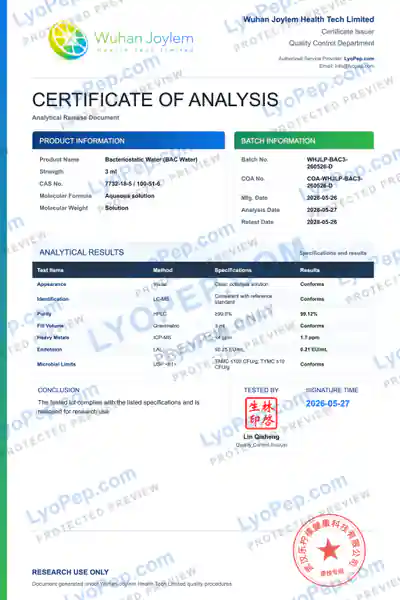
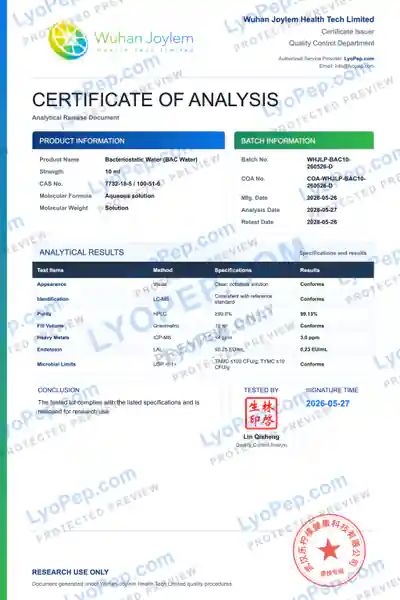
Bacteriostatic Water factory batch COAs

Representative records, refreshed periodically

Published COAs show representative factory batches and may not be the latest available. For a current quote or shipment, our sales team can confirm the applicable lot and provide its COA.

Independent testing, arranged on request

Third-party reports are not routinely published. If independent verification is required, we can agree the laboratory, method, acceptance criteria and remedy before testing. If the agreed specification is not met, an appropriate resolution—including a refund where applicable—can be discussed under the agreed terms. Unless otherwise agreed in writing, the buyer pays the cost of this optional testing.

Help reviewing your COA

Need help reading a factory COA or third-party report? Our sales team can clarify test items, specifications and how the results relate to the lot under discussion.

Ask for the current packet, not a generic certificate

  • Require water grade, benzyl-alcohol identity and quantitative content, pH or relevant chemical limits, visible-particle criteria, fill volume, container-closure specification, traceable lot and stability basis
  • If sterility, bacterial endotoxin or bioburden is claimed, require separate released-lot results with named methods and acceptance limits
  • Clear colourless appearance alone cannot prove composition, microbiological quality or suitability.
Released-batch COARP-HPLC result and method contextIdentity result appropriate to the moleculeWater / counter-ion context where relevantSDS and handling statementAdditional testing scoped on request

Available fills

Quote the fill and pack configuration you need

Reference SKUFillBase pack
BACW-03ML3 ml10 vials
BACW-10ML10 ml10 vials
BACW-30ML30 ml10 vials

Handling

Storage in the lab and temperature during transit are different decisions

Follow the released lot COA, SDS, label and stability statement. Temperature, light protection, container orientation, first-access period and excursion limits depend on the exact water grade, preservative concentration, container-closure system and claimed microbiological quality. Do not transfer storage instructions from Pfizer/Hospira or another finished product unless the offered lot is that labelled product.

State destination, season, acceptable transit exposure and whether your protocol requires insulated or cold-chain service. Additional temperature-control cost is quoted explicitly.

Buyer FAQ

Terms to settle before the purchase order

Can a buyer arrange third-party testing?+

Yes. Testing must be performed by a mutually accepted, established specialist laboratory. Fee allocation, specification, sampling, method and acceptance rule must be agreed before testing; if an agreed independent result shows nonconformance, the remedy follows the signed order terms. Unless otherwise agreed in writing, the buyer pays the cost of this optional testing.

Does HPLC purity prove peptide content?+

No. Chromatographic purity describes the relative peak profile under a stated method. Identity, water, counter-ion, residual solvents and assay/content may require separate methods.

Is cold-chain shipping always required?+

Not always. Heat can accelerate degradation, especially during summer and long transit. Cold-chain reduces exposure but raises cost. State the destination and stability risk so the right service can be quoted.

How are payment terms handled?+

Available methods and milestones depend on order value, destination and project type. The pro forma invoice should state currency, bank details, fees, payment milestones and the release condition.

Why must the testing laboratory understand peptide chemistry?+

Free-base and salt forms, hydrophilic and hydrophobic sequences, aggregation and adsorption can change sample preparation and method suitability. Use a laboratory experienced with the molecule class.

These are buyer-qualification references, not claims that this RUO material is regulated, certified or released under those frameworks. Applicability depends on the buyer's workflow and jurisdiction.

Selected sources

Literature behind the research context

  • Component identity: NIH PubChem CID 962 identifies water and CID 244 identifies benzyl alcohol as C₇H₈O, 108.14 g/mol and CAS 100-51-6; component records do not define the supplied blend.
  • Product-specific labelling: DailyMed records for approved Bacteriostatic Water for Injection products identify their own benzyl-alcohol concentration, pH, container and warnings. A 0.9% label and a 1.1% label are distinct records or presentations, not interchangeable proof for this RUO lot.
  • Multi-dose-vial context: current CDC Injection Safety guidance states that an opened, labelled multi-dose vial is generally discarded within 28 days unless the manufacturer states another date. This does not establish sterility, approved multi-dose status or peptide stability for an RUO vial.
  • Neonatal toxicology: Gershanik et al., N Engl J Med. 1982, PMID 7133084, documents fatal neonatal toxicity associated with benzyl-alcohol exposure; this is safety context, not an administration instruction.
  • Current allergy context: Le and Wu, Dermatitis. 2026, PMID 41649135, reviews benzyl alcohol as a potential contact allergen.
  1. 01

    The Gasping Syndrome and Benzyl Alcohol Poisoning

    New England Journal of Medicine · 1982 · peer-reviewed original research (landmark clinical report)

    Open source
  2. 02

    Toxicity of Benzyl Alcohol in Adult and Neonatal Mice

    Journal of Pharmaceutical Sciences · 1986 · peer-reviewed original research (animal toxicology)

    Open source
  3. 03

    Benzyl Alcohol: Allergen of the Year 2026

    Dermatitis (official journal of the American Contact Dermatitis Society) · 2026 · peer-reviewed review (society-commissioned 'Allergen of the Year' designation)

    Open source
  4. 04

    Bacteriostatic Water Injection, USP -- 0.9% Benzyl Alcohol Product Label

    DailyMed (US National Library of Medicine) / FDA-approved manufacturer label · 2014 · regulatory document (FDA-approved manufacturer package insert, hosted on DailyMed)

    Open source
  5. 05

    Preventing Unsafe Injection Practices

    CDC Injection Safety · 2026 · public-health guidance

    Open source
  6. 06

    PubChem Compound Summary: Benzyl Alcohol (CID 244)

    NIH PubChem · 2026 · authoritative chemical database

    Open source

Product FAQ

Questions buyers ask about Bacteriostatic Water

How should a laboratory choose between preserved and preservative-free water?+

Follow the exact method or formulation specification being replicated. Benzyl alcohol can change peptide stability, adsorption, assay response and cell compatibility, so a preserved diluent is not universally interchangeable with preservative-free water. Confirm the supplied preservative concentration, peptide/formulation compatibility, container and intended analytical endpoint; do not infer injectable suitability from the word “bacteriostatic”.

Which documents should support a preserved aqueous diluent?+

The batch package should state water grade, benzyl-alcohol identity and quantitative assay, pH or other relevant chemistry, visible-particle criteria, fill volume, container-closure details, lot and expiry or retest basis. Sterility, bacterial endotoxin and bioburden are different tests and should be reported only when performed with named methods and acceptance limits. A clear appearance or preservative assay cannot prove sterility.