Recent Confirmed OrdersLast 7 days
Australia2 gTirzepatide 100 mg · CagriSema 20 mg · BPC-157 10 mg · TB-500 5 mg · Melanotan II 10 mg · PT-141 10 mg · Bacteriostatic Water 3 ml
View all

Laboratory ancillaries

Sterile Water

Sterile-water laboratory ancillary · preservative, compendial and container status must be confirmed by lot

Not expressed as an HPLC area-purity percentage; qualify chemical water attributes, sterility, endotoxin and container closure separately · target, verify batch COACAS 7732-18-5RUO
Research statusLaboratory ancillary; suitability depends on released-lot grade, container, sterility, endotoxin and chemical-quality evidence
Supplied formAqueous laboratory ancillary (H₂O; non-peptide); sterile status requires released-lot evidence
Lead time7–14 days
Sterile Water — Clear, colourless liquid; appearance alone does not establish sterility, endotoxin status, compendial grade or container integrity
Sterile Water — Clear, colourless liquid; appearance alone does not establish sterility, endotoxin status, compendial grade or container integrity · Representative packaging image · verify the ordered lot
Representative packaging image · verify the ordered lot

Decision summary

Key benefits

  • Defensible laboratory value is a low-complexity aqueous solvent for validated reconstitution, dilution, blanks, recovery studies and method controls
  • Suitability is not universal: even water can drive hydrolysis, oxidation, adsorption, aggregation, pH shift or microbial contamination after opening
  • No injectable, clinical or “pyrogen-free” claim follows from clarity or the word sterile alone.
Published research context is presented for literature orientation only. It is not a dosing, treatment or human-use instruction.
Qualification data

Specifications to confirm against the released lot

CAS
7732-18-5
Formula
Not applicable to the supplied material
Molecular weight
18.015 g/mol
Appearance
Clear, colourless liquid; appearance alone does not establish sterility, endotoxin status, compendial grade or container integrity
Purity
Not expressed as an HPLC area-purity percentage; qualify chemical water attributes, sterility, endotoxin and container closure separately · target, verify batch COA
Storage
Follow the released-lot label, container specification and stability data. Do not infer controlled-room-temperature ranges, freezing restrictions, immediate-use rules or four-hour pharmacy-bulk-package limits unless the supplied lot is the exact labelled presentation to which those instructions apply. Quarantine damaged containers and temperature excursions.
MOQ
On request
Lead time
7–14 days

Qualification matrix

Identity, purity and content are separate release questions.

Identity

Confirm the stated molecule and supplied form. Start with the matching batch COA; request sequence-level evidence only when the buyer's written procedure requires it and availability or a separate scope has been agreed.

Purity

Review RP-HPLC method conditions, wavelength, integration and related-peak handling. A percentage without the method is not enough.

Content

Net peptide content is not the same as gross lyophilized powder weight. Ask which assay supports the stated amount and whether water/counter-ion is addressed.

Stability

Define long-term storage and transit exposure separately. Cold-chain can be quoted when the buyer’s risk assessment requires it and adds cost.

Research context

What researchers study about Sterile Water

Water has formula H₂O, but the words “sterile water” do not establish a pharmacopeial grade or finished-drug status. WFI refers to water meeting an applicable monograph; Sterile Water for Injection is a packaged sterile finished presentation; bacteriostatic water contains preservative; saline contains solute; and laboratory sterile water may be supplied only for research. Chemical water quality, sterility, bacterial endotoxin, particulate control, fill volume, container closure and shelf life are separate qualification dimensions.

  • Appropriate laboratory contexts include validated reconstitution and dilution, analytical blanks, recovery and adsorption studies, container-compatibility work and method controls
  • Suitability must be established for the exact analyte, method, water grade and released lot.

Mechanism context

The question the literature is testing

Water acts as a solvent through hydration and hydrogen-bonding interactions; it has no product-specific pharmacological mechanism. Dissolution and recovery depend on analyte chemistry, pH, ionic strength, concentration, vessel surface and time. A clear solution does not prove complete recovery, stability or absence of subvisible particles.

Evidence map

Research routes and exposure context

Evidence tierAnalytical / laboratory context
Routes reported in sources
No administration route applies
Dose / exposure contextProtocol-specific; verify the cited primary source
Routes and exposure contexts summarize cited studies or approved finished-product labels. They are not instructions for administering this RUO material; no customer dose is provided.

Evidence boundaries

Compatibility, limitations and decision context

  • Not for human or veterinary administration
  • FDA labels for specified Sterile Water for Injection finished products warn that undiluted intravenous administration of solute-free hypotonic water can cause haemolysis, but those clinical labels do not qualify this RUO item as an injectable product
  • Container compromise, microbial contamination, endotoxin, particulates and incorrect grade assignment are material laboratory risks.

Interactions reported in the literature

  • No blanket compatibility statement applies
  • Water-soluble does not mean stable, quantitatively recovered or assay-compatible
  • Compare required pH, ionic strength, tonicity, preservative tolerance, adsorption and oxidation risk
  • Bacteriostatic water and saline are different materials and must not be substituted without method validation.
Literature context is not a supplier release result or human-use instruction. Follow your institution's approved laboratory risk assessment.

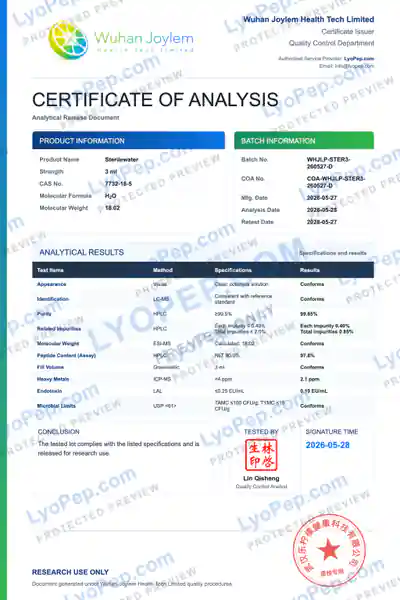
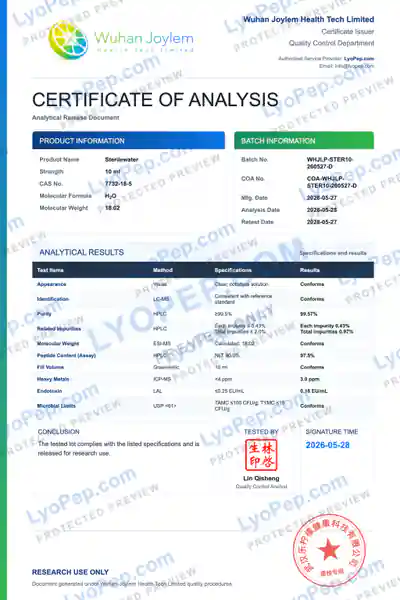
Factory batch documentation

Sterile Water factory batch COAs

Representative records, refreshed periodically

Published COAs show representative factory batches and may not be the latest available. For a current quote or shipment, our sales team can confirm the applicable lot and provide its COA.

Independent testing, arranged on request

Third-party reports are not routinely published. If independent verification is required, we can agree the laboratory, method, acceptance criteria and remedy before testing. If the agreed specification is not met, an appropriate resolution—including a refund where applicable—can be discussed under the agreed terms. Unless otherwise agreed in writing, the buyer pays the cost of this optional testing.

Help reviewing your COA

Need help reading a factory COA or third-party report? Our sales team can clarify test items, specifications and how the results relate to the lot under discussion.

Ask for the current packet, not a generic certificate

  • Require exact grade and monograph claim, lot and manufacturer traceability, chemical attributes such as conductivity and total organic carbon where applicable, bacterial-endotoxin method and result, sterility method and result, appearance and particulates, fill volume, container-closure integrity or validation, sterilization information and shelf-life data
  • Reject “≥99% purity,” generic injectable-grade language or “pyrogen-free” without the corresponding specification and released-lot evidence.
Released-batch COARP-HPLC result and method contextIdentity result appropriate to the moleculeWater / counter-ion context where relevantSDS and handling statementAdditional testing scoped on request

Available fills

Quote the fill and pack configuration you need

Reference SKUFillBase pack
STERW-03ML3 mL10 vials
STERW-10ML10 mL10 vials

Handling

Storage in the lab and temperature during transit are different decisions

Follow the released-lot label, container specification and stability data. Do not infer controlled-room-temperature ranges, freezing restrictions, immediate-use rules or four-hour pharmacy-bulk-package limits unless the supplied lot is the exact labelled presentation to which those instructions apply. Quarantine damaged containers and temperature excursions.

State destination, season, acceptable transit exposure and whether your protocol requires insulated or cold-chain service. Additional temperature-control cost is quoted explicitly.

Buyer FAQ

Terms to settle before the purchase order

Can a buyer arrange third-party testing?+

Yes. Testing must be performed by a mutually accepted, established specialist laboratory. Fee allocation, specification, sampling, method and acceptance rule must be agreed before testing; if an agreed independent result shows nonconformance, the remedy follows the signed order terms. Unless otherwise agreed in writing, the buyer pays the cost of this optional testing.

Does HPLC purity prove peptide content?+

No. Chromatographic purity describes the relative peak profile under a stated method. Identity, water, counter-ion, residual solvents and assay/content may require separate methods.

Is cold-chain shipping always required?+

Not always. Heat can accelerate degradation, especially during summer and long transit. Cold-chain reduces exposure but raises cost. State the destination and stability risk so the right service can be quoted.

How are payment terms handled?+

Available methods and milestones depend on order value, destination and project type. The pro forma invoice should state currency, bank details, fees, payment milestones and the release condition.

Why must the testing laboratory understand peptide chemistry?+

Free-base and salt forms, hydrophilic and hydrophobic sequences, aggregation and adsorption can change sample preparation and method suitability. Use a laboratory experienced with the molecule class.

These are buyer-qualification references, not claims that this RUO material is regulated, certified or released under those frameworks. Applicability depends on the buyer's workflow and jurisdiction.

Selected sources

Literature behind the research context

  • Primary references include the USP Water for Injection monograph, USP General Chapter 〈643〉 Total Organic Carbon, FDA DailyMed labelling for a specified Sterile Water for Injection finished presentation, and NIH PubChem CID 962 for molecular identity. Label-specific storage, entry and discard instructions are examples for those named presentations only and are not automatically attributes of this RUO catalogue lot.
  1. 01

    Hemolysis and renal failure associated with use of sterile water for injection to dilute 25% human albumin solution

    American Journal of Health-System Pharmacy · 1998 · peer-reviewed case series / letter

    Open source
  2. 02

    Hemolysis Associated with 25% Human Albumin Diluted with Sterile Water -- United States, 1994-1998

    Morbidity and Mortality Weekly Report (MMWR) · 1999 · regulatory/public-health surveillance report

    Open source
  3. 03

    Iatrogenic Water Intoxication After Intravenous Infusion of Sterile Water: A Rare and Preventable Case

    Cureus · 2025 · peer-reviewed case report

    Open source
  4. 04

    Water for Injection

    USP-NF (United States Pharmacopeia-National Formulary) · 2018 · official compendial monograph

    Open source
  5. 05

    Sterile Water for Injection, USP -- Official Prescribing Information / Package Insert

    Pfizer Official Labeling (labeling.pfizer.com) · 2024 · regulatory document / manufacturer official labeling

    Open source
  6. 06

    Sterile Water for Injection, USP -- FDA Drug Label

    DailyMed (U.S. National Library of Medicine) · 2023 · regulatory document / manufacturer official labeling (DailyMed repository)

    Open source
  7. 07

    ISMP List of High-Alert Medications in Acute Care Settings

    Institute for Safe Medication Practices (ISMP) · 2024 · industry patient-safety organization guidance document

    Open source
  8. 08

    Sterile Water Should Not Be Given "Freely"

    Pennsylvania Patient Safety Advisory · 2008 · state regulatory patient-safety advisory

    Open source

Product FAQ

Questions buyers ask about Sterile Water

Which evidence is needed to support a sterile-water claim?+

Request the claimed monograph and edition, manufacturing-water basis, chemical tests such as conductivity and total organic carbon where applicable, bacterial endotoxin with method and limit, sterility with method and result, appearance and particulates, fill volume, container-closure integrity or validation, sterilization information, lot traceability and shelf-life data. Sterility and endotoxin are different tests, and “pyrogen-free” should not be inferred from an LAL result alone.