Recent Confirmed OrdersLast 7 days
Australia520 mgTirzepatide 40 mg · Semaglutide 2 mg · Dihexa 10 mg
View all

Growth-hormone axis research

Ipamorelin

Stereochemically defined GHSR agonist pentapeptide

≥ 99.0% · target, verify batch COACAS 170851-70-4RUO
Research statusInvestigational; not FDA approved reference context · supplied material is RUO
Supplied formPentapeptide (linear, D-amino acid modified, C-terminal amidated)
Lead time7–14 days
Ipamorelin — Lyophilized material; confirm released-lot appearance on the COA
Ipamorelin — Lyophilized material; confirm released-lot appearance on the COA · Representative packaging image · verify the ordered lot
Representative packaging image · verify the ordered lot

Decision summary

Key benefits

  • Research value includes a compact GHS-receptor agonist scaffold, measurable GH-response pharmacology, animal endocrine and bone models, postoperative gastrointestinal-motility models, and analytical work on a peptide containing non-natural residues
  • These uses do not establish anti-aging, sleep, recovery, fat-loss, muscle-gain or tissue-repair benefits in humans.
Published research context is presented for literature orientation only. It is not a dosing, treatment or human-use instruction.
Qualification data

Specifications to confirm against the released lot

CAS
170851-70-4
Formula
C38H49N9O5
Molecular weight
711.853 Da
Appearance
Lyophilized material; confirm released-lot appearance on the COA
Purity
≥ 99.0% · target, verify batch COA
Storage
Use the released lot's COA and stability instructions. Control temperature, light, moisture, adsorption, agitation and freeze-thaw exposure; for solutions, specify matrix, concentration, container and validated hold time. FDA identifies aggregation and peptide-related impurities as relevant immunogenicity concerns for compounded ipamorelin products.
MOQ
On request
Lead time
7–14 days
PubChem CID 9831659

Qualification matrix

Identity, purity and content are separate release questions.

Identity

Confirm the stated molecule and supplied form. Start with the matching batch COA; request sequence-level evidence only when the buyer's written procedure requires it and availability or a separate scope has been agreed.

Purity

Review RP-HPLC method conditions, wavelength, integration and related-peak handling. A percentage without the method is not enough.

Content

Net peptide content is not the same as gross lyophilized powder weight. Ask which assay supports the stated amount and whether water/counter-ion is addressed.

Stability

Define long-term storage and transit exposure separately. Cold-chain can be quoted when the buyer’s risk assessment requires it and adds cost.

Research context

What researchers study about Ipamorelin

Ipamorelin (NNC 26-0161) is a synthetic, C-terminally amidated pentapeptide growth-hormone secretagogue that acts through the ghrelin/growth-hormone secretagogue receptor. Animal studies and a small intravenous healthy-volunteer study established GH-release pharmacology. A published Phase 2 randomized trial in postoperative ileus found no statistically significant benefit on its key or secondary efficacy outcomes. Ipamorelin is investigational, has no FDA-approved therapeutic use and is supplied here only for qualified research.

  • Qualified research contexts include GHS-receptor/GH-response pharmacology, animal bone and endocrine models, postoperative-ileus models, peptide identity and aggregation studies, and anti-doping analytical work
  • The published Phase 2 postoperative-ileus trial was negative for its key and secondary efficacy outcomes
  • No qualifying randomized human evidence was identified for marketed anti-aging, sleep, recovery or body-composition uses.

Mechanism context

The question the literature is testing

Ipamorelin is a GHS-receptor agonist that stimulated GH release in rat pituitary preparations, rats, swine and an intravenous healthy-volunteer study. The original animal comparison found less ACTH/cortisol release than selected earlier secretagogues under the tested conditions. That model-specific selectivity does not guarantee absent cortisol, prolactin, appetite or other effects in humans or with unstudied routes.

Evidence map

Research routes and exposure context

Evidence tierApproved finished-product context
Routes reported in sources
SubcutaneousIntravenous
Dose / exposure contextProtocol-specific; verify the cited primary source
Routes and exposure contexts summarize cited studies or approved finished-product labels. They are not instructions for administering this RUO material; no customer dose is provided.

Evidence boundaries

Compatibility, limitations and decision context

  • Research-use-only material; not for human or veterinary administration
  • FDA states that compounded ipamorelin products may present immunogenicity risk from aggregation or peptide-related impurities, that non-natural amino acids complicate characterization, and that adequate safety information is lacking for proposed subcutaneous administration
  • FDA also cites serious adverse events, including deaths of uncertain causality, in an intravenous postoperative-ileus study
  • Ipamorelin is named on WADA's 2026 Prohibited List.

Interactions reported in the literature

  • No clinically validated peptide-stacking or drug-interaction table was identified
  • Do not infer compatibility or synergy with CJC-1295, BPC-157, TB-500, sermorelin, other GHRPs or tesamorelin from shared pathway descriptions
  • Experimental co-exposure requires a justified protocol, independent controls and model-specific safety review.
Literature context is not a supplier release result or human-use instruction. Follow your institution's approved laboratory risk assessment.

Factory batch documentation

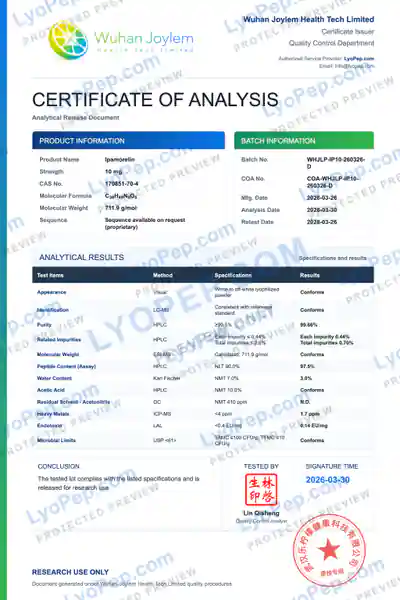
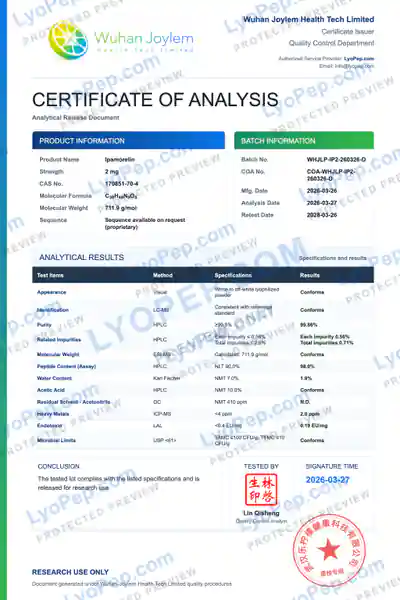
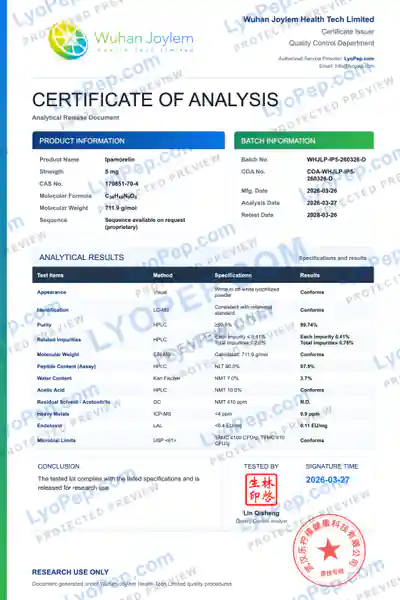
Ipamorelin factory batch COAs

Representative records, refreshed periodically

Published COAs show representative factory batches and may not be the latest available. For a current quote or shipment, our sales team can confirm the applicable lot and provide its COA.

Independent testing, arranged on request

Third-party reports are not routinely published. If independent verification is required, we can agree the laboratory, method, acceptance criteria and remedy before testing. If the agreed specification is not met, an appropriate resolution—including a refund where applicable—can be discussed under the agreed terms. Unless otherwise agreed in writing, the buyer pays the cost of this optional testing.

Help reviewing your COA

Need help reading a factory COA or third-party report? Our sales team can clarify test items, specifications and how the results relate to the lot under discussion.

Ask for the current packet, not a generic certificate

  • Lot release should verify the complete stereochemical sequence, intact mass, peptide content, chromatographic related-peptide/fragment profile, aggregate profile, counterion, water and residual solvents
  • Add orthogonal identity and model-appropriate microbiological controls when required
  • HPLC area purity is not peptide content; appearance, solution clarity or a reported hunger response cannot authenticate identity, purity or biological activity.
Released-batch COARP-HPLC result and method contextIdentity result appropriate to the moleculeWater / counter-ion context where relevantSDS and handling statementAdditional testing scoped on request

Available fills

Quote the fill and pack configuration you need

Reference SKUFillBase pack
IPA-02MG2 mg10 vials
IPA-05MG5 mg10 vials
IPA-10MG10 mg10 vials

Handling

Storage in the lab and temperature during transit are different decisions

Use the released lot's COA and stability instructions. Control temperature, light, moisture, adsorption, agitation and freeze-thaw exposure; for solutions, specify matrix, concentration, container and validated hold time. FDA identifies aggregation and peptide-related impurities as relevant immunogenicity concerns for compounded ipamorelin products.

State destination, season, acceptable transit exposure and whether your protocol requires insulated or cold-chain service. Additional temperature-control cost is quoted explicitly.

Buyer FAQ

Terms to settle before the purchase order

Can a buyer arrange third-party testing?+

Yes. Testing must be performed by a mutually accepted, established specialist laboratory. Fee allocation, specification, sampling, method and acceptance rule must be agreed before testing; if an agreed independent result shows nonconformance, the remedy follows the signed order terms. Unless otherwise agreed in writing, the buyer pays the cost of this optional testing.

Does HPLC purity prove peptide content?+

No. Chromatographic purity describes the relative peak profile under a stated method. Identity, water, counter-ion, residual solvents and assay/content may require separate methods.

Is cold-chain shipping always required?+

Not always. Heat can accelerate degradation, especially during summer and long transit. Cold-chain reduces exposure but raises cost. State the destination and stability risk so the right service can be quoted.

How are payment terms handled?+

Available methods and milestones depend on order value, destination and project type. The pro forma invoice should state currency, bank details, fees, payment milestones and the release condition.

Why must the testing laboratory understand peptide chemistry?+

Free-base and salt forms, hydrophilic and hydrophobic sequences, aggregation and adsorption can change sample preparation and method suitability. Use a laboratory experienced with the molecule class.

These are buyer-qualification references, not claims that this RUO material is regulated, certified or released under those frameworks. Applicability depends on the buyer's workflow and jurisdiction.

Selected sources

Literature behind the research context

  • Primary evidence: Raun et al. 1998 (PMID 9849822), foundational animal pharmacology; Gobburu et al. 1999 (PMID 10496658), intravenous human PK/PD; Venkova et al. 2009 (PMID 19289567), rodent postoperative-ileus model; Beck et al. 2014 (PMID 25331030; NCT00672074), Phase 2 RCT with no significant efficacy difference; ClinicalTrials.gov NCT01280344, completed 320-participant dose-finding study with no posted results. Identity and risk context: NCATS Inxight Drugs UNII Y9M3S784Z6, FDA compounding safety materials and WADA 2026 Prohibited List.
  1. 01

    Ipamorelin, the first selective growth hormone secretagogue

    European Journal of Endocrinology · 1998 · peer-reviewed original research

    Open source
  2. 02

    Ipamorelin, a new growth-hormone-releasing peptide, induces longitudinal bone growth in rats

    Growth Hormone & IGF Research · 1999 · peer-reviewed original research

    Open source
  3. 03

    The GH secretagogues ipamorelin and GH-releasing peptide-6 increase bone mineral content in adult female rats

    Journal of Endocrinology · 2000 · peer-reviewed original research

    Open source
  4. 04

    The growth hormone secretagogue ipamorelin counteracts glucocorticoid-induced decrease in bone formation of adult rats

    Growth Hormone & IGF Research · 2001 · peer-reviewed original research

    Open source
  5. 05

    Pharmacokinetic-pharmacodynamic modeling of ipamorelin, a growth hormone releasing peptide, in human volunteers

    Pharmaceutical Research · 1999 · peer-reviewed original research (Phase 1 human pharmacology)

    Open source
  6. 06

    Efficacy of ipamorelin, a novel ghrelin mimetic, in a rodent model of postoperative ileus

    Journal of Pharmacology and Experimental Therapeutics · 2009 · peer-reviewed original research

    Open source
  7. 07

    Prospective, randomized, controlled, proof-of-concept study of the Ghrelin mimetic ipamorelin for the management of postoperative ileus in bowel resection patients

    International Journal of Colorectal Disease · 2014 · peer-reviewed original research (Phase 2 randomized controlled trial)

    Open source
  8. 08

    Growth hormone secretagogues: history, mechanism of action, and clinical development

    JCSM Rapid Communications · 2020 · peer-reviewed review article

    Open source

Product FAQ

Questions buyers ask about Ipamorelin

How does the evidence distinguish Ipamorelin from GHRP-2 and GHRP-6?+

The foundational study found GH-release efficacy comparable with GHRP-6 in rats and swine and found no ACTH or cortisol increase beyond the GHRH comparator in the tested swine protocol, whereas GHRP-2 and GHRP-6 increased those hormones. That supports model-specific GH selectivity; it does not prove absent cortisol, prolactin, appetite or other effects in humans, unstudied routes or chronic exposure. Compare compounds in the same qualified assay rather than applying a universal “cleanest agonist” ranking.

Is combining Ipamorelin with CJC-1295 an evidence-based standard?+

No. GHSR and GHRH-receptor signaling can interact at somatotrophs, but no qualified human combination dataset establishes a universal ratio, enhanced benefit, compatibility or long-term safety for commercially mixed Ipamorelin/CJC-1295. CJC-1295 with DAC and shorter GHRH analogues are also different analytes. Combination research needs independently qualified components, single-agent and vehicle controls, a justified concentration matrix and model-specific interpretation; a 1:1 vial ratio is a vendor convention, not a scientific standard.

How should an Ipamorelin lot be reconstituted and qualified?+

Use the released-lot instructions and a protocol validated for the intended assay. Define counterion, solvent or buffer, stock concentration, pH, adsorption controls, container, agitation, filtration, temperature, freeze-thaw allowance and in-use period. Request complete stereochemical identity, high-resolution intact mass, peptide content, related-peptide and aggregate profiles, water, counterion and residual solvents. Generic bacteriostatic-water, 1–5 mg/mL, three-thaw or 24-month claims are not transferable without lot-specific stability data.