Recent Confirmed OrdersLast 7 days
United States8 gEpithalon 50 mg · TB-500 10 mg · CJC-1295 + Ipamorelin 10 mg · Melanotan II 10 mg · Bacteriostatic Water 10 ml
View all

Growth-hormone axis research

CJC-1295 without DAC

Tetrasubstituted GRF(1-29) analogue · no DAC · research use only

Lot-specific released result; request raw chromatography, content assay and orthogonal identity data · target, verify batch COACAS 446036-97-1RUO
Research statusLimited direct evidence for the no-DAC identity / not approved reference context · supplied material is RUO
Supplied formLinear 29-residue GHRH/GRF analogue without a DAC albumin-binding group
Lead time7–14 days
CJC-1295 without DAC — Lot-specific lyophilized solid; confirm colour and physical form on the released-batch COA
CJC-1295 without DAC — Lot-specific lyophilized solid; confirm colour and physical form on the released-batch COA · Representative packaging image · verify the ordered lot
Representative packaging image · verify the ordered lot

Decision summary

Key benefits

  • No sleep, recovery, body-composition, IGF-1, pituitary-support or receptor-desensitisation benefit has been established for this material
  • Defensible research uses include sequence and identity confirmation, comparison with native GHRH fragments and the DAC construct, controlled GHRHR signalling assays, proteolysis studies, and formulation-specific solubility, adsorption and stability work.
Published research context is presented for literature orientation only. It is not a dosing, treatment or human-use instruction.
Qualification data

Specifications to confirm against the released lot

CAS
446036-97-1
Formula
C152H252N44O42
Molecular weight
Approximately 3,367.9 Da
Appearance
Lot-specific lyophilized solid; confirm colour and physical form on the released-batch COA
Purity
Lot-specific released result; request raw chromatography, content assay and orthogonal identity data · target, verify batch COA
Storage
Store and ship according to the batch COA and validated stability data for the exact sequence, counterion, formulation, concentration and container. Generic 2-8 degrees Celsius and two-year statements are not substitutes for real-time or scientifically justified stability evidence. Avoid unvalidated freeze-thaw cycles and record excursions.
MOQ
On request
Lead time
7–14 days
PubChem CID 91976842

Qualification matrix

Identity, purity and content are separate release questions.

Identity

Confirm the stated molecule and supplied form. Start with the matching batch COA; request sequence-level evidence only when the buyer's written procedure requires it and availability or a separate scope has been agreed.

Purity

Review RP-HPLC method conditions, wavelength, integration and related-peak handling. A percentage without the method is not enough.

Content

Net peptide content is not the same as gross lyophilized powder weight. Ask which assay supports the stated amount and whether water/counter-ion is addressed.

Stability

Define long-term storage and transit exposure separately. Cold-chain can be quoted when the buyer’s risk assessment requires it and adds cost.

Research context

What researchers study about CJC-1295 without DAC

CJC-1295 without DAC, often marketed as Modified GRF(1-29) or Mod GRF(1-29), is a 29-residue tetrasubstituted GHRH analogue without the albumin-reactive DAC group. FDA's official 2024 briefing treats CJC-1295 free base and its acetate as a different active moiety from DAC-containing CJC-1295. Naming is inconsistent across supplier catalogues, so the complete sequence, C-terminal amide, counterion and absence of a DAC-bearing Lys30 must be confirmed analytically. The well-known 5.8–8.1-day human half-life and prolonged GH/IGF-1 results belong to the defined DAC-containing investigational molecule, not this no-DAC material. No authoritative dedicated human pharmacokinetic or efficacy study of the no-DAC identity was located; the repeated approximately 30-minute half-life is therefore secondary, not a measured product-specific value.

  • The no-DAC material is used as a research analogue of modified GHRH(1-29), but no dedicated published human efficacy study was located

Mechanism context

The question the literature is testing

The defined 29-residue analogue is expected to engage GHRHR and activate Gs/cAMP signalling. The commonly reported substitutions are D-Ala2, Gln8, Ala15 and Leu27 relative to the native sequence. These structural differences provide a rationale for laboratory comparison with native GHRH, but the magnitude of receptor affinity, protease resistance, human exposure and GH response must be established by applicable primary data and a qualified test article. A separate GHSR1a mechanism for ipamorelin does not prove synergy or a standard combination ratio.

Evidence map

Research routes and exposure context

Evidence tierApproved finished-product context
Routes reported in sources
Subcutaneous
Dose / exposure contextProtocol-specific; verify the cited primary source
Routes and exposure contexts summarize cited studies or approved finished-product labels. They are not instructions for administering this RUO material; no customer dose is provided.

Evidence boundaries

Compatibility, limitations and decision context

  • The no-DAC peptide is not an approved medicine and lacks a dedicated human safety database
  • FDA's official 2024 briefing identified inconsistent identity, peptide-related impurities, aggregation, immunogenicity, nonclinical toxicity and limited clinical evidence as material concerns across CJC-1295-related forms
  • Final PCAC minutes record 0 yes to 13 no for CJC-1295 free base and 1 yes to 12 no for CJC-1295 acetate on Section 503A Bulks List inclusion; committee advice is non-binding
  • FDA's current significant-safety-risk page states that compounded CJC-1295 may pose immunogenicity and characterization risks, available clinical data are limited, and serious adverse events including increased heart rate and systemic vasodilatory reaction have been identified
  • CJC-1295 is prohibited at all times under WADA 2026 S2.2.4
  • This material is not for human or veterinary use; laboratory work should follow institutional review and batch safety documentation.

Interactions reported in the literature

  • No product-specific human interaction protocol exists
  • Mechanistic expectations about GHRH-receptor signaling do not validate combinations with GHRPs, GH, insulin or other secretagogues
  • Community synergy and stack labels were removed because no controlled no-DAC interaction study supports them.
Literature context is not a supplier release result or human-use instruction. Follow your institution's approved laboratory risk assessment.

Factory batch documentation

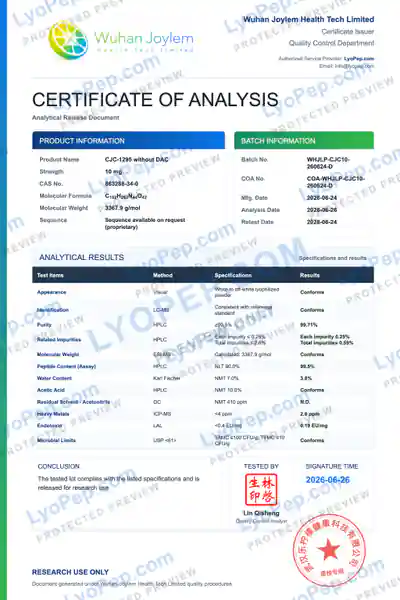
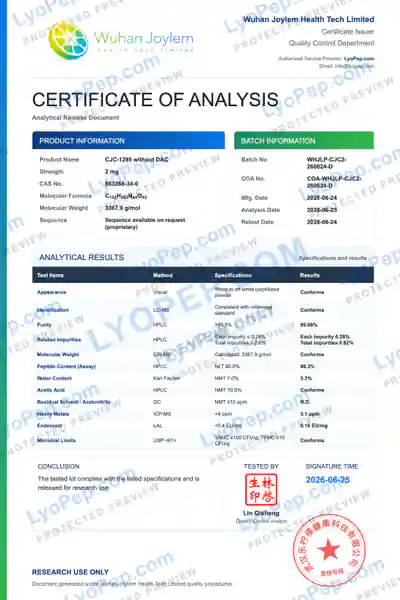
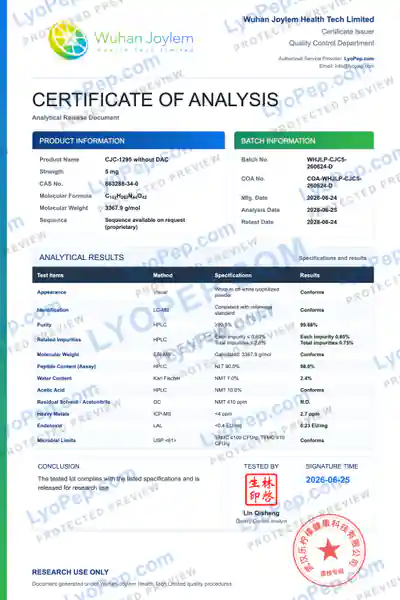
CJC-1295 without DAC factory batch COAs

Representative records, refreshed periodically

Published COAs show representative factory batches and may not be the latest available. For a current quote or shipment, our sales team can confirm the applicable lot and provide its COA.

Independent testing, arranged on request

Third-party reports are not routinely published. If independent verification is required, we can agree the laboratory, method, acceptance criteria and remedy before testing. If the agreed specification is not met, an appropriate resolution—including a refund where applicable—can be discussed under the agreed terms. Unless otherwise agreed in writing, the buyer pays the cost of this optional testing.

Help reviewing your COA

Need help reading a factory COA or third-party report? Our sales team can clarify test items, specifications and how the results relate to the lot under discussion.

Ask for the current packet, not a generic certificate

  • A supplier must distinguish the 29-residue no-DAC peptide from albumin-reactive DAC-containing CJC-1295
  • Qualification should require the complete sequence and terminal state, counterion, high-resolution intact mass and sequence-confirming MS/MS, chromatographic purity with raw chromatograms and impurity profile, quantitative peptide content, residual solvents, water and counterion content, and lot-specific stability
  • A vacuum-sealed vial, white powder, CAS label or nominal HPLC percentage does not prove the absence of a DAC linker or confirm identity
  • Sterility and endotoxin require separate validated tests.
Released-batch COARP-HPLC result and method contextIdentity result appropriate to the moleculeWater / counter-ion context where relevantSDS and handling statementAdditional testing scoped on request

Available fills

Quote the fill and pack configuration you need

Reference SKUFillBase pack
MODGRF-02MG2 mg10 vials
MODGRF-05MG5 mg10 vials
MODGRF-10MG10 mg10 vials

Handling

Storage in the lab and temperature during transit are different decisions

Store and ship according to the batch COA and validated stability data for the exact sequence, counterion, formulation, concentration and container. Generic 2-8 degrees Celsius and two-year statements are not substitutes for real-time or scientifically justified stability evidence. Avoid unvalidated freeze-thaw cycles and record excursions.

State destination, season, acceptable transit exposure and whether your protocol requires insulated or cold-chain service. Additional temperature-control cost is quoted explicitly.

Buyer FAQ

Terms to settle before the purchase order

Can a buyer arrange third-party testing?+

Yes. Testing must be performed by a mutually accepted, established specialist laboratory. Fee allocation, specification, sampling, method and acceptance rule must be agreed before testing; if an agreed independent result shows nonconformance, the remedy follows the signed order terms. Unless otherwise agreed in writing, the buyer pays the cost of this optional testing.

Does HPLC purity prove peptide content?+

No. Chromatographic purity describes the relative peak profile under a stated method. Identity, water, counter-ion, residual solvents and assay/content may require separate methods.

Is cold-chain shipping always required?+

Not always. Heat can accelerate degradation, especially during summer and long transit. Cold-chain reduces exposure but raises cost. State the destination and stability risk so the right service can be quoted.

How are payment terms handled?+

Available methods and milestones depend on order value, destination and project type. The pro forma invoice should state currency, bank details, fees, payment milestones and the release condition.

Why must the testing laboratory understand peptide chemistry?+

Free-base and salt forms, hydrophilic and hydrophobic sequences, aggregation and adsorption can change sample preparation and method suitability. Use a laboratory experienced with the molecule class.

These are buyer-qualification references, not claims that this RUO material is regulated, certified or released under those frameworks. Applicability depends on the buyer's workflow and jurisdiction.

Selected sources

Literature behind the research context

  • The principal CJC-1295 papers by Jetté et al. (Endocrinology 2005, DOI 10.1210/en.2004-1286), Teichman et al. (JCEM 2006, DOI 10.1210/jc.2005-1536) and Ionescu and Frohman (JCEM 2006, DOI 10.1210/jc.2006-1702) concern the DAC-containing long-acting molecule and are retained to prevent extrapolation. They do not establish no-DAC human pharmacokinetics, efficacy or dosing. PubChem CID 91976842 and FDA's 2024 briefing support the 29-residue free-peptide identity, formula C₁₅₂H₂₅₂N₄₄O₄₂ and mass near 3,367.9 Da. FDA's final PCAC minutes record form-specific advisory votes, while its current significant-safety-risk page provides ongoing agency risk context. WADA's official 2026 Prohibited List supplies the current anti-doping classification. None of these sources qualifies a supplied lot or creates an approved use.
  1. 01

    Human Growth Hormone-Releasing Factor (hGRF)1-29-Albumin Bioconjugates Activate the GRF Receptor on the Anterior Pituitary in Rats: Identification of CJC-1295 as a Long-Lasting GRF Analog

    Endocrinology · 2005 · peer-reviewed original research

    Open source
  2. 02

    Prolonged Stimulation of Growth Hormone (GH) and Insulin-Like Growth Factor I Secretion by CJC-1295, a Long-Acting Analog of GH-Releasing Hormone, in Healthy Adults

    The Journal of Clinical Endocrinology & Metabolism · 2006 · peer-reviewed original research (clinical trial)

    Open source
  3. 03

    Pulsatile Secretion of Growth Hormone (GH) Persists during Continuous Stimulation by CJC-1295, a Long-Acting GH-Releasing Hormone Analog

    The Journal of Clinical Endocrinology & Metabolism · 2006 · peer-reviewed original research (clinical trial)

    Open source
  4. 04

    FDA Briefing Document: CJC-1295-Related Bulk Drug Substances

    U.S. Food and Drug Administration · 2024 · official regulatory briefing

    Open source
  5. 05

    Final Minutes: December 4, 2024 Pharmacy Compounding Advisory Committee Meeting

    U.S. Food and Drug Administration · 2024 · official advisory committee minutes

    Open source
  6. 06

    PubChem Compound Summary: CJC1295 Without DAC (CID 91976842)

    PubChem · 2026 · authoritative public chemical database

    Open source
  7. 07

    Certain Bulk Drug Substances for Use in Compounding May Present Significant Safety Risks

    U.S. Food and Drug Administration · 2026 · current official regulatory safety resource

    Open source
  8. 08

    2026 Prohibited List

    World Anti-Doping Agency · 2026 · official anti-doping authority list

    Open source

Product FAQ

Questions buyers ask about CJC-1295 without DAC

What is the evidence-based difference between with-DAC and no-DAC CJC-1295?+

The no-DAC material is a 29-residue modified GRF(1-29) analogue. The with-DAC material adds a C-terminal Lys30 bearing a reactive maleimidopropionyl group and therefore has a different mass, identity and analytical specification. Human 5.8–8.1-day pharmacokinetic data belong to the defined DAC-containing investigational molecule. No authoritative dedicated human pharmacokinetic study was located for the no-DAC identity, so the widely repeated approximately 30-minute value must not be presented as a measured product-specific fact.