Recent Confirmed OrdersLast 7 days
Australia520 mgTirzepatide 40 mg · Semaglutide 2 mg · Dihexa 10 mg
View all

Growth-hormone axis research

GHRP-6

GHRP-6 amidated hexapeptide research reference · free-base and triacetate forms must be distinguished

Lot-specific chromatographic purity and quantitative peptide content; confirm both plus the supplied salt form on the released-lot COA · target, verify batch COACAS 87616-84-0RUO
Research statusExtensive receptor and short-term human challenge literature; no approved therapeutic use; laboratory Research Use Only reference context · supplied material is RUO
Supplied formLinear amidated hexapeptide containing D-Trp and D-Phe residues
Lead time10–18 days
GHRP-6 — Lot-specific lyophilized research peptide; confirm colour and physical form on the released-lot COA
GHRP-6 — Lot-specific lyophilized research peptide; confirm colour and physical form on the released-lot COA · Representative packaging image · verify the ordered lot
Representative packaging image · verify the ordered lot

Decision summary

Key benefits

  • GHRP-6 is a well-established experimental growth-hormone secretagogue with foundational receptor and human endocrine-response research
  • Published human work characterizes short-term GH responses and intravenous pharmacokinetics, while cytoprotective, cardiac, wound and kidney findings are predominantly preclinical or formulation-specific
Published research context is presented for literature orientation only. It is not a dosing, treatment or human-use instruction.
Qualification data

Specifications to confirm against the released lot

CAS
87616-84-0
Formula
C46H56N12O6
Molecular weight
873.03 Da
Appearance
Lot-specific lyophilized research peptide; confirm colour and physical form on the released-lot COA
Purity
Lot-specific chromatographic purity and quantitative peptide content; confirm both plus the supplied salt form on the released-lot COA · target, verify batch COA
Storage
Store and ship according to the supplied batch COA, salt/formulation-specific stability data and validated cold-chain conditions. A generic 2-8 degrees Celsius statement is not a substitute for stability data covering the exact acetate content, buffer, concentration, container and reconstituted state. Avoid unvalidated freeze-thaw cycles and record excursions.
MOQ
On request
Lead time
10–18 days
PubChem CID 9919153

Qualification matrix

Identity, purity and content are separate release questions.

Identity

Confirm the stated molecule and supplied form. Start with the matching batch COA; request sequence-level evidence only when the buyer's written procedure requires it and availability or a separate scope has been agreed.

Purity

Review RP-HPLC method conditions, wavelength, integration and related-peak handling. A percentage without the method is not enough.

Content

Net peptide content is not the same as gross lyophilized powder weight. Ask which assay supports the stated amount and whether water/counter-ion is addressed.

Stability

Define long-term storage and transit exposure separately. Cold-chain can be quoted when the buyer’s risk assessment requires it and adds cost.

Research context

What researchers study about GHRP-6

GHRP-6 (growth hormone-releasing peptide-6) is the synthetic amidated hexapeptide His-D-Trp-Ala-Trp-D-Phe-Lys-NH₂ and an early member of the growth-hormone secretagogue class developed through the Bowers research program. It activates the growth-hormone secretagogue receptor GHS-R1a and has been studied in animal models and human endocrine challenge studies. Reported readouts include growth-hormone release and orexigenic responses, but the magnitude depends on dose, route, physiological state and study population. Combined GHRH and GHRP-6 can produce a larger GH response than either stimulus alone. The compound is not an approved medicine, and historical human challenge studies are evidence context rather than instructions for an RUO vial.

  • Research domains include GHS-R1a-mediated GH secretion and interaction with endogenous GHRH, plus preclinical cytoprotection, wound healing, doxorubicin-injury and kidney-hydrogel models
  • A small EGF plus GHRP-6 stroke study evaluates a combination product and cannot isolate GHRP-6 efficacy
  • None of these domains constitutes an approved indication for GHRP-6.

Mechanism context

The question the literature is testing

GHRP-6 agonizes GHS-R1a, a Gq/11-coupled GPCR, in hypothalamic and pituitary systems, with PLC/IP₃/DAG signaling, intracellular calcium mobilization and growth-hormone release. Human antagonist studies indicate that endogenous GHRH contributes substantially to the GH response, so the GHRP-6 and GHRH pathways should not be described as fully independent or simply non-overlapping even though combined stimulation can be strongly synergistic. Cardiovascular CD36 mechanisms are well described for hexarelin and certain cyclic aza-GHRP-6 analogues; they should not automatically be attributed to unmodified GHRP-6 without compound-specific binding and functional evidence.

Evidence map

Research routes and exposure context

Evidence tierApproved finished-product context
Routes reported in sources
SubcutaneousIntravenousOralTopical
Dose / exposure contextProtocol-specific; verify the cited primary source
Routes and exposure contexts summarize cited studies or approved finished-product labels. They are not instructions for administering this RUO material; no customer dose is provided.

Evidence boundaries

Compatibility, limitations and decision context

  • GHRP-6 is not an approved medicine and is not for human or veterinary use
  • Small short-term human endocrine and intravenous pharmacokinetic studies cannot establish long-term safety, carcinogenic risk, reproductive safety, glucose effects or safe combinations
  • Appetite, cortisol, prolactin and glucose findings require protocol-specific interpretation
  • GHRP-6 is prohibited at all times under section S2.2.4 of the 2026 WADA Prohibited List
  • Laboratory handling should follow institutional risk assessment and released-lot safety documentation.

Interactions reported in the literature

  • Human combination protocols are not established for an RUO product
  • Mechanistic studies show that endogenous GHRH contributes to the GH response, but this does not validate commercial stacks with CJC-1295, sermorelin, other secretagogues, insulin, HGH or repair peptides
  • Compatibility, synergy and avoidance labels copied from community protocols were removed because product-specific safety and interaction studies are lacking.
Literature context is not a supplier release result or human-use instruction. Follow your institution's approved laboratory risk assessment.

Factory batch documentation

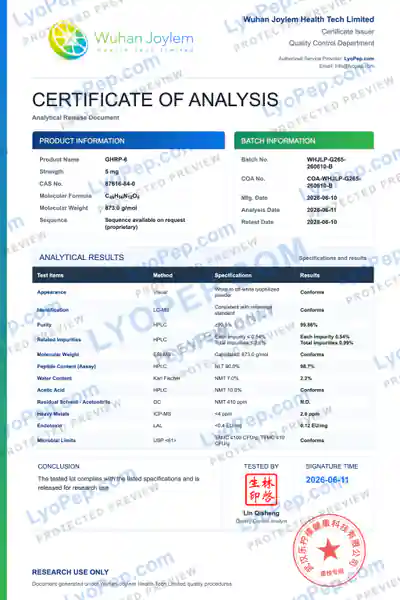
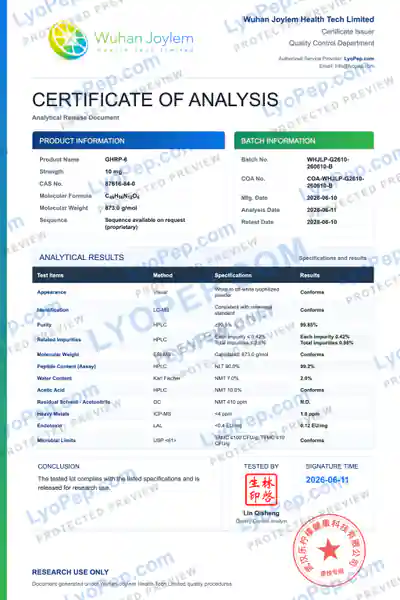
GHRP-6 factory batch COAs

Representative records, refreshed periodically

Published COAs show representative factory batches and may not be the latest available. For a current quote or shipment, our sales team can confirm the applicable lot and provide its COA.

Independent testing, arranged on request

Third-party reports are not routinely published. If independent verification is required, we can agree the laboratory, method, acceptance criteria and remedy before testing. If the agreed specification is not met, an appropriate resolution—including a refund where applicable—can be discussed under the agreed terms. Unless otherwise agreed in writing, the buyer pays the cost of this optional testing.

Help reviewing your COA

Need help reading a factory COA or third-party report? Our sales team can clarify test items, specifications and how the results relate to the lot under discussion.

Ask for the current packet, not a generic certificate

  • A white powder, clear solution or reported appetite response cannot establish identity, purity, content, sterility or potency
  • A useful lot package should distinguish free base from acetate form and report sequence identity by intact mass plus an orthogonal method such as MS/MS, chromatographic purity with method and impurity profile, quantitative peptide content, acetate/counterion and water content, residual solvents, and validated stability conditions
  • Sterility, endotoxin and particulate claims require separate validated tests
  • Biological response in a person is neither an ethical nor a valid incoming-quality test.
Released-batch COARP-HPLC result and method contextIdentity result appropriate to the moleculeWater / counter-ion context where relevantSDS and handling statementAdditional testing scoped on request

Available fills

Quote the fill and pack configuration you need

Reference SKUFillBase pack
GHRP6-05MG5 mg10 vials
GHRP6-10MG10 mg10 vials

Handling

Storage in the lab and temperature during transit are different decisions

Store and ship according to the supplied batch COA, salt/formulation-specific stability data and validated cold-chain conditions. A generic 2-8 degrees Celsius statement is not a substitute for stability data covering the exact acetate content, buffer, concentration, container and reconstituted state. Avoid unvalidated freeze-thaw cycles and record excursions.

State destination, season, acceptable transit exposure and whether your protocol requires insulated or cold-chain service. Additional temperature-control cost is quoted explicitly.

Buyer FAQ

Terms to settle before the purchase order

Can a buyer arrange third-party testing?+

Yes. Testing must be performed by a mutually accepted, established specialist laboratory. Fee allocation, specification, sampling, method and acceptance rule must be agreed before testing; if an agreed independent result shows nonconformance, the remedy follows the signed order terms. Unless otherwise agreed in writing, the buyer pays the cost of this optional testing.

Does HPLC purity prove peptide content?+

No. Chromatographic purity describes the relative peak profile under a stated method. Identity, water, counter-ion, residual solvents and assay/content may require separate methods.

Is cold-chain shipping always required?+

Not always. Heat can accelerate degradation, especially during summer and long transit. Cold-chain reduces exposure but raises cost. State the destination and stability risk so the right service can be quoted.

How are payment terms handled?+

Available methods and milestones depend on order value, destination and project type. The pro forma invoice should state currency, bank details, fees, payment milestones and the release condition.

Why must the testing laboratory understand peptide chemistry?+

Free-base and salt forms, hydrophilic and hydrophobic sequences, aggregation and adsorption can change sample preparation and method suitability. Use a laboratory experienced with the molecule class.

These are buyer-qualification references, not claims that this RUO material is regulated, certified or released under those frameworks. Applicability depends on the buyer's workflow and jurisdiction.

Selected sources

Literature behind the research context

  • Identity is supported by PubChem records for the free base and triacetate, with salt-specific mass and formula retained. The 1984 and 1991 Bowers-group papers are foundational pharmacology, while the 1995 and 1998 human studies address hypothalamic and endogenous-GHRH dependence. The 2013 nine-volunteer study provides intravenous pharmacokinetics only. The 2016 wound study, 2017 cytoprotection review, 2024 doxorubicin rat study and 2025 kidney-hydrogel mouse study are preclinical and must not be presented as human efficacy. The 2024 EGF plus GHRP-6 stroke trial concerns a combination and remains early evidence. Current sport status is verified against WADA's official 2026 Prohibited List and its official GHRF Testing Guide.
  1. 01

    On the in vitro and in vivo activity of a new synthetic hexapeptide that acts on the pituitary to specifically release growth hormone

    Endocrinology · 1984 · peer-reviewed original research (foundational/landmark)

    Open source
  2. 02

    On the actions of the growth hormone-releasing hexapeptide, GHRP

    Endocrinology · 1991 · peer-reviewed original research (foundational/landmark)

    Open source
  3. 03

    Blocked growth hormone-releasing peptide (GHRP-6)-induced GH secretion and absence of the synergic action of GHRP-6 plus GH-releasing hormone in patients with hypothalamopituitary disconnection: evidence that GHRP-6 main action is exerted at the hypothalamic level

    The Journal of Clinical Endocrinology & Metabolism · 1995 · peer-reviewed original research (clinical study)

    Open source
  4. 04

    Growth hormone (GH)-releasing peptide-6 requires endogenous hypothalamic GH-releasing hormone for maximal GH stimulation

    The Journal of Clinical Endocrinology & Metabolism · 1998 · peer-reviewed original research (clinical study)

    Open source
  5. 05

    Growth hormone secretagogues: the clinical future

    Hormone Research · 1999 · peer-reviewed review

    Open source
  6. 06

    Pharmacokinetic study of Growth Hormone-Releasing Peptide 6 (GHRP-6) in nine male healthy volunteers

    European Journal of Pharmaceutical Sciences · 2013 · peer-reviewed original research (phase I clinical pharmacokinetics)

    Open source
  7. 07

    Synthetic Growth Hormone-Releasing Peptides (GHRPs): A Historical Appraisal of the Evidences Supporting Their Cytoprotective Effects

    Clinical Medicine Insights: Cardiology · 2017 · peer-reviewed review

    Open source
  8. 08

    Growth Hormone-Releasing Peptide 6 Enhances the Healing Process and Improves the Esthetic Outcome of the Wounds

    Plastic Surgery International · 2016 · peer-reviewed original research (preclinical, rat/rabbit models)

    Open source

Product FAQ

Questions buyers ask about GHRP-6

What distinguishes GHRP-6 from GHRP-2 and Ipamorelin in comparative research?+

All three are growth-hormone secretagogue receptor agonists, but their receptor selectivity, endocrine readouts and orexigenic responses differ across models and study designs. GHRP-6 is commonly selected when appetite-related signaling is an explicit endpoint; Ipamorelin is often studied for a narrower pituitary secretagogue profile, while GHRP-2 has its own potency and off-target endocrine profile. These are comparative research tendencies, not proof that one compound has zero appetite effect or is universally the preferred tool. Use matched concentration-response conditions and measure the endpoints relevant to the model.