Recent Confirmed OrdersLast 7 days
Australia520 mgTirzepatide 40 mg · Semaglutide 2 mg · Dihexa 10 mg
View all

Longevity research

PNC-27

p53-HDM2-binding · penetratin-fused research peptide

≥ 99.0% · target, verify batch COACAS 1159861-00-3RUO
Research statusEmerging Research
Supplied formDotriacontapeptide (linear, p53-HDM2-binding domain fused to penetratin cell-penetrating sequence)
Lead time14–21 days
PNC-27 — White to off-white lyophilized powder
PNC-27 — White to off-white lyophilized powder · Representative packaging image · verify the ordered lot
Representative packaging image · verify the ordered lot

Decision summary

Key benefits

  • Preclinical studies report HDM-2-dependent membrane-pore formation and rapid necrosis in several cancer-cell models while tested non-transformed controls were less affected
  • Activity was reported in p53-null K562 cells, supporting a p53-independent mechanism in that model
  • Paclitaxel combination effects were demonstrated in vitro and in a mouse ID8 ovarian-cancer model
  • A 2019 study reported activity against human and murine acute-myeloid-leukemia models, including leukemia-stem-cell-enriched populations, while preserving normal hematopoietic stem-cell activity in the tested mouse experiments
  • A 2024 cell study also reported mitochondrial-membrane disruption
  • None of these findings constitutes human clinical validation.
Published research context is presented for literature orientation only. It is not a dosing, treatment or human-use instruction.
Qualification data

Specifications to confirm against the released lot

CAS
1159861-00-3
Formula
C188H293N53O44S
Molecular weight
Approximately 4031.72-4031.73 Da
Appearance
White to off-white lyophilized powder
Purity
≥ 99.0% · target, verify batch COA
Storage
Follow the released-lot COA and supplier instructions. Unless the batch documentation states otherwise, keep lyophilized material sealed, desiccated and protected from light at or below -20°C; avoid repeated freeze-thaw cycles after reconstitution and define solution stability in the laboratory's validated protocol.
MOQ
On request
Lead time
14–21 days
PubChem CID 16201774

Qualification matrix

Identity, purity and content are separate release questions.

Identity

Confirm the stated molecule and supplied form. Start with the matching batch COA; request sequence-level evidence only when the buyer's written procedure requires it and availability or a separate scope has been agreed.

Purity

Review RP-HPLC method conditions, wavelength, integration and related-peak handling. A percentage without the method is not enough.

Content

Net peptide content is not the same as gross lyophilized powder weight. Ask which assay supports the stated amount and whether water/counter-ion is addressed.

Stability

Define long-term storage and transit exposure separately. Cold-chain can be quoted when the buyer’s risk assessment requires it and adds cost.

Research context

What researchers study about PNC-27

PNC-27 is a 32-residue chimeric research peptide comprising the HDM-2-binding segment of p53 (residues 12-26) fused to a membrane-residency peptide derived from the Drosophila Antennapedia penetratin sequence. Cell and animal studies report selective lysis in models displaying membrane-associated HDM-2, but this remains preclinical evidence and does not establish efficacy or safety in people. The FDA has not approved PNC-27 for any disease and warned consumers after bacterial contamination was found in marketed inhalation solutions. A 2017 case report described fatal gastrointestinal hemorrhage after experimental treatment; causation was not established.

  • Membrane-associated HDM-2 and pore-formation research in pancreatic, breast, melanoma, ovarian and leukemia cell models. p53-independent necrosis research in p53-null K562 leukemia cells
  • Ex vivo study of patient-derived epithelial ovarian-cancer cultures
  • Combination research with paclitaxel in ID8 cells and a mouse ovarian-cancer model
  • Acute-myeloid-leukemia and leukemia-stem-cell research in human and murine preclinical models
  • Mitochondrial-membrane disruption research in MIA-PaCa-2 cells
  • No published peer-reviewed human interventional trial establishes clinical safety, efficacy, dose or route.

Mechanism context

The question the literature is testing

PNC-27 is proposed to bind membrane-associated HDM-2 through its p53-derived domain. PNC-27-HDM-2 complexes then assemble around transmembrane pores, causing rapid loss of membrane integrity and necrotic cell death, a process termed "poptosis" by the authors. The p53-null K562 model supports p53-independent activity. A 2024 MIA-PaCa-2 cell study additionally found PNC-27 on mitochondrial membranes, loss of mitochondrial-dye retention and preserved lysosomal-dye retention. These mechanisms are preclinical and model-dependent.

Evidence map

Research routes and exposure context

Evidence tierAnalytical / laboratory context
Routes reported in sources
IntravenousInhaled / nebulizedRectal
Dose / exposure contextProtocol-specific; verify the cited primary source
Routes and exposure contexts summarize cited studies or approved finished-product labels. They are not instructions for administering this RUO material; no customer dose is provided.

Evidence boundaries

Compatibility, limitations and decision context

  • PNC-27 is not FDA-approved for any disease
  • On January 10, 2017, the FDA warned consumers not to purchase or use PNC-27 after Variovorax paradoxus was found in an inhalation-solution sample
  • On March 27, 2017, the FDA reported Ralstonia insidiosa in another inhalation-solution sample
  • The FDA stated that contaminated products can cause serious, potentially life-threatening infections and identified young children, older adults, pregnant people and immunocompromised individuals as higher-risk groups
  • The warning also documented marketed nebulized, intravenous, vaginal-suppository and rectal-suppository forms, none evaluated or approved as safe and effective by the FDA
  • A 2017 ACG case report described massive gastrointestinal hemorrhage and death after experimental PNC-27 treatment, while explicitly leaving causation unresolved
  • No peer-reviewed human trial or human pharmacokinetic dataset establishes safety, efficacy, dose or route
  • PNC-27 must not replace evidence-based cancer care.

Interactions reported in the literature

  • Paclitaxel: preclinical synergy was reported in ID8 cells and a mouse ovarian-cancer model (PMID 28667027)
  • Ketone bodies: a claim appears in secondary sources, but no traceable peer-reviewed primary study was identified and it should not be presented as established
  • Other HDM-2/MDM2 inhibitors: target overlap is theoretically possible, but no interaction study was identified
  • No reliable interaction data were found for thymosin alpha-1, BPC-157, TB-500 or other commonly co-marketed research peptides.
Literature context is not a supplier release result or human-use instruction. Follow your institution's approved laboratory risk assessment.

Factory batch documentation

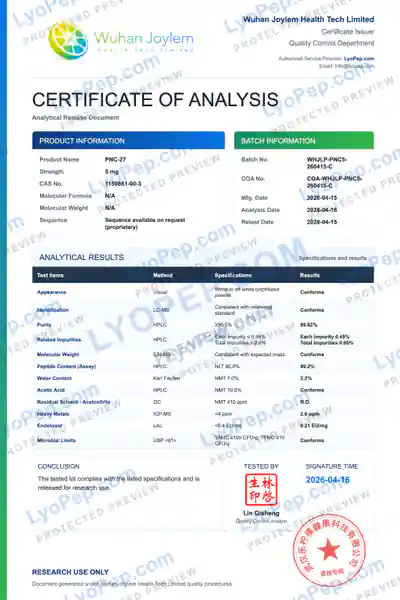
PNC-27 factory batch COAs

Representative records, refreshed periodically

Published COAs show representative factory batches and may not be the latest available. For a current quote or shipment, our sales team can confirm the applicable lot and provide its COA.

Independent testing, arranged on request

Third-party reports are not routinely published. If independent verification is required, we can agree the laboratory, method, acceptance criteria and remedy before testing. If the agreed specification is not met, an appropriate resolution—including a refund where applicable—can be discussed under the agreed terms. Unless otherwise agreed in writing, the buyer pays the cost of this optional testing.

Help reviewing your COA

Need help reading a factory COA or third-party report? Our sales team can clarify test items, specifications and how the results relate to the lot under discussion.

Ask for the current packet, not a generic certificate

  • Require a batch-specific COA that states the exact peptide form, sequence, molecular mass, counterion, purity method and net peptide content
  • Confirm identity by an orthogonal mass-spectrometric method rather than relying on HPLC purity alone
  • For material intended for cell-based work, define laboratory-appropriate endotoxin and bioburden limits and request the corresponding released-lot results
  • Review residual solvents, water content and counterion content when they affect assay concentration
  • Reject undocumented sterility claims and any claim that research-grade material is suitable for human use
  • Match CAS 1159861-00-3 and PubChem CID 16201774 to the 32-residue free-peptide sequence while confirming the supplied form on the COA.
Released-batch COARP-HPLC result and method contextIdentity result appropriate to the moleculeWater / counter-ion context where relevantSDS and handling statementAdditional testing scoped on request

Available fills

Quote the fill and pack configuration you need

Reference SKUFillBase pack
PNC27-5MG5 mg10 vials

Handling

Storage in the lab and temperature during transit are different decisions

Follow the released-lot COA and supplier instructions. Unless the batch documentation states otherwise, keep lyophilized material sealed, desiccated and protected from light at or below -20°C; avoid repeated freeze-thaw cycles after reconstitution and define solution stability in the laboratory's validated protocol.

State destination, season, acceptable transit exposure and whether your protocol requires insulated or cold-chain service. Additional temperature-control cost is quoted explicitly.

Buyer FAQ

Terms to settle before the purchase order

Can a buyer arrange third-party testing?+

Yes. Testing must be performed by a mutually accepted, established specialist laboratory. Fee allocation, specification, sampling, method and acceptance rule must be agreed before testing; if an agreed independent result shows nonconformance, the remedy follows the signed order terms. Unless otherwise agreed in writing, the buyer pays the cost of this optional testing.

Does HPLC purity prove peptide content?+

No. Chromatographic purity describes the relative peak profile under a stated method. Identity, water, counter-ion, residual solvents and assay/content may require separate methods.

Is cold-chain shipping always required?+

Not always. Heat can accelerate degradation, especially during summer and long transit. Cold-chain reduces exposure but raises cost. State the destination and stability risk so the right service can be quoted.

How are payment terms handled?+

Available methods and milestones depend on order value, destination and project type. The pro forma invoice should state currency, bank details, fees, payment milestones and the release condition.

Why must the testing laboratory understand peptide chemistry?+

Free-base and salt forms, hydrophilic and hydrophobic sequences, aggregation and adsorption can change sample preparation and method suitability. Use a laboratory experienced with the molecule class.

These are buyer-qualification references, not claims that this RUO material is regulated, certified or released under those frameworks. Applicability depends on the buyer's workflow and jurisdiction.

Selected sources

Literature behind the research context

  • 1) Sarafraz-Yazdi E, et al. Anticancer peptide PNC-27 adopts an HDM-2-binding conformation and kills cancer cells by binding to HDM-2 in their membranes. Proceedings of the National Academy of Sciences. 2010;107(5). PMID 20080680; PMCID PMC2836618; doi:10.1073/pnas.0909364107. 2) Bowne WB, et al. The anti-cancer peptide, PNC-27, induces tumor cell lysis as the intact peptide. Annals of Surgical Oncology. 2010. PMID 20182728. 3) Davitt K, et al. The anti-cancer peptide, PNC-27, induces tumor cell necrosis of a poorly differentiated non-solid tissue human leukemia cell line that depends on expression of HDM-2 in the plasma membrane of these cells. Annals of Clinical and Laboratory Science. 2014;44(3):241-248. PMID 25117093. 4) Alagkiozidis I, et al. Synergy between Paclitaxel and Anti-Cancer Peptide PNC-27 in the Treatment of Ovarian Cancer. Annals of Clinical and Laboratory Science. 2017;47(3):271-281. PMID 28667027. 5) Aguon PM, et al. Experimental PNC-27 Therapy and Massive GI Hemorrhage: A Complication or Coincidence? American Journal of Gastroenterology. 2017;112:S1035-S1036. doi:10.14309/00000434-201710001-01880. 6) Kandel ES, et al. Targeting cell membrane HDM2: A novel therapeutic approach for acute myeloid leukemia. Leukemia. 2019. PMID 31337857. 7) Pincus MR, et al. PNC-27, a Chimeric p53-Penetratin Peptide Binds to HDM-2 in a p53 Peptide-like Structure, Induces Selective Membrane-Pore Formation and Leads to Cancer Cell Lysis. Biomolecules. 2022;12(5):684. PMID 35625682; PMCID PMC9138867. 8) Krzesaj P, et al. Anti-Cancer Peptide PNC-27 Kills Cancer Cells by Unique Interactions with Plasma Membrane-Bound hdm-2 and with Mitochondrial Membranes Causing Mitochondrial Disruption. Annals of Clinical and Laboratory Science. 2024;54(2):137-148. PMID 38802154.
  1. 01

    Anticancer peptide PNC-27 adopts an HDM-2-binding conformation and kills cancer cells by binding to HDM-2 in their membranes

    Proceedings of the National Academy of Sciences of the USA (PNAS) · 2010 · peer-reviewed original research

    Open source
  2. 02

    The anti-cancer peptide, PNC-27, induces tumor cell lysis as the intact peptide

    Cancer Chemotherapy and Pharmacology · 2010 · peer-reviewed original research

    Open source
  3. 03

    PNC-27, a Chimeric p53-Penetratin Peptide Binds to HDM-2 in a p53 Peptide-like Structure, Induces Selective Membrane-Pore Formation and Leads to Cancer Cell Lysis

    Biomedicines · 2022 · peer-reviewed original research

    Open source
  4. 04

    Anti-Cancer Peptide PNC-27 Kills Cancer Cells by Unique Interactions with Plasma Membrane-Bound hdm-2 and with Mitochondrial Membranes Causing Mitochondrial Disruption

    Annals of Clinical and Laboratory Science · 2024 · peer-reviewed original research

    Open source
  5. 05

    PNC-27 Kills Cervical Cancer Cells but Not Untransformed Cervical Cells, an Effect that is Enhanced by Ketone Bodies

    Medical Research Archives · 2025 · peer-reviewed original research

    Open source
  6. 06

    Ex vivo Efficacy of Anti-Cancer Drug PNC-27 in the Treatment of Patient-Derived Epithelial Ovarian Cancer

    Annals of Clinical and Laboratory Science · 2015 · peer-reviewed original research

    Open source
  7. 07

    The anti-cancer peptide, PNC-27, induces tumor cell necrosis of a poorly differentiated non-solid tissue human leukemia cell line that depends on expression of HDM-2 in the plasma membrane of these cells

    Annals of Clinical and Laboratory Science · 2014 · peer-reviewed original research

    Open source
  8. 08

    FDA warns cancer patients not to use PNC-27 products for treatment

    U.S. Food and Drug Administration · 2017 · regulatory document (FDA consumer safety warning)

    Open source

Product FAQ

Questions buyers ask about PNC-27

What's the design rationale for PNC-27's two-domain structure?+

PNC-27's N-terminal segment corresponds to p53 residues 12-26 and provides the HDM-2-binding domain. Its C-terminal membrane-residency peptide is derived from the Drosophila Antennapedia penetratin sequence. Published cell studies indicate that the intact chimera is required for selective membrane-pore formation; neither isolated domain reproduced the full peptide's lytic effect.

Why does PNC-27 selectively affect cancer cells over normal cells?+

The proposed selectivity depends on membrane-associated HDM-2 in the tested tumor models. PNC-27-HDM-2 complexes were observed around membrane pores in cancer cells, whereas the tested untransformed fibroblasts did not form pores. This is a preclinical model-specific finding, not evidence that every tumor will respond or that normal human tissues are universally unaffected.