Recent Confirmed OrdersLast 7 days
United States11.8 gGHK-Cu 100 mg · Semaglutide 50 mg · AOD-9604 10 mg · Ipamorelin 10 mg · CJC-1295 + Ipamorelin 10 mg · Bacteriostatic Water 10 ml
View all

Other research materials

EPO

Recombinant erythropoietin glycoprotein · exact molecular product and potency must be qualified

Multi-attribute lot release; require identity, glycan/charge profile, aggregates/fragments, content, process impurities and qualified bioactivity rather than one HPLC percentage · target, verify batch COACAS 11096-26-7RUO
Research statusEpoetin is approved in specific finished medicines; this material is Research Use Only reference context · supplied material is RUO
Supplied formRecombinant 165-residue, multiply glycosylated erythropoiesis-stimulating protein
Lead timeConfirmed with quote
EPO — Lot- and formulation-specific material; confirm physical form, colour and container on the released-batch COA
EPO — Lot- and formulation-specific material; confirm physical form, colour and container on the released-batch COA · Representative packaging image · verify the ordered lot
Representative packaging image · verify the ordered lot

Decision summary

Key benefits

  • Research relevance includes EPOR signaling, erythroid-progenitor biology, hypoxia pathways, glycoprotein characterization, potency assays and anti-doping analytical methods
  • Clinical efficacy and performance effects are not product benefits of this RUO lot.
Published research context is presented for literature orientation only. It is not a dosing, treatment or human-use instruction.
Qualification data

Specifications to confirm against the released lot

CAS
11096-26-7
Formula
C809H1301N229O240S5 and 18,236.06 Da describe the 165-residue polypeptide sequence in the USP monograph; mature epoetin is a heterogeneous glycoprotein, so one empirical formula does not represent its glycans. Confirm construct, expression system, glycoform and sialylation profile, content and cell-based potency for the released lot.
Molecular weight
Component-specific; no single molecular weight
Appearance
Lot- and formulation-specific material; confirm physical form, colour and container on the released-batch COA
Purity
Multi-attribute lot release; require identity, glycan/charge profile, aggregates/fragments, content, process impurities and qualified bioactivity rather than one HPLC percentage · target, verify batch COA
Storage
Follow the released-lot COA, manufacturer stability instructions and qualified cold-chain plan. Avoid freezing, agitation and unvalidated excursions where specified; exact requirements depend on the formulation and container.
MOQ
On request
Lead time
Confirmed with quote

Qualification matrix

Identity, purity and content are separate release questions.

Identity

Confirm the stated molecule and supplied form. Start with the matching batch COA; request sequence-level evidence only when the buyer's written procedure requires it and availability or a separate scope has been agreed.

Purity

Review RP-HPLC method conditions, wavelength, integration and related-peak handling. A percentage without the method is not enough.

Content

Net peptide content is not the same as gross lyophilized powder weight. Ask which assay supports the stated amount and whether water/counter-ion is addressed.

Stability

Define long-term storage and transit exposure separately. Cold-chain can be quoted when the buyer’s risk assessment requires it and adds cost.

Research context

What researchers study about EPO

Erythropoietin is an endogenous glycoprotein hormone, and epoetins are recombinant erythropoiesis-stimulating biologics. Approved labels apply to specific finished medicines. An RUO EPO lot requires exact product identity, expression-system, glycoform, aggregate, potency and microbiological qualification and is subject to strict end-use and anti-doping controls.

  • EPOR signaling, erythropoiesis and hypoxia research, glycoprotein analytical and bioactivity method development, reference-lot qualification and anti-doping detection research
  • These are research applications, not clinical indications.

Mechanism context

The question the literature is testing

EPO binding activates EPOR-associated JAK2 and downstream STAT5, PI3K/Akt and MAPK signaling in erythroid progenitors. Proposed nonhematopoietic receptor mechanisms remain debated. Activity is sensitive to construct, glycosylation, sialylation, aggregates and assay design and must be measured for the released lot.

Evidence map

Research routes and exposure context

Evidence tierApproved finished-product context
Routes reported in sources
No administration route applies
Dose / exposure contextProtocol-specific; verify the cited primary source
Routes and exposure contexts summarize cited studies or approved finished-product labels. They are not instructions for administering this RUO material; no customer dose is provided.

Evidence boundaries

Compatibility, limitations and decision context

  • Not for human or veterinary use
  • Approved ESAs carry serious boxed warnings, including thromboembolic, cardiovascular, mortality, tumor-progression and antibody-mediated PRCA risks in defined clinical contexts
  • EPO is prohibited at all times under WADA S2.1.1
  • Follow the SDS, institutional biologics controls and end-use restrictions.

Interactions reported in the literature

  • Not applicable as patient, athlete or veterinary advice
  • No iron, androgen, HIF-pathway or other combination guidance is provided.
Literature context is not a supplier release result or human-use instruction. Follow your institution's approved laboratory risk assessment.

Factory batch documentation

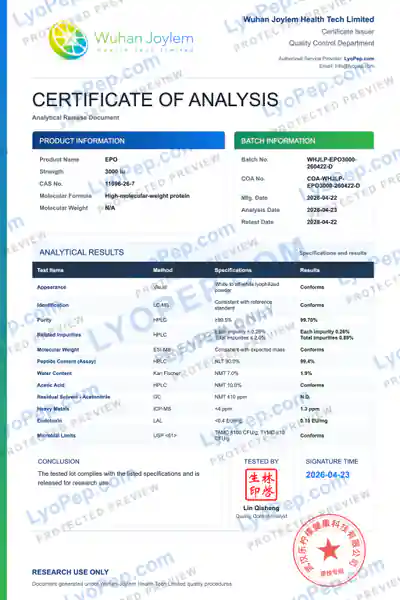
EPO factory batch COAs

Representative records, refreshed periodically

Published COAs show representative factory batches and may not be the latest available. For a current quote or shipment, our sales team can confirm the applicable lot and provide its COA.

Independent testing, arranged on request

Third-party reports are not routinely published. If independent verification is required, we can agree the laboratory, method, acceptance criteria and remedy before testing. If the agreed specification is not met, an appropriate resolution—including a refund where applicable—can be discussed under the agreed terms. Unless otherwise agreed in writing, the buyer pays the cost of this optional testing.

Help reviewing your COA

Need help reading a factory COA or third-party report? Our sales team can clarify test items, specifications and how the results relate to the lot under discussion.

Ask for the current packet, not a generic certificate

  • Require exact molecular product and expression system, peptide mapping or sequence confirmation, intact/subunit mass as appropriate, glycan and sialylation profile, charge variants, SEC aggregates/fragments, content, cell-based potency, endotoxin, host-cell proteins/DNA where relevant and cold-chain history
  • Sterility and bioburden are separate released-lot specifications.
Released-batch COARP-HPLC result and method contextIdentity result appropriate to the moleculeWater / counter-ion context where relevantSDS and handling statementAdditional testing scoped on request

Available fills

Quote the fill and pack configuration you need

Reference SKUFillBase pack
EPO-3KIU3,000 IU10 vials

Handling

Storage in the lab and temperature during transit are different decisions

Follow the released-lot COA, manufacturer stability instructions and qualified cold-chain plan. Avoid freezing, agitation and unvalidated excursions where specified; exact requirements depend on the formulation and container.

State destination, season, acceptable transit exposure and whether your protocol requires insulated or cold-chain service. Additional temperature-control cost is quoted explicitly.

Buyer FAQ

Terms to settle before the purchase order

Can a buyer arrange third-party testing?+

Yes. Testing must be performed by a mutually accepted, established specialist laboratory. Fee allocation, specification, sampling, method and acceptance rule must be agreed before testing; if an agreed independent result shows nonconformance, the remedy follows the signed order terms. Unless otherwise agreed in writing, the buyer pays the cost of this optional testing.

Does HPLC purity prove peptide content?+

No. Chromatographic purity describes the relative peak profile under a stated method. Identity, water, counter-ion, residual solvents and assay/content may require separate methods.

Is cold-chain shipping always required?+

Not always. Heat can accelerate degradation, especially during summer and long transit. Cold-chain reduces exposure but raises cost. State the destination and stability risk so the right service can be quoted.

How are payment terms handled?+

Available methods and milestones depend on order value, destination and project type. The pro forma invoice should state currency, bank details, fees, payment milestones and the release condition.

Why must the testing laboratory understand peptide chemistry?+

Free-base and salt forms, hydrophilic and hydrophobic sequences, aggregation and adsorption can change sample preparation and method suitability. Use a laboratory experienced with the molecule class.

These are buyer-qualification references, not claims that this RUO material is regulated, certified or released under those frameworks. Applicability depends on the buyer's workflow and jurisdiction.

Selected sources

Literature behind the research context

  • Regulatory and safety context: FDA EPOGEN/epoetin alfa information and DailyMed. Evidence: EPOR signaling review, CHOIR, TREAT, the cancer meta-analysis, ASCO/ASH guideline and Cochrane review. Anti-doping: 2026 WADA Prohibited List and USADA education. Related ESA studies are class context, not direct lot evidence.
  1. 01

    The Erythropoietin Receptor: Molecular Structure and Hematopoietic Signaling Pathways

    Journal of Investigative Medicine · 2011 · peer-reviewed review article

    Open source
  2. 02

    Correction of Anemia with Epoetin Alfa in Chronic Kidney Disease

    New England Journal of Medicine · 2006 · randomized controlled trial (landmark)

    Open source
  3. 03

    A Trial of Darbepoetin Alfa in Type 2 Diabetes and Chronic Kidney Disease

    New England Journal of Medicine · 2009 · randomized controlled trial (landmark)

    Open source
  4. 04

    Recombinant Human Erythropoiesis-Stimulating Agents and Mortality in Patients with Cancer: A Meta-Analysis of Randomised Trials

    The Lancet · 2009 · meta-analysis of randomized controlled trials

    Open source
  5. 05

    Management of Cancer-Associated Anemia With Erythropoiesis-Stimulating Agents: ASCO/ASH Clinical Practice Guideline Update

    Journal of Clinical Oncology (also co-published in Blood Advances) · 2019 · joint clinical practice guideline (ASCO/ASH)

    Open source
  6. 06

    Erythropoiesis-Stimulating Agents for Anaemia in Adults With Chronic Kidney Disease: A Network Meta-Analysis

    Cochrane Database of Systematic Reviews · 2023 · Cochrane systematic review / network meta-analysis (updated 2023, supersedes 2014 pub2 version)

    Open source
  7. 07

    Erythropoietin: A Personal Alice in Wonderland Trip in the Shadow of the Giants

    Biomolecules · 2024 · historical review (peer-reviewed)

    Open source
  8. 08

    Efficacy of Erythropoietin as a Neuroprotective Agent in CKD-Associated Cognitive Dysfunction: A Literature Systematic Review

    Pharmacological Research · 2024 · systematic review (peer-reviewed)

    Open source

Product FAQ

Questions buyers ask about EPO

Why can EPO not be qualified by CAS and HPLC purity alone?+

Epoetin is a glycoprotein biologic. Expression system, amino-acid construct, glycan and sialylation distribution, charge variants, aggregates, fragments and cell-based potency all affect identity and behavior. Procurement therefore requires orthogonal structural, glycan, purity and bioactivity data for the released lot.

Are epoetin alfa, darbepoetin and CERA interchangeable?+

No. They are related erythropoiesis-stimulating agents but differ in sequence, glycosylation or conjugation and pharmacological properties. Each must be identified and characterized as its exact molecular product; class-level literature does not establish lot equivalence.