Recent Confirmed OrdersLast 7 days
Australia2 gTirzepatide 100 mg · CagriSema 20 mg · BPC-157 10 mg · TB-500 5 mg · Melanotan II 10 mg · PT-141 10 mg · Bacteriostatic Water 3 ml
View all

Hormonal research

PT-141

Bremelanotide · cyclic melanocortin-receptor agonist reference material

≥ 99.0% · target, verify batch COACAS 189691-06-3RUO
Research statusApproved Active Moiety in a Specific Finished Drug / This SKU Is Research Use Only reference context · supplied material is RUO
Supplied formHeptapeptide (cyclic, lactam-bridged)
Lead time10–18 days
PT-141 — White to off-white lyophilized powder
PT-141 — White to off-white lyophilized powder · Representative packaging image · verify the ordered lot
Representative packaging image · verify the ordered lot

Decision summary

Key benefits

  • The defensible B2B value is a form-defined analytical or research material for melanocortin-receptor assays, ligand-binding and signalling studies, identity and impurity method development, formulation compatibility and controlled preclinical models
  • Pivotal trials support only the labelled finished drug and population, with modest absolute efficacy differences and substantial nausea
  • Early male or intranasal studies do not create an approved indication or a claim for this SKU.
Published research context is presented for literature orientation only. It is not a dosing, treatment or human-use instruction.
Qualification data

Specifications to confirm against the released lot

CAS
189691-06-3
Formula
C50H68N14O10 (free base)
Molecular weight
approximately 1025.2 g/mol
Appearance
White to off-white lyophilized powder
Purity
≥ 99.0% · target, verify batch COA
Storage
Follow lot-specific stability data for the declared free-base or acetate material. Protect from light and moisture and verify temperature-excursion, oxidation, deamidation, hydrolysis, adsorption and aggregate controls. The room-temperature instruction for Vyleesi's formulated prefilled autoinjector cannot establish storage or solution hold time for a lyophilized RUO vial.
MOQ
On request
Lead time
10–18 days
PubChem CID 9941379

Qualification matrix

Identity, purity and content are separate release questions.

Identity

Confirm the stated molecule and supplied form. Start with the matching batch COA; request sequence-level evidence only when the buyer's written procedure requires it and availability or a separate scope has been agreed.

Purity

Review RP-HPLC method conditions, wavelength, integration and related-peak handling. A percentage without the method is not enough.

Content

Net peptide content is not the same as gross lyophilized powder weight. Ask which assay supports the stated amount and whether water/counter-ion is addressed.

Stability

Define long-term storage and transit exposure separately. Cold-chain can be quoted when the buyer’s risk assessment requires it and adds cost.

Research context

What researchers study about PT-141

Bremelanotide is a synthetic N-acetylated cyclic heptapeptide melanocortin-receptor agonist related to alpha-MSH analogues. FDA approved Vyleesi, a defined bremelanotide-acetate injection, in 2019 for a limited acquired, generalized HSDD population. That approval applies to the sponsor's finished formulation and device; it does not approve generic PT-141 powder, male use, performance enhancement or other routes. The RUO page therefore uses the label as evidence context and identity support, not as administration guidance.

  • Appropriate work includes receptor-binding and functional signalling assays, structure-activity research, cyclic-peptide identity and stereochemical methods, free-base/acetate equivalence, impurity and degradation profiling, formulation compatibility and controlled preclinical models
  • HSDD treatment is an indication of Vyleesi only; male erectile dysfunction, postmenopausal use, sexual-performance enhancement, appetite effects and self-injection are not approved or validated uses of this SKU.

Mechanism context

The question the literature is testing

Bremelanotide is a melanocortin-receptor agonist with activity at multiple receptor subtypes. The current FDA label states that the mechanism by which it improves HSDD is unknown. MC4R-centred hypotheses and neuroimaging findings can guide research, but they do not establish single-receptor selectivity, eliminate MC1R-related pigmentation risk or prove a complete central signalling pathway.

Evidence map

Research routes and exposure context

Evidence tierApproved finished-product context
Routes reported in sources
Inhaled / nebulized
Dose / exposure contextProtocol-specific; verify the cited primary source
Routes and exposure contexts summarize cited studies or approved finished-product labels. They are not instructions for administering this RUO material; no customer dose is provided.

Evidence boundaries

Compatibility, limitations and decision context

  • This RUO material has no human safety qualification
  • The approved Vyleesi label includes transient blood-pressure increases and heart-rate reduction, contraindications for uncontrolled hypertension or known cardiovascular disease, focal hyperpigmentation that may not resolve, nausea, flushing, injection-site reactions, headache and vomiting, plus reproductive-use limitations
  • Those risks contradict claims that PT-141 has no cardiovascular or pigmentation effects
  • Chemical purity cannot establish sterile-drug safety, and this vial must not be used as a substitute for the prescription product.

Interactions reported in the literature

  • In finished-product labelling, bremelanotide may slow gastric emptying and alter absorption of oral medicines, and can significantly reduce systemic exposure to orally administered naltrexone
  • These are clinical label facts, not combination instructions for RUO powder
  • For laboratory work, evaluate buffer, pH, counterion, surfaces, proteases, oxidants and receptor-assay controls; no validated compatibility matrix exists for mixing this material with PDE5 inhibitors, melanocortin analogues, hormones or other peptides.
Literature context is not a supplier release result or human-use instruction. Follow your institution's approved laboratory risk assessment.

Factory batch documentation

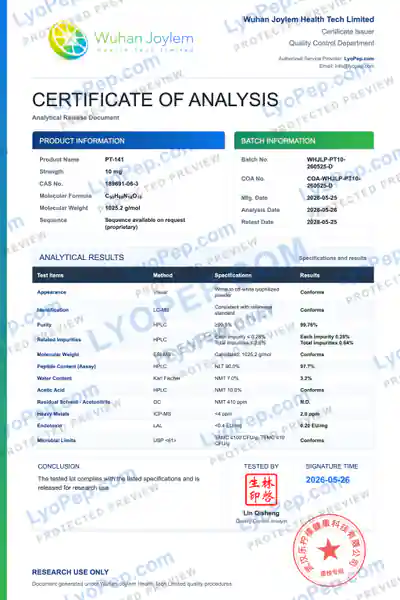
PT-141 factory batch COAs

Representative records, refreshed periodically

Published COAs show representative factory batches and may not be the latest available. For a current quote or shipment, our sales team can confirm the applicable lot and provide its COA.

Independent testing, arranged on request

Third-party reports are not routinely published. If independent verification is required, we can agree the laboratory, method, acceptance criteria and remedy before testing. If the agreed specification is not met, an appropriate resolution—including a refund where applicable—can be discussed under the agreed terms. Unless otherwise agreed in writing, the buyer pays the cost of this optional testing.

Help reviewing your COA

Need help reading a factory COA or third-party report? Our sales team can clarify test items, specifications and how the results relate to the lot under discussion.

Ask for the current packet, not a generic certificate

  • The COA must state free base versus acetate, acetate stoichiometry and assay on a free-base or as-is basis
  • Require high-resolution intact mass, MS/MS or mapping, sequence and ring-closure confirmation, D-Phe stereochemical control, N-terminal acetylation, C-terminal free acid, chromatographic purity and identified impurity profile, peptide content, acetate, water, residual solvents, elemental impurities, counterion and mass balance, plus lot stability
  • If a buyer needs bioburden or endotoxin limits for a non-administration assay, they must be specified separately; neither test establishes sterility or human-use suitability.
Released-batch COARP-HPLC result and method contextIdentity result appropriate to the moleculeWater / counter-ion context where relevantSDS and handling statementAdditional testing scoped on request

Available fills

Quote the fill and pack configuration you need

Reference SKUFillBase pack
PT141-10MG10 mg10 vials

Handling

Storage in the lab and temperature during transit are different decisions

Follow lot-specific stability data for the declared free-base or acetate material. Protect from light and moisture and verify temperature-excursion, oxidation, deamidation, hydrolysis, adsorption and aggregate controls. The room-temperature instruction for Vyleesi's formulated prefilled autoinjector cannot establish storage or solution hold time for a lyophilized RUO vial.

State destination, season, acceptable transit exposure and whether your protocol requires insulated or cold-chain service. Additional temperature-control cost is quoted explicitly.

Buyer FAQ

Terms to settle before the purchase order

Can a buyer arrange third-party testing?+

Yes. Testing must be performed by a mutually accepted, established specialist laboratory. Fee allocation, specification, sampling, method and acceptance rule must be agreed before testing; if an agreed independent result shows nonconformance, the remedy follows the signed order terms. Unless otherwise agreed in writing, the buyer pays the cost of this optional testing.

Does HPLC purity prove peptide content?+

No. Chromatographic purity describes the relative peak profile under a stated method. Identity, water, counter-ion, residual solvents and assay/content may require separate methods.

Is cold-chain shipping always required?+

Not always. Heat can accelerate degradation, especially during summer and long transit. Cold-chain reduces exposure but raises cost. State the destination and stability risk so the right service can be quoted.

How are payment terms handled?+

Available methods and milestones depend on order value, destination and project type. The pro forma invoice should state currency, bank details, fees, payment milestones and the release condition.

Why must the testing laboratory understand peptide chemistry?+

Free-base and salt forms, hydrophilic and hydrophobic sequences, aggregation and adsorption can change sample preparation and method suitability. Use a laboratory experienced with the molecule class.

These are buyer-qualification references, not claims that this RUO material is regulated, certified or released under those frameworks. Applicability depends on the buyer's workflow and jurisdiction.

Selected sources

Literature behind the research context

  • Current DailyMed labelling distinguishes bremelanotide acetate in the Vyleesi finished product from free-base molecular mass and states that the clinical mechanism is unknown. PubChem CID 9941379 supports free-base identity, formula and CAS 189691-06-3. The FDA approval package and multidisciplinary review define the limited approved indication and benefit-risk basis. Kingsberg 2019 reports the pivotal trials; Simon 2019 is an open-label extension with substantial attrition; subgroup and neuroimaging analyses remain secondary or mechanistic. No source converts Vyleesi approval into approval of this RUO powder.
  1. 01

    Bremelanotide for the Treatment of Hypoactive Sexual Desire Disorder: Two Randomized Phase 3 Trials

    Obstetrics & Gynecology · 2019 · peer-reviewed original research (pivotal RECONNECT phase 3 RCTs)

    Open source
  2. 02

    Long-Term Safety and Efficacy of Bremelanotide for Hypoactive Sexual Desire Disorder

    Obstetrics & Gynecology · 2019 · peer-reviewed original research (52-week open-label extension study)

    Open source
  3. 03

    Prespecified and Integrated Subgroup Analyses from the RECONNECT Phase 3 Studies of Bremelanotide

    Journal of Women's Health (Larchmont) · 2022 · peer-reviewed original research (integrated post-hoc subgroup analysis of pivotal trials)

    Open source
  4. 04

    Melanocortin 4 receptor agonism enhances sexual brain processing in women with hypoactive sexual desire disorder

    The Journal of Clinical Investigation · 2022 · peer-reviewed original research (randomized, double-blind, placebo-controlled crossover neuroimaging study)

    Open source
  5. 05

    VYLEESI (bremelanotide injection) Prescribing Information

    DailyMed · 2025 · current U.S. prescription-drug label

    Open source
  6. 06

    Vyleesi NDA 210557 Approval Package

    FDA Drugs@FDA · 2019 · U.S. government approval record

    Open source
  7. 07

    Vyleesi Multi-Discipline Review and Evaluation

    FDA Center for Drug Evaluation and Research · 2019 · U.S. government scientific benefit-risk review

    Open source
  8. 08

    PubChem Compound Summary: Bremelanotide

    PubChem · 2026 · authoritative chemical identity database

    Open source

Product FAQ

Questions buyers ask about PT-141

How does PT-141 differ from Melanotan II in receptor selectivity?+

Bremelanotide and Melanotan II are related cyclic melanocortin analogues, but neither should be described as acting at only one receptor. Bremelanotide has activity across melanocortin receptors, and the FDA label states that its mechanism for improving HSDD is unknown. Focal hyperpigmentation and transient blood-pressure increases are labelled bremelanotide risks, so receptor shorthand cannot be used to claim that this material lacks MC1R-related or cardiovascular effects.