Recent Confirmed OrdersLast 7 days
Australia520 mgTirzepatide 40 mg · Semaglutide 2 mg · Dihexa 10 mg
View all

Hormonal research

ACTH (1-39)

Full-length corticotropin research peptide · species sequence, supplied form and released-batch identity must be explicit

Lot-specific released result; request peptide mapping, intact mass, stability-indicating purity and quantitative content · target, verify batch COACAS 12279-41-3RUO
Research statusEstablished biology; RUO reference material
Supplied formLinear 39-residue peptide hormone; human, porcine and rodent sequence variants exist
Lead timeConfirmed with quote
ACTH (1-39) — Lot-specific lyophilized solid; confirm colour, cake condition and physical form on the released-batch COA
ACTH (1-39) — Lot-specific lyophilized solid; confirm colour, cake condition and physical form on the released-batch COA · Representative packaging image · verify the ordered lot
Representative packaging image · verify the ordered lot

Decision summary

Key benefits

  • Research applications include HPA-axis biology, MC2R pharmacology, adrenal steroidogenesis, receptor structure-activity studies and comparison of full-length ACTH with defined fragments or formulation-specific corticotropin products
  • Published cell assays report high-potency MC2R agonism in appropriate MRAP-expressing systems, but assay-specific potency values are not a release claim and do not establish the activity of an untested lot.
Published research context is presented for literature orientation only. It is not a dosing, treatment or human-use instruction.
Qualification data

Specifications to confirm against the released lot

CAS
12279-41-3
Formula
C207H308N56O58S for the stated human sequence
Molecular weight
approximately 4541 Da
Appearance
Lot-specific lyophilized solid; confirm colour, cake condition and physical form on the released-batch COA
Purity
Lot-specific released result; request peptide mapping, intact mass, stability-indicating purity and quantitative content · target, verify batch COA
Storage
Use the released lot COA, SDS and formulation-specific stability statement. Required temperature, light protection, shipping range and any post-reconstitution hold time depend on species sequence, salt or counterion, buffer, excipients, container and concentration. Do not transfer storage instructions from Acthar Gel, tetracosactide or another supplier. Because oxidation, deamidation, truncation and aggregation are relevant risks, any assigned shelf life or in-use period should be supported by stability-indicating data for the supplied form.
MOQ
On request
Lead time
Confirmed with quote

Qualification matrix

Identity, purity and content are separate release questions.

Identity

Confirm the stated molecule and supplied form. Start with the matching batch COA; request sequence-level evidence only when the buyer's written procedure requires it and availability or a separate scope has been agreed.

Purity

Review RP-HPLC method conditions, wavelength, integration and related-peak handling. A percentage without the method is not enough.

Content

Net peptide content is not the same as gross lyophilized powder weight. Ask which assay supports the stated amount and whether water/counter-ion is addressed.

Stability

Define long-term storage and transit exposure separately. Cold-chain can be quoted when the buyer’s risk assessment requires it and adds cost.

Research context

What researchers study about ACTH (1-39)

ACTH(1-39), also known as corticotropin, is the full-length 39-amino-acid endogenous peptide hormone produced by cleavage of proopiomelanocortin (POMC) in the anterior pituitary. It is the central effector of the hypothalamic-pituitary-adrenal (HPA) axis, binding melanocortin receptor 2 (MC2-R) to stimulate adrenal cortical synthesis and secretion of glucocorticoids such as cortisol. Commercial products come in human, porcine, and rat/mouse species-variant sequences, which differ mainly in the C-terminal region (around residues 26 and 31-33) and a few residues near the N-terminus; buyers should rely on the supplier's specific CAS number and sequence rather than the generic "ACTH(1-39)/Corticotropin" name to determine species origin. This product is a research-grade (RUO) reference peptide used to study HPA axis function, stress physiology, melanocortin receptor pharmacology, and adrenal cortex biology.

  • Laboratory research topics include HPA-axis physiology and stress signalling, MC2R/MRAP pharmacology, adrenal steroidogenesis, peptide degradation and sequence-variant comparisons
  • Human diagnostic testing and prescription uses of cosyntropin or repository corticotropin are outside the intended purpose of this RUO material and cannot be used as product claims.

Mechanism context

The question the literature is testing

ACTH(1-39) binds melanocortin receptor type 2 (MC2-R) on the surface of adrenal cortical cells. MC2-R is a Gs-coupled receptor that requires co-expression of the accessory protein MRAP for correct trafficking to the cell membrane. Receptor activation triggers the adenylate cyclase (AC)-cAMP-PKA signaling pathway, which phosphorylates and activates hormone-sensitive lipase (HSL) and steroidogenic acute regulatory protein (StAR), promoting cholesterol release from lipid droplets and its transport to the inner mitochondrial membrane. There, CYP11A1 (cholesterol side-chain cleavage enzyme, the rate-limiting step of steroidogenesis) converts cholesterol to pregnenolone, which is further processed into cortisol/corticosterone and other glucocorticoids (along with some mineralocorticoids and androgen precursors). PKA also phosphorylates downstream nuclear transcription factors that regulate transcription of steroidogenesis-related genes. Physiologically, ACTH secretion is driven by hypothalamic CRH and suppressed by cortisol negative feedback, producing a circadian secretion pattern.

Evidence map

Research routes and exposure context

Evidence tierAnalytical / laboratory context
Routes reported in sources
No administration route applies
Dose / exposure contextProtocol-specific; verify the cited primary source
Routes and exposure contexts summarize cited studies or approved finished-product labels. They are not instructions for administering this RUO material; no customer dose is provided.

Evidence boundaries

Compatibility, limitations and decision context

  • For laboratory research only (RUO); not for human administration, diagnosis or treatment
  • It is not equivalent to a licensed corticotropin or tetracosactide medicine
  • Handle the lyophilized material under an institution-approved chemical and biological risk assessment, using the lot SDS and suitable controls for dust and accidental contact
  • Animal work requires protocol-specific ethics approval and veterinary oversight; this catalogue does not provide an administration protocol.

Interactions reported in the literature

  • Experimental designs may compare ACTH(1-39) with CRH, glucocorticoid-feedback conditions, receptor antagonists or defined ACTH fragments
  • These are literature examples for assay design, not human drug-interaction information or combination recommendations
  • Compatibility must be demonstrated in the actual buffer, concentration, container and analytical method.
Literature context is not a supplier release result or human-use instruction. Follow your institution's approved laboratory risk assessment.

Factory batch documentation

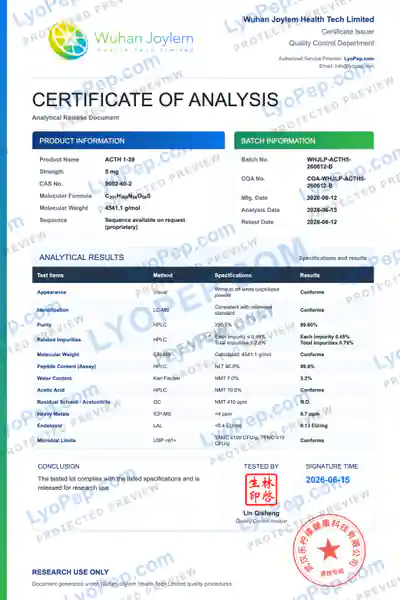
ACTH (1-39) factory batch COAs

Representative records, refreshed periodically

Published COAs show representative factory batches and may not be the latest available. For a current quote or shipment, our sales team can confirm the applicable lot and provide its COA.

Independent testing, arranged on request

Third-party reports are not routinely published. If independent verification is required, we can agree the laboratory, method, acceptance criteria and remedy before testing. If the agreed specification is not met, an appropriate resolution—including a refund where applicable—can be discussed under the agreed terms. Unless otherwise agreed in writing, the buyer pays the cost of this optional testing.

Help reviewing your COA

Need help reading a factory COA or third-party report? Our sales team can clarify test items, specifications and how the results relate to the lot under discussion.

Ask for the current packet, not a generic certificate

  • Qualify the exact species and 39-residue sequence, terminal state, salt or counterion and formulation
  • The batch package should include traceable lot identity, theoretical and measured intact mass, peptide mapping or other sequence-confirming evidence, a stability-indicating chromatographic purity and impurity profile, quantitative peptide content or assay, water and counterion data, and relevant residuals
  • Where function matters, agree a qualified MC2R/MRAP activity assay and acceptance criterion
  • Appearance or HPLC area percentage alone cannot establish sequence identity, peptide content, potency or stability.
Released-batch COARP-HPLC result and method contextIdentity result appropriate to the moleculeWater / counter-ion context where relevantSDS and handling statementAdditional testing scoped on request

Available fills

Quote the fill and pack configuration you need

Reference SKUFillBase pack
ACTH-5MG5 mg10 vials

Handling

Storage in the lab and temperature during transit are different decisions

Use the released lot COA, SDS and formulation-specific stability statement. Required temperature, light protection, shipping range and any post-reconstitution hold time depend on species sequence, salt or counterion, buffer, excipients, container and concentration. Do not transfer storage instructions from Acthar Gel, tetracosactide or another supplier. Because oxidation, deamidation, truncation and aggregation are relevant risks, any assigned shelf life or in-use period should be supported by stability-indicating data for the supplied form.

State destination, season, acceptable transit exposure and whether your protocol requires insulated or cold-chain service. Additional temperature-control cost is quoted explicitly.

Buyer FAQ

Terms to settle before the purchase order

Can a buyer arrange third-party testing?+

Yes. Testing must be performed by a mutually accepted, established specialist laboratory. Fee allocation, specification, sampling, method and acceptance rule must be agreed before testing; if an agreed independent result shows nonconformance, the remedy follows the signed order terms. Unless otherwise agreed in writing, the buyer pays the cost of this optional testing.

Does HPLC purity prove peptide content?+

No. Chromatographic purity describes the relative peak profile under a stated method. Identity, water, counter-ion, residual solvents and assay/content may require separate methods.

Is cold-chain shipping always required?+

Not always. Heat can accelerate degradation, especially during summer and long transit. Cold-chain reduces exposure but raises cost. State the destination and stability risk so the right service can be quoted.

How are payment terms handled?+

Available methods and milestones depend on order value, destination and project type. The pro forma invoice should state currency, bank details, fees, payment milestones and the release condition.

Why must the testing laboratory understand peptide chemistry?+

Free-base and salt forms, hydrophilic and hydrophobic sequences, aggregation and adsorption can change sample preparation and method suitability. Use a laboratory experienced with the molecule class.

These are buyer-qualification references, not claims that this RUO material is regulated, certified or released under those frameworks. Applicability depends on the buyer's workflow and jurisdiction.

Selected sources

Literature behind the research context

  • 1) NIH PubChem CID 90488848 reports the human ACTH(1-39) record, formula C₂₀₇H₃₀₈N₅₆O₅₈S, molecular weight approximately 4541 Da and deposited CAS 12279-41-3. The generic Corticotropin CID 16132265 is a merged record with several CAS numbers and cross-species synonyms, so it is not sufficient for ordering. 2) UniProt P01189, P01192, P01193 and P01194 provide the primary human, porcine, mouse and rat POMC sequences from which the distinct 39-residue ACTH segments are defined. 3) FDA's 2017 Federal Register determination for ACTHAR GEL SYNTHETIC states that historical seractide acetate is not sequence-identical to human corticotropin and differs at four positions. This conflicts with the deposited PubChem use of 'Seractide' under CID 90488848, so the name is treated as ambiguous. 4) PMC9290342 reports formulation-specific terminal half-lives for repository corticotropin injection and an ACTH(1-24) depot; these are not free human ACTH(1-39) values. 5) PMID 11701735 reports a median endogenous ACTH plasma half-life of 22 minutes. 6) The current DailyMed Acthar Gel label, set ID 7b48ddec-e815-45f4-9ca0-5c0daaf56f30, states an approximately 15-minute plasma half-life for intravenously administered ACTH and notes that Acthar Gel pharmacokinetics have not been adequately characterized. 7) MC2R functional-assay literature provides assay-specific potency context, not a release result for this lot. 8) Supplier technical records were used only as secondary catalogue cross-checks; consumer peptide guides were excluded.
  1. 01

    From Bioinactive ACTH to ACTH Antagonist: The Clinical Perspective

    Frontiers in Endocrinology · 2017 · peer-reviewed review

    Open source
  2. 02

    Molecular identification of melanocortin-2 receptor responsible for ligand binding and signaling

    Biochemistry · 2007 · peer-reviewed original research

    Open source
  3. 03

    ACTH Treatment for Management of Nephrotic Syndrome: A Systematic Review and Reappraisal

    International Journal of Nephrology · 2020 · systematic review

    Open source
  4. 04

    A pilot study to determine the dose and effectiveness of adrenocorticotrophic hormone (H.P. Acthar Gel) in nephrotic syndrome due to idiopathic membranous nephropathy

    Nephrology Dialysis Transplantation · 2014 · phase Ib/II clinical trial

    Open source
  5. 05

    A Systematic Literature Review and Indirect Treatment Comparison of Efficacy of Repository Corticotropin Injection versus Synthetic Adrenocorticotropic Hormone for Infantile Spasms

    Journal of Health Economics and Outcomes Research · 2021 · systematic literature review and indirect treatment comparison

    Open source
  6. 06

    A prospective observational registry of repository corticotropin injection (Acthar Gel) for the treatment of multiple sclerosis relapse

    Frontiers in Neurology · 2020 · multicenter prospective observational registry

    Open source
  7. 07

    Acthar Gel Treatment for Patients with Autoimmune and Inflammatory Diseases: An Historical Perspective and Characterization of Clinical Evidence

    Clinical Drug Investigation · 2023 · narrative review

    Open source
  8. 08

    A Narrative Review of the Immunomodulatory Effects of Acthar Gel Beyond Its Steroidogenic Properties

    Advances in Therapy · 2025 · narrative review

    Open source

Product FAQ

Questions buyers ask about ACTH (1-39)

Why is the species sequence essential when ordering ACTH(1-39)?+

Human, porcine and rodent ACTH(1-39) variants differ in sequence and may carry different CAS records. The generic name 'corticotropin' cannot resolve the material. The quotation and batch COA should state species, complete sequence, terminal state, counterion, CAS where applicable, theoretical mass and measured intact mass.

Which degradation and quality attributes should be controlled?+

Methionine oxidation, asparagine deamidation, truncation and aggregation can affect identity or function. Request a stability-indicating chromatographic method, intact mass and peptide mapping, quantitative content, water and counterion data; add a qualified functional assay when biological activity matters. A nominal HPLC area percentage does not establish potency or the correct species sequence.