Recent Confirmed OrdersLast 7 days
Australia2 gTirzepatide 100 mg · CagriSema 20 mg · BPC-157 10 mg · TB-500 5 mg · Melanotan II 10 mg · PT-141 10 mg · Bacteriostatic Water 3 ml
View all

Growth-hormone axis research

Somatropin (HGH 191 aa)

Recombinant 191-residue human growth hormone research protein · not a licensed finished medicine

Multi-attribute lot release; request protein purity, aggregate, identity, process-impurity and potency data · target, verify batch COACAS 12629-01-5RUO
Research statusSomatropin is an approved active ingredient in specific licensed prescription products; this catalogue's RUO material is not itself an FDA-approved drug product and is not interchangeable with any branded medicine. reference context · supplied material is RUO
Supplied formNonglycosylated 191-residue recombinant protein with two intramolecular disulfide bonds
Lead timeConfirmed with quote
Somatropin (HGH 191 aa) — Lot- and formulation-specific lyophilized material; confirm appearance on the released-batch COA
Somatropin (HGH 191 aa) — Lot- and formulation-specific lyophilized material; confirm appearance on the released-batch COA · Representative packaging image · verify the ordered lot
Representative packaging image · verify the ordered lot

Decision summary

Key benefits

  • In patients with correctly diagnosed growth-hormone deficiency, licensed somatropin replacement can improve growth in children and can improve body composition, bone-related measures, exercise capacity and selected quality-of-life outcomes in adults; effect size and clinical relevance vary by endpoint
  • Specific products also carry additional labelled indications, which are not uniform across brands or jurisdictions
  • Evidence from replacement therapy in deficient patients does not establish anti-aging, cosmetic, athletic-enhancement or healthy-adult body-recomposition benefit
  • Claims for improved skin, hair, immunity or general rejuvenation were removed because they were not supported as approved outcomes.
Published research context is presented for literature orientation only. It is not a dosing, treatment or human-use instruction.
Qualification data

Specifications to confirm against the released lot

CAS
12629-01-5
Formula
C990H1528N262O300S7 for native-sequence nonglycosylated somatropin
Molecular weight
Approximately 22,124-22,125 Da
Appearance
Lot- and formulation-specific lyophilized material; confirm appearance on the released-batch COA
Purity
Multi-attribute lot release; request protein purity, aggregate, identity, process-impurity and potency data · target, verify batch COA
Storage
Store and ship the supplied RUO material strictly according to its batch COA, stability statement and container-closure validation. Do not copy storage or post-reconstitution dating from a branded medicine: somatropin formulations differ in excipients, diluent, preservative, device and in-use stability. Licensed Genotropin, Omnitrope and other products must each be handled only according to their own current label; never freeze unless the specific validated documentation explicitly permits it.
MOQ
On request
Lead time
Confirmed with quote

Qualification matrix

Identity, purity and content are separate release questions.

Identity

Confirm the stated molecule and supplied form. Start with the matching batch COA; request sequence-level evidence only when the buyer's written procedure requires it and availability or a separate scope has been agreed.

Purity

Review RP-HPLC method conditions, wavelength, integration and related-peak handling. A percentage without the method is not enough.

Content

Net peptide content is not the same as gross lyophilized powder weight. Ask which assay supports the stated amount and whether water/counter-ion is addressed.

Stability

Define long-term storage and transit exposure separately. Cold-chain can be quoted when the buyer’s risk assessment requires it and adds cost.

Research context

What researchers study about Somatropin (HGH 191 aa)

Somatropin is recombinant 22 kDa human growth hormone: a nonglycosylated, single-chain protein of 191 amino acids whose sequence is identical to the principal mature pituitary GH1 product. It contains two intramolecular disulfide bonds, Cys53-Cys165 and Cys182-Cys189. The 217-residue human GH1 precursor includes a 26-residue signal peptide; removal of that signal peptide yields the 191-residue mature hormone. The historical product somatrem contains an additional N-terminal methionine and is a distinct 192-residue analogue. Somatropin can be produced in different recombinant hosts and formulated in product-specific ways. FDA approval attaches to named finished prescription products and their manufacturing controls, not to every vial or bulk material labelled 'HGH 191aa.' This catalogue item is research use only and must not be represented as a generic substitute for Genotropin, Norditropin, Omnitrope or another licensed medicine.

  • Licensed prescription somatropin products are approved for defined growth disorders or growth-hormone deficiency, but the exact indications vary by brand and jurisdiction
  • Examples across US labels include paediatric or adult growth-hormone deficiency and, for selected products, Turner syndrome, Prader-Willi syndrome, small-for-gestational-age short stature without catch-up growth, Noonan syndrome, SHOX deficiency, chronic kidney disease-associated growth failure, idiopathic short stature or HIV-associated wasting
  • No single somatropin label covers this entire list
  • This RUO listing has no approved indication and must not be marketed for anti-aging, bodybuilding, athletic enhancement or direct patient treatment.

Mechanism context

The question the literature is testing

Somatropin binds the growth-hormone receptor, promotes receptor conformational change or dimer signalling and activates JAK2-STAT pathways. It has direct metabolic effects and stimulates hepatic and local IGF-1 production, which mediates many growth-promoting effects. Pharmacokinetics are formulation-, population- and route-specific: the current Genotropin label reports a mean terminal half-life of about 0.4 hour intravenously in normal adults and about 3.0 hours subcutaneously in adults with growth-hormone deficiency, with the difference attributed to slow absorption from the injection site. These values describe licensed Genotropin studies and should not be used to infer purity, potency, bioavailability or dosing of this RUO material.

Evidence map

Research routes and exposure context

Evidence tierApproved finished-product context
Routes reported in sources
Subcutaneous
Dose / exposure contextProtocol-specific; verify the cited primary source
Routes and exposure contexts summarize cited studies or approved finished-product labels. They are not instructions for administering this RUO material; no customer dose is provided.

Evidence boundaries

Compatibility, limitations and decision context

  • This RUO material is not for human administration
  • Current licensed somatropin labels contraindicate or warn against use in acute critical illness after major surgery, trauma or respiratory failure, active malignancy, proliferative or severe non-proliferative diabetic retinopathy, closed epiphyses for growth promotion, and certain children with Prader-Willi syndrome who have severe obesity or respiratory impairment
  • Warnings include glucose intolerance or diabetes, intracranial hypertension, fluid retention, slipped capital femoral epiphysis, progression of scoliosis, pancreatitis, hypothyroidism or hypoadrenalism, hypersensitivity and neoplasm monitoring
  • The KIMS observational cohort of 15,809 treated adults with confirmed GHD found overall de novo cancer incidence comparable with the general population, but that finding applies to prescribed replacement in a diagnosed population and does not establish safety of supraphysiologic or unapproved use
  • FDA states that HGH distribution for anti-aging, bodybuilding or athletic enhancement is not authorized and is subject to the HGH-specific restrictions in section 303(e) of the FD&C Act
  • WADA's official 2026 Prohibited List places GH and its analogues under S2 as prohibited at all times, subject to the therapeutic-use-exemption framework.

Interactions reported in the literature

  • For licensed somatropin medicines, labels describe clinically relevant interactions or monitoring involving glucocorticoids, cytochrome P450-metabolized drugs, oral estrogen, insulin and other glucose-lowering therapy, and thyroid or adrenal replacement
  • Somatropin can reduce insulin sensitivity and can unmask central hypothyroidism or hypoadrenalism
  • Claims that exogenous HGH can be safely stacked with IGF-1 analogues, secretagogues, testosterone, GLP-1 medicines or other peptides were removed because controlled combination-safety evidence and product-label authorization are lacking
  • Compatibility of this RUO material with any diluent, excipient or other analyte must be established experimentally.
Literature context is not a supplier release result or human-use instruction. Follow your institution's approved laboratory risk assessment.

Factory batch documentation

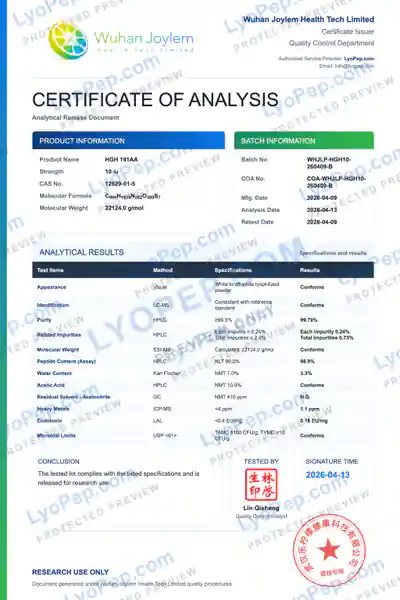
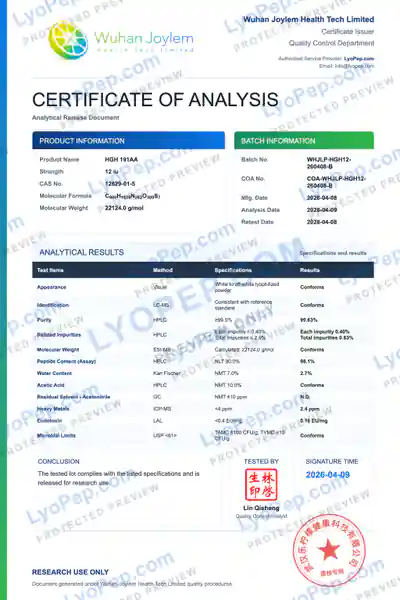
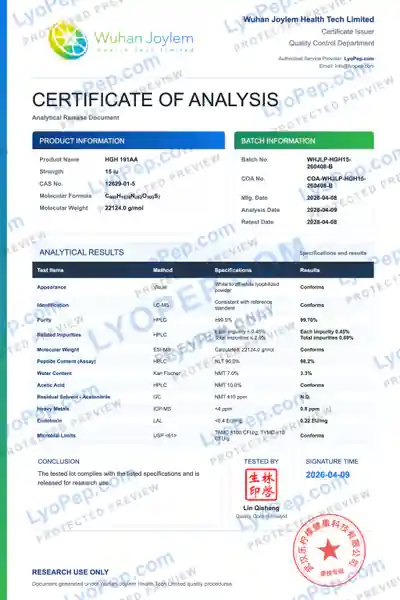
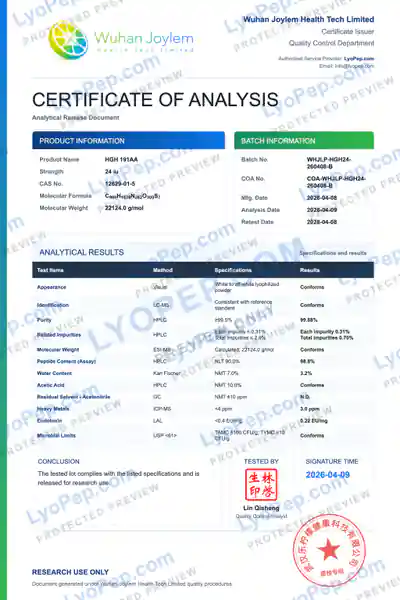
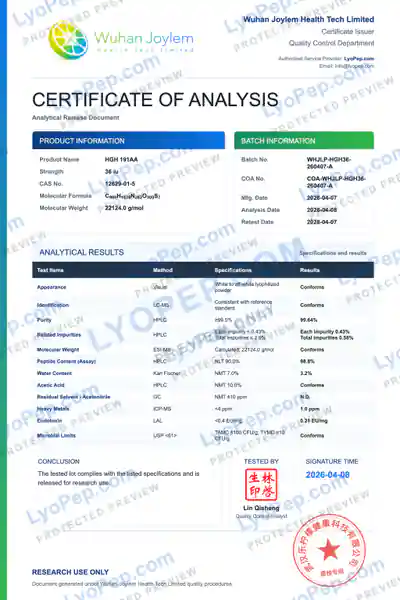
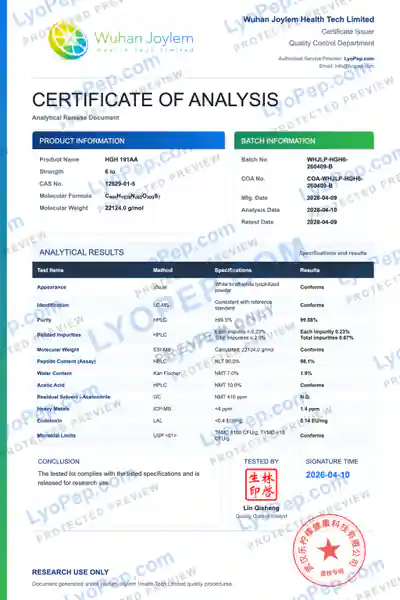
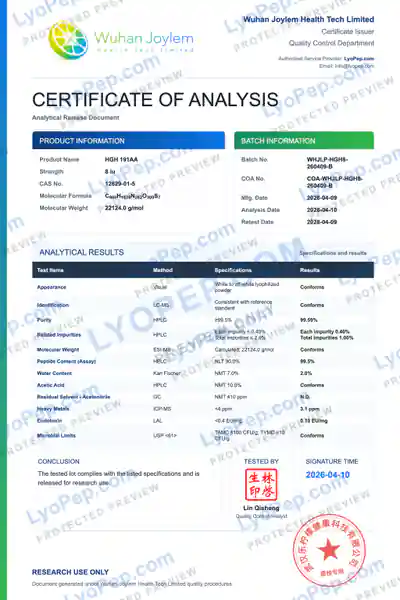
Somatropin (HGH 191 aa) factory batch COAs

Representative records, refreshed periodically

Published COAs show representative factory batches and may not be the latest available. For a current quote or shipment, our sales team can confirm the applicable lot and provide its COA.

Independent testing, arranged on request

Third-party reports are not routinely published. If independent verification is required, we can agree the laboratory, method, acceptance criteria and remedy before testing. If the agreed specification is not met, an appropriate resolution—including a refund where applicable—can be discussed under the agreed terms. Unless otherwise agreed in writing, the buyer pays the cost of this optional testing.

Help reviewing your COA

Need help reading a factory COA or third-party report? Our sales team can clarify test items, specifications and how the results relate to the lot under discussion.

Ask for the current packet, not a generic certificate

  • Somatropin is a folded protein, so a release decision requires more than RP-HPLC purity
  • Appropriate batch documentation should identify the recombinant construct and host, 191-residue sequence, intact and reduced mass, peptide map, disulfide connectivity, purity and related proteins, aggregates by a size-based method, host-cell proteins and DNA where applicable, bioburden, water or residual solvents as applicable, and a validated biological-potency assay traceable to a suitable reference standard
  • Sterility, bacterial endotoxins and visible or subvisible particles are separate finished-product attributes and must be reported only when the batch was manufactured and tested to those specifications
  • Appearance and reconstitution behaviour are formulation-specific; a white cake or clear solution does not prove identity, potency, sterility or correct folding
  • Do not use generic bacteriostatic water or copy a branded product's diluent instructions unless compatibility and in-use stability have been specifically validated for the supplied material.
Released-batch COARP-HPLC result and method contextIdentity result appropriate to the moleculeWater / counter-ion context where relevantSDS and handling statementAdditional testing scoped on request

Available fills

Quote the fill and pack configuration you need

Reference SKUFillBase pack
HGH-06IU6 IU10 vials
HGH-08IU8 IU10 vials
HGH-10IU10 IU10 vials
HGH-12IU12 IU10 vials
HGH-15IU15 IU10 vials
HGH-24IU24 IU10 vials
HGH-36IU36 IU10 vials

Handling

Storage in the lab and temperature during transit are different decisions

Store and ship the supplied RUO material strictly according to its batch COA, stability statement and container-closure validation. Do not copy storage or post-reconstitution dating from a branded medicine: somatropin formulations differ in excipients, diluent, preservative, device and in-use stability. Licensed Genotropin, Omnitrope and other products must each be handled only according to their own current label; never freeze unless the specific validated documentation explicitly permits it.

State destination, season, acceptable transit exposure and whether your protocol requires insulated or cold-chain service. Additional temperature-control cost is quoted explicitly.

Buyer FAQ

Terms to settle before the purchase order

Can a buyer arrange third-party testing?+

Yes. Testing must be performed by a mutually accepted, established specialist laboratory. Fee allocation, specification, sampling, method and acceptance rule must be agreed before testing; if an agreed independent result shows nonconformance, the remedy follows the signed order terms. Unless otherwise agreed in writing, the buyer pays the cost of this optional testing.

Does HPLC purity prove peptide content?+

No. Chromatographic purity describes the relative peak profile under a stated method. Identity, water, counter-ion, residual solvents and assay/content may require separate methods.

Is cold-chain shipping always required?+

Not always. Heat can accelerate degradation, especially during summer and long transit. Cold-chain reduces exposure but raises cost. State the destination and stability risk so the right service can be quoted.

How are payment terms handled?+

Available methods and milestones depend on order value, destination and project type. The pro forma invoice should state currency, bank details, fees, payment milestones and the release condition.

Why must the testing laboratory understand peptide chemistry?+

Free-base and salt forms, hydrophilic and hydrophobic sequences, aggregation and adsorption can change sample preparation and method suitability. Use a laboratory experienced with the molecule class.

These are buyer-qualification references, not claims that this RUO material is regulated, certified or released under those frameworks. Applicability depends on the buyer's workflow and jurisdiction.

Selected sources

Literature behind the research context

  • Primary identity and product sources: FDA GSRS/PubChem SID 472423450 for somatropin, CAS 12629-01-5 and UNII NQX9KB6PCL; UniProt P01241 for the GH1 precursor and mature 191-residue sequence; FDA somatropin chemistry reviews for formula, disulfide bonds, mass and orthogonal characterization; current DailyMed Genotropin prescribing information for product description, contraindications, warnings and route-specific pharmacokinetics. Evidence and clinical context: the Endocrine Society adult-GHD guideline; Growth Hormone Research Society consensus documents; the KIMS 15,809-patient observational cohort, PMID 35368070; systematic reviews of quality-of-life and long-acting versus daily therapy; and Takala et al. 1999 for mortality in critically ill adults receiving pharmacologic-dose GH. Regulatory and compliance sources: FDA Import Alert 66-71 for unapproved HGH and section 303(e) restrictions; WADA's official 2026 Prohibited List.
  1. 01

    Evaluation and treatment of adult growth hormone deficiency: an Endocrine Society Clinical Practice Guideline

    Journal of Clinical Endocrinology & Metabolism · 2006 · clinical practice guideline (peer-reviewed, professional society)

    Open source
  2. 02

    Consensus guidelines for the diagnosis and treatment of adults with GH deficiency II

    European Journal of Endocrinology · 2007 · multi-society consensus guideline (peer-reviewed)

    Open source
  3. 03

    Long-term Safety of Growth Hormone in Adults With Growth Hormone Deficiency: Overview of 15 809 GH-Treated Patients

    Journal of Clinical Endocrinology & Metabolism · 2022 · large observational cohort study (peer-reviewed original research)

    Open source
  4. 04

    Differential effect sizes of growth hormone replacement on quality of life, well-being and health status in growth hormone deficient patients: a meta-analysis

    Health and Quality of Life Outcomes · 2005 · meta-analysis (peer-reviewed)

    Open source
  5. 05

    Efficacy, safety, and patient satisfaction of norditropin and sogroya in patients with growth hormone deficiency: a systematic review and meta-analysis of randomized controlled trials

    Endocrine · 2024 · systematic review and meta-analysis of RCTs (peer-reviewed)

    Open source
  6. 06

    Somatotropin in the treatment of growth hormone deficiency and Turner syndrome in pediatric patients: a review

    Clinical Pharmacology: Advances and Applications · 2010 · narrative review (peer-reviewed)

    Open source
  7. 07

    History of growth hormone therapy

    Indian Journal of Endocrinology and Metabolism · 2011 · historical review (peer-reviewed)

    Open source
  8. 08

    A 2024 Update on Growth Hormone Deficiency Syndrome in Adults: From Guidelines to Real Life

    Journal of Clinical Medicine · 2024 · narrative review (peer-reviewed)

    Open source

Product FAQ

Questions buyers ask about Somatropin (HGH 191 aa)

What distinguishes somatropin 191 aa from somatrem and generic 'HGH' listings?+

Somatropin corresponds to the mature 191-residue human GH sequence; somatrem has an additional N-terminal methionine and is a distinct 192-residue analogue. Generic 'HGH' or IU labelling does not establish sequence, host-cell process, folding, formulation or potency. Require the exact construct, production host and released-lot identity package.

What analytical package is appropriate for a 191-residue recombinant protein?+

Qualification should address intact mass, peptide mapping and sequence coverage, disulfide connectivity, purity and related proteins, aggregates by SEC or another suitable method, host-cell impurities, endotoxin or bioburden where relevant, and a qualified potency assay. Small-peptide HPLC purity alone is not an adequate release package for somatropin.

Does an IU-labelled fill prove equivalence to an approved somatropin product?+

No. IU is a biological-activity unit and must be tied to a stated reference standard and validated potency method. Approval belongs to a named finished product with controlled formulation, device, manufacturing process and stability data. Batch documentation for RUO material cannot be replaced by a branded product's label or storage instructions.