Recent Confirmed OrdersLast 7 days
Australia2 gTirzepatide 100 mg · CagriSema 20 mg · BPC-157 10 mg · TB-500 5 mg · Melanotan II 10 mg · PT-141 10 mg · Bacteriostatic Water 3 ml
View all

Growth-hormone axis research

Tesamorelin

N-terminally acylated GHRH analog · active ingredient in approved HIV-lipodystrophy products

≥ 99.0% · target, verify batch COACAS 218949-48-5RUO
Research statusActive ingredient in FDA-approved EGRIFTA SV and EGRIFTA WR prescription products; this catalog material is Research Use Only reference context · supplied material is RUO
Supplied form44-residue peptide (GHRH analog, N-terminally acylated with trans-3-hexenoic acid)
Lead time10–18 days
Tesamorelin — White lyophilized powder
Tesamorelin — White lyophilized powder · Representative packaging image · verify the ordered lot
Representative packaging image · verify the ordered lot

Decision summary

Key benefits

  • Published findings, not claims for this RUO material: a pooled analysis of two Phase 3 studies in 806 antiretroviral-treated adults with HIV and excess abdominal fat reported a week-26 visceral-adipose-tissue treatment effect of -15.4% versus placebo
  • A 12-month extension found an approximately 18% reduction among participants continuing treatment, while earlier improvements were rapidly lost after switching to placebo
  • The FDA indication is limited to reducing excess abdominal fat in adults with HIV and lipodystrophy; the label describes the product as weight-neutral and not indicated for weight-loss management
  • In a separate 12-month randomized study of 61 people with HIV and NAFLD, the estimated relative liver-fat reduction was 37%, but the authors called for further study and this is not an approved indication
  • Exploratory cognition and muscle-composition analyses do not establish approved benefits.
Published research context is presented for literature orientation only. It is not a dosing, treatment or human-use instruction.
Qualification data

Specifications to confirm against the released lot

CAS
218949-48-5
Formula
C221H366N72O67S
Molecular weight
5,135.9 Da
Appearance
White lyophilized powder
Purity
≥ 99.0% · target, verify batch COA
Storage
Follow the released-lot COA and supplier instructions. Unless batch documentation specifies otherwise, keep sealed lyophilized RUO tesamorelin desiccated, protected from light, and at or below -20°C; avoid repeated freeze-thaw cycles after reconstitution and establish solution stability in the receiving laboratory's validated protocol. The FDA-labelled EGRIFTA SV and WR products are distinct sterile formulations with product-specific room-temperature handling; those conditions must not be transferred to bulk RUO material.
MOQ
On request
Lead time
10–18 days
PubChem CID 16137828

Qualification matrix

Identity, purity and content are separate release questions.

Identity

Confirm the stated molecule and supplied form. Start with the matching batch COA; request sequence-level evidence only when the buyer's written procedure requires it and availability or a separate scope has been agreed.

Purity

Review RP-HPLC method conditions, wavelength, integration and related-peak handling. A percentage without the method is not enough.

Content

Net peptide content is not the same as gross lyophilized powder weight. Ask which assay supports the stated amount and whether water/counter-ion is addressed.

Stability

Define long-term storage and transit exposure separately. Cold-chain can be quoted when the buyer’s risk assessment requires it and adds cost.

Research context

What researchers study about Tesamorelin

Tesamorelin is a 44-residue synthetic analog of human growth hormone-releasing hormone (GHRH 1-44) in which the N-terminal Tyr1 is acylated with trans-3-hexenoic acid. PubChem records the free peptide as CID 16137828, CAS 218949-48-5, formula C₂₂₁H₃₆₆N₇₂O₆₇S, and molecular weight 5,135.9 Da. FDA-approved EGRIFTA SV and EGRIFTA WR contain tesamorelin as an acetate salt and are indicated specifically to reduce excess abdominal fat in adults with HIV and lipodystrophy. Their labels state that they are not indicated for weight-loss management, that long-term cardiovascular safety has not been established, and that SV and WR are not substitutable. LyoPep's catalog material is a bulk Research Use Only reference and is not the approved finished drug.

  • Evidence is strongest for the FDA-approved finished-product indication: reduction of excess abdominal fat in adults with HIV and lipodystrophy
  • Other published research includes visceral- and liver-fat imaging in people with HIV, a 12-month randomized NAFLD study in people with HIV, biomarker analyses, exploratory muscle-composition analyses, and a 20-week cognition study in 152 older adults with or without mild cognitive impairment
  • These research contexts differ in population, formulation, regimen, and outcome, and none expands the FDA indication
  • Tesamorelin is not labelled for general weight loss, anti-aging, bodybuilding, or routine treatment of NAFLD or cognitive impairment.

Mechanism context

The question the literature is testing

Tesamorelin binds and stimulates pituitary growth hormone-releasing factor receptors, promoting synthesis and pulsatile release of endogenous growth hormone (GH). GH acts through multiple tissues, with some effects mediated by insulin-like growth factor 1 (IGF-1), and can influence lipolysis and visceral adipose tissue. The N-terminal trans-3-hexenoyl group increases resistance to enzymatic degradation relative to unmodified GHRH. A short plasma half-life is compatible with a transient receptor stimulus but does not by itself establish efficacy, dose, frequency, or safety for an RUO lot.

Evidence map

Research routes and exposure context

Evidence tierApproved finished-product context
Routes reported in sources
Subcutaneous
Dose / exposure contextProtocol-specific; verify the cited primary source
Routes and exposure contexts summarize cited studies or approved finished-product labels. They are not instructions for administering this RUO material; no customer dose is provided.

Evidence boundaries

Compatibility, limitations and decision context

  • FDA-labelled contraindications include disruption of the hypothalamic-pituitary axis, active malignancy, hypersensitivity to tesamorelin or excipients, and pregnancy
  • Warnings address neoplasms, elevated IGF-1, fluid retention, glucose intolerance or diabetes, hypersensitivity, injection-site reactions, and increased mortality with pharmacologic GH exposure in acute critical illness
  • In combined 26-week studies, injection-site reactions occurred in 17% versus 6% with placebo, arthralgia in 13% versus 11%, pain in extremity in 6% versus 5%, myalgia in 6% versus 2%, and peripheral edema in 6% versus 2%
  • The label reports a hazard ratio of 3.3 (95% CI 1.4-9.6) for HbA1c reaching at least 6.5% and documents frequent IGF-1 elevations
  • Long-term cardiovascular safety has not been established
  • These prescription-label findings do not qualify a bulk RUO lot for human use.

Interactions reported in the literature

  • The FDA label states that GH may alter clearance of compounds metabolized by CYP450 enzymes and identifies glucocorticoid replacement therapy as a specific consideration; it also reports dedicated studies with simvastatin and ritonavir
  • These label observations concern the approved prescription products and require qualified clinical oversight
  • No authoritative evidence identified for this review establishes the safety or effectiveness of combining tesamorelin with ipamorelin, CJC-1295, sermorelin, exogenous GH, octreotide, or other research peptides
  • This catalog does not recommend combinations or provide medication-management advice.
Literature context is not a supplier release result or human-use instruction. Follow your institution's approved laboratory risk assessment.

Factory batch documentation

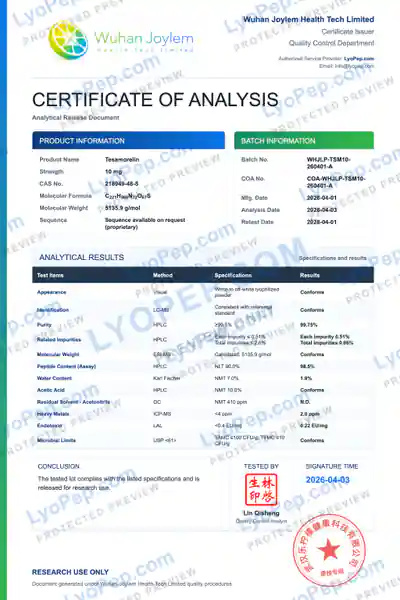
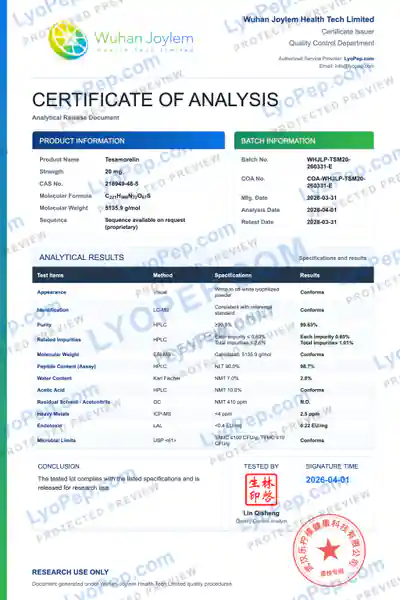
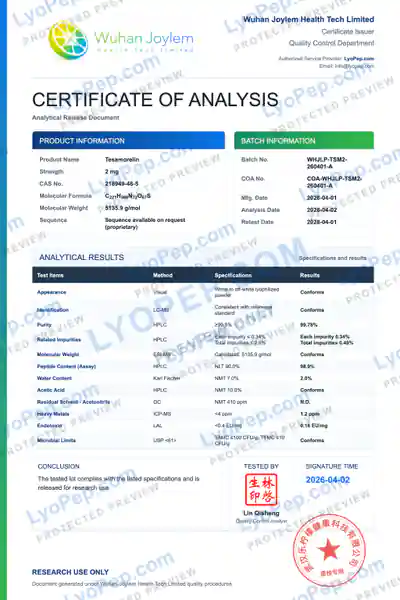
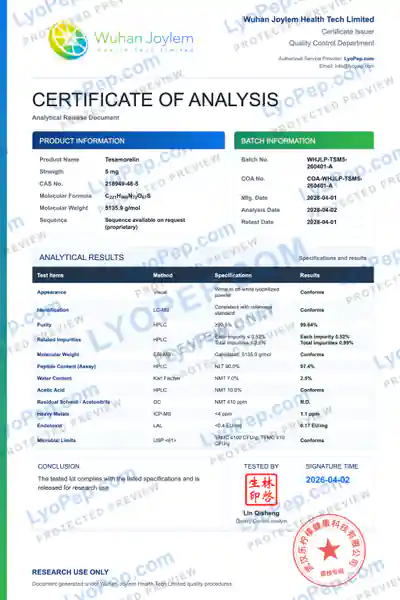
Tesamorelin factory batch COAs

Representative records, refreshed periodically

Published COAs show representative factory batches and may not be the latest available. For a current quote or shipment, our sales team can confirm the applicable lot and provide its COA.

Independent testing, arranged on request

Third-party reports are not routinely published. If independent verification is required, we can agree the laboratory, method, acceptance criteria and remedy before testing. If the agreed specification is not met, an appropriate resolution—including a refund where applicable—can be discussed under the agreed terms. Unless otherwise agreed in writing, the buyer pays the cost of this optional testing.

Help reviewing your COA

Need help reading a factory COA or third-party report? Our sales team can clarify test items, specifications and how the results relate to the lot under discussion.

Ask for the current packet, not a generic certificate

  • Require a released-lot COA specifying free peptide versus acetate salt, acetate or other counterion content, exact N-terminal trans-3-hexenoyl modification, full 44-residue sequence, theoretical and measured intact mass, identity method, chromatographic purity and impurity profile, water content, residual solvents, and net peptide assay
  • For cell or animal research, define endotoxin and bioburden acceptance criteria in the receiving laboratory's protocol
  • Analytical purity alone does not establish correct acylation, salt stoichiometry, sterility, clinical grade, or equivalence to EGRIFTA SV/WR.
Released-batch COARP-HPLC result and method contextIdentity result appropriate to the moleculeWater / counter-ion context where relevantSDS and handling statementAdditional testing scoped on request

Available fills

Quote the fill and pack configuration you need

Reference SKUFillBase pack
TESA-02MG2 mg10 vials
TESA-05MG5 mg10 vials
TESA-10MG10 mg10 vials
TESA-20MG20 mg10 vials

Handling

Storage in the lab and temperature during transit are different decisions

Follow the released-lot COA and supplier instructions. Unless batch documentation specifies otherwise, keep sealed lyophilized RUO tesamorelin desiccated, protected from light, and at or below -20°C; avoid repeated freeze-thaw cycles after reconstitution and establish solution stability in the receiving laboratory's validated protocol. The FDA-labelled EGRIFTA SV and WR products are distinct sterile formulations with product-specific room-temperature handling; those conditions must not be transferred to bulk RUO material.

State destination, season, acceptable transit exposure and whether your protocol requires insulated or cold-chain service. Additional temperature-control cost is quoted explicitly.

Buyer FAQ

Terms to settle before the purchase order

Can a buyer arrange third-party testing?+

Yes. Testing must be performed by a mutually accepted, established specialist laboratory. Fee allocation, specification, sampling, method and acceptance rule must be agreed before testing; if an agreed independent result shows nonconformance, the remedy follows the signed order terms. Unless otherwise agreed in writing, the buyer pays the cost of this optional testing.

Does HPLC purity prove peptide content?+

No. Chromatographic purity describes the relative peak profile under a stated method. Identity, water, counter-ion, residual solvents and assay/content may require separate methods.

Is cold-chain shipping always required?+

Not always. Heat can accelerate degradation, especially during summer and long transit. Cold-chain reduces exposure but raises cost. State the destination and stability risk so the right service can be quoted.

How are payment terms handled?+

Available methods and milestones depend on order value, destination and project type. The pro forma invoice should state currency, bank details, fees, payment milestones and the release condition.

Why must the testing laboratory understand peptide chemistry?+

Free-base and salt forms, hydrophilic and hydrophobic sequences, aggregation and adsorption can change sample preparation and method suitability. Use a laboratory experienced with the molecule class.

These are buyer-qualification references, not claims that this RUO material is regulated, certified or released under those frameworks. Applicability depends on the buyer's workflow and jurisdiction.

Selected sources

Literature behind the research context

  • 1) FDA and DailyMed. EGRIFTA WR prescribing information, revised March 2025, set ID 839334d3-8c1d-4c26-9036-2ab524a6ea75; NDA 022505/S-020. 2) FDA and DailyMed. EGRIFTA SV prescribing information, revised March 2024, set ID 3d783378-b02d-4f19-99dd-0fc91a042224. 3) PubChem. Tesamorelin, CID 16137828; CAS 218949-48-5; formula C221H366N72O67S. 4) Falutz J, et al. Effects of tesamorelin in HIV-infected patients with excess abdominal fat: pooled analysis of two Phase 3 trials. J Clin Endocrinol Metab. 2010. PMID 20554713. 5) Falutz J, et al. Long-term safety and effects of tesamorelin in HIV patients with abdominal fat accumulation. AIDS. 2008. PMID 18690162; doi:10.1097/QAD.0b013e32830a5058. 6) Stanley TL, et al. Effect of tesamorelin on visceral fat and liver fat in HIV-infected patients. JAMA. 2014. PMID 25038357. 7) Stanley TL, et al. Effects of tesamorelin on non-alcoholic fatty liver disease in HIV. Lancet HIV. 2019. PMID 31611038; PMCID PMC6981288; doi:10.1016/S2352-3018(19)30338-8. 8) Baker LD, et al. Effects of growth hormone-releasing hormone on cognitive function in adults with mild cognitive impairment and healthy older adults. Arch Neurol. 2012. PMID 22869065.
  1. 01

    Metabolic effects of a growth hormone-releasing factor in patients with HIV

    New England Journal of Medicine · 2007 · peer-reviewed original research (pivotal Phase 3 randomized controlled trial)

    Open source
  2. 02

    Effects of tesamorelin, a growth hormone-releasing factor, in HIV-infected patients with abdominal fat accumulation: a randomized placebo-controlled trial with a safety extension

    Journal of Acquired Immune Deficiency Syndromes (JAIDS) · 2010 · peer-reviewed original research (Phase 3 RCT with 12-month safety extension)

    Open source
  3. 03

    Effect of tesamorelin on visceral fat and liver fat in HIV-infected patients with abdominal fat accumulation: a randomized clinical trial

    JAMA · 2014 · peer-reviewed original research (randomized, double-blind, placebo-controlled trial)

    Open source
  4. 04

    Effects of tesamorelin on non-alcoholic fatty liver disease in HIV: a randomised, double-blind, multicentre trial

    The Lancet HIV · 2019 · peer-reviewed original research (randomized, double-blind, multicenter trial)

    Open source
  5. 05

    Effects of growth hormone-releasing hormone on cognitive function in adults with mild cognitive impairment and healthy older adults: results of a controlled trial

    Archives of Neurology (now JAMA Neurology) · 2012 · peer-reviewed original research (randomized, double-blind, placebo-controlled trial)

    Open source
  6. 06

    Body composition, hepatic fat, metabolic, and safety outcomes of Tesamorelin, a GHRH analogue, in HIV-associated lipodystrophy: a meta-analysis of randomized controlled trials

    Obesity Research & Clinical Practice · 2026 · systematic review and meta-analysis of randomized controlled trials

    Open source
  7. 07

    Effects of tesamorelin (TH9507), a growth hormone-releasing factor analog, in human immunodeficiency virus-infected patients with excess abdominal fat: a pooled analysis of two multicenter, double-blind placebo-controlled phase 3 trials with safety extension data

    The Journal of Clinical Endocrinology & Metabolism · 2010 · peer-reviewed original research (pooled analysis of two Phase 3 RCTs)

    Open source
  8. 08

    Full Prescribing Information — EGRIFTA WR (tesamorelin for injection), for subcutaneous use

    FDA.gov (accessdata.fda.gov, NDA 022505) · 2025 · regulatory document (FDA-approved prescribing information/label)

    Open source

Product FAQ

Questions buyers ask about Tesamorelin

How is Tesamorelin different from the other GHRH analogues?+

Tesamorelin is a 44-residue human GHRH(1-44) analog with an N-terminal trans-3-hexenoyl group. Sermorelin is a shorter GHRH(1-29) analog, while CJC-1295 variants contain different substitutions and, in some forms, a drug-affinity-complex moiety. These molecules are not interchangeable reference standards. Match the exact sequence, terminal modification, salt form, and cited study material to the batch COA.

What's the recommended analytical packet for first-time Tesamorelin qualification?+

For first-time qualification, request the released-lot HPLC chromatogram and impurity profile, intact-mass result against the theoretical mass of the stated form, LC-MS/MS coverage of the N-terminus to confirm the trans-3-hexenoyl modification, full-sequence confirmation, acetate or other counterion content, water, residual solvents, and net peptide assay. For cell or animal research, define endotoxin and microbial limits in the receiving laboratory's protocol. A ≥99.0% area result alone does not prove correct acylation, content, sterility, or equivalence to EGRIFTA.