Research statusDefined peptide with FDA-approved finished-drug formulations and extensive clinical literature; LyoPep material remains Research Use Only. reference context · supplied material is RUO
Supplied formLipidated peptide (39-mer, linear, C20 fatty-diacid-acylated via γGlu-(AEEA)2 linker on the Lys20 side chain)
Lead time10–18 days
Representative packaging image · verify the ordered lot
Decision summary
Key benefits
Research value includes dual-receptor pharmacology, biased-signaling and structure-activity comparisons, analytical qualification of lipidated peptides, formulation and stability studies, and controlled comparison with single-receptor or other multi-agonist standards
These are not claims of weight loss, glycemic control or OSA treatment for this product.
Published research context is presented for literature orientation only. It is not a dosing, treatment or human-use instruction.
Qualification data
Specifications to confirm against the released lot
CAS
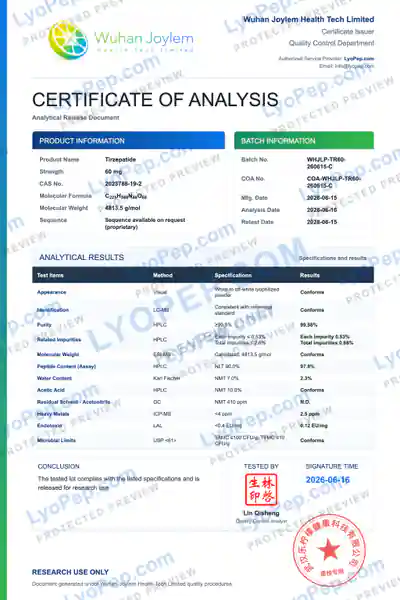
2023788-19-2
Formula
C225H348N48O68
Molecular weight
Approximately 4813 g/mol
Appearance
Lot-specific lyophilized research peptide; confirm released-lot appearance on the COA
Purity
≥ 99.0% · target, verify batch COA
Storage
Follow the released-batch storage statement and SDS. Confirm post-opening or prepared-sample stability against the laboratory's validated protocol.
Identity, purity and content are separate release questions.
Identity
Confirm the stated molecule and supplied form. Start with the matching batch COA; request sequence-level evidence only when the buyer's written procedure requires it and availability or a separate scope has been agreed.
Purity
Review RP-HPLC method conditions, wavelength, integration and related-peak handling. A percentage without the method is not enough.
Content
Net peptide content is not the same as gross lyophilized powder weight. Ask which assay supports the stated amount and whether water/counter-ion is addressed.
Stability
Define long-term storage and transit exposure separately. Cold-chain can be quoted when the buyer’s risk assessment requires it and adds cost.
Research context
What researchers study about Tirzepatide
Tirzepatide is a 39-residue synthetic peptide with two Aib residues, a C-terminal amide and a C20 fatty-diacid albumin-binding moiety attached through a gamma-Glu-(AEEA)2-containing linker. It activates GIP and GLP-1 receptors. FDA-approved Mounjaro is a finished formulation for type 2 diabetes, while Zepbound has finished-product indications for chronic weight management and moderate-to-severe obstructive sleep apnea in adults with obesity. Those approvals and their clinical evidence do not apply to this RUO analytical lot.
Dual GIPR/GLP-1R signaling; receptor-bias and structure-activity studies; lipidated-peptide identity and impurity methods; albumin-binding, formulation and stability research; controlled comparison with semaglutide, dulaglutide or multi-agonist reference standards.
Mechanism context
The question the literature is testing
Tirzepatide engages GIPR and GLP-1R with receptor- and assay-dependent signaling profiles. Albumin association from its lipidated side chain contributes to prolonged exposure in approved formulations. Cellular signaling, animal models and clinical outcomes should be reported at their own evidence levels.
Dose / exposure contextProtocol-specific; verify the cited primary source
Routes and exposure contexts summarize cited studies or approved finished-product labels. They are not instructions for administering this RUO material; no customer dose is provided.
Evidence boundaries
Compatibility, limitations and decision context
Research Use Only; not a sterile finished drug and not for human or veterinary use
FDA boxed warnings, contraindications and adverse reactions describe approved Mounjaro or Zepbound formulations and should be consulted in their current labels, not rewritten as instructions for this lot
Handle under the SDS and institutional risk assessment.
Interactions reported in the literature
For bench studies, control albumin or serum content, receptor expression, glucose, assay timing and comparator concentration
No clinical combination with insulin, metformin, GLP-1 agonists, GH-axis peptides or other research compounds is recommended.
Literature context is not a supplier release result or human-use instruction. Follow your institution's approved laboratory risk assessment.
Factory batch documentation
Tirzepatide factory batch COAs
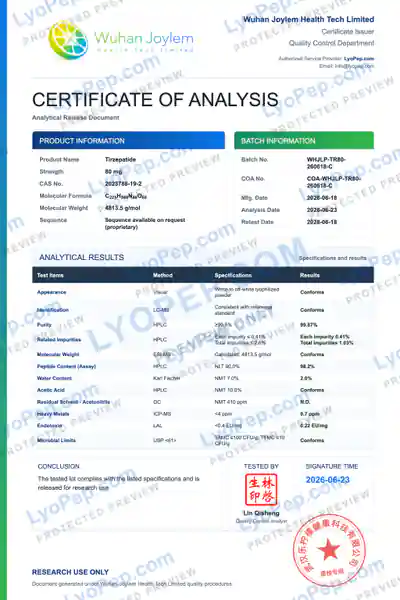
Tirzepatide80 mg · WHJLP-TR80-260618-C
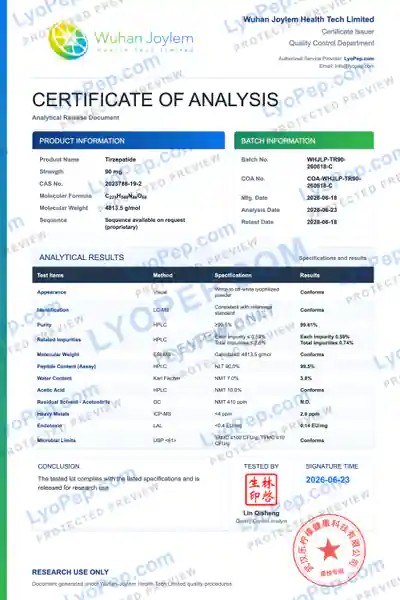
Tirzepatide90 mg · WHJLP-TR90-260618-C
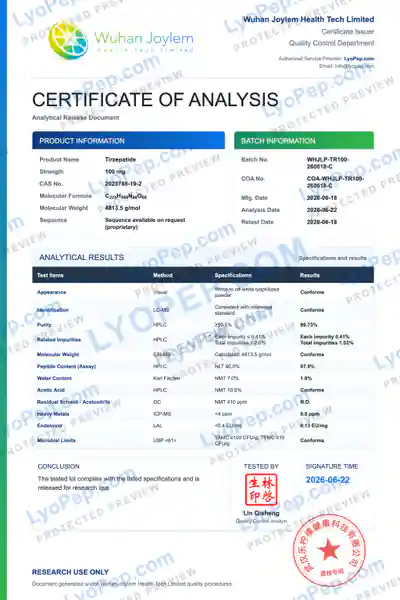
Tirzepatide100 mg · WHJLP-TR100-260618-C
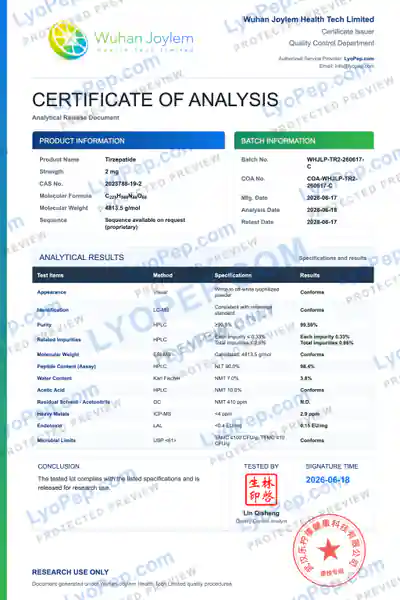
Tirzepatide2 mg · WHJLP-TR2-260617-C
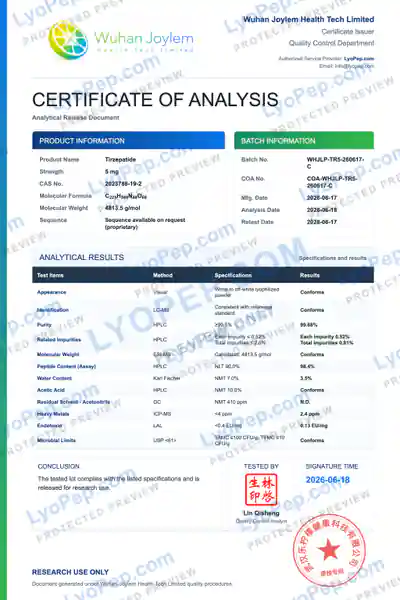
Tirzepatide5 mg · WHJLP-TR5-260617-C
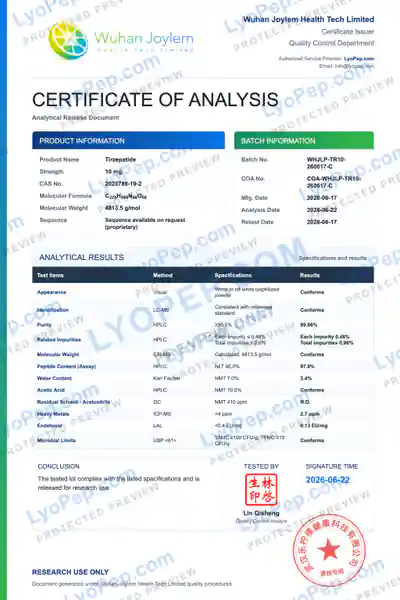
Tirzepatide10 mg · WHJLP-TR10-260617-C
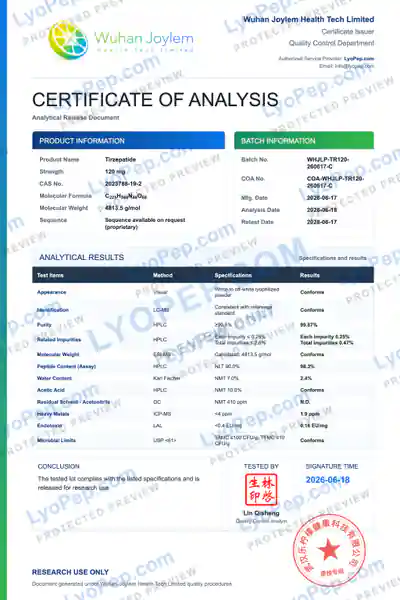
Tirzepatide120 mg · WHJLP-TR120-260617-C
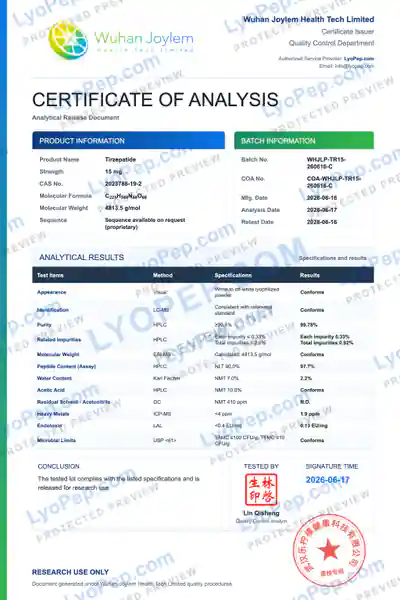
Tirzepatide15 mg · WHJLP-TR15-260616-C
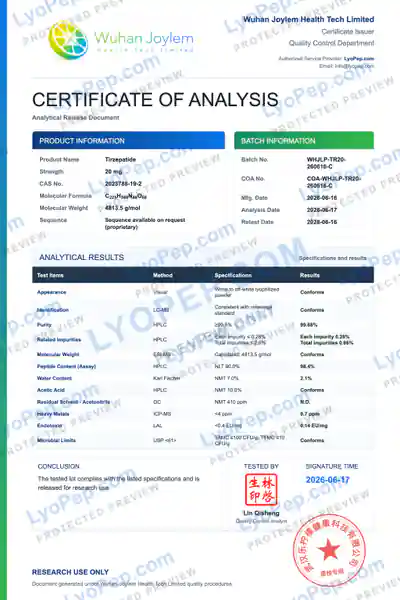
Tirzepatide20 mg · WHJLP-TR20-260616-C
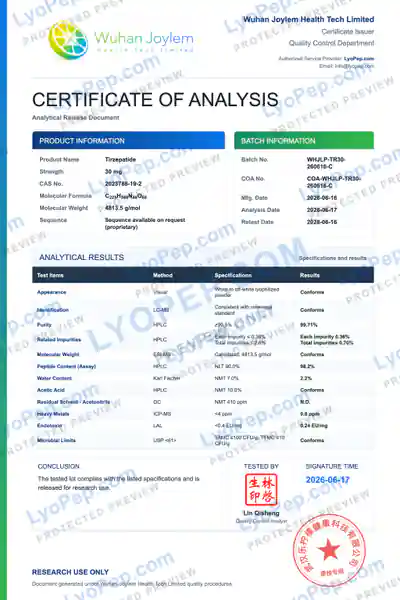
Tirzepatide30 mg · WHJLP-TR30-260616-C
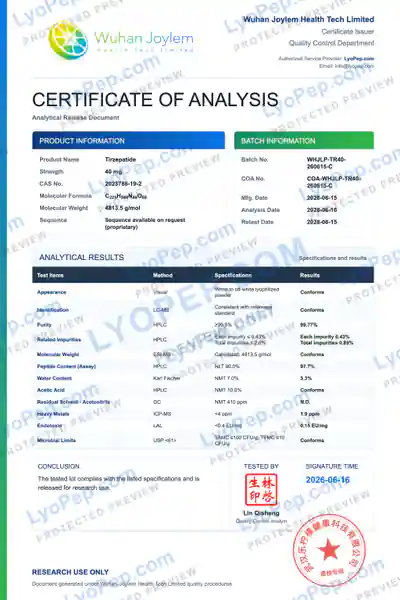
Tirzepatide40 mg · WHJLP-TR40-260615-C
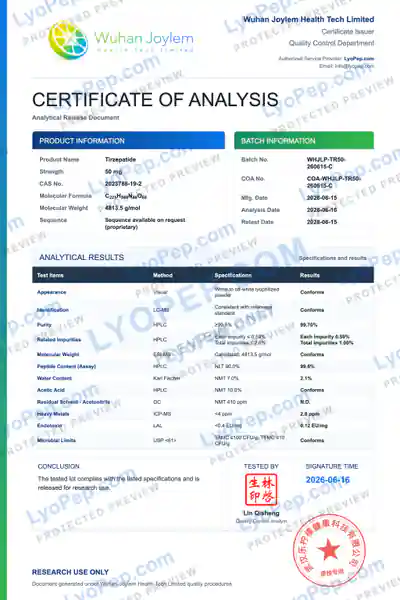
Tirzepatide50 mg · WHJLP-TR50-260615-C
Tirzepatide60 mg · WHJLP-TR60-260615-C
Representative records, refreshed periodically
Published COAs show representative factory batches and may not be the latest available. For a current quote or shipment, our sales team can confirm the applicable lot and provide its COA.
Independent testing, arranged on request
Third-party reports are not routinely published. If independent verification is required, we can agree the laboratory, method, acceptance criteria and remedy before testing. If the agreed specification is not met, an appropriate resolution—including a refund where applicable—can be discussed under the agreed terms. Unless otherwise agreed in writing, the buyer pays the cost of this optional testing.
Help reviewing your COA
Need help reading a factory COA or third-party report? Our sales team can clarify test items, specifications and how the results relate to the lot under discussion.
Ask for the current packet, not a generic certificate
Require full modified sequence, lipidation site and linker identity, RP-HPLC purity with method, intact mass, LC-MS/MS sequence/modification evidence, peptide content, related substances, counterion, water and residual solvents
Endotoxin, bioburden and sterility are separate lot tests
Appearance and solution clarity cannot prove identity or suitability.
Released-batch COARP-HPLC result and method contextIdentity result appropriate to the moleculeWater / counter-ion context where relevantSDS and handling statementAdditional testing scoped on request
Available fills
Quote the fill and pack configuration you need
Reference SKUFillBase pack
TIRZE-002MG2 mg10 vials
TIRZE-005MG5 mg10 vials
TIRZE-010MG10 mg10 vials
TIRZE-015MG15 mg10 vials
TIRZE-020MG20 mg10 vials
TIRZE-030MG30 mg10 vials
TIRZE-040MG40 mg10 vials
TIRZE-050MG50 mg10 vials
TIRZE-060MG60 mg10 vials
TIRZE-080MG80 mg10 vials
TIRZE-090MG90 mg10 vials
TIRZE-100MG100 mg10 vials
TIRZE-120MG120 mg10 vials
Handling
Storage in the lab and temperature during transit are different decisions
Follow the released-batch storage statement and SDS. Confirm post-opening or prepared-sample stability against the laboratory's validated protocol.
State destination, season, acceptable transit exposure and whether your protocol requires insulated or cold-chain service. Additional temperature-control cost is quoted explicitly.
Buyer FAQ
Terms to settle before the purchase order
Can a buyer arrange third-party testing?+
Yes. Testing must be performed by a mutually accepted, established specialist laboratory. Fee allocation, specification, sampling, method and acceptance rule must be agreed before testing; if an agreed independent result shows nonconformance, the remedy follows the signed order terms. Unless otherwise agreed in writing, the buyer pays the cost of this optional testing.
Does HPLC purity prove peptide content?+
No. Chromatographic purity describes the relative peak profile under a stated method. Identity, water, counter-ion, residual solvents and assay/content may require separate methods.
Is cold-chain shipping always required?+
Not always. Heat can accelerate degradation, especially during summer and long transit. Cold-chain reduces exposure but raises cost. State the destination and stability risk so the right service can be quoted.
How are payment terms handled?+
Available methods and milestones depend on order value, destination and project type. The pro forma invoice should state currency, bank details, fees, payment milestones and the release condition.
Why must the testing laboratory understand peptide chemistry?+
Free-base and salt forms, hydrophilic and hydrophobic sequences, aggregation and adsorption can change sample preparation and method suitability. Use a laboratory experienced with the molecule class.
These are buyer-qualification references, not claims that this RUO material is regulated, certified or released under those frameworks. Applicability depends on the buyer's workflow and jurisdiction.
Selected sources
Literature behind the research context
Identity: PubChem CID 156588324. Regulatory context: current FDA/Drugs@FDA Mounjaro and Zepbound labels. Clinical evidence context: linked SURPASS and SURMOUNT primary studies. Cardiovascular outcomes: PMID 41406444, which established noninferiority but not superiority versus dulaglutide.
01
Tirzepatide Once Weekly for the Treatment of Obesity
New England Journal of Medicine · 2022 · peer-reviewed original research (phase 3 randomized controlled trial)
Tirzepatide once weekly for the treatment of obesity in people with type 2 diabetes (SURMOUNT-2): a double-blind, randomised, multicentre, placebo-controlled, phase 3 trial
The Lancet · 2023 · peer-reviewed original research (phase 3 randomized controlled trial)
Once-weekly tirzepatide versus once-daily insulin degludec as add-on to metformin with or without SGLT2 inhibitors in patients with type 2 diabetes (SURPASS-3): a randomised, open-label, parallel-group, phase 3 trial
The Lancet · 2021 · peer-reviewed original research (phase 3 randomized controlled trial)
What are Tirzepatide's reference identity values (CAS, formula, MW)?+
Tirzepatide is associated with CAS 2023788-19-2 and PubChem CID 156588324. The neutral reference structure has formula C₂₂₅H₃₄₈N₄₈O₆₈ and average mass of approximately 4813 g/mol. It is a 39-residue synthetic peptide carrying a C20 fatty-diacid moiety through a linker on a lysine side chain. The released-lot COA must identify the exact form, counterion, water basis, theoretical mass, observed mass and quantitative peptide content; catalogue values cannot substitute for batch evidence.
How is Tirzepatide identity confirmed for a metabolic-research workflow?+
Confirm the stated molecule and supplied form. Start with the matching batch COA; request sequence-level evidence only when the buyer's written procedure requires it and availability or a separate scope has been agreed.
How does Tirzepatide differ from Semaglutide in chemistry and receptor pharmacology?+
Semaglutide is a 31-residue, C18-lipidated selective GLP-1R agonist, whereas tirzepatide is a 39-residue, C20-lipidated dual GIPR/GLP-1R agonist with a different sequence, linker and receptor-signaling profile. Outcomes from approved formulations or clinical trials cannot be reduced to a universal class effect at ‘comparable exposure’ or transferred to an RUO lot. Comparative experiments should match molar concentration, albumin or serum conditions, receptor expression, assay timing and formulation.
Related research materials
Compare adjacent molecules and documentation needs.