Recent Confirmed OrdersLast 7 days
Australia2 gTirzepatide 100 mg · CagriSema 20 mg · BPC-157 10 mg · TB-500 5 mg · Melanotan II 10 mg · PT-141 10 mg · Bacteriostatic Water 3 ml
View all

Metabolic and incretin research

Retatrutide

GIP / GLP-1 / glucagon tri-agonist · 39-mer metabolic research peptide

≥ 99.0% · target, verify batch COACAS 2381089-83-2RUO
Research statusExtensively Studied (Investigational — Not FDA Approved) reference context · supplied material is RUO
Supplied formLipidated peptide analog (39-residue, C20 fatty-diacid acylated) — GIP-backbone GLP-1/GIP/glucagon triple agonist
Lead time14–21 days
Retatrutide — White lyophilized powder
Retatrutide — White lyophilized powder · Representative packaging image · verify the ordered lot
Representative packaging image · verify the ordered lot

Decision summary

Key benefits

  • Research value: a single defined peptide enables study of coordinated GIPR, GLP-1R and GCGR agonism, receptor bias, metabolic signaling, analytical characterization and comparison with single- or dual-receptor agonists
  • Published clinical outcomes describe Lilly's investigational finished product and do not establish clinical performance, interchangeability or suitability of an RUO lot.
Published research context is presented for literature orientation only. It is not a dosing, treatment or human-use instruction.
Qualification data

Specifications to confirm against the released lot

CAS
2381089-83-2
Formula
C221H342N46O68
Molecular weight
4731.33 Da
Appearance
White lyophilized powder
Purity
≥ 99.0% · target, verify batch COA
Storage
Use the released-lot COA and stability statement for the supplied form. Define temperature, moisture and light protection, container closure, freeze-thaw allowance and solution matrix before use; do not infer solution stability from another vendor or a clinical finished product.
MOQ
On request
Lead time
14–21 days
PubChem CID 171390338

Qualification matrix

Identity, purity and content are separate release questions.

Identity

Confirm the stated molecule and supplied form. Start with the matching batch COA; request sequence-level evidence only when the buyer's written procedure requires it and availability or a separate scope has been agreed.

Purity

Review RP-HPLC method conditions, wavelength, integration and related-peak handling. A percentage without the method is not enough.

Content

Net peptide content is not the same as gross lyophilized powder weight. Ask which assay supports the stated amount and whether water/counter-ion is addressed.

Stability

Define long-term storage and transit exposure separately. Cold-chain can be quoted when the buyer’s risk assessment requires it and adds cost.

Research context

What researchers study about Retatrutide

Retatrutide (LY3437943) is Lilly's investigational 39-residue, lipidated peptide agonist of the GIP, GLP-1 and glucagon receptors. Peer-reviewed evidence includes Phase 1 and Phase 2 studies and the 2026 Phase 3 TRANSCEND-T2D-1 trial. Lilly reported TRIUMPH-1 topline results on May 21, 2026 and additional nested-substudy data at the June 2026 ADA meeting; those sponsor-reported results should remain distinct from full peer-reviewed publication. As of July 2026, FDA states that retatrutide is not a component of an approved drug, has not been found safe and effective for any condition and cannot be used in compounding under U.S. federal law. The material described here is an analytical/research reagent, not Lilly's clinical product or a finished dosage form.

  • Evidence contexts include receptor pharmacology, metabolic signaling, obesity, type 2 diabetes, body composition and liver-fat endpoints
  • The 2023 Phase 2 obesity and diabetes trials, 2024 MASLD substudy, 2025 body-composition substudy and 2026 TRANSCEND-T2D-1 Phase 3 paper are peer reviewed
  • TRIUMPH-1 obesity, OSA and knee-OA figures currently cited in this record are sponsor-reported topline or conference results pending full peer-reviewed publication
  • These studies concern Lilly's investigational clinical product and do not create an approved indication or validate this RUO material for human use.

Mechanism context

The question the literature is testing

Retatrutide is an agonist at GIPR, GLP-1R and GCGR. The discovery paper reports comparatively greater GIPR potency with balanced GLP-1R and GCGR activity in the tested systems. Incretin-receptor signaling affects insulin secretion, food intake and metabolic control, while GCGR engagement can influence hepatic substrate handling and energy expenditure. Receptor activity supports mechanistic hypotheses but does not by itself prove a clinical outcome or lot-specific biological potency.

Evidence map

Research routes and exposure context

Evidence tierApproved finished-product context
Routes reported in sources
Subcutaneous
Dose / exposure contextProtocol-specific; verify the cited primary source
Routes and exposure contexts summarize cited studies or approved finished-product labels. They are not instructions for administering this RUO material; no customer dose is provided.

Evidence boundaries

Compatibility, limitations and decision context

  • Retatrutide remains unapproved
  • Peer-reviewed and sponsor-reported trials describe gastrointestinal adverse events and other safety observations for Lilly's investigational finished product, but do not establish safety of an independently supplied RUO lot
  • FDA states that retatrutide has not been found safe and effective for any condition and cannot be used in compounding under U.S. federal law
  • Handle as a research chemical under an institutionally approved risk assessment; this catalog entry provides no human-use guidance.

Interactions reported in the literature

  • No combination-use guidance is provided for this RUO material
  • Clinical trial exclusion criteria and concomitant-medication management belong to the registered protocols and investigator oversight; they must not be rewritten as self-directed interaction advice.
Literature context is not a supplier release result or human-use instruction. Follow your institution's approved laboratory risk assessment.

Factory batch documentation

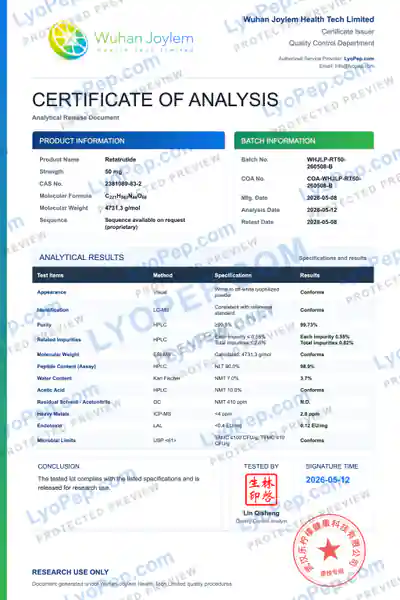
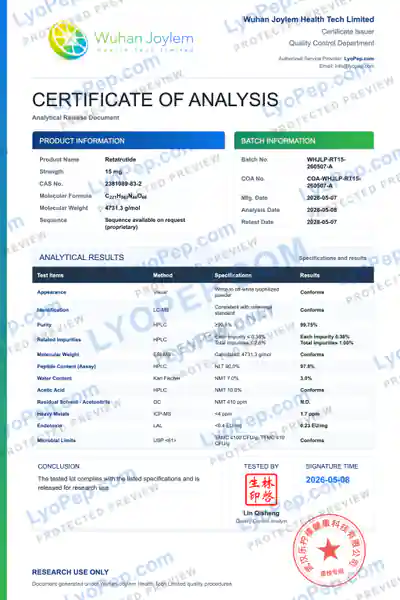
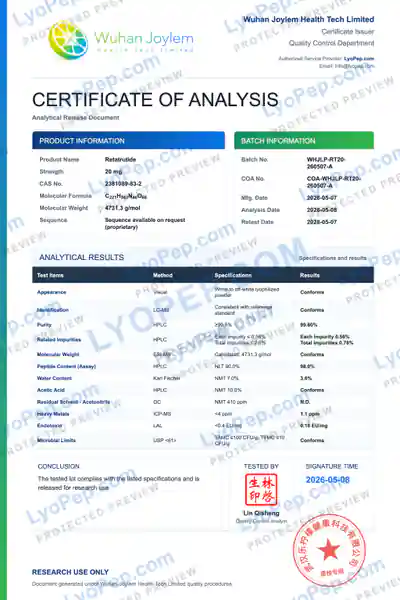
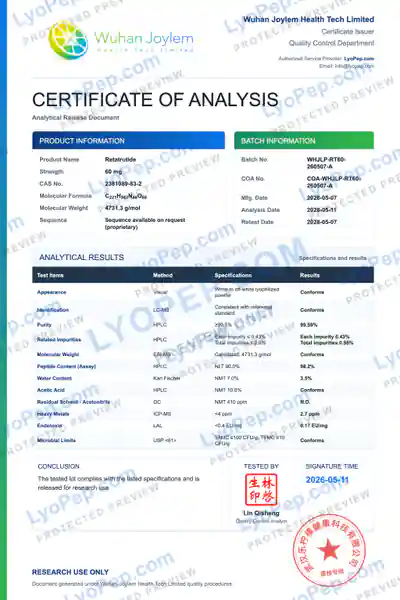
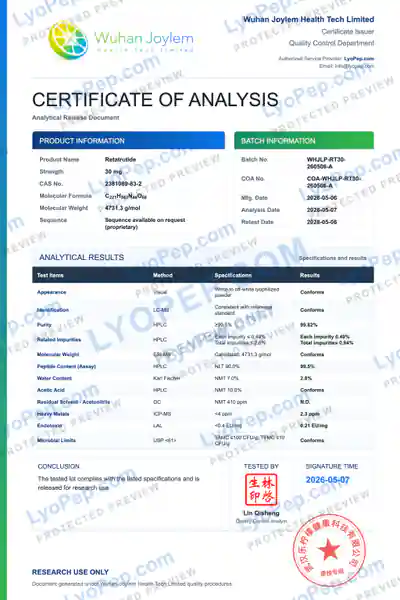
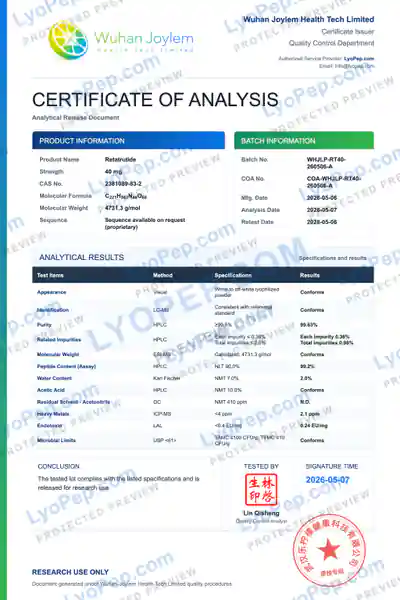
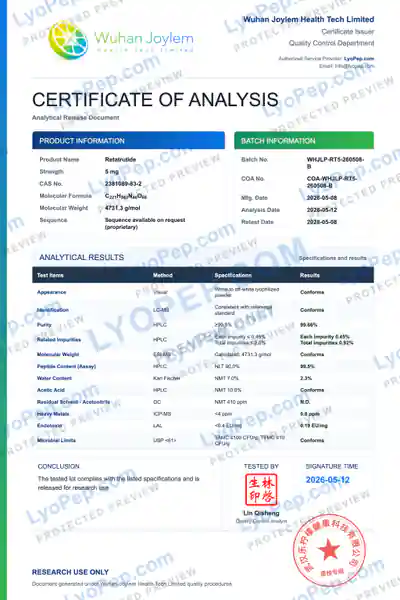
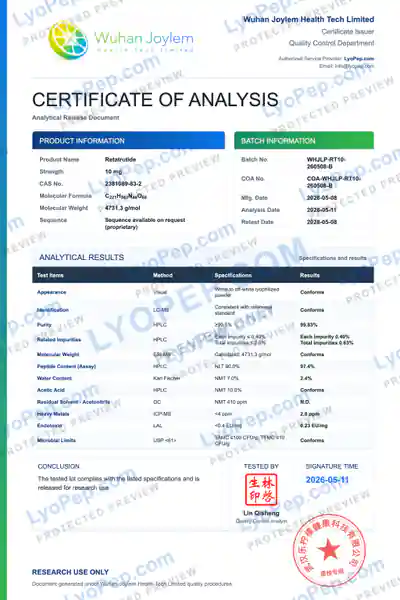
Retatrutide factory batch COAs

Representative records, refreshed periodically

Published COAs show representative factory batches and may not be the latest available. For a current quote or shipment, our sales team can confirm the applicable lot and provide its COA.

Independent testing, arranged on request

Third-party reports are not routinely published. If independent verification is required, we can agree the laboratory, method, acceptance criteria and remedy before testing. If the agreed specification is not met, an appropriate resolution—including a refund where applicable—can be discussed under the agreed terms. Unless otherwise agreed in writing, the buyer pays the cost of this optional testing.

Help reviewing your COA

Need help reading a factory COA or third-party report? Our sales team can clarify test items, specifications and how the results relate to the lot under discussion.

Ask for the current packet, not a generic certificate

  • Require complete modified-sequence identity, high-resolution intact mass, LC-MS/MS or another orthogonal sequence method, peptide-content assay, chromatographic purity with impurity assignment, counterion identity, water, residual solvents and aggregate assessment
  • Define endotoxin or bioburden only when the experimental model requires it
  • Appearance and HPLC area purity alone do not establish content, identity or clinical equivalence.
Released-batch COARP-HPLC result and method contextIdentity result appropriate to the moleculeWater / counter-ion context where relevantSDS and handling statementAdditional testing scoped on request

Available fills

Quote the fill and pack configuration you need

Reference SKUFillBase pack
RETA-005MG5 mg10 vials
RETA-010MG10 mg10 vials
RETA-015MG15 mg10 vials
RETA-020MG20 mg10 vials
RETA-030MG30 mg10 vials
RETA-040MG40 mg10 vials
RETA-050MG50 mg10 vials
RETA-060MG60 mg10 vials

Handling

Storage in the lab and temperature during transit are different decisions

Use the released-lot COA and stability statement for the supplied form. Define temperature, moisture and light protection, container closure, freeze-thaw allowance and solution matrix before use; do not infer solution stability from another vendor or a clinical finished product.

State destination, season, acceptable transit exposure and whether your protocol requires insulated or cold-chain service. Additional temperature-control cost is quoted explicitly.

Buyer FAQ

Terms to settle before the purchase order

Can a buyer arrange third-party testing?+

Yes. Testing must be performed by a mutually accepted, established specialist laboratory. Fee allocation, specification, sampling, method and acceptance rule must be agreed before testing; if an agreed independent result shows nonconformance, the remedy follows the signed order terms. Unless otherwise agreed in writing, the buyer pays the cost of this optional testing.

Does HPLC purity prove peptide content?+

No. Chromatographic purity describes the relative peak profile under a stated method. Identity, water, counter-ion, residual solvents and assay/content may require separate methods.

Is cold-chain shipping always required?+

Not always. Heat can accelerate degradation, especially during summer and long transit. Cold-chain reduces exposure but raises cost. State the destination and stability risk so the right service can be quoted.

How are payment terms handled?+

Available methods and milestones depend on order value, destination and project type. The pro forma invoice should state currency, bank details, fees, payment milestones and the release condition.

Why must the testing laboratory understand peptide chemistry?+

Free-base and salt forms, hydrophilic and hydrophobic sequences, aggregation and adsorption can change sample preparation and method suitability. Use a laboratory experienced with the molecule class.

These are buyer-qualification references, not claims that this RUO material is regulated, certified or released under those frameworks. Applicability depends on the buyer's workflow and jurisdiction.

Selected sources

Literature behind the research context

  • Key primary sources: Coskun et al., Cell Metabolism 2022 (PMID 35985340); Jastreboff et al., NEJM 2023 (PMID 37366315); Rosenstock et al., Lancet 2023 (PMID 37385280); Sanyal et al., Nature Medicine 2024 (PMID 38858523); Giblin et al., Diabetes, Obesity and Metabolism 2026 (PMID 41090431); Bajaj et al., Lancet 2026 (PMID 42250575); ClinicalTrials.gov NCT05929066 and NCT06383390; PubChem CID 171390338; FDA's current unapproved-GLP-1 notice; and Lilly's official May and June 2026 TRIUMPH-1 disclosures. Peer-reviewed publications, registry records and sponsor-reported topline results are labelled separately in the literature section.
  1. 01

    LY3437943, a novel triple glucagon, GIP, and GLP-1 receptor agonist for glycemic control and weight loss: From discovery to clinical proof of concept

    Cell Metabolism · 2022 · peer-reviewed original research (preclinical + first-in-human phase 1)

    Open source
  2. 02

    Triple-Hormone-Receptor Agonist Retatrutide for Obesity - A Phase 2 Trial

    New England Journal of Medicine · 2023 · peer-reviewed original research (randomized, double-blind, placebo-controlled phase 2 trial)

    Open source
  3. 03

    Retatrutide, a GIP, GLP-1 and glucagon receptor agonist, for people with type 2 diabetes: a randomised, double-blind, placebo and active-controlled, parallel-group, phase 2 trial conducted in the USA

    The Lancet · 2023 · peer-reviewed original research (randomized, double-blind, placebo- and active-controlled phase 2 trial)

    Open source
  4. 04

    Triple hormone receptor agonist retatrutide for metabolic dysfunction-associated steatotic liver disease: a randomized phase 2a trial

    Nature Medicine · 2024 · peer-reviewed original research (randomized, double-blind, placebo-controlled phase 2a substudy)

    Open source
  5. 05

    Effects of retatrutide on body composition in people with type 2 diabetes: a substudy of a phase 2, double-blind, parallel-group, placebo-controlled, randomised trial

    The Lancet Diabetes & Endocrinology · 2025 · peer-reviewed original research (randomized, double-blind, placebo-controlled phase 2 substudy)

    Open source
  6. 06

    Retatrutide for the treatment of obesity, obstructive sleep apnea and knee osteoarthritis: Rationale and design of the TRIUMPH registrational clinical trials

    Diabetes, Obesity and Metabolism · 2026 · peer-reviewed trial design/rationale paper (phase 3 program description)

    Open source
  7. 07

    Efficacy and safety of retatrutide, a GIP, GLP-1, and glucagon receptor agonist, in people with type 2 diabetes and inadequate glycaemic control with diet and exercise (TRANSCEND-T2D-1): a double-blind, randomised, phase 3 trial

    The Lancet · 2026 · peer-reviewed original research (randomized, double-blind, placebo-controlled phase 3 trial)

    Open source
  8. 08

    Multireceptor modulation in metabolic disease: are more targets better?

    The Lancet · 2026 · peer-reviewed editorial/comment (companion to TRANSCEND-T2D-1 phase 3 publication)

    Open source

Product FAQ

Questions buyers ask about Retatrutide

What is Retatrutide's reference identity, and why is formula/MW often shown as 'per COA'?+

Retatrutide is identified by CAS 2381089-83-2 and the investigational code LY3437943, but a batch specification must still state the complete modified sequence, terminal state, lipidation, free-peptide or salt basis and counter-ions. NCATS lists retatrutide and a related sodium form as distinct substance records. The COA should report the theoretical mass basis used, the measured high-resolution intact mass and the acceptance rule for the supplied form; a catalogue number or an unqualified average molecular weight is not enough.

How is Retatrutide pharmacologically different from Tirzepatide?+

Tirzepatide is a dual GIPR/GLP-1R agonist, whereas Retatrutide also activates GCGR. Both are long-acting lipidated peptides, but their sequences, receptor pharmacology and clinical-development programs differ. Cross-trial results cannot establish molecule-to-molecule superiority; a direct comparator study is required for that conclusion.

What identity testing should a lab request when qualifying Retatrutide from a new source?+

Request the complete modified sequence and terminal state, high-resolution intact mass, LC-MS/MS or another orthogonal sequence method, RP-HPLC/UPLC chromatogram with impurity assignment, peptide-content assay, counterion identity, water and residual solvents. Specify aggregate, endotoxin or bioburden limits only when required by the experimental model. HPLC area purity and intact mass alone do not establish content or full sequence.