Recent Confirmed OrdersLast 7 days
Australia520 mgTirzepatide 40 mg · Semaglutide 2 mg · Dihexa 10 mg
View all

Metabolic and incretin research

Liraglutide

GLP-1 receptor agonist · 31-mer metabolic reference standard

≥ 99.0% · target, verify batch COACAS 204656-20-2RUO
Research statusExtensively studied GLP-1 receptor agonist and active ingredient in approved finished drugs; this bulk Research Use Only material is not an approved medicine reference context · supplied material is RUO
Supplied formHentriacontapeptide (linear, C16-palmitoylated/lipidated GLP-1(7-37) analog)
Lead time10–18 days
Liraglutide — White lyophilized powder
Liraglutide — White lyophilized powder · Representative packaging image · verify the ordered lot
Representative packaging image · verify the ordered lot

Decision summary

Key benefits

  • Promotes glucose-dependent insulin secretion, suppresses glucagon secretion, delays gastric emptying, and reduces appetite and energy intake via hypothalamic GLP-1 receptor pathways, producing glucose-lowering and weight-reduction effects in both research models and clinical trials
  • The LEADER cardiovascular outcomes trial (NEJM 2016, PMID 27295427; 9,340 patients with T2DM at high cardiovascular risk, median follow-up 3.8 years) showed the primary composite endpoint (cardiovascular death, non-fatal MI, non-fatal stroke) occurred in 13.0% of the liraglutide group versus 14.9% of the placebo group (hazard ratio 0.87, 95% CI 0.78-0.97), along with a reduction in all-cause mortality risk
  • Liraglutide has also been studied for NAFLD/NASH-related hepatic steatosis and inflammation mechanisms — the LEAN trial (a phase II, multicenter, double-blind, placebo-controlled randomized trial in humans, not merely animal models or meta-analyses) found that after 48 weeks of treatment, NASH resolution without worsening fibrosis occurred in 39% of patients versus 9% on placebo
  • This is not an FDA-approved indication and remains an emerging research area.
Published research context is presented for literature orientation only. It is not a dosing, treatment or human-use instruction.
Qualification data

Specifications to confirm against the released lot

CAS
204656-20-2
Formula
C172H265N43O51
Molecular weight
3751.2 Da
Appearance
White lyophilized powder
Purity
≥ 99.0% · target, verify batch COA
Storage
Follow the released-lot label, COA and stability data for the supplied bulk form. The 2–8°C unopened and in-use instructions in FDA labels apply to specified finished injector pens and do not establish storage, reconstitution or after-opening stability for a lyophilized research lot.
MOQ
On request
Lead time
10–18 days
PubChem CID 16134956

Qualification matrix

Identity, purity and content are separate release questions.

Identity

Confirm the stated molecule and supplied form. Start with the matching batch COA; request sequence-level evidence only when the buyer's written procedure requires it and availability or a separate scope has been agreed.

Purity

Review RP-HPLC method conditions, wavelength, integration and related-peak handling. A percentage without the method is not enough.

Content

Net peptide content is not the same as gross lyophilized powder weight. Ask which assay supports the stated amount and whether water/counter-ion is addressed.

Stability

Define long-term storage and transit exposure separately. Cold-chain can be quoted when the buyer’s risk assessment requires it and adds cost.

Research context

What researchers study about Liraglutide

Liraglutide is a long-acting human glucagon-like peptide-1 (GLP-1) receptor agonist sharing approximately 97% amino acid sequence homology with native human GLP-1(7-37). It is produced by attaching a C16 palmitic (palmitoyl) fatty-acid side chain to the lysine residue at position 26 via a gamma-glutamic acid spacer, combined with a Lys34-to-Arg substitution (which ensures acylation occurs selectively at position 26 without materially affecting GLP-1 receptor binding). At pharmaceutical concentrations, the resulting molecule self-associates into a micelle-like heptameric structure, and together with other structural effects this markedly extends its plasma half-life, enabling once-daily dosing. As the active ingredient in two approved products (Victoza for type 2 diabetes, Saxenda for weight management), liraglutide is a widely used tool compound for studying insulin secretion regulation, appetite/energy homeostasis, and metabolic signaling pathways, and it served as the structural starting point for later GLP-1 analogs such as semaglutide.

  • Appropriate research contexts include GLP-1 receptor pharmacology, glucose-dependent signalling, acylated-peptide self-association, albumin binding, proteolytic stability, comparative analytical methods and reference-standard qualification
  • Approved clinical indications belong to named finished drugs and do not authorize use of this RUO material.

Mechanism context

The question the literature is testing

As a GLP-1 receptor agonist, liraglutide binds GLP-1 receptors on pancreatic beta cells, activating the cAMP/PKA signaling pathway to enhance insulin secretion in a glucose-dependent manner while suppressing glucagon release from alpha cells. It also acts on central nervous system GLP-1 receptors (including in the hypothalamic arcuate nucleus) to regulate satiety and appetite. Its extended plasma half-life of approximately 13 hours (versus roughly 1.5-2 minutes for native GLP-1) results from three combined mechanisms: (1) at pharmaceutical concentrations, self-association into a heptameric structure that slows absorption from the subcutaneous injection site; (2) the C16 fatty-acid acylation, which drives high-affinity (~99%) reversible binding to plasma albumin, creating a slow-release depot and delaying renal clearance; and (3) the same modification sterically shields the specific cleavage sites recognized by DPP-4 and neutral endopeptidase (NEP), increasing resistance to proteolytic degradation.

Evidence map

Research routes and exposure context

Evidence tierApproved finished-product context
Routes reported in sources
Subcutaneous
Dose / exposure contextProtocol-specific; verify the cited primary source
Routes and exposure contexts summarize cited studies or approved finished-product labels. They are not instructions for administering this RUO material; no customer dose is provided.

Evidence boundaries

Compatibility, limitations and decision context

  • Not for human or veterinary administration
  • The FDA labels for approved liraglutide finished drugs contain contraindications, boxed and other warnings, adverse reactions and presentation-specific instructions; those labels do not establish safety or suitability of bulk RUO material
  • Laboratory qualification should address identity and salt form, assay, related peptides, water, residual solvents, counterions, aggregation, particulates, endotoxin where relevant and lot-specific stability.

Interactions reported in the literature

  • No human combination guidance applies
  • Laboratory combination studies require defined receptor systems, authenticated comparators, exposure controls and component-resolved analysis; clinical drug-interaction statements must remain attached to the approved label and population from which they came.
Literature context is not a supplier release result or human-use instruction. Follow your institution's approved laboratory risk assessment.

Factory batch documentation

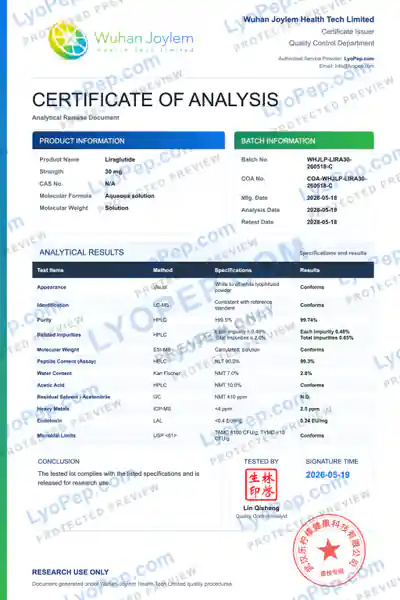
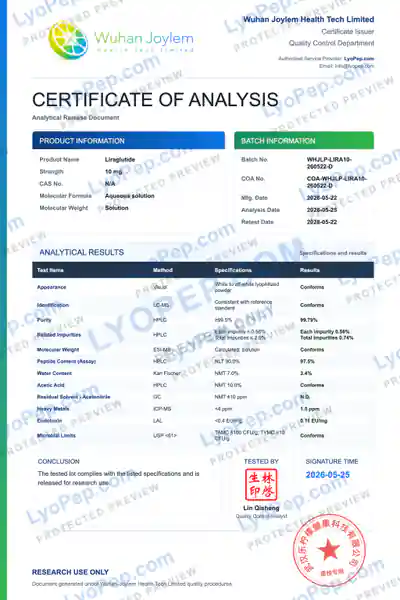
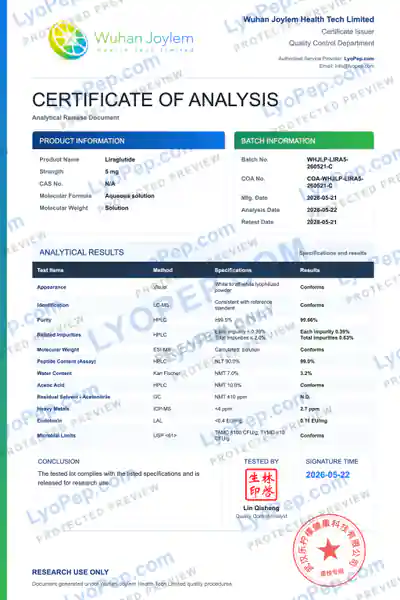
Liraglutide factory batch COAs

Representative records, refreshed periodically

Published COAs show representative factory batches and may not be the latest available. For a current quote or shipment, our sales team can confirm the applicable lot and provide its COA.

Independent testing, arranged on request

Third-party reports are not routinely published. If independent verification is required, we can agree the laboratory, method, acceptance criteria and remedy before testing. If the agreed specification is not met, an appropriate resolution—including a refund where applicable—can be discussed under the agreed terms. Unless otherwise agreed in writing, the buyer pays the cost of this optional testing.

Help reviewing your COA

Need help reading a factory COA or third-party report? Our sales team can clarify test items, specifications and how the results relate to the lot under discussion.

Ask for the current packet, not a generic certificate

  • Require sequence and modification confirmation, free-base or acetate identity, intact mass and peptide mapping where appropriate, chromatographic purity, quantitative peptide content on a stated basis, related peptides, water, counterions, residual solvents, aggregation or particulates where relevant, container integrity and lot-specific stability
  • Do not infer finished-drug sterility, concentration, excipients or in-use period from the active name.
Released-batch COARP-HPLC result and method contextIdentity result appropriate to the moleculeWater / counter-ion context where relevantSDS and handling statementAdditional testing scoped on request

Available fills

Quote the fill and pack configuration you need

Reference SKUFillBase pack
MIC-05MG5 mg10 vials
MIC-10MG10 mg10 vials
MIC-30MG30 mg10 vials

Handling

Storage in the lab and temperature during transit are different decisions

Follow the released-lot label, COA and stability data for the supplied bulk form. The 2–8°C unopened and in-use instructions in FDA labels apply to specified finished injector pens and do not establish storage, reconstitution or after-opening stability for a lyophilized research lot.

State destination, season, acceptable transit exposure and whether your protocol requires insulated or cold-chain service. Additional temperature-control cost is quoted explicitly.

Buyer FAQ

Terms to settle before the purchase order

Can a buyer arrange third-party testing?+

Yes. Testing must be performed by a mutually accepted, established specialist laboratory. Fee allocation, specification, sampling, method and acceptance rule must be agreed before testing; if an agreed independent result shows nonconformance, the remedy follows the signed order terms. Unless otherwise agreed in writing, the buyer pays the cost of this optional testing.

Does HPLC purity prove peptide content?+

No. Chromatographic purity describes the relative peak profile under a stated method. Identity, water, counter-ion, residual solvents and assay/content may require separate methods.

Is cold-chain shipping always required?+

Not always. Heat can accelerate degradation, especially during summer and long transit. Cold-chain reduces exposure but raises cost. State the destination and stability risk so the right service can be quoted.

How are payment terms handled?+

Available methods and milestones depend on order value, destination and project type. The pro forma invoice should state currency, bank details, fees, payment milestones and the release condition.

Why must the testing laboratory understand peptide chemistry?+

Free-base and salt forms, hydrophilic and hydrophobic sequences, aggregation and adsorption can change sample preparation and method suitability. Use a laboratory experienced with the molecule class.

These are buyer-qualification references, not claims that this RUO material is regulated, certified or released under those frameworks. Applicability depends on the buyer's workflow and jurisdiction.

Selected sources

Literature behind the research context

  • FDA Victoza prescribing information label (accessdata.fda.gov / DailyMed, most recently updated 2025), detailing pharmacokinetics (approximately 13-hour half-life, apparent clearance 1.2 L/h) and the thyroid C-cell tumor black-box warning; Marso SP et al., "Liraglutide and Cardiovascular Outcomes in Type 2 Diabetes," N Engl J Med 2016;375:311-322 (the LEADER trial, PMID 27295427), demonstrating reduced cardiovascular death and MACE composite endpoint risk (HR 0.87, 95% CI 0.78-0.97); Armstrong MJ, Gaunt P, Aithal GP, et al., "Liraglutide safety and efficacy in patients with non-alcoholic steatohepatitis (LEAN): a multicentre, double-blind, randomised, placebo-controlled phase 2 study," Lancet 2016;387(10019):679-690 (the LEAN trial), demonstrating NASH resolution in 39% of patients after 48 weeks versus 9% on placebo; Knudsen LB & Lau J, "The Discovery and Development of Liraglutide and Semaglutide," Front Endocrinol 2019;10:155/PMC6474072, providing a systematic account of the structural modifications (C16 palmitoylation, Lys34Arg substitution, gamma-glutamic acid spacer, self-associating heptamer formation) and mechanism of action; PubChem CID 16134956 (molecular formula C₁₇₂H₂₆₅N₄₃O₅₁, MW 3751.2 Da) and DrugBank DB06655 confirming free-base identity data; cross-verification of salt-form molecular weight and CAS numbers via Cayman Chemical's acetate product page/SDS (CAS 1997361-86-0, FW 3811.3), Santa Cruz Biotechnology, ChemicalBook, AChemBlock, and MedChemExpress technical pages
  1. 01

    Liraglutide and Cardiovascular Outcomes in Type 2 Diabetes

    New England Journal of Medicine · 2016 · peer-reviewed original research (randomized controlled trial, cardiovascular outcomes trial)

    Open source
  2. 02

    A Randomized, Controlled Trial of 3.0 mg of Liraglutide in Weight Management

    New England Journal of Medicine · 2015 · peer-reviewed original research (pivotal Phase 3 randomized controlled trial)

    Open source
  3. 03

    Liraglutide once a day versus exenatide twice a day for type 2 diabetes: a 26-week randomised, parallel-group, multinational, open-label trial (LEAD-6)

    The Lancet · 2009 · peer-reviewed original research (pivotal Phase 3 randomized controlled trial, LEAD program)

    Open source
  4. 04

    The Discovery and Development of Liraglutide and Semaglutide

    Frontiers in Endocrinology · 2019 · peer-reviewed review article (authored by the Novo Nordisk scientist credited with inventing liraglutide)

    Open source
  5. 05

    Effects of liraglutide (NN2211), a long-acting GLP-1 analogue, on glycaemic control and bodyweight in subjects with Type 2 diabetes

    Diabetic Medicine · 2005 · peer-reviewed original research (early clinical dose-response study)

    Open source
  6. 06

    A Systematic Review and Meta-Analysis of Efficacy and Safety of Liraglutide in Patients with Type 2 Diabetes Mellitus

    Diabetes, Metabolic Syndrome and Obesity · 2026 · peer-reviewed systematic review and meta-analysis

    Open source
  7. 07

    The efficacy and safety of liraglutide in the obese, non-diabetic individuals: a systematic review and meta-analysis

    African Health Sciences · 2019 · peer-reviewed systematic review and meta-analysis

    Open source
  8. 08

    VICTOZA (liraglutide) injection, for subcutaneous use — Highlights of Prescribing Information

    U.S. Food and Drug Administration (accessdata.fda.gov) · 2025 · regulatory document (FDA-approved drug label)

    Open source

Product FAQ

Questions buyers ask about Liraglutide

What are liraglutide’s reference identity values?+

The free-base reference is CAS 204656-20-2, formula C₁₇₂H₂₆₅N₄₃O₅₁ and average molecular mass about 3751.20 Da. Liraglutide is a 31-residue GLP-1 analogue with Arg at position 34 and a C16 palmitoyl group linked to Lys26 through a γ-glutamyl spacer. These values do not identify an acetate or other salt automatically; the released-lot COA must state the supplied form, mass convention, counterion and quantitative peptide-content basis.

How can liraglutide, semaglutide and tirzepatide be compared as a reference series?+

They are distinct acylated incretin-receptor agonists, not interchangeable grades of one molecule. Liraglutide uses a C16 fatty-acid substituent, semaglutide a C18 diacid side chain with a different linker and sequence, and tirzepatide a C20 diacid side chain on a dual GIP/GLP-1 receptor agonist sequence. A valid comparison qualifies each lot independently and normalizes identity, content, salt form, matrix and concentration before interpreting structure–activity differences.

What identity testing should a laboratory request for liraglutide?+

Request orthogonal evidence appropriate to an acylated peptide: intact mass, a peptide map or tandem-MS sequence assignment that localizes the modification, chromatographic purity and related-peptide profile, and quantitative peptide content on a stated basis. Also reconcile free base or acetate, counterion, water, residual solvents, aggregation and particulates where relevant. Endotoxin is a separate study-dependent attribute and should be supported by a released-lot method, interference controls, limit and result when required.