Recent Confirmed OrdersLast 7 days
Australia520 mgTirzepatide 40 mg · Semaglutide 2 mg · Dihexa 10 mg
View all

Other research materials

ACE-031

ActRIIB-Fc decoy receptor fusion protein · myostatin pathway

≥ 99.0% · target, verify batch COACAS 1169766-01-1RUO
Research statusLimited Research
Supplied formFusion protein (ActRIIB receptor-Fc)
Lead time21–45 days
ACE-031 — White to off-white lyophilized powder; should reconstitute into a clear solution with no visible turbidity or precipitate
ACE-031 — White to off-white lyophilized powder; should reconstitute into a clear solution with no visible turbidity or precipitate · Representative packaging image · verify the ordered lot
Representative packaging image · verify the ordered lot

Decision summary

Key benefits

  • Historical studies reported exploratory body-composition, muscle-volume, muscle-force and biomarker signals, but no approved benefit was established and the development program was discontinued
Published research context is presented for literature orientation only. It is not a dosing, treatment or human-use instruction.
Qualification data

Specifications to confirm against the released lot

CAS
1169766-01-1
Formula
C3418H5188N928O1062S38 (homodimeric glycoprotein; per KEGG DRUG D10347)
Molecular weight
Approximately 77.49 kDa
Appearance
White to off-white lyophilized powder; should reconstitute into a clear solution with no visible turbidity or precipitate
Purity
≥ 99.0% · target, verify batch COA
Storage
Store and ship the supplied batch according to its COA, formulation-specific stability study and validated cold-chain requirements. Generic vendor statements such as 2-8 degrees Celsius, minus 20 degrees Celsius for long-term storage or a fixed post-reconstitution period are not interchangeable across an Fc-fusion biologic, salt/buffer systems and container formats. Record excursions and avoid unvalidated freeze-thaw cycles.
MOQ
On request
Lead time
21–45 days

Qualification matrix

Identity, purity and content are separate release questions.

Identity

Confirm the stated molecule and supplied form. Start with the matching batch COA; request sequence-level evidence only when the buyer's written procedure requires it and availability or a separate scope has been agreed.

Purity

Review RP-HPLC method conditions, wavelength, integration and related-peak handling. A percentage without the method is not enough.

Content

Net peptide content is not the same as gross lyophilized powder weight. Ask which assay supports the stated amount and whether water/counter-ion is addressed.

Stability

Define long-term storage and transit exposure separately. Cold-chain can be quoted when the buyer’s risk assessment requires it and adds cost.

Research context

What researchers study about ACE-031

ACE-031 (ramatercept; YY-125) is an investigational recombinant homodimeric fusion protein comprising the extracellular ligand-binding domain of human ActRIIB/ACVR2B linked to a human IgG1 Fc region. It functions as a soluble ligand trap for several TGF-beta-family ligands, including myostatin, GDF-11 and activins. It was studied in Phase 1 and Phase 2 programs, including Duchenne muscular dystrophy, but the DMD study was stopped after vascular adverse events including epistaxis and telangiectasia; the development program was later discontinued. ACE-031 has no approved indication. Current use is limited to controlled research, reference and anti-doping contexts, and an RUO lot is not interchangeable with the historical clinical-trial material.

  • Historical research included Duchenne muscular dystrophy and single-dose body-composition studies, but the DMD trial stopped after the second regimen because of epistaxis and telangiectasias, efficacy differences were not statistically significant, and development was permanently discontinued
  • More recent marmoset work remains preclinical
  • ACE-031 is explicitly included among decoy activin receptors prohibited at all times under WADA category S4.3; anti-doping status must be read from the current official list and applicable TUE rules, not from vendor summaries.

Mechanism context

The question the literature is testing

ACE-031 uses the ActRIIB extracellular domain to bind multiple circulating TGF-beta-family ligands and reduce their access to native activin type II receptors, thereby decreasing downstream Smad2/3 signaling. This broad ligand-trap design differs from a myostatin-selective antibody and from bimagrumab, which blocks ActRIIA/ActRIIB receptors. The DMD trial documented epistaxis and telangiectasia. Broad capture of ligands involved in vascular homeostasis, including BMP9/10, has been proposed as a mechanistic explanation, but the trial did not establish the causal contribution of each ligand. The vascular safety signal and discontinued status are part of the mechanism interpretation, not optional context.

Evidence map

Research routes and exposure context

Evidence tierAnalytical / laboratory context
Routes reported in sources
Subcutaneous
Dose / exposure contextProtocol-specific; verify the cited primary source
Routes and exposure contexts summarize cited studies or approved finished-product labels. They are not instructions for administering this RUO material; no customer dose is provided.

Evidence boundaries

Compatibility, limitations and decision context

  • ACE-031 is an unapproved, discontinued investigational biologic and is not for human use
  • In the DMD Phase 2 report, epistaxis and telangiectasias led to early study termination; gingival bleeding was also reported in program summaries
  • Its broad ligand trap may affect BMP-9/BMP-10 signaling and provides a biologically plausible explanation for vascular findings, but this mechanism should not be presented as definitive proof for every event
  • A 2025 peer-reviewed analysis found major identity and impurity problems in products sold as ACE-031
  • Laboratory work requires an institutional risk assessment, batch-specific safety documentation and controls appropriate to an unverified recombinant protein
  • WADA S4.3 status is a separate anti-doping restriction and does not establish pharmaceutical quality or safety.

Interactions reported in the literature

  • As an RUO substance, no formal human co-administration protocol exists
  • Mechanistically, there is a theoretical possibility of additive inhibition of the same signaling pathway when combined with other myostatin-pathway inhibitors (e.g., YK-11, Follistatin-344), but no safety data support this
  • Because of its broad TGF-beta superfamily ligand-binding profile (including BMP-9/10), combining it with substances that affect coagulation or vascular integrity warrants particular caution — this is consistent with, and not contradictory to, the vascular-related adverse-effect mechanism described in the safety section.
Literature context is not a supplier release result or human-use instruction. Follow your institution's approved laboratory risk assessment.

Factory batch documentation

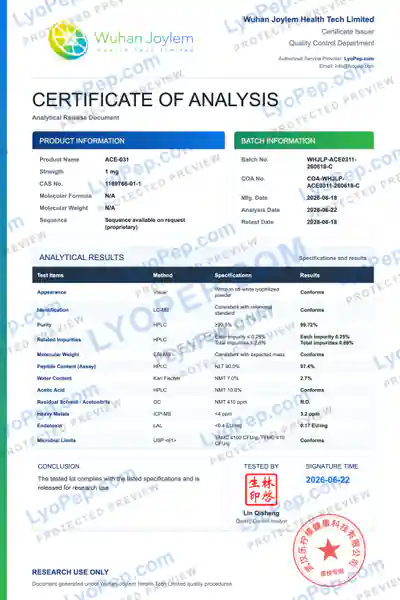
ACE-031 factory batch COAs

Representative records, refreshed periodically

Published COAs show representative factory batches and may not be the latest available. For a current quote or shipment, our sales team can confirm the applicable lot and provide its COA.

Independent testing, arranged on request

Third-party reports are not routinely published. If independent verification is required, we can agree the laboratory, method, acceptance criteria and remedy before testing. If the agreed specification is not met, an appropriate resolution—including a refund where applicable—can be discussed under the agreed terms. Unless otherwise agreed in writing, the buyer pays the cost of this optional testing.

Help reviewing your COA

Need help reading a factory COA or third-party report? Our sales team can clarify test items, specifications and how the results relate to the lot under discussion.

Ask for the current packet, not a generic certificate

  • Visual appearance cannot establish identity, purity, folding, glycosylation or biological activity
  • Procurement qualification should define ACE-031 as the disulfide-linked ACVR2B extracellular-domain-IgG1 Fc fusion homodimer and require traceable expression and purification records, intact and reduced mass characterization, peptide mapping or orthogonal sequence confirmation, identity-selective immunoblotting, aggregate and fragment analysis, purity with method and chromatograms, protein content, host-cell protein and DNA controls, endotoxin, bioburden or sterility where claimed, and formulation/stability data
  • The 2025 study of 14 black-market products found that only 12 were ACVR2B-immunoreactive and those contained full-length human ACVR2B rather than authentic ACVR2B-Fc ACE-031, with additional protein impurities
  • A plausible band or clear solution alone is therefore insufficient.
Released-batch COARP-HPLC result and method contextIdentity result appropriate to the moleculeWater / counter-ion context where relevantSDS and handling statementAdditional testing scoped on request

Available fills

Quote the fill and pack configuration you need

Reference SKUFillBase pack
ACE-1MG1 mg10 vials

Handling

Storage in the lab and temperature during transit are different decisions

Store and ship the supplied batch according to its COA, formulation-specific stability study and validated cold-chain requirements. Generic vendor statements such as 2-8 degrees Celsius, minus 20 degrees Celsius for long-term storage or a fixed post-reconstitution period are not interchangeable across an Fc-fusion biologic, salt/buffer systems and container formats. Record excursions and avoid unvalidated freeze-thaw cycles.

State destination, season, acceptable transit exposure and whether your protocol requires insulated or cold-chain service. Additional temperature-control cost is quoted explicitly.

Buyer FAQ

Terms to settle before the purchase order

Can a buyer arrange third-party testing?+

Yes. Testing must be performed by a mutually accepted, established specialist laboratory. Fee allocation, specification, sampling, method and acceptance rule must be agreed before testing; if an agreed independent result shows nonconformance, the remedy follows the signed order terms. Unless otherwise agreed in writing, the buyer pays the cost of this optional testing.

Does HPLC purity prove peptide content?+

No. Chromatographic purity describes the relative peak profile under a stated method. Identity, water, counter-ion, residual solvents and assay/content may require separate methods.

Is cold-chain shipping always required?+

Not always. Heat can accelerate degradation, especially during summer and long transit. Cold-chain reduces exposure but raises cost. State the destination and stability risk so the right service can be quoted.

How are payment terms handled?+

Available methods and milestones depend on order value, destination and project type. The pro forma invoice should state currency, bank details, fees, payment milestones and the release condition.

Why must the testing laboratory understand peptide chemistry?+

Free-base and salt forms, hydrophilic and hydrophobic sequences, aggregation and adsorption can change sample preparation and method suitability. Use a laboratory experienced with the molecule class.

These are buyer-qualification references, not claims that this RUO material is regulated, certified or released under those frameworks. Applicability depends on the buyer's workflow and jurisdiction.

Selected sources

Literature behind the research context

  • The evidence base should be read in layers. Attie et al. 2013, PMID 23169607, is a small first-in-human single-dose study and establishes pharmacokinetic and body-composition signals, not approval. Campbell et al. 2017, PMID 27462804, reports the stopped randomized DMD trial, vascular adverse events and non-significant efficacy trends. Lee 2021, PMID 33938454, provides pathway and development context. Reichel et al. 2025, PMID 40312924, directly demonstrates the authenticity risk of black-market products. KEGG D10347 and NCATS UNII 42HQC6QLEK support standardized identity, and the current WADA Prohibited List governs anti-doping status. Patient-advocacy announcements are useful for chronology but do not replace trial reports or regulatory records.
  1. 01

    Myostatin inhibitor ACE-031 treatment of ambulatory boys with Duchenne muscular dystrophy: Results of a randomized, placebo-controlled clinical trial

    Muscle & Nerve · 2017 · peer-reviewed original research (randomized, placebo-controlled Phase 2 clinical trial report)

    Open source
  2. 02

    A single ascending-dose study of muscle regulator ACE-031 in healthy volunteers

    Muscle & Nerve · 2013 · peer-reviewed original research (Phase 1 randomized, double-blind, placebo-controlled dose-escalation trial)

    Open source
  3. 03

    Targeting the myostatin signaling pathway to treat muscle loss and metabolic dysfunction

    The Journal of Clinical Investigation · 2021 · peer-reviewed review article

    Open source
  4. 04

    Gel electrophoretic detection of black market ACE-031

    Drug Testing and Analysis · 2025 · peer-reviewed original research, WADA-funded anti-doping analytical study

    Open source
  5. 05

    Administration study of black market ACE-031 (Ramatercept)

    World Anti-Doping Agency (WADA) — Scientific Research resource page · 2025 · regulatory/anti-doping body resource page (WADA-funded research summary)

    Open source
  6. 06

    UPDATE: ACE-031 Clinical Trials in Duchenne MD

    Quest Magazine, Muscular Dystrophy Association (MDA) · 2013 · patient advocacy organization publication (news/update article)

    Open source
  7. 07

    Acceleron awarded $1.5 million grant from Muscular Dystrophy Association to support ACE-031

    Muscular Dystrophy Association (MDA), distributed via EurekAlert! · 2011 · patient advocacy organization press release

    Open source
  8. 08

    ACE-031 Study Terminated: What Does This Mean?

    Parent Project Muscular Dystrophy (PPMD) Community Blog · 2011 · patient advocacy organization community blog post

    Open source

Product FAQ

Questions buyers ask about ACE-031

Why did ACE-031 development halt in Phase 2 despite the myostatin-blocking mechanism being promising?+

The DMD study of ACE-031 was stopped after vascular adverse events including epistaxis and telangiectasia were observed. Its ActRIIB-Fc domain traps multiple TGF-β-family ligands rather than myostatin alone, so the program could not isolate muscle-pathway activity from broader vascular biology. Later programs illustrate different strategies: apitegromab and domagrozumab target myostatin biology more selectively, whereas bimagrumab blocks the ActRIIA/ActRIIB receptors and must not be described as a ligand-selective antibody. ACE-031 remains an investigational research tool; discontinuation and the human safety findings must accompany any discussion of its mechanism.

How does ACE-031 differ from ligand-selective and receptor-blocking antibodies?+

ACE-031 is a soluble ActRIIB extracellular-domain/IgG1-Fc ligand trap that can sequester several ActRIIB ligands, including myostatin, GDF-11 and activins. Apitegromab and domagrozumab are examples of antibodies directed at myostatin biology, so they are narrower ligand strategies. Bimagrumab is different again: it binds and blocks the ActRIIA and ActRIIB receptors rather than selectively binding myostatin. These reagents are not interchangeable. Choose among them according to whether the experiment needs broad ligand trapping, a myostatin-focused perturbation or receptor blockade, and include matched controls for the Fc domain and assay matrix.

How should an in vitro ACE-031 working concentration be selected?+

There is no universal working concentration or standard seven-point dilution for every ACE-031 assay. Select a range from the published method that matches the ligand, cell system, incubation time, endpoint and actual lot, then confirm it with a pilot concentration-response study. Convert molar and mass concentrations using the lot-specific molecular-mass basis and supplied form, not a generic approximate mass. Buffer, carrier protein and surface-adsorption controls must be compatible with the assay, and storage or aliquoting conditions should follow formulation-specific stability data rather than a universal BSA or minus 80 degrees Celsius rule.