Recent Confirmed OrdersLast 7 days
Australia2 gTirzepatide 100 mg · CagriSema 20 mg · BPC-157 10 mg · TB-500 5 mg · Melanotan II 10 mg · PT-141 10 mg · Bacteriostatic Water 3 ml
View all

Metabolic and incretin research

Cagrilintide

Long-acting lipidated amylin analogue research reference

Lot-specific chromatographic purity plus quantitative peptide content; verify method and basis on the released-lot COA · target, verify batch COACAS 1415456-99-3RUO
Research statusInvestigational clinical-stage analogue; offered catalogue material is laboratory Research Use Only
Supplied formModified 37-residue peptide with a disulfide bond and C20 fatty-diacid lipidation
Lead time14–21 days
Cagrilintide — Lot-specific lyophilized research peptide; confirm colour and cake condition on the released-lot COA
Cagrilintide — Lot-specific lyophilized research peptide; confirm colour and cake condition on the released-lot COA · Representative packaging image · verify the ordered lot
Representative packaging image · verify the ordered lot

Decision summary

Key benefits

  • Research relevance includes amylin/calcitonin-receptor pharmacology, structure-function studies of a long-acting lipidated analogue, aggregation and fibrillation method development, and component-level analytical work supporting properly controlled combination hypotheses
  • Clinical efficacy values are evidence context for the sponsor products and do not establish performance or safety of an RUO lot.
Published research context is presented for literature orientation only. It is not a dosing, treatment or human-use instruction.
Qualification data

Specifications to confirm against the released lot

CAS
1415456-99-3
Formula
C194H312N54O59S2
Molecular weight
Approximately 4,409 Da
Appearance
Lot-specific lyophilized research peptide; confirm colour and cake condition on the released-lot COA
Purity
Lot-specific chromatographic purity plus quantitative peptide content; verify method and basis on the released-lot COA · target, verify batch COA
Storage
Follow the released-lot COA, SDS and formulation-specific stability statement. Required temperature, pH, concentration, light protection, container, shipping range and post-preparation hold time depend on the exact supplied form and matrix. Sponsor formulation conditions and general amylin fibrillation literature do not create a universal RUO storage instruction.
MOQ
On request
Lead time
14–21 days
PubChem CID 171397054

Qualification matrix

Identity, purity and content are separate release questions.

Identity

Confirm the stated molecule and supplied form. Start with the matching batch COA; request sequence-level evidence only when the buyer's written procedure requires it and availability or a separate scope has been agreed.

Purity

Review RP-HPLC method conditions, wavelength, integration and related-peak handling. A percentage without the method is not enough.

Content

Net peptide content is not the same as gross lyophilized powder weight. Ask which assay supports the stated amount and whether water/counter-ion is addressed.

Stability

Define long-term storage and transit exposure separately. Cold-chain can be quoted when the buyer’s risk assessment requires it and adds cost.

Research context

What researchers study about Cagrilintide

Cagrilintide, development code AM833, is an investigational long-acting lipidated amylin analogue developed by Novo Nordisk. FDA GSRS records a 37-residue disulfide-linked peptide with defined terminal and lipid modifications under UNII AO43BIF1U8; PubChem CID 171397054 records formula C₁₉₄H₃₁₂N₅₄O₅₉S₂ and molecular weight approximately 4,409 Da. Clinical evidence includes monotherapy studies and the sponsor fixed-dose combination with semaglutide, CagriSema. As of 15 July 2026, no cagrilintide approval was identified; the sponsor filed a US CagriSema NDA in December 2025 and continued to describe the combination as investigational in June 2026. FDA states cagrilintide is not a component of an FDA-approved drug and cannot be used in compounding under federal law. This RUO lot is not the sponsor formulation.

  • Amylin/calcitonin-receptor assays, lipidated-peptide structure-function research, aggregation/fibrillation and stability-indicating method development, and controlled component-level combination studies
  • These are laboratory applications, not clinical indications.

Mechanism context

The question the literature is testing

Cagrilintide is engineered from an amylin-analogue scaffold with sequence substitutions, a disulfide bond and C20 fatty-diacid lipidation that extend exposure and influence aggregation behaviour. It activates amylin-receptor complexes and the calcitonin receptor; clinical research links this pharmacology to satiety and gastric-emptying effects. Exact receptor system, concentration, matrix and readout must be defined in laboratory assays. Clinical pharmacology does not supply a customer dose, mixing procedure or storage rule.

Evidence map

Research routes and exposure context

Evidence tierHuman clinical research
Routes reported in sources
No administration route applies
Dose / exposure contextProtocol-specific; verify the cited primary source
Routes and exposure contexts summarize cited studies or approved finished-product labels. They are not instructions for administering this RUO material; no customer dose is provided.

Evidence boundaries

Compatibility, limitations and decision context

  • Not for human or veterinary use
  • Sponsor clinical adverse-event and antidrug-antibody findings describe studied formulations and populations and cannot establish safety of this RUO lot
  • Chemical purity does not establish sterility, endotoxin control, injectable suitability or formulation equivalence
  • Follow the lot SDS and institutional controls.

Interactions reported in the literature

  • No patient drug-interaction, stacking or medication-timing advice is provided
  • Combination results with semaglutide belong to the sponsor CagriSema formulation and do not prove compatibility of separately sourced RUO lots
  • Other incretin, amylin or insulin combinations require an independently justified research design and are not purchasing recommendations.
Literature context is not a supplier release result or human-use instruction. Follow your institution's approved laboratory risk assessment.

Factory batch documentation

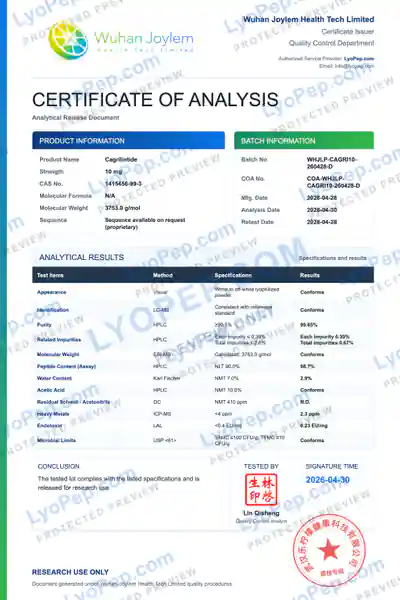
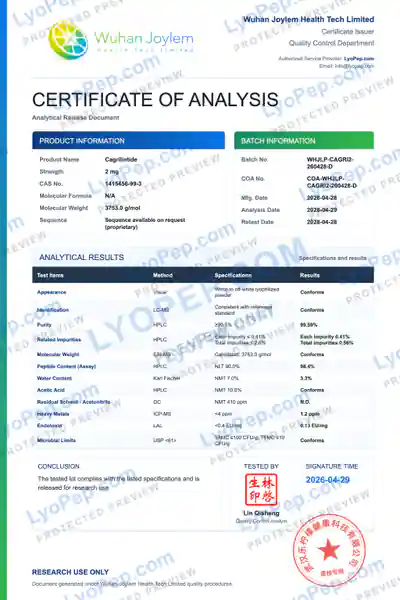
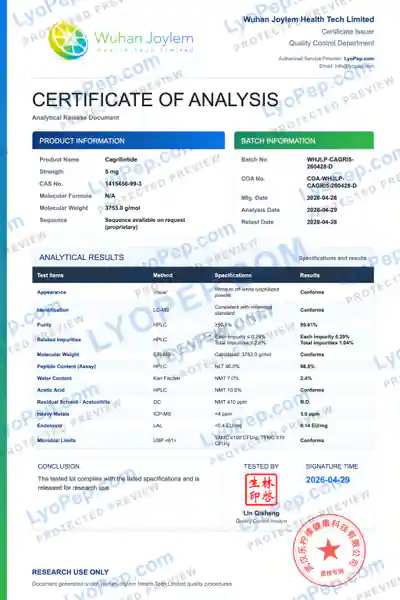
Cagrilintide factory batch COAs

Representative records, refreshed periodically

Published COAs show representative factory batches and may not be the latest available. For a current quote or shipment, our sales team can confirm the applicable lot and provide its COA.

Independent testing, arranged on request

Third-party reports are not routinely published. If independent verification is required, we can agree the laboratory, method, acceptance criteria and remedy before testing. If the agreed specification is not met, an appropriate resolution—including a refund where applicable—can be discussed under the agreed terms. Unless otherwise agreed in writing, the buyer pays the cost of this optional testing.

Help reviewing your COA

Need help reading a factory COA or third-party report? Our sales team can clarify test items, specifications and how the results relate to the lot under discussion.

Ask for the current packet, not a generic certificate

  • Require exact modified sequence, termini, disulfide connectivity, lipidation site/linker/fatty diacid and supplied form; theoretical and observed high-resolution intact mass; sequence/modification mapping; stability-indicating chromatography; quantitative peptide content; relevant related peptides, chemical degradants, aggregates and fibrillation; counterion, water and residual solvents; and lot-specific stability for the actual matrix, concentration and container
  • Sterility and bacterial endotoxin are separate released attributes
  • A generic “>98%” HPLC area claim is insufficient.
Released-batch COARP-HPLC result and method contextIdentity result appropriate to the moleculeWater / counter-ion context where relevantSDS and handling statementAdditional testing scoped on request

Available fills

Quote the fill and pack configuration you need

Reference SKUFillBase pack
CAGL-02MG2 mg10 vials
CAGL-05MG5 mg10 vials
CAGL-10MG10 mg10 vials

Handling

Storage in the lab and temperature during transit are different decisions

Follow the released-lot COA, SDS and formulation-specific stability statement. Required temperature, pH, concentration, light protection, container, shipping range and post-preparation hold time depend on the exact supplied form and matrix. Sponsor formulation conditions and general amylin fibrillation literature do not create a universal RUO storage instruction.

State destination, season, acceptable transit exposure and whether your protocol requires insulated or cold-chain service. Additional temperature-control cost is quoted explicitly.

Buyer FAQ

Terms to settle before the purchase order

Can a buyer arrange third-party testing?+

Yes. Testing must be performed by a mutually accepted, established specialist laboratory. Fee allocation, specification, sampling, method and acceptance rule must be agreed before testing; if an agreed independent result shows nonconformance, the remedy follows the signed order terms. Unless otherwise agreed in writing, the buyer pays the cost of this optional testing.

Does HPLC purity prove peptide content?+

No. Chromatographic purity describes the relative peak profile under a stated method. Identity, water, counter-ion, residual solvents and assay/content may require separate methods.

Is cold-chain shipping always required?+

Not always. Heat can accelerate degradation, especially during summer and long transit. Cold-chain reduces exposure but raises cost. State the destination and stability risk so the right service can be quoted.

How are payment terms handled?+

Available methods and milestones depend on order value, destination and project type. The pro forma invoice should state currency, bank details, fees, payment milestones and the release condition.

Why must the testing laboratory understand peptide chemistry?+

Free-base and salt forms, hydrophilic and hydrophobic sequences, aggregation and adsorption can change sample preparation and method suitability. Use a laboratory experienced with the molecule class.

These are buyer-qualification references, not claims that this RUO material is regulated, certified or released under those frameworks. Applicability depends on the buyer's workflow and jurisdiction.

Selected sources

Literature behind the research context

  • Identity: FDA GSRS/UNII AO43BIF1U8 and PubChem CID 171397054. Molecular design and pharmacokinetic context: Kruse et al., Journal of Medicinal Chemistry 2021, DOI 10.1021/acs.jmedchem.1c00565. Clinical context: Lau et al., Lancet 2021; REDEFINE 1 and REDEFINE 2, New England Journal of Medicine 2025. Current status: Novo Nordisk announcements dated 18 December 2025, 23 February 2026 and June 2026; FDA page “FDA’s Concerns with Unapproved GLP-1 Drugs Used for Weight Loss,” current in July 2026. These sources do not qualify the offered RUO lot or provide customer-use instructions.
  1. 01

    Development of Cagrilintide, a Long-Acting Amylin Analogue

    Journal of Medicinal Chemistry · 2021 · peer-reviewed original research (medicinal chemistry / drug discovery)

    Open source
  2. 02

    Safety, tolerability, pharmacokinetics, and pharmacodynamics of concomitant administration of multiple doses of cagrilintide with semaglutide 2·4 mg for weight management: a randomised, controlled, phase 1b trial

    The Lancet · 2021 · peer-reviewed original research (phase 1b randomized controlled trial)

    Open source
  3. 03

    Once-weekly cagrilintide for weight management in people with overweight and obesity: a multicentre, randomised, double-blind, placebo-controlled and active-controlled, dose-finding phase 2 trial

    The Lancet · 2021 · peer-reviewed original research (phase 2 randomized controlled trial)

    Open source
  4. 04

    Coadministered Cagrilintide and Semaglutide in Adults with Overweight or Obesity (REDEFINE 1)

    New England Journal of Medicine · 2025 · peer-reviewed original research (phase 3 randomized controlled trial)

    Open source
  5. 05

    Cagrilintide-Semaglutide in Adults with Overweight or Obesity and Type 2 Diabetes (REDEFINE 2)

    New England Journal of Medicine · 2025 · peer-reviewed original research (phase 3 randomized controlled trial)

    Open source
  6. 06

    Cagrilintide: A Long-Acting Amylin Analog for the Treatment of Obesity

    Cardiology in Review · 2024 · peer-reviewed review article

    Open source
  7. 07

    Cagrilintide is not associated with clinically relevant QTc prolongation: A thorough QT study in healthy participants

    Diabetes, Obesity and Metabolism · 2024 · peer-reviewed original research (thorough QT cardiac safety trial)

    Open source
  8. 08

    Cagrilintide lowers bodyweight through brain amylin receptors 1 and 3

    eBioMedicine · 2025 · peer-reviewed original research (preclinical mechanism-of-action study)

    Open source

Product FAQ

Questions buyers ask about Cagrilintide

What identity evidence should a cagrilintide lot provide?+

The released-lot package should state the exact modified sequence, N- and C-terminal states, disulfide connectivity, lipidation site, linker and C20 fatty diacid, salt/counterion and theoretical mass. Require observed high-resolution intact mass plus sequence/modification evidence, not a supplier promise that ESI-MS was performed. CAS 1415456-99-3 and FDA UNII AO43BIF1U8 help map the substance but do not prove the offered lot or confer approval.

Which quality risks matter for a lipidated amylin analogue?+

In addition to identity and peptide content, qualify related peptides, oxidation/deamidation or other sequence-relevant changes, aggregates and fibrillation, water, counterion, residual solvents, pH where formulation-relevant, container compatibility and stability under the actual concentration and matrix. A high HPLC area percentage alone does not establish correct lipidation, quantitative content, sterility or suitability for an assay.