Recent Confirmed OrdersLast 7 days
Australia520 mgTirzepatide 40 mg · Semaglutide 2 mg · Dihexa 10 mg
View all

Metabolic and incretin research

Survodutide

GLP-1 / glucagon dual agonist · metabolic research peptide (BI 456906)

≥ 99.0% · target, verify batch COACAS 2805997-46-8RUO
Research statusExtensively studied investigational compound (Phase 3 program; not approved for marketing) reference context · supplied material is RUO
Supplied formNonacosapeptide (linear, lipidated)
Lead time14–21 days
Survodutide — White lyophilized powder
Survodutide — White lyophilized powder · Representative packaging image · verify the ordered lot
Representative packaging image · verify the ordered lot

Decision summary

Key benefits

  • Published trial findings, not established product benefits: in the 46-week Phase 2 obesity trial, mean body-weight change at the 4.8 mg target dose was -14.9% versus -2.8% with placebo
  • In the peer-reviewed 76-week SYNCHRONIZE-1 report (n=725), the primary treatment-regimen estimand showed mean changes of -12.2% with 3.6 mg, -13.0% with 6.0 mg, and -5.4% with placebo; at least 5% weight reduction occurred in 72.6%, 71.9%, and 46.3%, respectively
  • In the 48-week Phase 2 MASH trial, MASH improvement without fibrosis worsening occurred in 47%, 62%, and 43% at the three evaluated doses versus 14% with placebo; fibrosis improvement by at least one stage without MASH worsening occurred in 34%, 36%, and 34% versus 22%
  • In SYNCHRONIZE-MASLD, 218 participants were randomized and 216 were treated; under the week-48 efficacy estimand, at least 30% relative liver-fat reduction occurred in 84.2% versus 24.3%, liver fat normalized to below 5% in 61.0% versus 5.7%, and mean body-weight change was -12.2% versus -1.0%
  • These indication-, dose-, population-, and estimand-specific results must not be generalized to an RUO product or to individual outcomes.
Published research context is presented for literature orientation only. It is not a dosing, treatment or human-use instruction.
Qualification data

Specifications to confirm against the released lot

CAS
2805997-46-8
Formula
C192H289N47O61
Molecular weight
Approximately 4231.69 Da
Appearance
White lyophilized powder
Purity
≥ 99.0% · target, verify batch COA
Storage
Follow the released-lot COA and supplier instructions. Unless the batch documentation specifies otherwise, keep the sealed lyophilized RUO material desiccated, protected from light, and at or below -20°C; avoid repeated freeze-thaw cycles after reconstitution and establish solution stability in the laboratory's validated protocol. Storage claims for clinical pens or formulated investigational product do not qualify an RUO bulk peptide.
MOQ
On request
Lead time
14–21 days
PubChem CID 168429725

Qualification matrix

Identity, purity and content are separate release questions.

Identity

Confirm the stated molecule and supplied form. Start with the matching batch COA; request sequence-level evidence only when the buyer's written procedure requires it and availability or a separate scope has been agreed.

Purity

Review RP-HPLC method conditions, wavelength, integration and related-peak handling. A percentage without the method is not enough.

Content

Net peptide content is not the same as gross lyophilized powder weight. Ask which assay supports the stated amount and whether water/counter-ion is addressed.

Stability

Define long-term storage and transit exposure separately. Cold-chain can be quoted when the buyer’s risk assessment requires it and adds cost.

Research context

What researchers study about Survodutide

Survodutide (BI 456906) is an investigational 29-residue, lipidated glucagon-receptor/GLP-1-receptor dual agonist co-developed by Boehringer Ingelheim and Zealand Pharma. The FDA Global Substance Registration System identifies it as UNII 2ALA66NS64, CAS 2805997-46-8, with formula C₁₉₂H₂₈₉N₄₇O₆₁; PubChem assigns CID 168429725. The peptide contains Ac4c at position 2 and a Lys24 side-chain modification that includes a C18 diacid-linked hydrophilic spacer, features designed to resist enzymatic cleavage and prolong exposure through albumin binding. Peer-reviewed Phase 3 publications now include SYNCHRONIZE-1 in adults with obesity or overweight without diabetes and SYNCHRONIZE-MASLD in metabolic dysfunction-associated steatotic liver disease. Other programs, including SYNCHRONIZE-2, SYNCHRONIZE-CVOT, and LIVERAGE, remain under study. The developer reports FDA Fast Track and Breakthrough Therapy designations for non-cirrhotic MASH with F2/F3 fibrosis. Survodutide remains investigational; its safety and efficacy have not been approved for marketing by any regulatory authority.

  • Published or registered research areas include obesity or overweight without diabetes (Phase 2 and SYNCHRONIZE-1), obesity with type 2 diabetes (Phase 2 and SYNCHRONIZE-2), metabolic dysfunction-associated steatotic liver disease (SYNCHRONIZE-MASLD), biopsy-confirmed MASH with fibrosis (Phase 2 and LIVERAGE), cardiovascular outcomes (SYNCHRONIZE-CVOT), and pharmacokinetics in people with compensated or decompensated cirrhosis
  • Evidence maturity differs by indication: positive peer-reviewed results are available for selected Phase 2 studies, SYNCHRONIZE-1, and SYNCHRONIZE-MASLD, whereas other programs remain ongoing or have published design/baseline information only
  • Survodutide is investigational and not approved for marketing.

Mechanism context

The question the literature is testing

Survodutide activates both the glucagon receptor (GCGR) and GLP-1 receptor (GLP-1R). GLP-1R signaling is associated with reduced appetite, delayed gastric emptying, and glucose-dependent effects on insulin and glucagon, while GCGR signaling can increase energy expenditure and hepatic lipid oxidation. The combined clinical effect remains dose-, population-, and study-dependent. Ac4c at position 2 reduces susceptibility to DPP-4 cleavage, and the Lys24-linked C18 diacid/spacer promotes high albumin binding and an approximately six-day terminal half-life reported in clinical pharmacokinetic studies. Mechanistic and body-composition interpretations remain model- and protocol-dependent and do not establish clinical performance of an RUO lot.

Evidence map

Research routes and exposure context

Evidence tierApproved finished-product context
Routes reported in sources
Subcutaneous
Dose / exposure contextProtocol-specific; verify the cited primary source
Routes and exposure contexts summarize cited studies or approved finished-product labels. They are not instructions for administering this RUO material; no customer dose is provided.

Evidence boundaries

Compatibility, limitations and decision context

  • Safety findings are trial-specific
  • In SYNCHRONIZE-1, gastrointestinal adverse events occurred in 80.9% of the 3.6 mg group, 89.7% of the 6.0 mg group, and 47.9% of placebo participants; no deaths occurred during the trial
  • In SYNCHRONIZE-MASLD, adverse-event-related treatment discontinuation occurred in 19.9% of survodutide-treated participants versus 4.3% with placebo; mean heart-rate change at week 52 was +3.6 versus +0.8 beats per minute
  • That study reported no adjudication-confirmed drug-induced liver injury, acute pancreatitis, pancreatic cancer, or thyroid cancer in the survodutide group, but its authors noted limitations including 48-week duration, two-country recruitment, a predominantly White population, and mostly early or mild-to-moderate fibrosis
  • A cirrhosis pharmacokinetic study found broadly similar exposure across hepatic-function groups, but this does not establish general safety or authorize a dose recommendation
  • Survodutide remains investigational and an RUO lot is not a finished drug or suitable for human use.

Interactions reported in the literature

  • No established combination-use, compatibility, or interaction profile exists for an RUO survodutide material
  • In the Phase 2 type 2 diabetes study, semaglutide 1.0 mg served as an open-label comparator rather than a combination treatment, and metformin was allowed as background therapy under protocol-defined conditions
  • These observations do not establish compatibility with semaglutide, tirzepatide, insulin, other incretin therapies, glucagon-receptor agonists, or any medication
  • Interaction and co-treatment questions require an approved protocol and qualified clinical or institutional oversight; this catalog does not provide medication-management advice.
Literature context is not a supplier release result or human-use instruction. Follow your institution's approved laboratory risk assessment.

Factory batch documentation

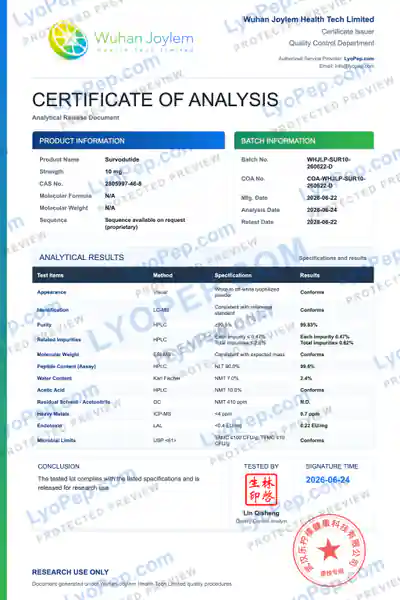
Survodutide factory batch COAs

Representative records, refreshed periodically

Published COAs show representative factory batches and may not be the latest available. For a current quote or shipment, our sales team can confirm the applicable lot and provide its COA.

Independent testing, arranged on request

Third-party reports are not routinely published. If independent verification is required, we can agree the laboratory, method, acceptance criteria and remedy before testing. If the agreed specification is not met, an appropriate resolution—including a refund where applicable—can be discussed under the agreed terms. Unless otherwise agreed in writing, the buyer pays the cost of this optional testing.

Help reviewing your COA

Need help reading a factory COA or third-party report? Our sales team can clarify test items, specifications and how the results relate to the lot under discussion.

Ask for the current packet, not a generic certificate

  • Require a released-lot COA that identifies the exact peptide form, sequence, theoretical mass, counterion, purity method, water content, and net peptide content
  • Confirm identity by orthogonal mass spectrometry rather than HPLC alone
  • Match CAS 2805997-46-8, PubChem CID 168429725, formula C₁₉₂H₂₈₉N₄₇O₆₁, and the Lys24 side-chain modification to the supplied form
  • Define endotoxin, bioburden, residual-solvent, and solution-stability requirements in the receiving laboratory's validated protocol
  • Do not infer sterility, clinical grade, or suitability for human administration from analytical purity.
Released-batch COARP-HPLC result and method contextIdentity result appropriate to the moleculeWater / counter-ion context where relevantSDS and handling statementAdditional testing scoped on request

Available fills

Quote the fill and pack configuration you need

Reference SKUFillBase pack
SURVO-10MG10 mg10 vials

Handling

Storage in the lab and temperature during transit are different decisions

Follow the released-lot COA and supplier instructions. Unless the batch documentation specifies otherwise, keep the sealed lyophilized RUO material desiccated, protected from light, and at or below -20°C; avoid repeated freeze-thaw cycles after reconstitution and establish solution stability in the laboratory's validated protocol. Storage claims for clinical pens or formulated investigational product do not qualify an RUO bulk peptide.

State destination, season, acceptable transit exposure and whether your protocol requires insulated or cold-chain service. Additional temperature-control cost is quoted explicitly.

Buyer FAQ

Terms to settle before the purchase order

Can a buyer arrange third-party testing?+

Yes. Testing must be performed by a mutually accepted, established specialist laboratory. Fee allocation, specification, sampling, method and acceptance rule must be agreed before testing; if an agreed independent result shows nonconformance, the remedy follows the signed order terms. Unless otherwise agreed in writing, the buyer pays the cost of this optional testing.

Does HPLC purity prove peptide content?+

No. Chromatographic purity describes the relative peak profile under a stated method. Identity, water, counter-ion, residual solvents and assay/content may require separate methods.

Is cold-chain shipping always required?+

Not always. Heat can accelerate degradation, especially during summer and long transit. Cold-chain reduces exposure but raises cost. State the destination and stability risk so the right service can be quoted.

How are payment terms handled?+

Available methods and milestones depend on order value, destination and project type. The pro forma invoice should state currency, bank details, fees, payment milestones and the release condition.

Why must the testing laboratory understand peptide chemistry?+

Free-base and salt forms, hydrophilic and hydrophobic sequences, aggregation and adsorption can change sample preparation and method suitability. Use a laboratory experienced with the molecule class.

These are buyer-qualification references, not claims that this RUO material is regulated, certified or released under those frameworks. Applicability depends on the buyer's workflow and jurisdiction.

Selected sources

Literature behind the research context

  • 1) FDA Global Substance Registration System. Survodutide substance record, UNII 2ALA66NS64; CAS 2805997-46-8; formula C192H289N47O61. PubChem CID 168429725. 2) le Roux CW, et al. Efficacy and safety of survodutide, a glucagon and GLP-1 receptor dual agonist, in people with obesity: a randomised, double-blind, placebo-controlled, dose-finding phase 2 trial. Lancet Diabetes Endocrinol. 2024. PMID 38330987; doi:10.1016/S2213-8587(23)00356-X. 3) Blüher M, et al. BI 456906: dual glucagon/GLP-1 receptor agonist in people with overweight or obesity and type 2 diabetes. Diabetologia. 2023; PMCID PMC10844353. 4) Sanyal AJ, et al. A Phase 2 Randomized Trial of Survodutide in MASH and Fibrosis. N Engl J Med. 2024. PMID 38847460; doi:10.1056/NEJMoa2401755. 5) Hohmann N, et al. Efficacy, tolerability and pharmacokinetics of survodutide in people with cirrhosis. J Hepatol. 2024. PMID 38857788; doi:10.1016/j.jhep.2024.06.003. 6) Wharton S, et al. Survodutide for Treatment of Obesity. N Engl J Med. 2026. PMID 42253238; doi:10.1056/NEJMoa2600751; NCT06066515. 7) Newsome PN, et al. Survodutide in metabolic dysfunction-associated steatotic liver disease: a randomized, double-blind, placebo-controlled phase 3 trial. Nat Med. 2026. PMID 42252333; doi:10.1038/s41591-026-04479-3; NCT06309992. 8) ClinicalTrials.gov and developer records for SYNCHRONIZE-2, SYNCHRONIZE-CVOT, and LIVERAGE; use current registry status and peer-reviewed results where available rather than promotional or consumer summaries.
  1. 01

    Glucagon and GLP-1 receptor dual agonist survodutide for obesity: a randomised, double-blind, placebo-controlled, dose-finding phase 2 trial

    Lancet Diabetes & Endocrinology · 2024 · peer-reviewed original research (randomized controlled trial)

    Open source
  2. 02

    A Phase 2 Randomized Trial of Survodutide in MASH and Fibrosis

    New England Journal of Medicine · 2024 · peer-reviewed original research (randomized controlled trial)

    Open source
  3. 03

    Survodutide Once Weekly for the Treatment of Adults with Obesity

    New England Journal of Medicine · 2026 · peer-reviewed original research (randomized controlled trial, phase 3)

    Open source
  4. 04

    Survodutide in adults with obesity and metabolic dysfunction-associated steatotic liver disease: SYNCHRONIZE-MASLD, a randomized, double-blind, placebo-controlled phase 3 trial

    Nature Medicine · 2026 · peer-reviewed original research (randomized controlled trial, phase 3)

    Open source
  5. 05

    Survodutide for treatment of obesity: rationale and design of two randomized phase 3 clinical trials (SYNCHRONIZE-1 and -2)

    Obesity (Silver Spring) · 2025 · peer-reviewed trial-design/rationale publication

    Open source
  6. 06

    Boehringer Ingelheim's novel glucagon/GLP-1 dual agonist survodutide achieved significant weight loss of 16.6% delivering meaningful metabolic improvement in people with obesity or overweight in Phase III trial

    Boehringer Ingelheim (official company website) · 2026 · company press release / official clinical results page

    Open source
  7. 07

    Positive data from two Phase III SYNCHRONIZE obesity trials

    Boehringer Ingelheim US (official company website) · 2026 · company press release / official clinical results page

    Open source
  8. 08

    Boehringer receives U.S. FDA Breakthrough Therapy designation and initiates two phase III trials in MASH for survodutide

    GlobeNewswire (Boehringer Ingelheim official press release) · 2024 · regulatory milestone / company press release

    Open source

Product FAQ

Questions buyers ask about Survodutide

What distinguishes Survodutide from Mazdutide as reference standards?+

Both are dual GLP-1 / glucagon co-agonists with no GIP arm, so at the receptor-coverage level they share a bracket; they differ in peptide sequence and lipidation chemistry, and they trace to different clinical-development programs. For reference-standard selection the practical driver is matching the molecule to the data set a study cites. Confirm exact identity per batch COA before treating the two as interchangeable.

What documentation ships with a Survodutide lot?+

Confirm the stated molecule and supplied form. Start with the matching batch COA; request sequence-level evidence only when the buyer's written procedure requires it and availability or a separate scope has been agreed.